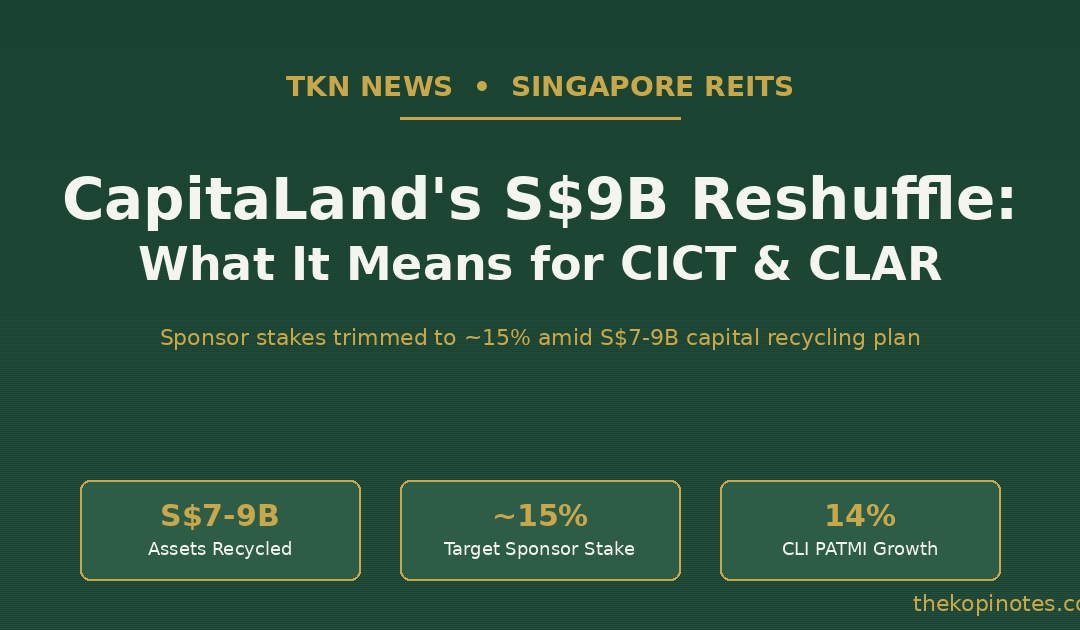
CapitaLand Investment unveiled plans on 13 August 2026 to recycle S$7 billion to S$9 billion of non-core assets and trim its sponsor stakes in CICT and CLAR to around 15%. For the roughly one in three Singapore retail portfolios that hold a CapitaLand-family REIT, this reshapes both the near-term unit supply picture and the long-term sponsor-support story. Data verified as at 16 August 2026.
This is an editorial analysis. Not financial advice. Data verified as at 16 August 2026.
What CapitaLand Investment Actually Announced
On 13 August 2026, CapitaLand Investment (SGX: 9CI), the sponsor behind CICT, CLAR, CapitaLand Ascott Trust and several other S-REITs, unveiled a portfolio restructuring that earmarks S$7 billion to S$9 billion of non-core and legacy assets for capital recycling.
The bulk of the assets sit in China, with the remainder spread across Singapore, India and Europe. Roughly 30% to 40% will come from sub-scale private funds, with the rest drawn from excess holdings in CLI-managed REITs and platforms. As part of the plan, CLI is targeting a sponsor stake of about 15% across its listed REITs — down from roughly 20% in CapitaLand Integrated Commercial Trust (CICT) and 16% in CapitaLand Ascendas REIT (CLAR). Paring back roughly S$8 billion of REIT units across the group could free up a couple of billion dollars in capital while improving free float on both counters (The Smart Investor via Yahoo Finance, 14 Aug 2026).
The announcement came alongside CLI’s first-half 2026 results: total PATMI (profit after tax and minority interests) rose 14% year-on-year to S$327 million, fee revenue climbed 20%, and operating profit rose 13% — its best improvement in five years — even as overall revenue slipped about 2% to roughly S$1.02 billion on lower real estate investment income following prior divestments (Quartr/TradingView earnings transcript, 13 Aug 2026). CLI shares closed at S$2.75 on 14 August 2026.
What this means for SG investors: CLI itself is becoming leaner and more fee-driven — good news for CLI shareholders. But the REIT-level sponsor stake cuts are the part that matters most if you hold CICT or CLAR units directly.
Why Sponsor Stakes Are Being Cut — And What “15%” Actually Means
A REIT sponsor stake is the proportion of units the parent company retains after listing the trust. It signals alignment of interest: a sponsor still holding 20%–30% of units has real skin in the game alongside retail unitholders. Generally, a stake of 20% or more is viewed as healthy, while stakes under 10% can raise questions about long-term commitment.
At 15%, CICT and CLAR would still sit above that lower-alarm threshold, so this isn’t a signal that CapitaLand is walking away from either S-REIT. Rather, it’s a capital-efficiency move: selling down excess REIT units lets CLI redeploy capital into higher-fee-generating private funds and platforms, consistent with its multi-year shift toward an asset-light, fund-management model.
For unitholders, the more immediate consideration is supply. If CLI sells down roughly S$8 billion of REIT units across its stable over time, that’s a meaningful volume that could weigh on unit prices in the short run if not absorbed by institutional demand, even though the sales are likely to be staggered rather than dumped at once.
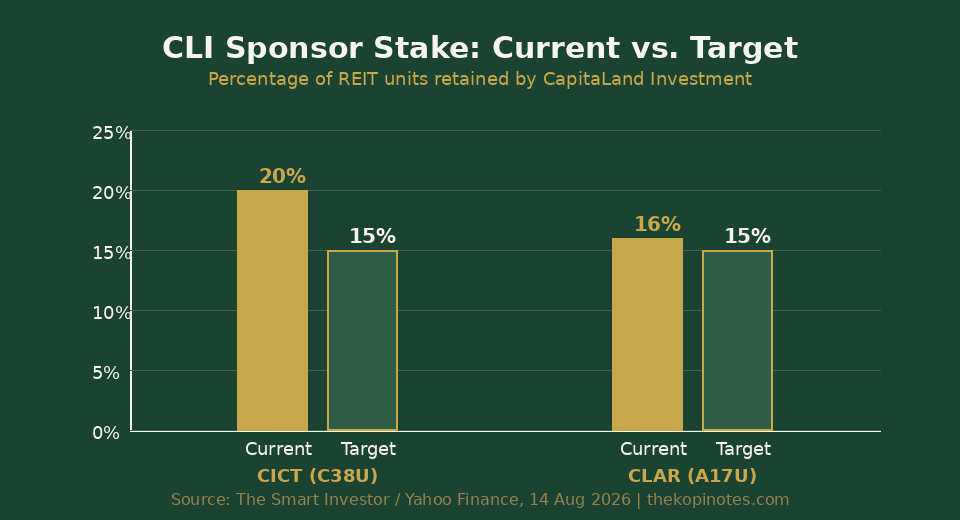
What this means for SG investors: Don’t read a fundamental red flag into a stake reduction from 20% to 15% — that’s still within a normal, healthy range. Do expect some near-term price sensitivity around block trades or placements as the sell-down is executed.
CICT and CLAR: The Numbers Behind the Headlines
Both REITs reported resilient first-half 2026 results just before the restructuring news broke, which is worth separating from the sponsor-stake story.
| Metric | CICT (SGX: C38U) | CLAR (SGX: A17U) |
|---|---|---|
| 1H2026 DPU | 6.02 cents (+7.1% YoY) | 7.482 cents (flat YoY) |
| 1H2026 distributable income | S$466.7 million (+13.3% YoY) | S$359.4 million (+8.6% YoY) |
| Unit price (14 Aug 2026 close) | S$2.43 | ~S$2.51 (7 Aug 2026) |
| Approx. trailing distribution yield | ~4.9% | ~5.9%–6.0% |
| Current CLI sponsor stake | ~20% | ~16% |
| CLI’s targeted sponsor stake | ~15% | ~15% |
Sources: CapitaLand Investment 1H2026 results releases for CICT and CLAR (capitaland.com, 5–12 Aug 2026); StockAnalysis.com pricing data (14 Aug 2026).
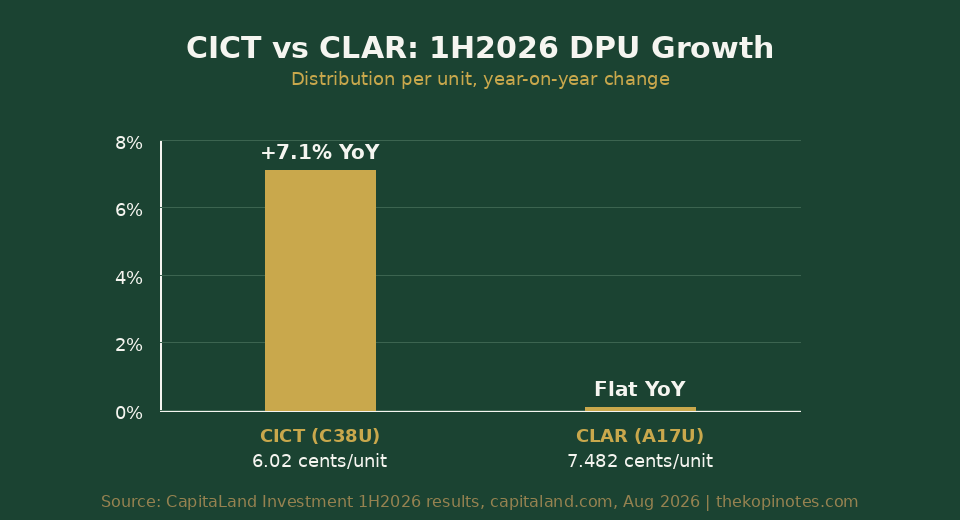
CICT’s 1H2026 gross revenue rose 7.5% to S$846.8 million and net property income rose 8.7% to S$630.5 million, with portfolio occupancy at 95.6%. CLAR’s distributable income growth of 8.6% was driven by acquisitions completed across Singapore, Europe, the US and Japan in 2025–2026.
What this means for SG investors: On operating fundamentals, both REITs delivered growth — the sponsor-stake story is a capital-structure development layered on top of, not a symptom of, weaker performance. See our Best S-REITs Singapore 2026 yield comparison for how CICT and CLAR stack up against the rest of the sector.
The Macro Backdrop: Singapore’s Growth Upgrade
The CLI news landed in a week when the Ministry of Trade and Industry (MTI) raised Singapore’s full-year 2026 GDP growth forecast to 4.5%–5.5%, up sharply from its earlier 2%–4% range, following first-half growth of 6.1% year-on-year on the back of an AI-fuelled electronics and semiconductor export boom (MTI, 11 Aug 2026). Manufacturing surged 12.5% year-on-year, while finance and insurance grew 6.2%; food and beverage services was the lone laggard, contracting 1.5%.
A stronger domestic growth outlook generally supports office and retail-facing REITs like CICT through firmer leasing demand, while broad-based manufacturing and trade strength underpins industrial and logistics landlords like CLAR. MTI flagged three risks to watch: an escalation of Middle East conflict, further US tariff actions, and a possible correction in AI-linked financial markets.
What this means for SG investors: The macro tailwind is a reason CLI may feel comfortable selling down REIT units now — a resilient economy and firm unit prices make for a better time to recycle capital than during a downturn.
Risks and What to Watch Next
Three things will determine how this plays out for unitholders over the next 12–18 months. First, the pace of the sell-down: a rapid block sale would pressure prices more than a gradual, market-friendly reduction. Second, how CLI redeploys proceeds — reinvestment into new REIT-accretive acquisitions would be a net positive, while pure debt reduction at the CLI parent level does less for unitholders directly. Third, whether other sponsors follow suit; a broader trend of Singapore REIT sponsors trimming stakes to fund asset-light pivots would be a structural shift worth tracking across the sector, not just at CapitaLand.
For income-focused investors, the practical takeaway echoes standard dividend portfolio construction advice: don’t concentrate too heavily in any single sponsor family. Spreading REIT exposure across multiple sponsors reduces the impact of any one group’s capital-recycling decisions on your overall income stream.
Bottom Line for SG Investors
CapitaLand Investment’s S$7–9 billion capital recycling plan and the reduction of REIT sponsor stakes to around 15% is a capital-efficiency move, not a signal of distress — CICT and CLAR both posted solid 1H2026 distribution growth alongside the announcement. A 15% sponsor stake remains within the range generally considered healthy, though existing unitholders should expect some near-term unit price sensitivity as the sell-down is executed, particularly around placement or block-trade announcements. Long-term holders focused on distributable income and occupancy trends have more reason for reassurance than concern; short-term traders should watch for volume-driven price dips that may offer better entry points.
What did CapitaLand Investment announce on 13 August 2026?
CapitaLand Investment (SGX: 9CI) announced a portfolio restructuring that earmarks S$7 billion to S$9 billion of non-core and legacy assets, mostly in China with the rest across Singapore, India and Europe, for capital recycling. It also plans to reduce its sponsor stakes across its REITs, including CICT and CLAR, to around 15%.
Why is CapitaLand Investment cutting its REIT sponsor stakes?
The move frees up capital that CLI can redeploy into higher-fee private funds and platforms, supporting its shift toward an asset-light, fee-based business model. It also improves free float in CICT and CLAR, which can support index weighting and trading liquidity.
Will CICT and CLAR unit prices fall because of this?
There could be near-term price sensitivity, especially around any block trades or placements used to execute the sell-down. However, the reduction is being framed as gradual, and both REITs reported growing distributions in 1H2026, which supports the operating case independent of the sponsor-stake story.
What is a REIT sponsor stake, and why does it matter to retail investors?
A sponsor stake is the percentage of units a REIT’s parent company retains after listing. A higher stake generally signals stronger alignment between the sponsor and retail unitholders. Industry convention treats 20% or more as healthy, while stakes below 10% can raise concerns about commitment. At a targeted 15%, CICT and CLAR would remain within an acceptable range.
Is CICT or CLAR the better buy for Singapore dividend investors right now?
This is not financial advice, but based on the data: CICT offers a lower yield (~4.9%) with exposure to Singapore retail, office and integrated developments, while CLAR offers a higher yield (~5.9%–6.0%) with exposure to industrial, logistics and business park assets across multiple countries. The better fit depends on your existing portfolio’s sector and geographic concentration.
How does this fit into the wider Singapore REIT sector in 2026?
It follows a week of broader S-REIT portfolio activity, including Digital Core REIT’s divestment of North American assets to fund its first Singapore acquisition. Combined with MTI’s upgraded 2026 GDP growth forecast of 4.5%–5.5%, the sector backdrop remains constructive even as individual sponsors restructure their holdings.
This article was researched with the help of AI. While we strive to keep all information accurate and up to date, there may be errors. If you notice any discrepancies, please contact us.