Uranium ETF Singapore: How to Buy NUKL, NCLR & Nuclear Energy ETFs (2026 Guide)
A uranium ETF gives you exposure to uranium miners and nuclear energy infrastructure companies, not physical uranium itself. There’s no uranium ETF listed on the SGX, so Singapore investors buy UCITS-compliant funds like NUKL or NCLR on the London Stock Exchange — which sidesteps the 30% US dividend withholding tax and US estate tax exposure that comes with buying America’s URA on the NYSE.
Not financial advice. All figures are for educational reference only. Data verified as at 14 August 2026 unless noted.
- No SGX-listed uranium ETF exists — you’ll need a broker with London Stock Exchange access, like IBKR.
- NUKL (VanEck) and NCLR (WisdomTree) are the two largest UCITS uranium and nuclear energy ETFs, with TERs of 0.55% and 0.45%.
- Uranium ETFs are volatile (37% annualised volatility) and concentrated in a handful of miners — size the position accordingly.
Table of Contents
- Why Uranium Is Back on Investors’ Radar in 2026
- Can Singapore Investors Buy a Uranium ETF?
- Best UCITS Uranium ETFs for Singapore Investors
- NUKL vs NCLR: Which Uranium ETF Should You Buy?
- How to Buy a Uranium ETF From Singapore
- Risks of Investing in Uranium ETFs
- Uranium ETF vs Broader Nuclear Energy ETF
- Frequently Asked Questions
Why Uranium Is Back on Investors’ Radar in 2026
Nuclear power went from a stalled industry to a growth story in under three years. Here’s why.
AI data centres need enormous, reliable, round-the-clock electricity. Solar and wind can’t provide that on their own. So hyperscalers like Microsoft and Amazon have signed long-term power deals directly with nuclear plant operators. That has pulled uranium demand forecasts sharply higher.
At the same time, over 20 countries — including the US, UK, Japan and France — have committed to tripling global nuclear capacity by 2050. Utilities have started contracting uranium supply years in advance, worried that mine output won’t keep up.
However, that number cuts both ways. A fund that can rally 148% in three years can also fall hard — NUKL’s maximum drawdown since inception is -37.63%. This is a cyclical, commodity-linked sector, not a steady dividend play.
Can Singapore Investors Buy a Uranium ETF?
Yes, but not on the SGX. As at August 2026, there is no uranium-themed ETF listed in Singapore. You have two real options.
Option 1: Buy the US-listed Global X Uranium ETF (URA) on the NYSE Arca. This is the largest and most liquid uranium ETF in the world, with a 0.69% expense ratio. The catch: US-domiciled ETFs withhold 30% tax on dividends for non-US holders, and — more seriously — expose your estate to US estate tax on any holding above US$60,000 if you pass away while holding US-situs assets. You can read the full mechanics in our US estate tax guide for Singapore investors.
Option 2: Buy a UCITS-compliant uranium ETF listed on the London Stock Exchange. Funds like NUKL and NCLR are domiciled in Ireland, so Irish tax treaties cut US withholding tax on underlying dividends to 15% instead of 30%, and Ireland has no estate tax treaty exposure for Singapore residents in the same way US-situs shares do. This is the route most Singapore investors on IBKR or Saxo use for thematic ETFs. We explain the full tax logic in why Singapore investors buy ETFs on the London Stock Exchange.
Best UCITS Uranium ETFs for Singapore Investors
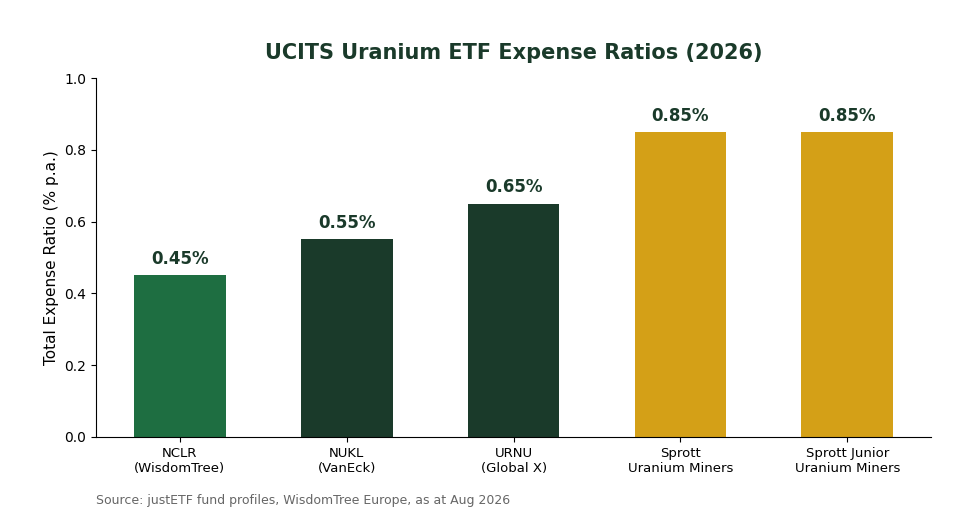
Five UCITS funds give you uranium and nuclear energy exposure on European exchanges. Here’s how they compare.
| ETF (Ticker) | TER | AUM | Inception | Top Holding |
|---|---|---|---|---|
| VanEck Uranium & Nuclear Technologies (NUKL / NUCL.L) | 0.55% | €2.05bn | Feb 2023 | Cameco 15.6% |
| WisdomTree Uranium & Nuclear Energy (NCLR.L) | 0.45% | US$339.6m | Mar 2025 | Cameco 7.3% |
| Global X Uranium UCITS ETF (URNU) | 0.65% | €609m | 2023 | Cameco-weighted |
| HANetf Sprott Uranium Miners UCITS ETF | 0.85% | €327m | 2022 | Pure-play miners |
| HANetf Sprott Junior Uranium Miners UCITS ETF | 0.85% | €53m | 2023 | Small-cap explorers |
Source: justETF fund profile (NUKL), WisdomTree Europe (NCLR), as at 12–13 August 2026.
For most Singapore investors, NUKL and NCLR are the two to compare — they have the largest fund sizes, tightest spreads on the LSE, and cover both uranium miners and nuclear infrastructure builders in one basket. The Sprott funds are more concentrated, pure-play uranium mining bets with higher fees.
NUKL vs NCLR: Which Uranium ETF Should You Buy?
Both funds track the same theme but weight it differently. Here’s the practical difference.
NUKL (VanEck) tracks the MarketVector Global Uranium and Nuclear Energy Infrastructure index. It leans harder into nuclear infrastructure builders — companies like Mitsubishi Heavy Industries, Hitachi and AtkinsRéalis that build and service reactors — alongside pure uranium miners. Its top 10 holdings make up 67.8% of the fund, so it’s fairly concentrated.
NCLR (WisdomTree) classifies holdings into Upstream, Midstream and Innovator categories, targeting 60/25/15% weights. It’s more balanced across smaller uranium miners like NexGen Energy, Paladin Energy and Denison Mines, with a lower 0.45% TER — the cheapest of the five UCITS options.
| Metric | NUKL | NCLR |
|---|---|---|
| TER | 0.55% | 0.45% |
| 1-year return | +12.55% | Since Mar 2025 launch, n/a full 1Y |
| 3-year return | +147.96% | Not yet available (launched 2025) |
| Top 10 concentration | 67.8% | Lower, more diversified across 20+ holdings |
| Volatility (1Y) | 37.4% | Comparable, sector-driven |
Source: justETF, WisdomTree Europe fund pages, as at 10–12 August 2026.
If you want the longer track record and heavier nuclear infrastructure tilt, NUKL is the more established choice. If you want the lowest fee and a newer, more diversified miner basket, NCLR fits better. Either way, this shouldn’t be a core holding — think satellite position, sized at a few percent of your portfolio.
A Worked Example: Sizing a Uranium ETF Position
Say you hold a S$100,000 portfolio, mostly in a core global equity fund like VWRA, plus some S-REITs for income. You want thematic exposure to the nuclear renaissance without derailing your core strategy.
A common approach: allocate 3–5% (S$3,000–S$5,000) to a uranium and nuclear ETF like NUKL or NCLR. At NUKL’s current NAV of roughly US$54, S$4,000 (around US$2,970) buys you approximately 55 units before FX and brokerage costs.
Because these are thematic satellite positions, many investors rebalance annually — trimming back to the target 3–5% weight if uranium ETFs rally hard, and topping up if they lag. This keeps a volatile sector from quietly becoming an outsized share of your net worth.
For a broader view of how thematic satellites fit around a core CPFIS-eligible or global ETF base, our Singapore retirement calculator can help you check whether adding volatility here still keeps your overall plan on track.
How to Buy a Uranium ETF From Singapore
Here’s the step-by-step, using IBKR as the example broker since it has the widest LSE UCITS ETF access among Singapore-friendly platforms.
- Open and fund an IBKR account. You’ll need a USD or GBP-denominated account to trade LSE-listed ETFs without excessive FX conversion fees. See our IBKR vs Saxo vs MooMoo vs Syfe broker comparison if you’re still deciding on a platform.
- Search the ticker. Use NUKL (XETRA/gettex, EUR) or NUCL (LSE, USD) for VanEck’s fund, or NCLR (LSE, USD) for WisdomTree’s.
- Check the trading currency. LSE listings quote in USD or GBP depending on the share class — NUCL trades in USD on the LSE, NCLR trades in USD too. Match this to your account’s base currency to avoid double conversion.
- Place a limit order. These are thinner-volume thematic ETFs. A market order can fill at a worse price than expected — always use a limit order a few cents from the last traded price.
- Size the position deliberately. Given the 37% annualised volatility, most investors treat uranium ETFs as a 2–5% satellite allocation, not a core holding.
If you’d rather build a diversified global portfolio first and add thematic satellites later, an Endowus referral code or FSMOne referral code can get your core CSPX/VWRA allocation started before you layer in single-theme bets like uranium.
Risks of Investing in Uranium ETFs
Before you buy, understand what you’re signing up for.
High volatility. NUKL’s 1-year volatility sits at 37.4%, roughly triple that of a broad global equity fund like VWRA. A -30% drawdown in a single year is well within normal range for this sector.
Concentration risk. A handful of miners — Cameco, NexGen Energy, Denison Mines — dominate the investable universe. If Cameco has a bad quarter, your ETF feels it disproportionately.
Commodity cyclicality. Uranium prices are driven by utility contracting cycles that can turn sharply. The 2011 Fukushima disaster crushed uranium prices for over a decade; a similar shock (however unlikely) would hit these funds hard.
You’re not holding physical uranium. These ETFs hold equities in mining and nuclear infrastructure companies, not the metal itself. Company-specific risks — mine permitting delays, management execution, currency exposure — apply on top of the commodity story.
Uranium ETF vs Broader Nuclear Energy ETF: What’s the Difference?
A pure uranium ETF like the Sprott funds holds almost exclusively mining companies. A uranium and nuclear energy ETF like NUKL or NCLR blends miners with reactor builders, utilities and nuclear technology innovators — a broader, somewhat less volatile basket.
If you want a wider view of the nuclear renaissance theme, including small modular reactor (SMR) developers and utilities, see our dedicated Nuclear ETF Singapore guide. If you want pure commodity leverage to the uranium price itself, the Sprott miner funds in the table above are the more concentrated bet.
Frequently Asked Questions
Is there a uranium ETF listed on the SGX?
No. As at August 2026, no uranium-themed ETF is listed on the Singapore Exchange. Singapore investors access this theme through LSE-listed UCITS funds like NUKL or NCLR.
What is the best uranium ETF for Singapore investors?
NUKL (VanEck) and NCLR (WisdomTree) are the two largest and most liquid UCITS options. NUKL has the longer track record; NCLR has the lower 0.45% TER.
Can I buy the US Global X Uranium ETF (URA) from Singapore?
Yes, if your broker supports US markets, but URA is a US-domiciled fund. That means 30% dividend withholding tax and US estate tax exposure above US$60,000 in holdings — a UCITS alternative avoids both.
How volatile are uranium ETFs?
NUKL’s 1-year volatility is 37.4%, with a maximum drawdown since inception of -37.63%. This is a high-volatility, thematic sector fund, not a core portfolio holding.
Do uranium ETFs pay dividends?
NUKL and NCLR are both accumulating share classes, meaning any dividend income from underlying holdings is reinvested automatically rather than paid out to you.
What’s driving uranium ETF demand in 2026?
AI data centre electricity demand and government commitments to triple global nuclear capacity by 2050 have pushed utilities to lock in long-term uranium supply, tightening the market.
Ready to Build Your Core Portfolio First?
Before layering in thematic bets like uranium ETFs, get your core global equity allocation started.
This article was researched with the help of AI. While we strive to keep all information accurate and up to date, there may be errors. If you notice any discrepancies, please contact us.