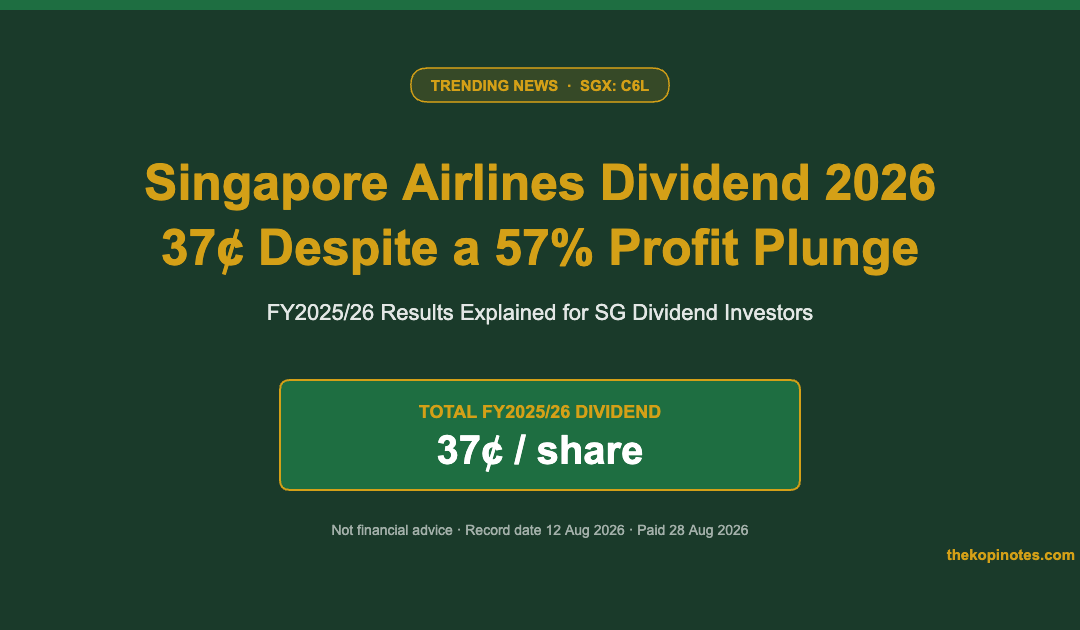
Singapore Airlines Dividend 2026: How SIA Paid 37¢ Despite a 57% Profit Plunge
SIA’s FY2025/26 net profit crashed — but the dividend barely budged. Here’s what that gap really means for Singapore dividend investors.
Singapore Airlines’ FY2025/26 net profit fell 57.4% to S$1.18 billion, yet the airline still paid out 37 cents per share in total dividends — down just 7.5% from last year. The gap exists because operating profit actually rose 39%, and a new three-year special dividend plan cushioned the payout. Here’s what happened, and what it means for you.
Not financial advice. All figures are for educational reference only. Data as at August 2026 unless noted.
- SIA’s net profit crashed 57% to S$1.18B — but that’s almost entirely an accounting effect from last year’s one-off Air India-Vistara gain, not a weaker business.
- Operating profit, the truer measure of the airline’s core performance, actually rose 39% to S$2.4B.
- Total FY2025/26 dividend is 37¢/share (record date 12 Aug 2026, paid 28 Aug 2026) — down just 7.5%, cushioned by a new 3-year special dividend plan.
Table of Contents
Contents — Click to expand
- What Happened: SIA’s FY2025/26 Results at a Glance
- Why the Dividend Barely Moved When Profit Crashed
- Breaking Down the 37-Cent Dividend
- Key Dates: Record Date, Ex-Dividend and Payment
- Air India: The Silent Profit Drag
- The Bigger Lesson for Dividend Investors
- Is SIA a Good Dividend Stock for You?
- Frequently Asked Questions
What Happened: SIA’s FY2025/26 Results at a Glance
Singapore Airlines released its FY2025/26 full-year results on 14 May 2026, covering the 12 months to 31 March 2026. The headline numbers looked contradictory at first glance.
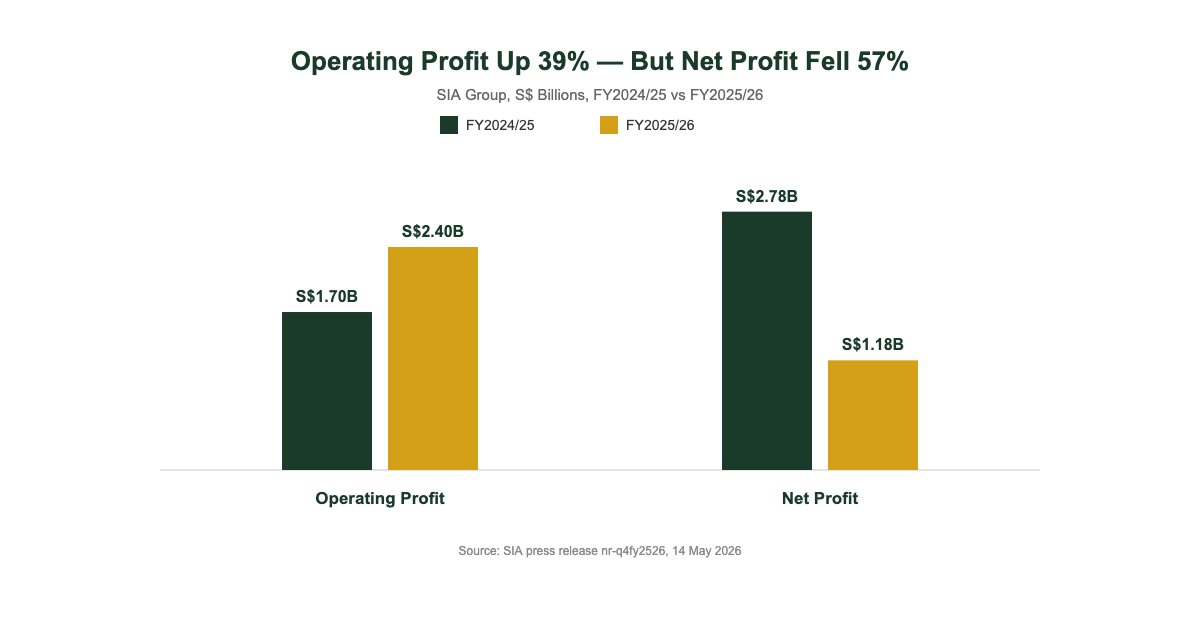
Group revenue hit a record S$20.52 billion, up about 5% from S$19.5 billion the year before. Operating profit — what SIA earns from actually flying planes, before interest, tax, and one-off items — jumped 39% to S$2.4 billion.
But net profit, the number most headlines focus on, fell 57.4% to S$1.18 billion. SIA and budget arm Scoot also carried a record 42.4 million passengers, up 7.7% year-on-year, with passenger load factor climbing 1.1 percentage points to 87.7%.
| Metric | FY2024/25 | FY2025/26 | YoY Change |
|---|---|---|---|
| Group Revenue | S$19.5B | S$20.52B (record) | +5.0% |
| Operating Profit | S$1.7B | S$2.4B | +39.0% |
| Net Profit | S$2.78B (record, one-off gain) | S$1.18B | -57.4% |
| Passengers (SIA+Scoot) | 39.4M | 42.4M | +7.7% |
| Total Dividend/Share | 40¢ | 37¢ | -7.5% |
Source: SIA press release nr-q4fy2526, 14 May 2026; SIA nr-0225, May 2025.
Why the Dividend Barely Moved When Profit Crashed 57%
If net profit fell by more than half, you’d expect the dividend to follow. It didn’t — not by nearly as much.
SIA’s board still proposed a total FY2025/26 dividend of 37 cents per share, down just 7.5% from 40 cents the year before. That’s the key disconnect dividend investing Singapore readers need to understand.
The 57.4% net profit drop isn’t really about the airline’s operations getting worse. FY2024/25’s S$2.78 billion net profit was flattered by a S$1.1 billion one-off, non-cash accounting gain from folding Vistara into Air India. Strip that out, and FY2024/25’s underlying profit was much lower — this year’s operating profit actually grew.
In other words: the number that fell off a cliff (net profit) was partly an accounting mirage from the year before. The number that matters more for cash generation — operating profit — went up.
Breaking Down the 37-Cent Dividend
SIA’s FY2025/26 dividend has two distinct parts: an ordinary dividend and a special dividend.
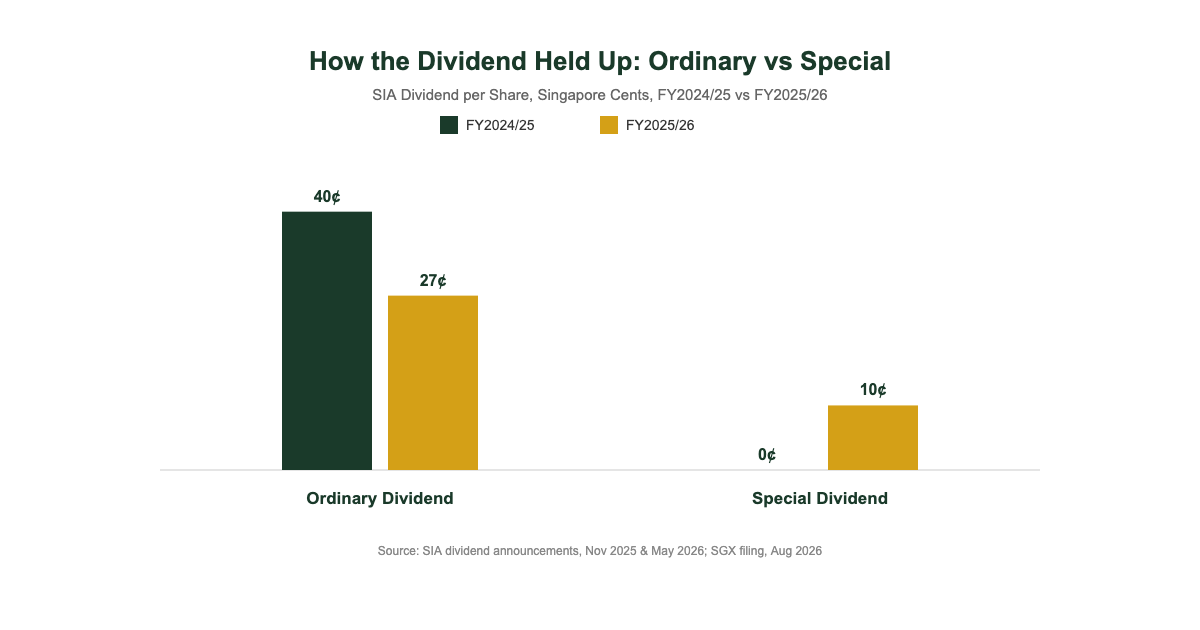
The ordinary dividend — the airline’s regular, recurring payout — fell from 40 cents to 27 cents per share, a 32.5% drop that tracks the weaker net profit much more closely than the total headline figure does.
The gap was cushioned by a brand-new special dividend. In November 2025, alongside its half-year results, SIA announced a capital-return plan: 10 cents per share in special dividends every year for three financial years (FY2025/26 to FY2027/28), returning roughly S$900 million to shareholders in total.
FY2025/26’s special dividend came in two tranches: 3 cents per share paid in December 2025, and 7 cents per share due this August — together adding 10 cents back on top of the 27-cent ordinary payout.
| Component | FY2024/25 | FY2025/26 | Change |
|---|---|---|---|
| Ordinary Dividend | 40¢ | 27¢ | -32.5% |
| Special Dividend | 0¢ | 10¢ (Tranche 1+2 of 3-yr plan) | New |
| Total Dividend | 40¢ | 37¢ | -7.5% |
Source: SIA dividend announcements, Nov 2025 & May 2026; SGX filing, Aug 2026.
Key Dates: Record Date, Ex-Dividend and Payment
Shareholders’ approval for the final dividend came at SIA’s Annual General Meeting on 24 July 2026.
The stock traded ex-dividend from 11 August 2026 — meaning anyone who bought shares on or after that date won’t receive this particular payout.
Book closure (the record date) was 12 August 2026 at 5:00pm Singapore time. If you held C6L shares before the ex-date, you’re entitled to the 22-cent final ordinary dividend and the 7-cent final special dividend.
Payment is due on 28 August 2026, with the usual CDP or broker crediting process following within a day or two after that.
Like most SGX blue chips, SIA’s ordinary and special dividends are tax-exempt (one-tier) for shareholders, so you won’t owe additional Singapore income tax on the payout — one of the reasons dividend income remains attractive for SG investors versus interest income from other assets.
Air India: The Silent Profit Drag
So what actually dragged net profit down, if operations improved? The answer is largely Air India.
SIA holds a stake in Air India — just over a quarter of the enlarged airline — following the 2024 merger of Vistara into Air India. Because SIA doesn’t control Air India outright, it uses equity accounting: SIA’s own profit and loss statement absorbs a slice of Air India’s losses (or gains) each period.
Air India has been loss-making as it works through a complex three-way integration — Air India, Air India Express, and Vistara — in a fiercely competitive Indian aviation market. That ongoing drag, combined with the disappearance of last year’s one-off merger accounting gain, explains most of the net profit swing. It isn’t a sign of a weaker Singapore Airlines core business.
The Bigger Lesson for Dividend Investors
This is a useful case study for anyone building a passive income Singapore portfolio, not just SIA shareholders.
Net profit — the number in most headlines — includes one-off items, associate accounting swings, impairments, and other non-cash noise. It isn’t the same as the cash a company actually has available to pay dividends.
Operating profit, and even more so free cash flow, are usually better guides to whether a dividend is sustainable. S-REIT investors already know this instinct well: Distribution Per Unit (DPU) — basically how much cash each REIT unit pays you per quarter — is based on distributable income, not statutory net profit. That’s exactly why REIT results often look different from what the headline profit number suggests.
A useful habit: when a payout ratio (dividend as a percentage of profit) suddenly looks extreme — either far above 100% or swinging wildly year to year — check whether operating cash flow tells the same story as net profit. If it doesn’t, the dividend is probably more sustainable (or less) than the headline number suggests.
Before reacting to a scary profit headline, check what’s actually driving it. A 57% profit drop caused by an accounting quirk is a very different signal from a 57% drop caused by falling ticket sales or rising fuel costs.
Is SIA a Good Dividend Stock for You?
SIA isn’t a classic income stock, and it’s worth being clear-eyed about that before adding it alongside your high dividend stocks in Singapore picks.
At a recent share price of around S$7.61, SIA’s FY2025/26 payout works out to a yield in the region of 4.6% to 5.8%, depending on whether you annualise the latest dividend or use the trailing 12-month total. That’s a respectable yield for a blue-chip stock, but it comes with real cyclicality — airline profits swing hard with fuel prices, competition, and global travel demand.
Compare that to S-REITs, which are required to distribute at least 90% of their taxable income to keep their tax-transparent status. SIA has no such obligation — its dividend, ordinary or special, is entirely at the board’s discretion each year. The current special dividend plan is also finite: it’s scheduled to end after FY2027/28, not run indefinitely.
To put the numbers in perspective: a Singapore investor holding 1,000 SIA shares would have received S$370 in total FY2025/26 dividends (27 cents ordinary plus 10 cents special, both times 1,000 shares), down from S$400 the year before. That’s a S$30 difference per 1,000 shares — a real but manageable dip, nowhere close to the 57% collapse the net profit headline implies.
If you want a dividend built for stability, TKN’s guide to the best S-REITs in Singapore 2026 is a better starting point. If you’re comfortable with more cyclical, capital-return-driven income and want blue-chip diversification alongside your REITs, SIA’s current payout is worth watching — just don’t assume 37 cents is the new floor.
Frequently Asked Questions
When is Singapore Airlines' 2026 dividend paid?
SIA’s FY2025/26 final and special dividends are due to be paid on 28 August 2026, to shareholders on the register as at the 12 August 2026 book closure (the stock traded ex-dividend from 11 August 2026).
Why did Singapore Airlines' net profit fall 57% in FY2025/26?
Mostly accounting, not operations. FY2024/25’s net profit included a S$1.1 billion one-off gain from merging Vistara into Air India. Without that one-off boost, plus an ongoing drag from Air India’s losses, FY2025/26’s net profit looks much smaller — even though operating profit actually rose 39%.
What is SIA's special dividend capital-return plan?
Announced in November 2025, it’s a commitment to pay 10 cents per share in special dividends every year for three financial years (FY2025/26 to FY2027/28), returning about S$900 million to shareholders in total.
How much is Singapore Airlines' total FY2025/26 dividend?
37 cents per share — a 27-cent ordinary dividend (interim 5 cents plus final 22 cents) plus a 10-cent special dividend (3 cents paid in December 2025, 7 cents due in August 2026).
What is Singapore Airlines' dividend yield in 2026?
Roughly 4.6% to 5.8%, depending on the calculation basis, based on a share price around S$7.61 as at August 2026.
Is Singapore Airlines a good stock for dividend investors?
It can complement a portfolio, but it’s cyclical and discretionary. Unlike S-REITs, SIA has no minimum payout requirement, and the current special dividend plan is scheduled to end after FY2027/28.
Building a Singapore Dividend Portfolio?
Put your dividends and capital gains to work through a low-cost brokerage or robo platform. Check out our Singapore retirement calculator to see how a steady income stream adds up over time.
This article was researched with the help of AI. While we strive to keep all information accurate and up to date, there may be errors. If you notice any discrepancies, please contact us.