CDL Hospitality Trusts 1H2026 Results: Distribution Up 9.7% to S$27.5M Despite Middle East Travel Disruption (SGX: J85)
DPU rises 8.6% to 2.15 cents as leverage falls to 35.3%, even as the Gulf conflict hits Maldives and Japan RevPAR
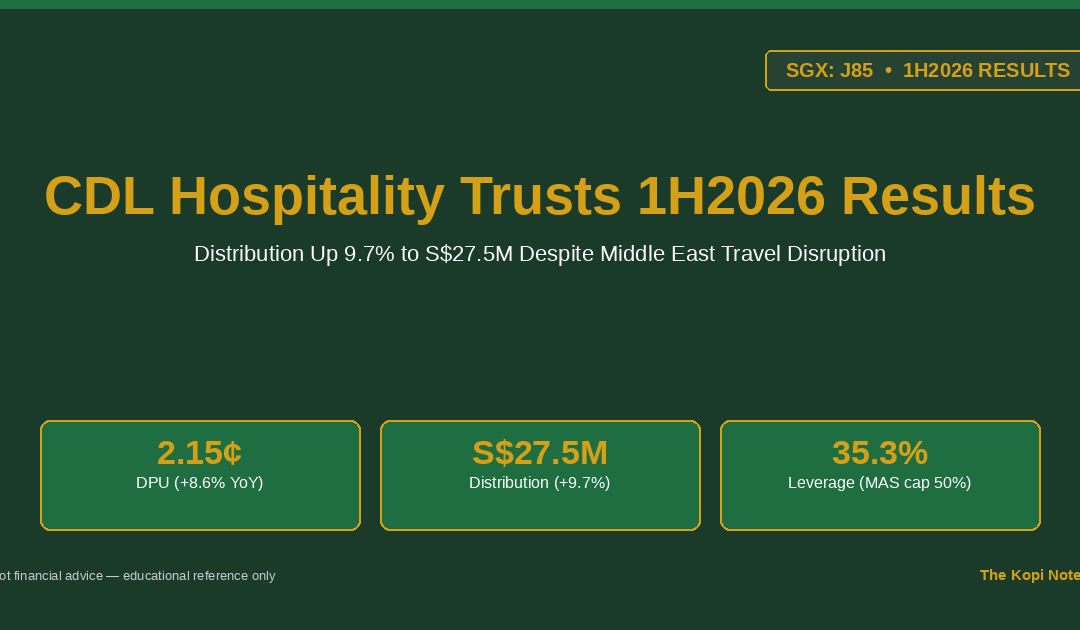
CDL Hospitality Trusts (SGX: J85) reported 1H2026 gross revenue of S$126.9 million, up 1.4% year-on-year, with total distribution to stapled securityholders rising 9.7% to S$27.5 million. Distribution per stapled security (DPS) grew 8.6% to 2.15 cents. Gains in New Zealand, Singapore, and the UK offset steep RevPAR declines in the Maldives, Japan, and Germany caused by the US-Iran conflict’s disruption to regional air travel.
Not financial advice. All figures are for educational reference only. Data as at August 2026 unless noted.
- Distribution per stapled security rose 8.6% YoY to 2.15 cents, even though revenue only grew 1.4% — lower interest costs from refinancing did most of the heavy lifting.
- The Maldives (-18.3% RevPAR), Germany (-12.7%) and Japan (-4.5%) took the brunt of the Gulf conflict’s hit to travel. New Zealand (+10.4%) and Singapore (+4.1%) picked up the slack.
- Leverage fell to a comfortable 35.3%, well under the 50% MAS ceiling, after CDLHT used S$250 million of perpetual securities to repay pricier debt.
Table of Contents
Contents — Click to expand
- CDLHT 1H2026 Key Results at a Glance
- DPS: Why It Grew Faster Than Revenue
- How the Gulf Conflict Hit Travel Demand
- RevPAR and NPI by Region: Winners and Losers
- Balance Sheet: Leverage, Refinancing & Debt Cost
- Growth Pipeline: Moxy Clarke Quay and Portfolio Upgrades
- Outlook: What’s Ahead for 2H2026
- What This Means for Singapore Investors
- Frequently Asked Questions
CDLHT 1H2026 Key Results at a Glance
CDL Hospitality Trusts (CDLHT) filed its unaudited results for the six months ended 30 June 2026 on 30 July 2026. If you hold CDLHT units, or you’re weighing whether Singapore’s oldest hotel REIT deserves a spot in your income portfolio, here’s what actually happened underneath the headline numbers.
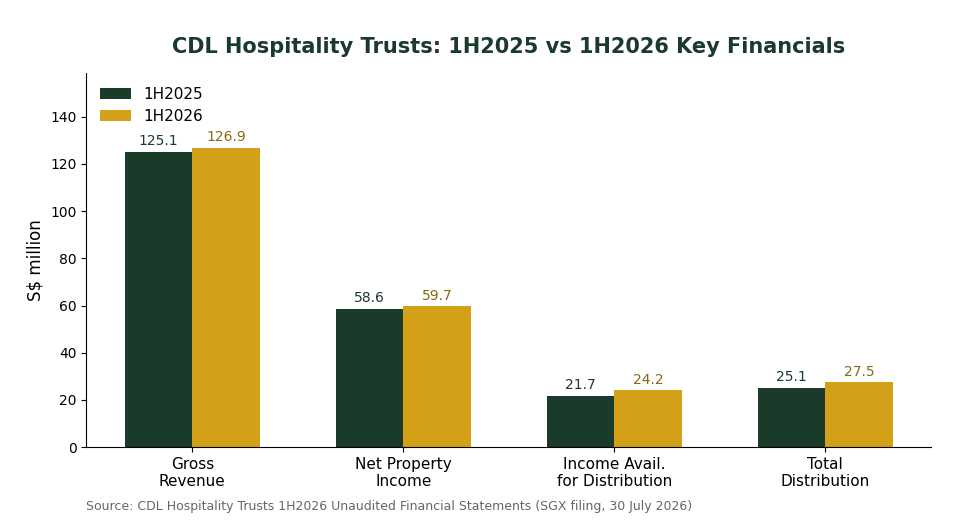
Gross revenue rose a modest 1.4% year-on-year to S$126.9 million. Net property income (NPI) — revenue after property-level operating costs — climbed 1.8% to S$59.7 million. The bigger story is further down the income statement: income available for distribution jumped 11.9% to S$24.2 million, and total distribution to stapled securityholders rose 9.7% to S$27.5 million.
| Metric | 1H2025 | 1H2026 | YoY Change |
|---|---|---|---|
| Gross Revenue (S$m) | 125.1 | 126.9 | +1.4% |
| Net Property Income (S$m) | 58.6 | 59.7 | +1.8% |
| Income Available for Distribution (S$m) | 21.7 | 24.2 | +11.9% |
| Total Distribution (S$m) | 25.1 | 27.5 | +9.7% |
| DPS After Retention (cents) | 1.98 | 2.15 | +8.6% |
| Aggregate Leverage | — | 35.3% | — |
Source: CDL Hospitality Trusts 1H2026 Unaudited Financial Statements, SGX filing (30 July 2026)
DPS: Why It Grew Faster Than Revenue
Here’s the part that surprises a lot of unitholders. Revenue barely moved — up just 1.4%. So why did your distribution per stapled security (DPS) jump 8.6%?
The answer is interest costs, not hotel operations. CDLHT’s finance costs fell 31.9% year-on-year, saving S$7.7 million. Management used proceeds from S$250 million of perpetual securities — S$150 million issued in November 2025 at 3.70% per annum, plus S$100 million in February 2026 at 4.00% — to repay higher-cost borrowings and cut floating-rate exposure.
Even after stripping out the effect of perpetual security distributions (which sit above DPS in the payout waterfall), CDLHT’s funding costs still fell 14.5%, or S$3.5 million, year-on-year. That’s a genuine improvement in the cost of capital, not just an accounting shuffle.
Income retained for working capital also eased slightly, from S$2.17 million in 1H2025 to S$2.43 million in 1H2026 — a small buffer increase rather than a distribution cut. Net-net, unitholders received more cash per unit while the trust’s balance sheet got healthier at the same time. That combination doesn’t happen every reporting season.
How the Gulf Conflict Hit Travel Demand
CDLHT’s results carry a common thread that most other S-REIT results this season don’t: geopolitics. The escalation of the US-Iran conflict in late February 2026 disrupted flight corridors across the Middle East, cutting capacity from Middle Eastern carriers and pushing up jet fuel prices and airfares globally.
That mattered a lot for CDLHT specifically, because two of its markets — the Maldives and, to a lesser extent, its European hotels — depend heavily on long-haul connections routed through Gulf hubs. UN Tourism trimmed its 2026 global arrivals growth forecast by 1 to 2 percentage points because of the conflict, and both the Asian Development Bank and OECD flagged it as a drag on regional growth.
The first quarter told a different story: a strong events calendar, including the return of the Singapore Airshow, drove healthy demand across CDLHT’s portfolio. The second quarter is where the conflict’s effects show up clearly — global economic uncertainty, cautious corporate travel budgets, and weaker long-haul demand all softened momentum from April onward.
RevPAR and NPI by Region: Winners and Losers
RevPAR — Revenue Per Available Room, the standard yardstick for hotel performance — tells a genuinely mixed story across CDLHT’s eight-country portfolio for 1H2026.
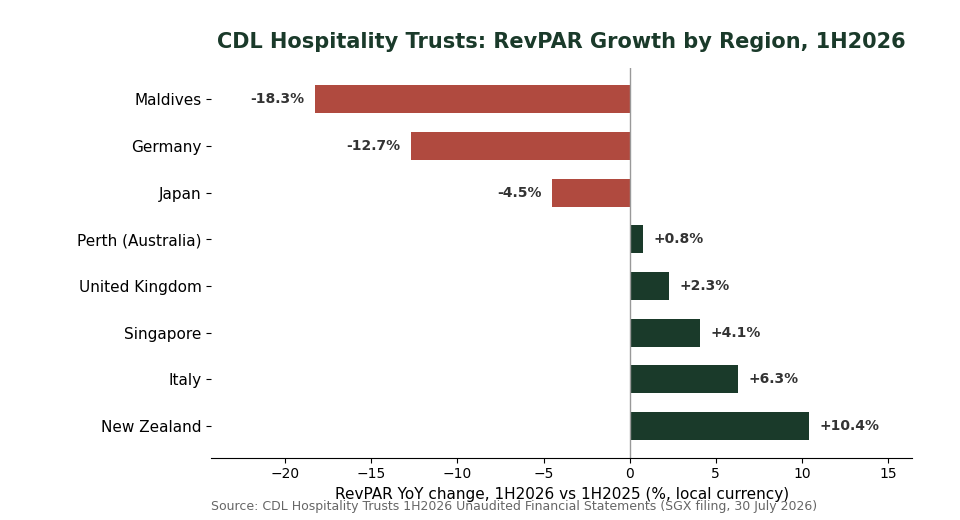
The Maldives Resorts were hit hardest, with RevPAR down 18.3% year-on-year. Visitor arrivals to the Maldives fell 15.2% between March and June 2026 as several Middle Eastern carriers suspended or reduced services. Because resort operating costs are largely fixed, the revenue shortfall flowed straight through to a S$2.6 million NPI decline.
Germany’s Pullman Hotel Munich saw RevPAR fall 12.7%, mainly because 2Q2025 had benefited from one-off citywide events — a major trade fair and the UEFA Champions League Final — that didn’t recur in 2Q2026. The Japan Hotels slipped 4.5% on ongoing Japan-China geopolitical tensions and a weaker yen.
On the other side of the ledger, New Zealand’s Grand Millennium Auckland was the standout, with RevPAR up 10.4% and NPI up 60.4% (27.1% after adjusting for a one-off lease accounting item), thanks to newly completed room renovations and strong convention demand. Singapore Hotels RevPAR rose 4.1%, supported by the Singapore Airshow in February, even after 4,439 room nights were taken offline for M Hotel’s ongoing renovation. Italy’s Hotel Cerretani Firenze gained 6.3%, and the UK portfolio’s NPI — hotels plus living assets — climbed 17.8%, led by a 51.3% NPI jump at CDLHT’s two UK living-sector assets, The Castings (Build-to-Rent) and Benson Yard (student accommodation).
| Region | RevPAR YoY (1H2026) | NPI YoY (1H2026) |
|---|---|---|
| New Zealand | +10.4% | +60.4% |
| Italy | +6.3% | +11.5% |
| Singapore Hotels | +4.1% | +0.2% |
| United Kingdom (Hotels) | +2.3% | +17.8% (portfolio) |
| Perth, Australia | +0.8% | +50.2% |
| Japan | -4.5% | -11.5% |
| Germany | -12.7% | -13.1% |
| Maldives | -18.3% | -S$2.6M (abs. change) |
Source: CDL Hospitality Trusts 1H2026 Unaudited Financial Statements, SGX filing (30 July 2026). RevPAR figures in local currency terms.
Balance Sheet: Leverage, Refinancing & Debt Cost
Aggregate leverage — how much of the portfolio is funded by debt rather than unitholder equity — stood at 35.3% as at 30 June 2026. That’s comfortably within the 50% ceiling set by the Monetary Authority of Singapore (MAS) for S-REITs, and among the lower leverage ratios in the hospitality REIT sub-sector.
Interest coverage ratio (ICR) — how many times over CDLHT’s earnings can cover its interest bill — came in at 2.31 times for the H-REIT Group, above the 1.5 times regulatory minimum. Management’s own sensitivity analysis shows the ICR would still hold at 1.8 times even under a combined 10% EBITDA decline and a 100 basis point rise in average interest rates — a reasonable buffer given the geopolitical uncertainty already weighing on parts of the portfolio.
The refinancing story matters here too. CDLHT issued S$250 million of fixed-rate perpetual securities across two tranches (November 2025 and February 2026) and used the proceeds to retire more expensive borrowings. As at 30 June 2026, S$1.25 billion remains available for issuance under its S$1.5 billion multi-currency debt programme, giving management room to keep optimising its capital structure without needing to raise new unit-diluting equity.
Growth Pipeline: Moxy Clarke Quay and Portfolio Upgrades
CDLHT isn’t just defending its existing 22 properties — it’s adding to the Singapore portfolio. Moxy Singapore Clarke Quay, a 475-room lifestyle hotel being acquired via a forward purchase arrangement, is expected to obtain its Temporary Occupation Permit (TOP) in late 2026, with the acquisition completing and operations starting in the first half of 2027. Once it lands, CDLHT’s Singapore room count grows from 2,555 to 3,030 keys — a meaningful step-up in its home-market exposure.
Two renovation projects are underway in the meantime. M Hotel’s guestroom renovation started in May 2026 and runs in phases through 3Q2027, while Copthorne King’s Hotel’s main-wing refurbishment is scheduled to begin in 4Q2026. Both are being phased to limit disruption to ongoing operations, though investors should expect some continued room-night drag from M Hotel through the rest of 2026 and into 2027.
Outlook: What’s Ahead for 2H2026
Management’s outlook centres on Singapore’s events calendar carrying the second half. Confirmed drawcards include the Formula 1 Singapore Grand Prix from 9 to 11 October 2026 — featuring Singapore’s first-ever Sprint race format — a sold-out four-night BTS World Tour stop at the National Stadium in December, and a strong MICE line-up including TOKEN2049, ITB Asia, and the Singapore FinTech Festival. The Singapore Tourism Board is forecasting 17.0 million to 18.0 million visitor arrivals for 2026, above 2025’s 16.9 million.
That said, the macro picture isn’t all clear skies. International visitor arrivals to Singapore were actually down 1.7% year-to-date through June 2026, largely due to softer arrivals from Indonesia, one of the country’s largest source markets. Management flagged that broader macroeconomic uncertainty and a relatively strong Singapore dollar have moderated regional travel demand more generally — a headwind that applies well beyond CDLHT alone.
On costs, CDLHT has locked in electricity tariffs for most of its portfolio through end-2026, with the Singapore Hotels securing meaningfully lower rates for 2027 through 2031. That gives some visibility on one of hospitality’s more volatile cost lines, regardless of how the broader travel recovery plays out.
What This Means for Singapore Investors
If you already hold CDLHT: this is a solid, if unspectacular, result. Distribution growth outpaced revenue growth thanks to real interest-cost savings, not accounting noise, and leverage actually improved rather than deteriorated — a combination income investors don’t see every reporting season. The geographic diversification that sometimes gets criticised as diluting focus is doing its job here: New Zealand and the UK living assets picked up the slack while the Maldives and Germany struggled.
If you’re considering a new position: CDLHT gives you exposure to global hospitality demand recovery, not just Singapore’s. That’s a double-edged sword — it means idiosyncratic shocks like the Gulf conflict hit some markets hard, but it also means you’re not purely dependent on Singapore Tourism Board arrival numbers. The 35.3% leverage and 2.31x ICR suggest a balance sheet with room to absorb further shocks, though the Moxy Clarke Quay acquisition and ongoing renovations mean near-term capex commitments remain.
Either way, CDLHT is a useful bellwether for how S-REITs with international hospitality exposure are navigating 2026’s geopolitical crosscurrents. For a broader view of how CDLHT compares with the rest of the sector, see our CDL Hospitality Trusts share price and yield guide, or check our best S-REITs in Singapore 2026 roundup for how it stacks up against industrial, retail and data centre peers. If you’re building a broader income strategy, our passive income Singapore guide covers how hospitality REIT distributions fit alongside other income sleeves, and you can model your own retirement income mix — including REIT distributions — with our free Singapore retirement calculator.
Investors looking to diversify beyond single-REIT exposure might also want to review our Singapore REIT ETF guide, which covers basket exposure to the whole S-REIT sector. Those investing via cash or SRS accounts can compare platform fees through our Syfe referral code and sign-up bonus page, which supports SGX trading.
Track More S-REIT Results Like This
Get free tools to plan your income portfolio and access to broker referral bonuses.
Frequently Asked Questions
What was CDL Hospitality Trusts' DPS for 1H2026?
Why did CDLHT's distribution grow faster than its revenue?
Which markets were hit hardest in CDLHT's 1H2026 results?
Is CDLHT's leverage level safe?
What is CDLHT acquiring next?
Is CDL Hospitality Trusts a good buy after its 1H2026 results?
What is CDLHT's SGX ticker and sector?
This article was researched with the help of AI. While we strive to keep all information accurate and up to date, there may be errors. If you notice any discrepancies, please contact us.