AIMS APAC REIT 1Q FY2027 Results: DPU Up 2.5% as Leverage Falls to 24.9% (SGX: O5RU)
A results-day deep-dive into AIMS APAC REIT’s 1Q FY2027 business update — revenue growth, occupancy, gearing, the Perth acquisition, and what analysts are saying about O5RU today.
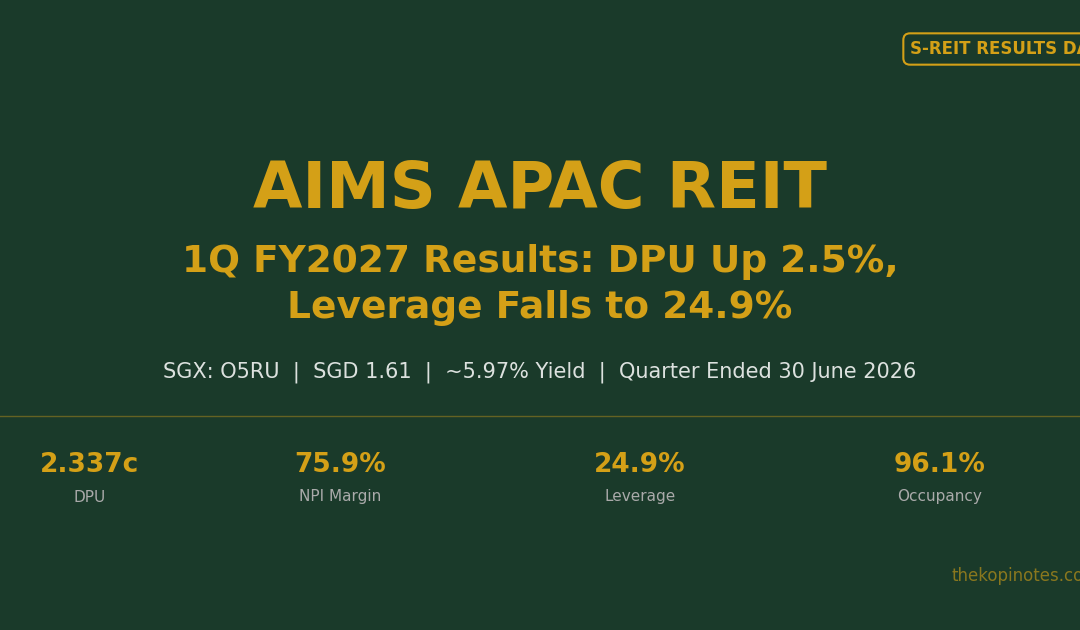
AIMS APAC REIT (SGX: O5RU) reported 1Q FY2027 DPU of 2.337 cents, up 2.5% year-on-year, for the quarter ended 30 June 2026. Gross revenue rose 6.6% to S$50.6 million and net property income jumped 12.5% to S$38.4 million, while aggregate leverage fell to 24.9% from 26.8% the prior quarter. The REIT trades at SGD 1.61 with a forward yield of around 5.97%, and its industrial portfolio in Singapore and Australia benefited from a fresh Perth acquisition this quarter.
Not financial advice. All figures are for educational reference only. Data as at 30 June 2026 unless otherwise noted, results released early August 2026.
- DPU grew 2.5% YoY to 2.337 cents, even as AIMS APAC REIT expanded its asset base with a new Perth industrial acquisition — a sign the deal was funded without diluting existing unitholders’ payouts.
- NPI margin jumped from 71.9% to 75.9%, and leverage actually fell to 24.9% — one of the lowest gearing ratios among Singapore-listed industrial REITs.
- The stock trades close to analysts’ SGD 1.68 consensus target, so most of the “easy” re-rating may already be priced in — this is now more of a steady income play than a deep-value trade.
Table of Contents
Contents — Click to expand
- What Is AIMS APAC REIT?
- 1Q FY2027 Results Snapshot
- Revenue and NPI: Why Margins Jumped
- DPU and Distribution Breakdown
- Balance Sheet: Leverage, NAV and the Perth Deal
- Occupancy and Lease Expiry (WALE)
- Analyst Ratings and Price Targets
- Risks to Watch
- Buy, Hold, or Sell? Our Verdict
- Frequently Asked Questions
What Is AIMS APAC REIT?
AIMS APAC REIT (AA REIT, SGX: O5RU) is a Singapore-listed industrial REIT. It owns a portfolio of logistics, warehouse, and business park properties, mostly in Singapore, with a growing exposure to industrial assets in Australia.
Unlike some larger S-REITs, AA REIT pays distributions quarterly rather than semi-annually — one of only a handful of Singapore REITs to do so. That makes its results cadence more frequent, and also means income investors get paid out more often.
The REIT’s fiscal year runs from April to March, so “1Q FY2027” refers to the quarter from 1 April to 30 June 2026 — AA REIT’s first quarter of its FY2027 financial year. This is a smaller, low-leverage industrial REIT that has quietly become one of the best risk-adjusted income names in the mid-cap S-REIT space.
You can buy O5RU through any SGX-linked brokerage. Singapore investors commonly use the Syfe referral code for direct brokerage access to SGX stocks and REITs.
1Q FY2027 Results Snapshot
AIMS APAC REIT’s 1Q FY2027 business update (quarter ended 30 June 2026) showed broad-based growth across almost every metric that matters to unitholders — revenue, income, occupancy, and even the balance sheet all improved together, which is not something you see in every REIT results release.
| Metric | 1Q FY2026 | 1Q FY2027 | Change |
|---|---|---|---|
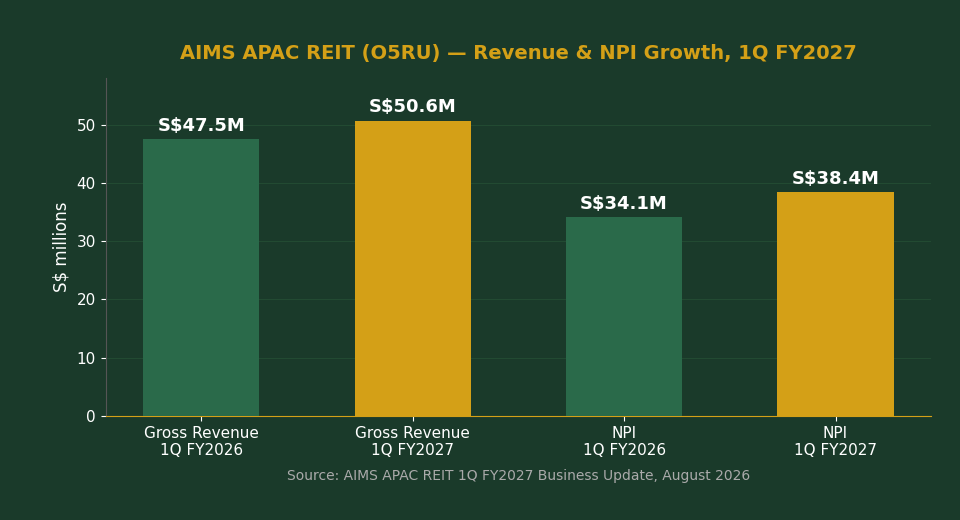
| Gross Revenue | ~S$47.5M | S$50.6M | +6.6% |
| Net Property Income | ~S$34.1M | S$38.4M | +12.5% |
| NPI Margin | 71.9% | 75.9% | +4.0 ppt |
| DPU | ~2.28 cents | 2.337 cents | +2.5% |
| Aggregate Leverage | — | 24.9% | Down from 26.8% (31 Mar 2026) |
| Portfolio Occupancy | 93.7% | 96.1% | +2.4 ppt |
Source: AIMS APAC REIT 1Q FY2027 Business Update via Beansprout, August 2026
Revenue and NPI: Why Margins Jumped
Here is the standout number in this results release: Net Property Income (NPI) grew almost twice as fast as revenue. Gross revenue rose 6.6% year-on-year to S$50.6 million, but NPI jumped 12.5% to S$38.4 million. That pushed the NPI margin — how much of each revenue dollar turns into actual property-level profit — up from 71.9% to 75.9%.
Why does that matter to you as an investor? A REIT growing revenue by raising rents is good. A REIT growing NPI faster than revenue means it is also cutting property operating expenses, or its rental growth is coming from higher-margin space. Either way, this is a management team executing well, not just riding rental market tailwinds.
In practical terms: for every S$100 of rent AIMS APAC REIT collected this quarter, S$75.90 dropped through to net property income, versus S$71.90 a year ago. That extra margin flows straight to unitholders after financing costs and REIT-level expenses.
DPU and Distribution Breakdown
1Q FY2027 DPU came in at 2.337 Singapore cents, up 2.5% from the same quarter last year. The distribution is split into two components: 2.247 cents of taxable income distribution and 0.090 cents of capital distribution.
Annualising this quarter’s DPU (2.337 cents × 4) gives approximately 9.35 cents per year. At the current share price of SGD 1.61, that works out to a forward yield of roughly 5.8%, broadly in line with the REIT’s reported trailing yield of around 5.97% based on the last four quarters.
For context: if you hold SGD 20,000 worth of AA REIT units at SGD 1.61 (approximately 12,422 units), you would receive roughly SGD 291 this quarter alone, or about SGD 1,163 per year at the current run-rate — paid out four times a year rather than twice, which some income investors prefer for smoothing cash flow.
The most notable part of this DPU growth is that it happened during a quarter in which the REIT expanded its asset base with a new Perth acquisition (see below). Growing per-unit payouts while also growing the portfolio usually means the deal was funded in a way that did not meaningfully dilute existing unitholders — a good sign for capital discipline.
Balance Sheet: Leverage, NAV and the Perth Deal
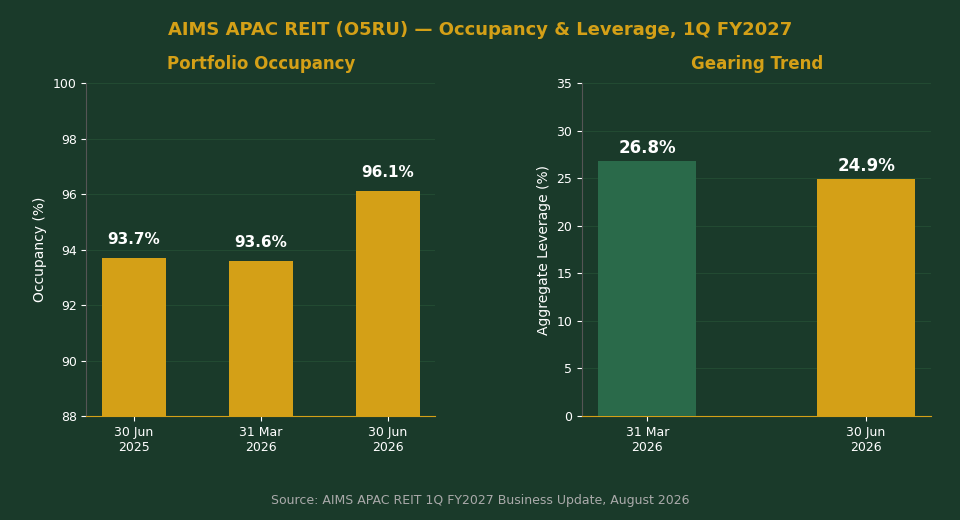
This is where the quarter gets interesting. AIMS APAC REIT’s aggregate leverage fell to 24.9% as at 30 June 2026, down from 26.8% at the end of March 2026 — even though the REIT completed a yield-accretive industrial property acquisition in Perth, Australia during the quarter, alongside sustainability-linked loan facilities that extend its debt maturity profile.
Net assets rose sharply, from S$1,667.5 million as at 31 March 2026 to S$2,414.1 million as at 30 June 2026. A jump of that size in a single quarter almost never comes from rental income alone — it typically reflects a combination of new borrowings, a unit issuance to help fund the acquisition, and portfolio revaluation gains. AIMS APAC REIT has not broken out the exact split publicly at the time of writing, but the fact that leverage fell rather than rose is the key takeaway: the Perth deal appears to have been funded conservatively rather than by stretching the balance sheet.
NAV per unit stood at approximately S$1.27 as at 30 June 2026. With the unit trading at SGD 1.61, that puts AA REIT at roughly 1.27x its book value — a premium valuation that reflects the market’s confidence in management’s execution, low gearing, and quarterly distribution profile.
| Balance Sheet Metric | 31 Mar 2026 | 30 Jun 2026 |
|---|---|---|
| Aggregate Leverage | 26.8% | 24.9% |
| Net Assets | S$1,667.5M | S$2,414.1M |
| NAV per Unit | — | ~S$1.27 |
Source: AIMS APAC REIT company announcement via TipRanks, August 2026
The Monetary Authority of Singapore caps REIT aggregate leverage at 50% under its property fund guidelines. At 24.9%, AA REIT has roughly 25 percentage points of headroom before hitting that ceiling — one of the lowest gearing ratios of any Singapore-listed industrial REIT, and a real structural advantage if acquisition opportunities in Australia or Singapore come up over the next 12 months. Curious how your own REIT holdings compare on this metric? Our S-REIT gearing ratio and ICR calculator lets you check any S-REIT’s leverage safety margin.
Occupancy and Lease Expiry (WALE)
Portfolio occupancy improved to 96.1% as at 30 June 2026, up from 93.7% a year earlier and 93.6% as at 31 March 2026. That is a meaningful jump in a single quarter, and it means AA REIT is now running close to full capacity across its Singapore and Australian industrial assets.
The Weighted Average Lease Expiry (WALE) — basically how long, on average, existing tenants are locked into their leases — shortened slightly to 3.6 years, from 4.0 years as at 31 March 2026. A shorter WALE is not automatically bad: it can create near-term reversion opportunities if market rents are rising, since more leases come up for renewal (and repricing) sooner. Given AA REIT’s strong occupancy and revenue momentum this quarter, that reads as an opportunity rather than a risk for now.
Analyst Ratings and Price Targets
Analyst opinion on AA REIT has become more mixed after a strong run-up in the share price through July 2026. Here is where the two most recent broker calls stand:
- DBS downgraded AA REIT to HOLD (from BUY) on valuation grounds after the stock’s outperformance, but still raised its target price to SGD 1.68 (from SGD 1.66) — a signal that the fundamentals improved even as the risk/reward for new buyers got less attractive.
- Maybank maintains a BUY call with a DDM-based (dividend discount model) target price of SGD 1.68, representing roughly 9% upside from where the stock traded when that call was published in late July 2026.
- Consensus average target: approximately SGD 1.68, with estimates ranging from SGD 1.66 to SGD 1.70 — a tight cluster, suggesting most analysts broadly agree on fair value even if they disagree on the “buy now vs wait” call.
| Broker / Source | Rating | Price Target (SGD) | Implied Upside* |
|---|---|---|---|
| Consensus (avg. analysts) | Mixed (Buy/Hold) | SGD 1.68 | ~+4% |
| DBS | HOLD (downgraded) | SGD 1.68 | ~+4% |
| Maybank | BUY | SGD 1.68 | ~+4-9%† |
*Upside calculated vs. SGD 1.61 share price as at early August 2026. †Maybank’s figure was published in late July 2026 vs. the share price at that time. Source: DBS, Maybank equity research via public broker-note summaries, July–August 2026.
The takeaway: after a strong run, AA REIT is trading close to where most analysts think fair value sits. That does not make it a bad hold — the 5.8-6.0% yield and improving fundamentals are real — but it does mean new buyers are paying closer to full price than they would have a few months ago. Compare this against other options in our best S-REITs in Singapore 2026 guide.
Risks to Watch
1. Net Asset Growth Composition Is Not Fully Disclosed
The jump in net assets from S$1,667.5 million to S$2,414.1 million is a big number for one quarter. Until AA REIT’s full financial statements clarify exactly how much came from new debt, new units issued, and revaluation gains, investors should treat the exact drivers as provisional rather than fully confirmed.
2. Shorter WALE Means More Near-Term Lease Renewals
A WALE of 3.6 years, down from 4.0 years, means a larger share of leases will come up for renewal over the next few years. If Singapore or Australian industrial rents soften, that reversion opportunity could turn into a reversion risk instead.
3. Valuation Has Compressed After the Rally
With the stock trading close to the SGD 1.68 consensus target and at a premium to its ~S$1.27 NAV per unit, much of the “cheap entry point” argument that existed earlier in 2026 has faded. New money coming in now is paying for continued execution, not a discount.
4. Interest Rate and Currency Exposure on the Australian Portfolio
AA REIT’s growing Australian exposure introduces AUD/SGD currency risk on that portion of income, plus sensitivity to Australian interest rates on any AUD-denominated debt. Read our Singapore T-bills 2026 guide for context on how rate movements ripple through to REIT valuations generally.
Buy, Hold, or Sell? Our Verdict
Plain-English verdict: AA REIT is a HOLD-to-BUY at SGD 1.61 for income-focused investors, but no longer the deep-value trade it was a few quarters ago.
Buy if: You want quarterly (not semi-annual) distributions, one of the lowest gearing ratios among S-REITs at 24.9%, and a management team that has just demonstrated it can grow the portfolio without diluting per-unit payouts. You are comfortable buying near analyst fair value rather than at a discount, in exchange for lower balance-sheet risk.
Hold if: You already own AA REIT and are earning the ~5.8-6.0% yield — there is little reason to sell into strength when the underlying business is executing this well. Watch the next set of full financial statements for clarity on how the Perth deal and net asset jump were actually funded.
Wait if: You are a new buyer specifically looking for a valuation discount to NAV. At ~1.27x NAV and close to the SGD 1.68 consensus target, AA REIT is no longer trading at the wide margin of safety it offered earlier in the year. A pullback toward SGD 1.50-1.55 would offer a more attractive entry.
For a broader view of building a REIT income stream, see our passive income Singapore guide, and model your target portfolio income with our Singapore retirement calculator. AA REIT sits alongside other Temasek- and sponsor-backed names covered in our Mapletree Investments REIT family guide for readers comparing industrial REIT options.
Disclaimer: This article is for informational and educational purposes only. It does not constitute financial advice. Past performance is not indicative of future results. Always do your own research or consult a licensed financial adviser before making any investment decision.
Frequently Asked Questions
What is AIMS APAC REIT and what does it own?
AIMS APAC REIT (SGX: O5RU) is a Singapore-listed industrial REIT that owns logistics, warehouse, and business park properties primarily in Singapore, with a growing portfolio of industrial assets in Australia. It is one of a small number of S-REITs that pays distributions quarterly rather than semi-annually.
What were AIMS APAC REIT's 1Q FY2027 results?
For the quarter ended 30 June 2026 (1Q FY2027), AIMS APAC REIT reported gross revenue of S$50.6 million (+6.6% YoY), net property income of S$38.4 million (+12.5% YoY), and DPU of 2.337 cents (+2.5% YoY). Portfolio occupancy rose to 96.1% and aggregate leverage fell to 24.9%, down from 26.8% as at 31 March 2026.
Why did AIMS APAC REIT's leverage fall even after a new acquisition?
AA REIT completed a yield-accretive industrial property acquisition in Perth, Australia during 1Q FY2027, alongside new sustainability-linked loan facilities. Despite this expansion, aggregate leverage fell to 24.9% from 26.8% the prior quarter — suggesting the deal was funded through a mix of new debt, equity, and portfolio revaluation gains rather than by materially stretching the balance sheet. The exact funding split has not been fully broken out in public disclosures at the time of writing.
What is AIMS APAC REIT's dividend yield today?
Based on the 1Q FY2027 DPU of 2.337 cents annualised (×4 = ~9.35 cents) and a share price of SGD 1.61, AA REIT’s forward yield works out to approximately 5.8%. Reported trailing yield based on the last four quarters is around 5.97%. Singapore individual investors generally receive S-REIT distributions without additional withholding tax at the unitholder level.
Is AIMS APAC REIT's leverage safe?
Yes. At 24.9% aggregate leverage, AA REIT sits well below the Monetary Authority of Singapore’s 50% cap for REITs, with roughly 25 percentage points of headroom. This is one of the lowest gearing ratios among Singapore-listed industrial REITs, giving management flexibility to pursue further acquisitions without needing an immediate equity raise.
What is the analyst price target for AIMS APAC REIT (O5RU)?
As at early August 2026, the analyst consensus target price for AA REIT is approximately SGD 1.68, with DBS (HOLD, downgraded from BUY) and Maybank (BUY) both citing SGD 1.68 as their target. That implies roughly 4% upside from the SGD 1.61 share price, plus the ~5.8-6.0% forward yield. These are estimates, not guarantees — actual returns depend on execution, interest rates, and market conditions.
Can I invest in AIMS APAC REIT using CPF or SRS funds?
AIMS APAC REIT is listed on the SGX Mainboard and is generally eligible for investment under the CPF Investment Scheme (CPFIS) using CPF Ordinary Account funds above the required minimum balance, as well as under the Supplementary Retirement Scheme (SRS). Confirm current eligibility with your brokerage or the CPF Board, as scheme rules can change.
How does AIMS APAC REIT compare to other Singapore industrial REITs?
AA REIT is smaller than giants like Mapletree Industrial Trust or CapitaLand Ascendas REIT, but it stands out for its low 24.9% leverage, quarterly (not semi-annual) distributions, and a portfolio concentrated in Singapore with growing Australian exposure. Larger peers typically offer more diversification across data centres and multiple countries, while AA REIT offers a simpler, lower-risk balance sheet and a slightly different distribution rhythm.
Is AIMS APAC REIT a good dividend stock for Singapore investors in 2026?
AA REIT offers a forward yield of around 5.8-6.0%, quarterly payouts, improving occupancy (96.1%), and one of the lowest leverage ratios in the S-REIT sector. It suits income-focused investors who value balance sheet safety and payout frequency. However, after a strong share price rally, it now trades close to analyst fair value and at a premium to NAV, so it is better suited to holding for income than to buying purely for a valuation discount.
Start Building Your Singapore REIT Portfolio
Compare brokerages and use referral codes for sign-up bonuses when opening your account.
This article was researched with the help of AI. While we strive to keep all information accurate and up to date, there may be errors. If you notice any discrepancies, please contact us.