What Is CPF MediSave? The Complete 2026 Guide to Contributions, Interest & How to Use It
Your MediSave rate, the $79,000 BHS cap, interest rates, and exactly what your healthcare savings account can pay for in 2026.
CPF MediSave is one of your three CPF accounts, set aside purely for healthcare. In 2026, between 8% and 10.5% of your monthly wage flows into it, depending on your age. You can use MediSave to pay hospital bills, Integrated Shield Plan premiums, and approved outpatient treatments. It earns a guaranteed 4% p.a. base interest, and it has a cap called the Basic Healthcare Sum (BHS) — $79,000 in 2026. Once you understand these mechanics, MediSave stops feeling like a mystery deduction and starts looking like a real healthcare safety net.
Not financial advice. All figures are for educational reference only, sourced from CPF Board and MOH publications. Data verified as at August 2026.
- MediSave gets 8%–10.5% of your wage, rising with age until it plateaus at 50
- Your MediSave balance is capped at the Basic Healthcare Sum — $79,000 in 2026, up from $75,500
- You can use it for hospital bills, Shield Plan premiums, and a growing list of outpatient treatments — but not everything
Free download: The Singapore Money Playbook — 7 money mindset shifts written for Singapore, with the CPF-adjusted retirement number most guides get wrong (PDF + Notion).
Table of Contents
Contents — Click to expand
What Is CPF MediSave, Exactly?
MediSave is one of the three accounts inside your CPF. The other two are your Ordinary Account (OA), which funds housing and investing, and your Special Account (SA), which is locked in for retirement. MediSave sits apart from both. It exists for one purpose only: healthcare.
Every working Singaporean and Permanent Resident has a MediSave account from their very first paycheck. A slice of your monthly wage, plus a matching slice from your employer, goes straight in. You don’t get to choose — it’s compulsory, and that’s by design. The government wants every citizen to build a healthcare buffer before they actually need one.
Here’s why that matters. Medical bills in Singapore can be large and sudden. A hospital stay for a serious illness can run into five figures. Without a dedicated pool of money set aside years in advance, many households would struggle to pay on the spot. MediSave solves that problem quietly, in the background, for your entire working life.
How Much Goes Into MediSave Every Month
Your MediSave contribution rate depends on your age, not your income level. It starts at 8% of your wage and climbs in steps as you get older, until it plateaus at 10.5% from age 50 onwards — and stays there for the rest of your working life.
This is part of your total CPF contribution, which is split across OA, SA, and MediSave. Employers and employees both contribute, and the combined rate applies to monthly wages up to the $8,000 Ordinary Wage ceiling in 2026.
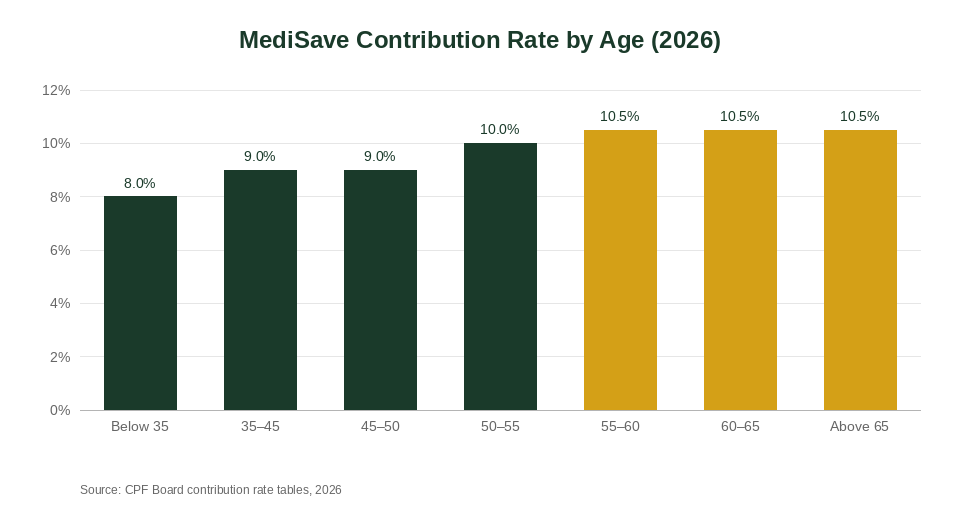
| Age Band | MediSave Contribution Rate | On a $5,000 Wage |
|---|---|---|
| Below 35 | 8.0% | $400/month |
| 35 to 45 | 9.0% | $450/month |
| 45 to 50 | 9.0% | $450/month |
| 50 to 55 | 10.0% | $500/month |
| 55 to 60 | 10.5% | $525/month |
| 60 to 65 | 10.5% | $525/month |
| Above 65 | 10.5% | $525/month |
Source: CPF Board contribution rate tables, 2026. Illustrative wage examples only.
If you’re self-employed, this works differently. You don’t have an employer topping up your MediSave, so you contribute based on your net trade income once you file your taxes, at rates that mirror the employee bands above. For the full breakdown by income bracket, see our MediSave contribution rate guide.
The Basic Healthcare Sum: Your MediSave Ceiling
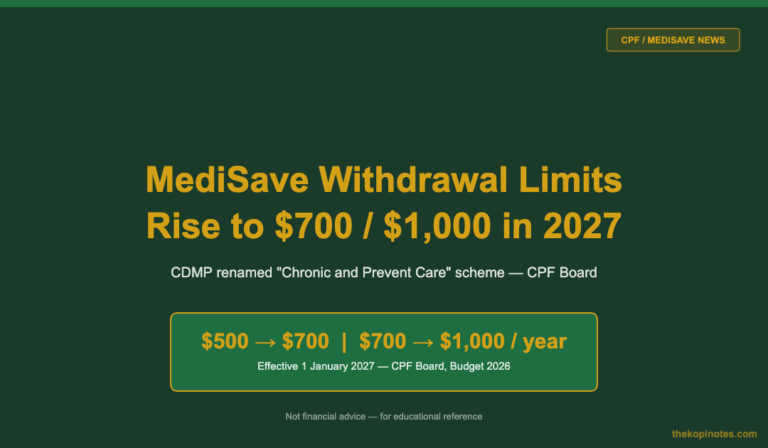
MediSave doesn’t grow forever. There’s a cap called the Basic Healthcare Sum (BHS) — basically the maximum amount CPF wants sitting in your MediSave account. In 2026, that cap is $79,000, up from $75,500 in 2025.
Here’s the part people often misunderstand. Hitting the BHS doesn’t mean your contributions disappear or get wasted. Once your MediSave balance reaches the cap, new contributions simply overflow into your Ordinary Account if you’re below 55, or your Retirement Account if you’re 55 and above. Nothing is lost — the money just gets redirected to a different bucket.
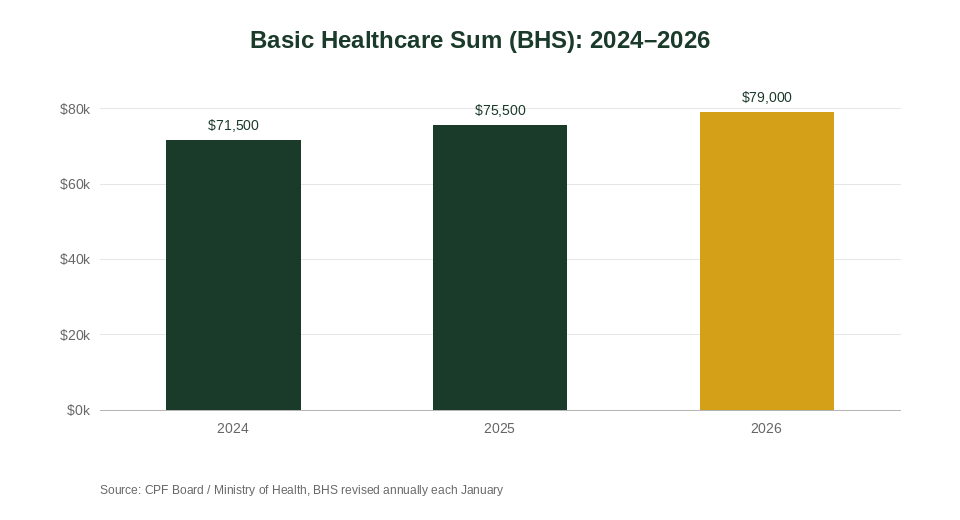
The BHS is also revised every January to keep pace with rising healthcare costs. It has risen for several years in a row, which means the “ceiling” keeps moving upward too. That’s worth knowing if you’re close to your current cap — you may find room again the following year.
The BHS is separate from your annual MediSave withdrawal limits for hospital bills and Shield Plan claims. Hitting the cap doesn’t restrict what you can spend — it only affects new contributions. For the full mechanics, including how BHS interacts with your Integrated Shield Plan premiums, read our Basic Healthcare Sum guide.
How MediSave Earns Interest
MediSave isn’t just a holding account — it earns interest, and the rate is better than almost any savings account you’ll find at a bank. The legislated minimum is 4% per annum on your MediSave balance, guaranteed regardless of market conditions.
On top of that base rate, CPF pays extra interest on your combined MediSave, Special Account, and Retirement Account balances. If you’re below 55, you earn an additional 1% on the first $60,000 combined (capped at $20,000 from your Ordinary Account). If you’re 55 or older, the extra interest steps up further, giving older members an even stronger return on their healthcare savings.
This compounding matters more than most people realise. A MediSave balance sitting at 4%+ for 20 or 30 years grows meaningfully — which is exactly why the BHS cap exists. Without it, MediSave balances could balloon far beyond what most people need for actual healthcare spending.
What You Can (and Can’t) Use MediSave For
MediSave covers more than most people expect, but it’s not unlimited. Here’s what it’s actually approved for in 2026:
| Covered by MediSave | Not Covered by MediSave |
|---|---|
| Hospitalisation bills at public and private hospitals | Cosmetic or elective procedures |
| MediShield Life and Integrated Shield Plan premiums | Most general outpatient GP visits |
| Approved day surgery procedures | Over-the-counter medication |
| Chronic disease management under CDMP (up to a yearly cap) | Non-approved traditional/alternative treatments |
| Maternity-related hospitalisation (with limits) | Health screenings outside approved schemes |
Source: CPF Board / Ministry of Health approved use guidelines, 2026.
The single biggest use case for most people is Integrated Shield Plan premiums. If you’re not sure which plan makes sense for your MediSave budget, our best Integrated Shield Plan guide breaks down the options after the recent MOH rider overhaul.
A Real SGD Worked Example
Say you’re 32 years old, earning $5,000 a month. At 8% of your wage, that’s $400 flowing into MediSave every month, or $4,800 a year. Over 10 years, ignoring interest, that’s $48,000 in contributions alone.
Now factor in the 4% minimum interest, compounding annually. By your early 40s, your actual MediSave balance would sit meaningfully higher than the raw contribution total — likely well past $55,000, even before your contribution rate steps up at age 35 and 45.
Fast forward to age 50: your rate jumps to 10.0%, then 10.5% from 55 onward. Combined with decades of compounding, many Singaporeans hit the Basic Healthcare Sum well before retirement — which is exactly why understanding the BHS overflow mechanic matters so much.
Where MediSave Fits Into Your Wider CPF Strategy
MediSave is just one piece of your CPF picture. Your Ordinary Account funds housing, your Special Account builds retirement income, and MediSave protects you from healthcare shocks along the way. Understanding how they interact — especially as contribution rates keep shifting for older workers — helps you plan years ahead instead of reacting to surprises.
If you’re approaching retirement, it’s also worth understanding how your Retirement Account balance eventually translates into a monthly income stream. Our CPF LIFE payout table shows exactly how much you’ll receive at BRS, FRS, and ERS, and our CPF LIFE calculator lets you estimate your own payout across Standard, Basic, and Escalating plans. For the latest on how contribution rates are changing for senior workers, see our guide to CPF contribution rate changes for 2027.
Beyond CPF, many Singaporeans also build a separate cash or SRS investment pool to complement their MediSave and Retirement Account savings. If you’re weighing where to put money outside CPF, platforms like Endowus and FSMOne let you invest SRS funds tax-efficiently — you can check the Endowus referral code and sign-up bonus or the FSMOne referral code if you’re setting up an account for the first time. TKN may earn a referral fee if you sign up through these links, at no extra cost to you.
And if you want a fuller picture of how your CPF and other savings translate into a retirement income number, our Singapore retirement calculator pulls it all together in one place.
Frequently Asked Questions
What is CPF MediSave used for?
How much MediSave do I contribute each month in 2026?
What happens when my MediSave hits the Basic Healthcare Sum?
Does MediSave earn interest?
Can self-employed people contribute to MediSave?
Is CPF MediSave the same as MediShield Life?
This article was researched with the help of AI. While we strive to keep all information accurate and up to date, there may be errors. If you notice any discrepancies, please contact us.