CPF LIFE Premium Singapore 2026: How Much of Your RA Actually Gets Locked In
Standard vs Basic vs Escalating Plan — the real BRS/FRS/ERS premium figures, and what happens to that money if you pass away early.
Every CPF member joining CPF LIFE hears the word “premium” thrown around, but few articles explain what it actually means in dollars. Your CPF LIFE premium is not a fee you pay out of pocket — it is the chunk of your own Retirement Account (RA) savings that gets converted into a lifelong annuity the moment your monthly payouts start. How much of your RA becomes that premium, and how much stays behind as a bequest for your family, depends entirely on which of the three CPF LIFE plans you pick.
This guide breaks down the actual 2026 premium figures at BRS, FRS and ERS, compares how the Standard, Basic and Escalating Plans treat your RA savings differently, and walks through exactly what your loved ones receive if you pass away before your premium is used up.
This article is for general information only and is not financial advice. CPF LIFE payout and premium figures are estimates based on CPF Board data as of 2026 and may be adjusted for long-term changes in interest rates or life expectancy.
Free download: The Singapore Money Playbook — 7 money mindset shifts written for Singapore, with the CPF-adjusted retirement number most guides get wrong (PDF + Notion).
Table of Contents
Contents — Click to expand
What Is a CPF LIFE Premium, Exactly?
Think of CPF LIFE as a national annuity scheme, not an investment. When you buy a private annuity, you hand over a lump sum premium to an insurer in exchange for a guaranteed income stream for life. CPF LIFE works the same way — except the “insurer” is CPF Board, and the premium comes directly from the savings already sitting in your Retirement Account.
At age 65 (or whenever you start your payouts), CPF Board converts some or all of your RA savings into your CPF LIFE premium. Your monthly payouts are then drawn first from this premium. Once the premium is fully drawn down, you keep receiving payouts for the rest of your life — funded by pooled interest contributed by all CPF LIFE members, since no one knows in advance who will live longer than the actuarial average.
How Your Premium Is Set at 65
Your CPF LIFE premium is not simply “whatever you saved by 55.” At 55, CPF Board sets aside your Retirement Sum (up to the Basic, Full or Enhanced Retirement Sum) from your Special and Ordinary Account savings into a newly created RA. Between 55 and 65, that RA balance keeps earning up to 6% p.a. in combined base and extra interest. By the time you turn 65, compounding has grown your original Retirement Sum into a noticeably larger number — and it’s that larger, age-65 number that becomes your CPF LIFE premium under the Standard and Escalating Plans.
This is a detail a lot of people miss: the BRS/FRS/ERS figures widely quoted are your savings target at 55, not your actual premium at 65.
The 2026 Premium Table: BRS, FRS & ERS
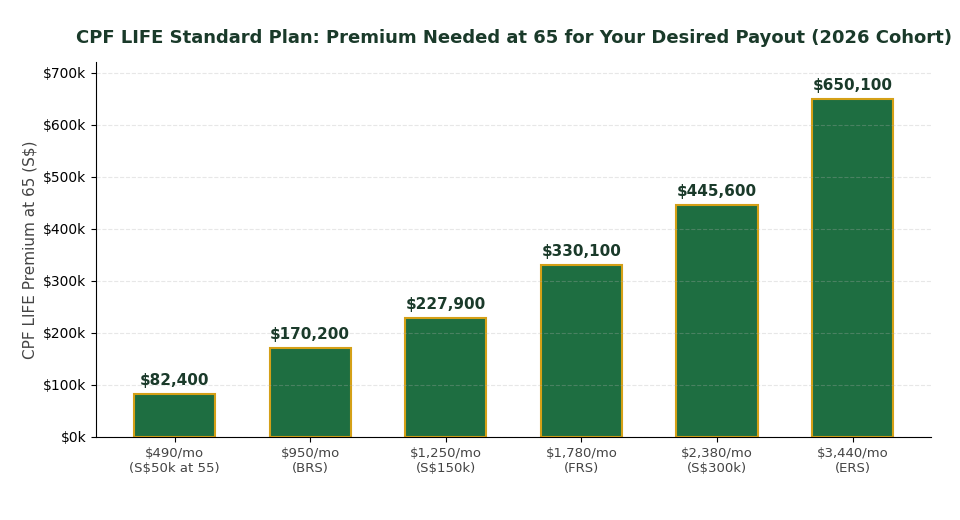
For members turning 55 in 2026, the Basic Retirement Sum (BRS), Full Retirement Sum (FRS) and Enhanced Retirement Sum (ERS) rose 3.5% from 2025 levels. Based on CPF Board’s illustrative figures (via Beansprout, sourced from CPF), here’s what your actual CPF LIFE Standard Plan premium looks like at 65, compared to the savings you set aside at 55:
| Desired Monthly Payout (from 65) | CPF LIFE Premium at 65 | Savings Needed at 55 |
|---|---|---|
| $490 | $82,400 | $50,000 |
| $950 | $170,200 | $110,200 (BRS 2026) |
| $1,250 | $227,900 | $150,000 |
| $1,780 | $330,100 | $220,400 (FRS 2026) |
| $2,380 | $445,600 | $300,000 |
| $3,440 | $650,100 | $440,800 (ERS 2026) |
Figures are Standard Plan estimates for members turning 65 in 2036 (i.e. those turning 55 in 2026), based on a male member, computed as of 2026. Actual payouts may be adjusted for long-term interest rate or life expectancy changes. Source: CPF Board, via Beansprout.
Notice the gap between the “savings needed at 55” column and the “premium at 65” column — at FRS, your $220,400 at 55 compounds into a $330,100 premium by 65. That $109,700 of growth is entirely CPF interest working in the background, and it directly explains why deferring your CPF LIFE payout start age (more on this below) boosts your monthly income so significantly.
Standard vs Basic vs Escalating: Who Locks In the Most RA?
All three CPF LIFE plans draw your premium from the same RA balance, but they treat it very differently:
- Standard Plan — the default plan. Your entire RA balance at 65 becomes your premium. This maximises your monthly payout but leaves the smallest bequest if you pass away early.
- Escalating Plan — also converts your full RA balance into premium, but a larger share of it is set aside to fund the payout’s built-in +2% annual increase. Payouts start roughly 20% lower than Standard, then compound upward each year on the anniversary of your first payout — useful if you expect a long retirement and want inflation protection.
- Basic Plan — only about 10–20% of your RA savings is deducted as the CPF LIFE premium. The remaining 80–90% stays in your RA, continuing to earn CPF interest, and is drawn down directly to fund your monthly payouts until one month before you turn 90. Only after 90 do payouts switch to being funded by the (much smaller) premium and pooled interest. Because so little of your RA becomes irrevocable premium, the Basic Plan leaves a meaningfully larger bequest, at the cost of a monthly payout that runs roughly 10–15% lower than Standard for the same RA balance.
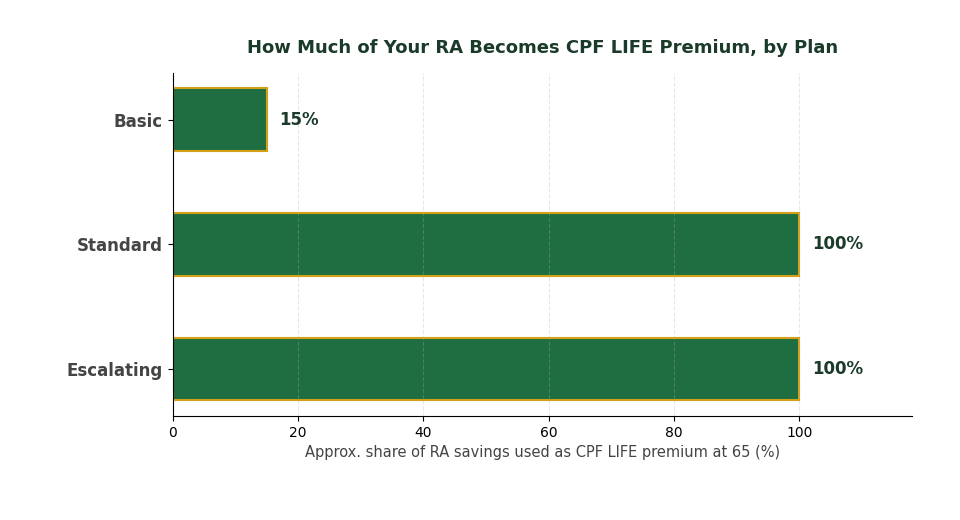
In short: Basic Plan members keep the biggest chunk of RA savings as a liquid, interest-earning balance and pass on the largest inheritance; Standard and Escalating Plan members convert almost everything into a locked-in annuity for a higher guaranteed income.
What Happens to Your Premium If You Pass Away Early
This is the part that surprises a lot of members: your CPF LIFE premium is never “lost” if you pass away before it runs out. Under all three plans, CPF Board guarantees capital protection — you or your nominees will always get back your full premium, either through monthly payouts received during your lifetime, or as a bequest to your beneficiaries after you pass away.
The bequest formula is simple:
Bequest = Total CPF LIFE Premium Paid − Total Payouts Already Received
Worked example: Say you joined CPF LIFE Standard Plan with a premium of $170,200 (the BRS 2026 premium at 65) and received a monthly payout of $950 for 24 months before passing away. Your beneficiaries would receive:
$170,200 − ($950 × 24) = $170,200 − $22,800 = $147,400
This bequest is paid out on top of any other CPF savings you hold, and is distributed according to your CPF nomination — which is exactly why making a CPF nomination matters, regardless of which CPF LIFE plan you choose.
One important nuance: your beneficiaries receive back the principal premium only, not the interest that would have accrued on it. Any interest your unused premium would have earned is pooled together with other CPF LIFE members’ pooled interest, and used to keep funding monthly payouts for members who live well beyond the actuarial average lifespan. This risk-pooling is precisely what makes CPF LIFE a true longevity insurance scheme rather than a savings account.
Frequently Asked Questions
Is the CPF LIFE premium the same as my Full Retirement Sum?
No. Your Full Retirement Sum (or BRS/ERS) is the target you set aside in your RA at age 55. By the time you turn 65, that amount has grown through compound interest, and it’s this larger, age-65 balance — not the original 55-year-old figure — that becomes your actual CPF LIFE premium under the Standard and Escalating Plans.
Do I pay my CPF LIFE premium out of my own pocket?
No. The premium is deducted automatically from your existing Retirement Account savings when your payouts start — you don’t need to make a separate cash payment. If your RA savings are lower than your desired retirement sum, you can choose to top up before payouts begin.
Which CPF LIFE plan uses the least amount of my RA as premium?
The Basic Plan uses the least, deducting only around 10–20% of your RA balance as premium. The remaining 80–90% stays in your RA earning interest and is drawn down directly for your monthly payouts until just before you turn 90.
What happens to my unused CPF LIFE premium if I die before 90?
Your nominees receive a bequest equal to your total premium paid minus total payouts already received. This is paid out in addition to any other CPF savings you have, according to your CPF nomination.
Does my CPF LIFE premium keep earning interest after I join?
Yes. Your premium continues to earn the prevailing CPF interest rate (currently a 4% p.a. floor on RA savings, plus up to 2% extra interest on the first $60,000 of combined balances). This interest is factored into your monthly payouts, but only the principal — not interest — is paid out as a bequest if you pass away early.
Can I top up my premium after I've already started CPF LIFE payouts?
Generally, top-ups need to happen before your premium is finalised at your chosen payout start age. Once payouts have started, the premium amount is locked in, though your monthly payout can still increase later if you had chosen the Escalating Plan (2% p.a. built in) or through other CPF interest-rate adjustments CPF Board applies from time to time.
Why does the Escalating Plan need a bigger premium than the Standard Plan?
The Escalating Plan needs to fund payouts that grow by 2% every year for potentially 25-30+ years, so a larger share of your RA is committed upfront to sustain that future growth, compared to Standard Plan payouts which never increase.
This article was researched with the help of AI. While we strive to keep all information accurate and up to date, there may be errors. If you notice any discrepancies, please contact us.