Best Cybersecurity ETFs for Singapore Investors (2026 Guide)
LOCK, ISPY, CIBR and HACK compared on fees, tax treatment and 2026 performance — plus how to buy them from Singapore.
The best cybersecurity ETFs for Singapore investors are LOCK (iShares Digital Security UCITS ETF) and ISPY (L&G Cyber Security UCITS ETF) — both Ireland-domiciled and listed on the London Stock Exchange. They give you exposure to firms like CrowdStrike, Palo Alto Networks and Fortinet while keeping US dividend withholding tax at 15% instead of 30%, with no US estate tax exposure.
Not financial advice. All figures are for educational reference only. Data verified as at August 2026 unless otherwise noted.
- Global cybersecurity spending hits US$248.9 billion in 2026, up 12.7% year-on-year — cyberattacks aren’t slowing down, and neither is the money chasing defence against them.
- LSE-listed, Ireland-domiciled ETFs (LOCK, ISPY) are the tax-efficient pick for Singapore investors. US-listed alternatives (CIBR, HACK, BUG) have bigger AUM and stronger recent returns, but cost you more in withholding tax and carry US estate tax risk.
- You can buy any of these through IBKR, Saxo or MooMoo — LOCK and ISPY need an LSE-enabled account, while CIBR/HACK/BUG trade on Nasdaq/NYSE Arca.
What Is a Cybersecurity ETF?
A cybersecurity ETF is a fund that pools your money into a basket of companies that build software or hardware to protect networks, data and devices from attack. Think firewalls, endpoint protection, identity management and cloud security.
Instead of picking a single stock like CrowdStrike or Palo Alto Networks, you own a slice of the whole sector in one trade. That spreads out your risk. If one company has a bad quarter, the fund doesn’t sink with it.
Most cybersecurity ETFs track a themed index — for example, the STOXX Global Digital Security Index or the ISE Cyber Security UCITS Index. The index rules decide which companies get in and how much weight each one gets. Some funds are market-cap weighted (bigger companies count for more), others are equal-weighted (every holding gets roughly the same slice).
For Singapore investors, the more useful distinction isn’t the index — it’s where the fund is domiciled. That single detail changes how much tax you pay every year.
Why Cybersecurity ETFs Are Trending in 2026
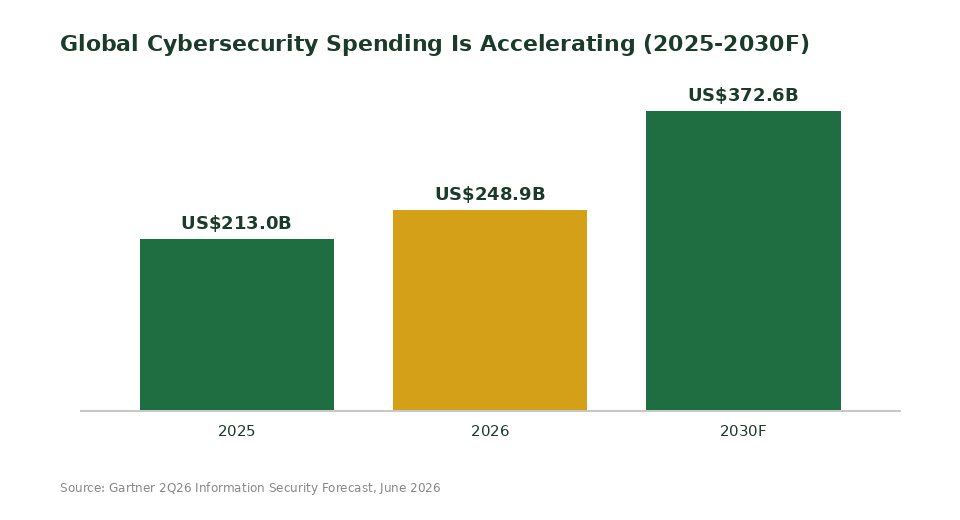
Cybersecurity spending isn’t a fad. It’s a structural budget line that keeps growing because attacks keep growing. Gartner’s 2Q26 forecast (published June 2026) puts global information security spending at US$248.9 billion for 2026, up 12.7% from the year before — and Gartner expects that number to reach US$372.6 billion by 2030.
Here’s why: AI has made attacks cheaper and faster to launch, but it’s also made securing AI systems a brand-new budget category that didn’t exist a year ago. Gartner now tracks “securing AI” as the fastest-growing spending line through 2030, on top of the usual cloud security and identity management categories.
Singapore isn’t insulated from this. The Cyber Security Agency of Singapore (CSA) recorded 165 ransomware cases in 2025, up from 159 in 2024, with SMEs disproportionately affected due to weaker defences. Infected infrastructure detected locally jumped 142% year-on-year to 284,300 in 2025, and phishing attempts rose 49% to 6,100 cases. CSA has since flagged an “AI-driven threat landscape” as its central 2026 concern, including AI-enabled scam calls impersonating government officials.
That’s the demand side. On the supply side, five ETFs now give you direct access to this theme — two on the London Stock Exchange (tax-efficient for you), three on US exchanges (bigger and more liquid, but with a tax cost attached).
Best Cybersecurity ETFs for Singapore Investors
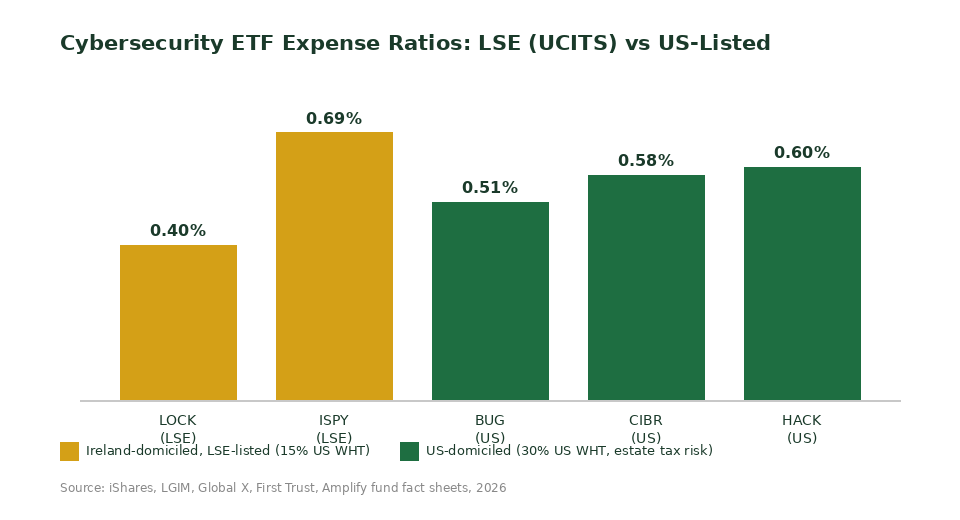
Here’s how the two LSE-listed, UCITS-compliant options stack up against the three largest US-listed alternatives. All figures are TER (total expense ratio) and AUM as reported by each fund’s official factsheet in 2026.
Key Facts: LOCK vs ISPY at a Glance
| Metric | LOCK | ISPY |
|---|---|---|
| Index Tracked | STOXX Global Digital Security | ISE Cyber Security UCITS |
| Weighting Method | Market-cap weighted | Equal-weighted |
| Share Classes | Accumulating & Distributing | Distributing |
| Sector Tilt | ~59% Technology Services | Broad-based pure-play cyber |
| Currency | USD | USD / GBP |
Source: iShares and LGIM fund factsheets, 2026.
| ETF | Exchange | Domicile | TER | AUM | US WHT |
|---|---|---|---|---|---|
| LOCK (iShares Digital Security) | LSE | Ireland | 0.40% | ~US$1.7B | 15% |
| ISPY (L&G Cyber Security) | LSE | Ireland | 0.69% | ~US$2.7B | 15% |
| CIBR (First Trust Nasdaq Cybersecurity) | Nasdaq | USA | 0.58% | ~US$14.4B | 30% |
| HACK (Amplify Cybersecurity) | NYSE Arca | USA | 0.60% | Largest by assets | 30% |
| BUG (Global X Cybersecurity) | Nasdaq | USA | 0.51% | Smaller, ~25 holdings | 30% |
Source: iShares, LGIM, First Trust, Amplify and Global X fund factsheets, 2026.
LOCK — iShares Digital Security UCITS ETF
LOCK tracks the STOXX Global Digital Security Index (see the iShares Digital Security UCITS ETF factsheet) and is the cheapest way into this theme at a 0.40% TER. It leans heavily into Technology Services (about 59% of the basket) with roughly 69% North American exposure. Because it’s Ireland-domiciled and UCITS-compliant, it qualifies for the reduced 15% US dividend withholding tax under the Ireland-US tax treaty, and carries no US estate tax exposure for a Singapore resident.
ISPY — L&G Cyber Security UCITS ETF
ISPY tracks the ISE Cyber Security UCITS Index using an equal-weighted approach — every holding gets roughly the same slice, rather than letting mega-caps dominate. That means more exposure to faster-growing mid-caps like CrowdStrike and Zscaler, which tends to help in risk-on years and hurt in risk-off ones. Its TER is higher at 0.69%, but it’s also Ireland-domiciled with the same 15% WHT and no estate tax exposure.
CIBR, HACK and BUG — US-Listed Alternatives
These three are bigger and more liquid, and CIBR in particular delivered a strong ~32% one-year return through mid-2026 on the back of its market-cap-weighted tilt toward Palo Alto Networks and CrowdStrike. HACK returned roughly 28%, blending pure-play cybersecurity names with IT services firms that handle federal security contracts. BUG’s equal-weighted, 25-stock pure-play approach lagged at around 10% over the same period.
The catch: as US-domiciled funds, they’re subject to 30% US dividend withholding tax for non-US residents — double what LOCK or ISPY pays — and US estate tax applies to non-resident aliens holding more than USD 60,000 in US-situs assets, which includes these ETFs.
How to Buy Cybersecurity ETFs in Singapore
You’ll need a brokerage account that gives you access to either the London Stock Exchange (for LOCK and ISPY) or US exchanges (for CIBR, HACK and BUG). If you’re brand new to ETF investing, our step-by-step guide on how to buy ETFs in Singapore covers account setup from scratch. Here’s how it works broker by broker:
Interactive Brokers (IBKR) gives you access to both LSE and US exchanges from one account, with tight spreads and low commissions — this is the most cost-effective option if you’re investing a meaningful sum. Fund your account, search the ticker (e.g. “LOCK” and select the LSE listing), and place a limit order in USD or GBP depending on the share class.
Saxo Markets also covers LSE and US listings with a similarly broad universe, though commissions run slightly higher than IBKR for smaller trade sizes.
MooMoo Singapore gives you access to US-listed ETFs (CIBR, HACK, BUG) directly, but does not currently support LSE trading — so if you want LOCK or ISPY specifically, you’ll need IBKR or Saxo.
Syfe Brokerage is the simplest option for beginners who want US-listed exposure without comparing multiple platforms, though again it won’t get you onto the LSE for LOCK or ISPY.
A practical example: if you’re a Singapore investor with SGD 15,000 to allocate and you want the tax-efficient route, you’d open (or already have) an IBKR or Saxo account, fund it in USD, search “LOCK” on the LSE, and place a market or limit order. The minimum investment is just one share — LOCK trades at roughly USD 8-10 per unit as at 2026, so there’s no real barrier to entry.
Note that LSE-listed ETFs like LOCK and ISPY are not CPF-investable, but they are SRS-compatible if your broker supports SRS-funded international trades — check with your broker before assuming this works, as SRS is more commonly linked to SGX-listed instruments in practice.
Risks to Consider
Cybersecurity ETFs concentrate your money in one sector — that’s the whole point, but it cuts both ways. If cybersecurity stocks fall out of favour, this fund falls with them. You don’t get the cushion a broad-market ETF like VWRA gives you.
Many cybersecurity stocks also trade at high valuations relative to their earnings, since the market is pricing in years of future growth. That makes the sector more sensitive to rate changes and growth-scare sell-offs than value-oriented sectors.
There’s also currency risk — LOCK and ISPY trade in USD or GBP, so your SGD returns will move with the exchange rate on top of the fund’s own performance. And because this is a relatively narrow theme, single-stock concentration risk is real: CrowdStrike, Palo Alto Networks and Fortinet often make up a large chunk of these funds, so a bad quarter from any one of them moves the whole basket.
Finally, remember the thematic-ETF caveat that applies to any hot sector: cybersecurity has been trending for several years now, and “trending” doesn’t guarantee forward returns. Treat this as a satellite allocation alongside a core global portfolio like CSPX or VWRA, not a replacement for one.
Frequently Asked Questions
What is a cybersecurity ETF and why do Singapore investors buy them?
A cybersecurity ETF holds a basket of companies focused on network security, endpoint protection, identity management and cloud security — names like CrowdStrike, Palo Alto Networks and Fortinet. Singapore investors use them to get diversified exposure to rising global cybersecurity spending (US$248.9 billion in 2026, per Gartner) without picking individual stocks.
Is LOCK or ISPY better for Singapore investors?
LOCK has the lower TER (0.40% vs 0.69%) and tracks a market-cap-weighted index, making it the lower-cost, lower-volatility choice. ISPY’s equal-weighted approach gives more exposure to faster-growing mid-caps, which can outperform in risk-on markets but adds volatility. Both are Ireland-domiciled with the same 15% US dividend withholding tax, so the choice comes down to cost versus growth tilt.
Can I buy cybersecurity ETFs like CIBR or HACK using CPF or SRS?
No — CIBR, HACK and BUG are US-listed ETFs and are not on the CPF Investment Scheme (CPFIS) approved list. LSE-listed LOCK and ISPY are also not CPF-investable. Some brokers allow SRS funds to be used for international trades including LSE- and US-listed ETFs, but this varies by broker — confirm with your provider before assuming SRS applies.
Which broker is best for buying cybersecurity ETFs in Singapore?
Interactive Brokers (IBKR) is the most cost-effective for buying LOCK or ISPY on the LSE, since it also covers US exchanges in the same account. MooMoo Singapore and Syfe Brokerage support CIBR, HACK and BUG on US exchanges but do not currently offer LSE access.
What is the minimum investment for a cybersecurity ETF?
There’s no fixed minimum beyond the price of one share. LOCK trades at roughly USD 8-10 per unit as at 2026, so you can start with under SGD 15. The real minimum to consider is your broker’s minimum funding requirement and per-trade commission, which matters more for small position sizes.
Are cybersecurity ETFs risky? What should I watch out for?
Yes — they’re a concentrated sector bet, not a diversified core holding. Watch for high valuations relative to earnings, single-stock concentration (a handful of names often dominate the basket), currency risk from USD/GBP exposure, and the general risk that any “hot theme” can cool off. Most advisors suggest treating thematic ETFs like this as a smaller satellite position alongside a broad-market core like VWRA or CSPX.
Ready to Add Cybersecurity ETFs to Your Portfolio?
Open a brokerage account and start with a core global ETF before layering in thematic exposure. Use our referral links for exclusive sign-up bonuses.
This article was researched with the help of AI. While we strive to keep all information accurate and up to date, there may be errors. If you notice any discrepancies, please contact us.