How to Buy ETFs in Singapore: Step-by-Step Guide (2026)
A complete guide for Singapore investors — brokers, UCITS ETFs, withholding tax, CPF/SRS rules, and 2026 data.
To buy ETFs in Singapore, open a brokerage account with IBKR, Saxo, moomoo, or Syfe Trade, fund it in SGD or USD, search for an Ireland-domiciled UCITS ETF listed on the London Stock Exchange (such as CSPX or VWRA), and place a market or limit order. Singapore investors favour LSE-listed ETFs because they attract only 15% withholding tax on US dividends and carry no US estate tax risk — versus 30% WHT and USD 60,000 estate tax exposure for US-listed equivalents like SPY or VOO.
Not financial advice. All figures are for educational reference only. Data as at May 2026 unless noted.
Table of Contents
Contents — Click to expand
- Why Singapore Investors Buy ETFs
- Types of ETFs Available in Singapore
- The UCITS ETF Advantage for Singapore Investors
- Best Brokers to Buy ETFs in Singapore
- Step-by-Step: How to Buy Your First ETF
- Understanding Costs and Fees
- CPF and SRS Considerations
- Top ETFs to Consider in 2026
- Frequently Asked Questions
Why Singapore Investors Buy ETFs
Exchange-traded funds (ETFs) have become one of the most popular investment vehicles among Singapore retail investors — and for good reason. An ETF is a basket of securities (shares, bonds, or commodities) that tracks an index and trades on a stock exchange like an ordinary share. Unlike unit trusts sold through banks, ETFs trade intraday at market prices, carry lower annual fees (the total expense ratio, or TER), and require no minimum investment beyond one share.
For Singapore residents, ETFs offer four core advantages:
- Instant diversification — a single CSPX share gives you exposure to all 500 companies in the S&P 500 index.
- Low cost — TERs for major UCITS ETFs range from 0.07% to 0.25% p.a., far below the 1–2% charged by most actively managed unit trusts sold in Singapore.
- Tax efficiency — Singapore has no capital gains tax and no dividend tax, making ETF returns fully accessible to investors.
- Flexibility — ETFs can be bought and sold at any time during market hours through a standard brokerage account.
The Singapore ETF market has grown rapidly since 2020. As at May 2026, the SGX lists over 80 ETFs across equities, REITs, bonds, and commodities. Many Singapore investors also access global ETFs listed on the London Stock Exchange (LSE) and the New York Stock Exchange (NYSE) through international brokerages like Interactive Brokers and Saxo.
Types of ETFs Available in Singapore
Before learning how to buy ETFs in Singapore, it helps to understand the main categories you will encounter:
| ETF Type | Example Tickers | Listed On | Best For |
|---|---|---|---|
| Global Equity (UCITS) | CSPX, VWRA, IWDA | LSE (London) | Tax-efficient global exposure |
| US Equity (US-listed) | SPY, VOO, QQQ | NYSE / NASDAQ | Lower TER but 30% WHT risk |
| Singapore Equity | ES3 (STI ETF), G3B | SGX | Local market, CPF-eligible |
| S-REIT ETF | CLR (Lion-Phillip) | SGX | Dividend income, REIT exposure |
| Commodity ETF | O87 (SPDR Gold) | SGX | Inflation hedge, gold exposure |
Source: SGX ETF listings, May 2026
For most Singapore investors building a long-term, low-cost portfolio, Ireland-domiciled UCITS ETFs listed on the LSE — such as CSPX (iShares Core S&P 500) and VWRA (Vanguard FTSE All-World) — are the preferred choice due to their favourable tax treatment. The Singapore REIT ETF guide covers the SGX-listed options in more detail if you prefer domestic dividend income.
The UCITS ETF Advantage for Singapore Investors
UCITS stands for Undertakings for Collective Investment in Transferable Securities — the European regulatory framework for investment funds. UCITS ETFs domiciled in Ireland are the go-to structure for Singapore investors for two key reasons: withholding tax and estate tax.
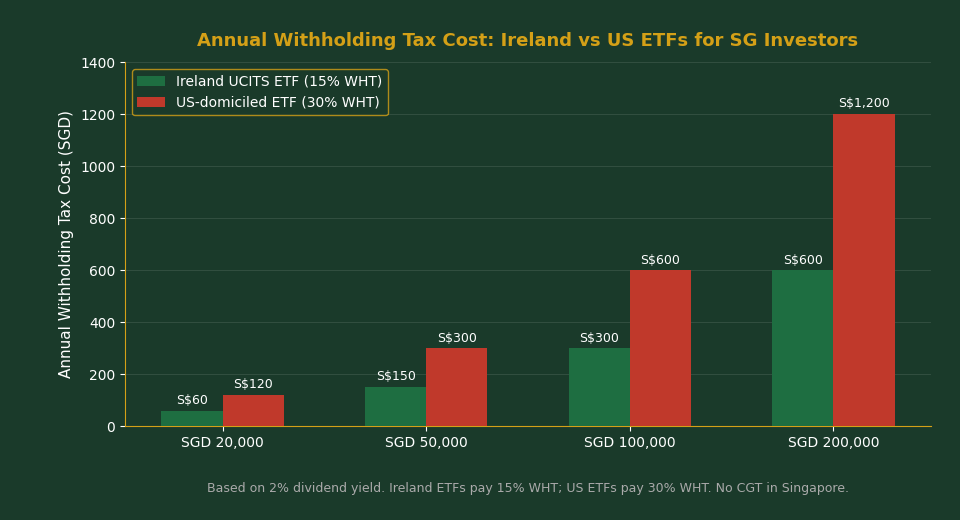
Withholding Tax (WHT): When a US company pays a dividend to an ETF, the US government withholds tax at source. For a US-domiciled ETF (like VOO or SPY), the WHT rate is 30%. For an Ireland-domiciled UCITS ETF, the rate is reduced to 15% under the Ireland-US tax treaty. Since Singapore has no dividend tax, this 15% WHT is your only tax drag — compared to 30% for US-listed equivalents. On a SGD 100,000 portfolio with a 2% yield, that difference saves you approximately SGD 300 per year.
US Estate Tax: Non-US residents holding US-situs assets (including US-listed ETFs) above USD 60,000 are subject to US estate tax at rates up to 40% upon death. Ireland-domiciled UCITS ETFs are not considered US-situs assets and therefore carry no US estate tax risk. For a Singapore investor with a growing portfolio, this is a significant protection.
| ETF Type | Domicile | US Dividend WHT | US Estate Tax Risk | TER (typical) |
|---|---|---|---|---|
| CSPX / VWRA (LSE) | Ireland | 15% | None | 0.07–0.22% |
| VOO / SPY (NYSE) | USA | 30% | Yes (above USD 60k) | 0.03–0.09% |
Source: iShares CSPX factsheet (Q1 2026), Vanguard VWRA factsheet (Q1 2026), IRS Publication 515
Best Brokers to Buy ETFs in Singapore (2026)
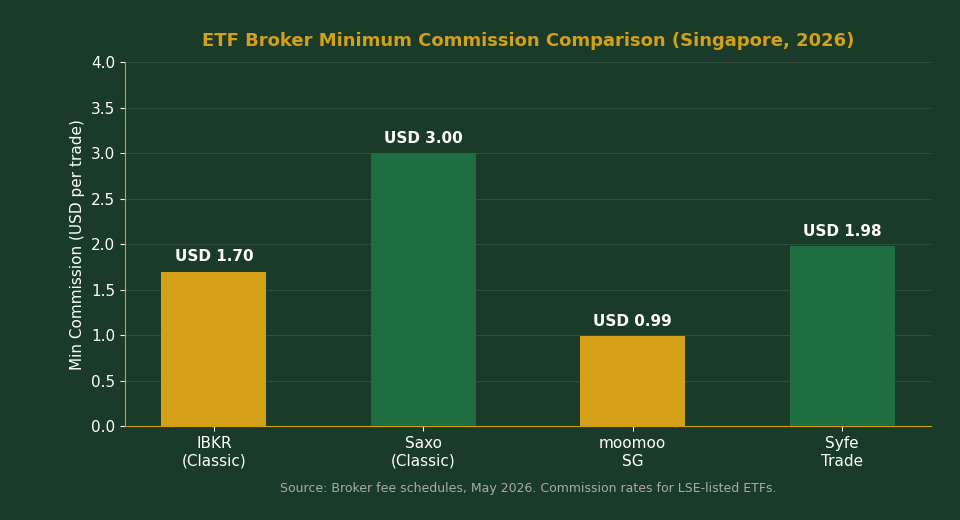
Choosing the right broker is the first practical step in how to buy ETFs in Singapore. The four most popular options among Singapore retail investors are Interactive Brokers (IBKR), Saxo Markets, moomoo Singapore, and Syfe Trade. Each suits a different investor profile.
| Broker | Min Commission | Platform Fee | Best For | LSE ETFs? |
|---|---|---|---|---|
| IBKR (Classic) | USD 1.70/trade | None | Active / large portfolios | ✓ Yes |
| Saxo (Classic) | USD 3.00/trade | None | Beginners, clean UI | ✓ Yes |
| moomoo SG | USD 0.99/trade | None | Cost-conscious, US ETFs | Limited |
| Syfe Trade | USD 1.98/trade | None | Simplicity, SRS-linked | ✓ Yes |
Source: Broker fee schedules, May 2026. Rates are indicative and subject to change.
IBKR is the most cost-effective for investors making regular purchases of LSE-listed ETFs. At USD 1.70 minimum commission (0.05% of trade value, min USD 1.70), a single trade of SGD 5,000 or more costs roughly SGD 2.30 — significantly cheaper than a CDP-linked broker at 0.25–0.28%. IBKR also offers fractional shares on US-listed ETFs and the widest range of global exchanges. You can read a full breakdown in our moomoo Singapore review for a comparison with moomoo’s features.
Syfe Trade is recommended for investors who want simplicity and SRS compatibility. Syfe’s platform is straightforward, and its Syfe referral code gets you a sign-up bonus on your first deposit. For robo-advisory ETF investing (rather than self-directed), Syfe Core and Syfe Select portfolios also provide managed ETF exposure with no trading commissions.
moomoo Singapore offers the lowest headline commission for US-listed ETFs but has limited access to LSE-listed UCITS ETFs — making it less suitable for tax-efficient CSPX or VWRA purchases.
Step-by-Step: How to Buy ETFs in Singapore
Here is the exact process for buying an Ireland-domiciled UCITS ETF (such as CSPX) on the London Stock Exchange through IBKR — the most popular route for Singapore investors in 2026.
Step 1: Open and Fund a Brokerage Account
Visit the IBKR Singapore website and complete the online application. You will need your NRIC or passport, proof of address (utility bill or bank statement), and an income declaration. Approval typically takes 1–3 business days. Fund your account via FAST or SWIFT bank transfer in SGD or USD. IBKR automatically converts SGD to USD or GBP at the mid-market rate when you place an order in a foreign currency.
If you prefer a simpler onboarding experience, Syfe Trade or moomoo Singapore both offer SingPass MyInfo-verified sign-up in under 10 minutes. Use an Endowus referral code if you are considering Endowus for managed ETF portfolios via your SRS or CPF-OA funds instead.
Step 2: Search for the ETF by Ticker
Once your account is funded, search for the ETF using its ticker symbol. For CSPX on IBKR:
- Type CSPX in the search bar
- Select CSPX — iShares Core S&P 500 UCITS ETF
- Choose exchange: LSE (London Stock Exchange)
- Currency: USD (or GBP for the GBP-denominated share class)
Always confirm you are buying the LSE-listed version (not the NYSE-listed equivalent) to get the Ireland domicile and 15% WHT benefit.
Step 3: Choose Order Type — Market or Limit
For most investors making routine monthly purchases, a limit order is recommended. Set your limit price at or just above the last traded price to ensure execution while protecting against sudden price spikes. A market order fills immediately at the best available price but can slip during high-volatility periods. Given the tight bid-ask spreads on CSPX (typically 0.01–0.02% of NAV), slippage is rarely a concern for amounts under SGD 100,000.
Step 4: Review and Confirm
Before confirming, check:
- Ticker and exchange (should read CSPX · LSE)
- Quantity (number of shares or units)
- Estimated total cost including brokerage commission
- Currency of settlement (USD or GBP)
Submit the order and monitor it in your portfolio tab. For liquid ETFs like CSPX and VWRA, limit orders during LSE trading hours (3:00pm–11:30pm SGT) typically fill within minutes.
Step 5: Track Your Holdings
Use your broker’s portfolio dashboard to monitor NAV, total return, and currency exposure. For long-term passive investors, there is no need to check prices daily — set a monthly review cadence and reinvest dividends (for accumulating ETFs, this happens automatically within the fund). Use the Singapore retirement calculator to model how your ETF contributions compound towards your retirement goal.
Understanding Costs and Fees When Buying ETFs in Singapore
The total cost of ETF investing in Singapore has three layers: the TER (built into the ETF), brokerage commission, and FX spread.
| Cost Component | CSPX (LSE) | Frequency | Notes |
|---|---|---|---|
| TER (Expense Ratio) | 0.07% p.a. | Annual (deducted daily) | Built into NAV — not a separate charge |
| Brokerage Commission | USD 1.70–3.00 | Per trade | Min charge regardless of trade size |
| FX Spread (SGD→USD) | ~0.15–0.30% | Per conversion | IBKR charges ~0.15%; bank wire ~0.5–1% |
| Custody / Platform Fee | None | — | IBKR and moomoo do not charge custody fees |
| Withholding Tax (on dividends) | 15% (accumulated) | On dividend events | CSPX is accumulating — WHT is handled inside the fund |
Source: iShares CSPX factsheet (Q1 2026); IBKR, Saxo fee schedules (May 2026)
Worked example: A Singapore investor buys SGD 10,000 of CSPX via IBKR. The FX conversion costs approximately SGD 20 (0.20%). The commission is USD 1.70 (approximately SGD 2.30). Total one-time cost: ~SGD 22.30 (0.22% of trade). The annual TER of 0.07% then costs SGD 7 per year on that holding. Compare this to a unit trust with a 1% p.a. management fee — that is SGD 100 per year on the same SGD 10,000.
CPF and SRS Considerations for ETF Investors
Many Singapore investors ask whether they can use CPF or SRS funds to buy ETFs. The answer depends on the ETF and the brokerage.
CPF Investment Scheme (CPFIS): CPFIS allows CPF Ordinary Account (OA) and Special Account (SA) funds to be invested in approved instruments. LSE-listed UCITS ETFs (CSPX, VWRA, IWDA) are not CPFIS-approved and cannot be bought with CPF funds. SGX-listed ETFs that are CPFIS-approved include the Nikko AM STI ETF (G3B) and the SPDR STI ETF (ES3). For a full list, refer to the CPF Board’s approved investment list on cpf.gov.sg. You can find more strategies in our CPF investment strategy Singapore guide.
Supplementary Retirement Scheme (SRS): SRS funds can be used to buy ETFs through SRS-linked brokerages. IBKR and Syfe Trade both accept SRS funds. You can use SRS to buy CSPX or VWRA on the LSE, making it one of the few tax-sheltered ways to invest in global UCITS ETFs. SRS contributions reduce your chargeable income dollar-for-dollar (up to SGD 15,300 for Singapore citizens/PRs), adding a further tax advantage. The passive income Singapore guide covers how to combine SRS ETF investing with dividend income strategies.
Top ETFs to Consider for Singapore Investors in 2026
Once you know how to buy ETFs in Singapore, the next question is which ETF to buy. Here are the most widely held options among Singapore retail investors as at May 2026:
| ETF | Ticker | Index | TER | Structure | Exchange |
|---|---|---|---|---|---|
| iShares Core S&P 500 | CSPX | S&P 500 | 0.07% | Accumulating | LSE |
| Vanguard FTSE All-World | VWRA | FTSE All-World | 0.22% | Accumulating | LSE |
| iShares Core MSCI World | IWDA | MSCI World | 0.20% | Accumulating | LSE |
| Nikko AM STI ETF | G3B | Straits Times Index | 0.30% | Distributing | SGX |
| Lion-Phillip S-REIT ETF | CLR | MAS S-REIT Index | 0.60% | Distributing | SGX |
Source: Fund factsheets and SGX data, May 2026. TER figures from respective fund managers.
For investors looking for dividend income in Singapore rather than pure capital growth, the best S-REITs in Singapore 2026 and the Singapore Savings Bonds guide provide complementary income options alongside your ETF portfolio. You might also explore the FSMOne referral code if you prefer a local platform with access to both unit trusts and ETFs.
Not financial advice. Past performance is not a guarantee of future results. Always assess your own risk tolerance and financial goals before investing. Data as at May 2026.
Frequently Asked Questions
How do I buy ETFs in Singapore as a beginner?
The simplest way for a beginner to buy ETFs in Singapore is to open an account with Syfe Trade or moomoo Singapore, fund it via PayNow or bank transfer, and search for a low-cost index ETF such as CSPX (on the LSE) or the Nikko AM STI ETF (G3B) on the SGX. Both platforms offer SingPass MyInfo sign-up, making onboarding fast. Start with a single ETF covering a broad index before adding more positions.
Can I buy ETFs in Singapore using CPF funds?
Yes, but only for CPF Investment Scheme (CPFIS)-approved ETFs. These are generally SGX-listed ETFs such as the Nikko AM STI ETF (G3B), the SPDR STI ETF (ES3), and a small number of bond ETFs. Popular LSE-listed UCITS ETFs like CSPX and VWRA are not CPFIS-approved and cannot be bought with CPF-OA or CPF-SA funds. For CPF-OA investing, check the full approved list on the CPF Board website before proceeding.
What is the minimum investment to buy an ETF in Singapore?
There is no fixed minimum — you buy ETFs by the share (unit). One share of CSPX costs approximately USD 545 (around SGD 730) as at May 2026. One unit of the Nikko AM STI ETF (G3B) costs approximately SGD 3.50. For IBKR, there is a minimum commission of USD 1.70 per trade, so buying very small amounts (below SGD 1,000) makes each trade relatively expensive. Many investors accumulate monthly and buy in batches of SGD 2,000–5,000 to keep commission as a percentage of trade value low.
Are ETF gains taxable in Singapore?
No. Singapore has no capital gains tax, so profits from selling ETFs are not taxed. There is also no dividend tax in Singapore, meaning distributions received from SGX-listed ETFs are received gross. The only tax applicable to most Singapore investors is the withholding tax deducted at source by the ETF’s domicile country — for Ireland-domiciled UCITS ETFs, this is 15% on US-sourced dividends, already handled inside the fund before it reaches you.
Is CSPX or VOO better for Singapore investors?
For most Singapore investors, CSPX (Ireland-domiciled, LSE-listed) is the better choice over VOO (US-domiciled, NYSE-listed). While VOO has a lower TER (0.03% vs CSPX’s 0.07%), VOO is subject to 30% withholding tax on US dividends versus 15% for CSPX. On a SGD 100,000 portfolio with a 2% yield, that extra 15% WHT costs approximately SGD 300 per year — far exceeding the TER saving of SGD 40. Additionally, VOO holdings above USD 60,000 are subject to US estate tax for non-US residents, which CSPX avoids entirely.
Can I use SRS funds to buy ETFs in Singapore?
Yes. SRS (Supplementary Retirement Scheme) funds can be used to buy a wide range of investments including ETFs, through SRS-linked brokerages. IBKR Singapore and Syfe Trade both accept SRS funds. Using SRS to invest in ETFs like CSPX or VWRA lets you combine the tax deduction benefit of SRS contributions (up to SGD 15,300 per year for citizens and PRs) with the growth potential of a globally diversified index ETF. Withdrawals after age 62 are taxed at 50% of the prevailing income tax rate.
Which broker has the lowest fees for buying LSE ETFs in Singapore?
For LSE-listed UCITS ETFs such as CSPX and VWRA, Interactive Brokers (IBKR) generally offers the lowest commission at USD 1.70 minimum per trade (0.05% of trade value). Saxo Markets charges USD 3.00 minimum. Syfe Trade charges USD 1.98. moomoo Singapore has very low commissions for US-listed ETFs but limited access to LSE-listed ETFs. For investors making monthly purchases of SGD 3,000 or more, IBKR is the most cost-effective option.
Ready to Start Buying ETFs in Singapore?
Open a brokerage account today and use our referral links for exclusive sign-up bonuses.
This article was researched with the help of AI. While we strive to keep all information accurate and up to date, there may be errors. If you notice any discrepancies, please contact us.