Fed Holds Rates in July 2026: 9-3 Vote Signals a Hawkish Turn — What It Means for Singapore Investors
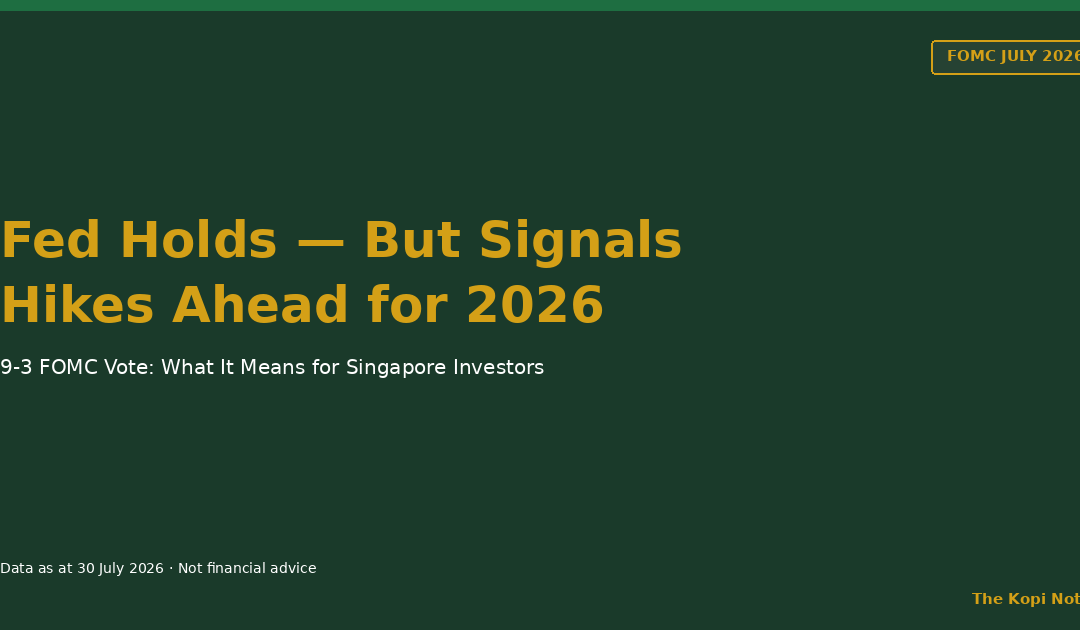
The FOMC held steady at 3.50%–3.75% on 29 July 2026 — but three dissenting votes and a hawkish tone are reshaping what “lower rates ahead” means for your CPF, T-bills and portfolio.
The US Federal Reserve held its benchmark interest rate at 3.50%–3.75% on 29 July 2026, the fifth straight meeting without a change. What made this decision newsworthy wasn’t the hold itself — markets expected it — but the 9-3 vote, with all three dissenters wanting a rate hike, not a cut. That hawkish signal matters for every Singapore dollar you hold in CPF, T-bills or the stock market.
Not financial advice. All figures are for educational reference only. Data as at 30 July 2026 unless noted.
- The Fed held rates at 3.50%–3.75% for the fifth meeting in a row — but 3 of 12 voters wanted to raise rates, not cut them.
- The 2025 cutting cycle (three 0.25-point cuts) has completely stalled in 2026, and markets now price in two possible hikes before year-end.
- A “higher for longer” US dollar keeps CPF Special Account’s 4% floor looking attractive next to T-bills — and adds a bit of drag on Singapore stocks even after their best month since 2020.
Table of Contents
Contents — Click to expand
- What the Fed Actually Decided on 29 July
- From Three Rate Cuts to Talk of Hikes: The 2026 Pivot
- Why the Fed Is Turning Hawkish
- What a Stronger US Dollar Means for the Singapore Dollar
- Impact on Your CPF, T-Bills and Savings Bonds
- Singapore Stocks Just Had Their Best Month Since 2020 — Does This Change That?
- What Should You Do Now?
- FAQs
What the Fed Actually Decided on 29 July
The Federal Open Market Committee (FOMC) — the group of Federal Reserve officials who set US interest rates — voted 9-3 to hold the federal funds rate at 3.50%–3.75%. That’s the same range it’s been at since December 2025.
Here’s the part that moved markets. All three dissenting votes came from regional Fed bank presidents (Cleveland’s Beth Hammack, Minneapolis’s Neel Kashkari, and Dallas’s Lorie Logan). They didn’t want a cut. They wanted to raise the rate by a quarter point. That’s a hawkish dissent — a rare signal that part of the committee thinks current policy is still too loose, not too tight.
In its statement, the Fed said the US economy is “expanding at a solid pace.” Job gains are keeping up with the workforce, and productivity growth is strong. The main wildcard flagged: “elevated uncertainty” tied partly to the ongoing conflict in the Middle East, which has kept energy prices and inflation expectations jumpy. That’s a very different tone from the “we’re worried about a slowdown” language that justified the 2025 cuts.
We covered the run-up to this meeting in our Fed Decision Day preview, where a hold was the base case but the actual outcome landed after Singapore business hours on the 29th (2am SGT on the 30th). Now that the vote is confirmed, here’s the fuller picture — and why the vote breakdown matters more than the headline “hold.”
From Three Rate Cuts to Talk of Hikes: The 2026 Pivot
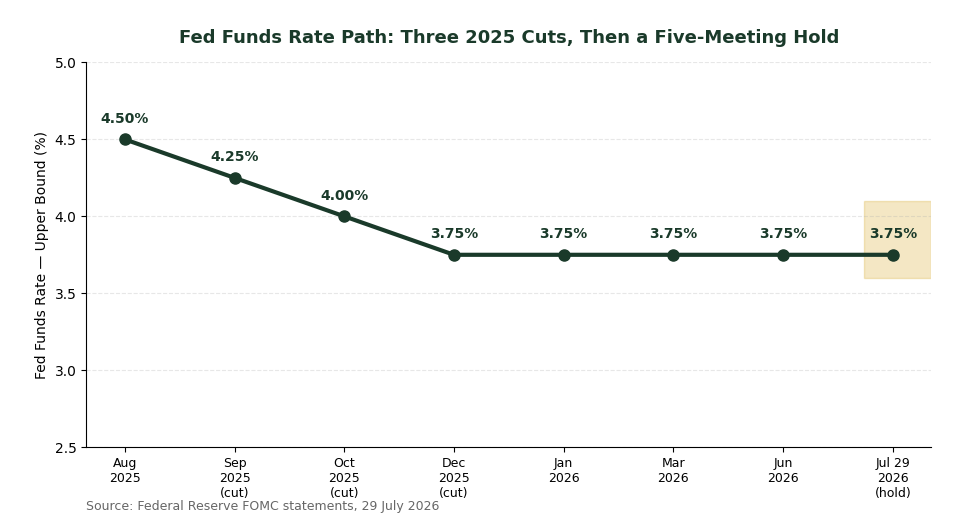
To understand why this hold feels different, look at the path that got us here. The Fed cut rates three times in 2025 — September, October and December — each time by a quarter point, bringing the upper bound down from 4.50% to 3.75%.
Then the cutting stopped. The Fed has held rates steady at every single meeting in 2026 so far, including this one. That’s five holds in a row after three cuts. In practice, the “rate cut cycle” that savers and borrowers were expecting has quietly paused for seven months.
Here’s the bigger shift: markets are no longer just pricing “no more cuts.” According to Fed funds futures pricing after the July meeting, traders now see roughly even odds of two separate quarter-point hikes — one in September, one in December 2026. That would push the upper bound back up to 4.25%, undoing a third of last year’s cuts.
The Fed’s own June 2026 projections (the “dot plot,” where each policymaker anonymously marks where they expect rates to land) put the year-end range at 3.6% to 4.1%. That’s a wide band — wider than usual — and it tells you the committee itself is split on which way the next move goes. For Singapore savers, the practical takeaway is simple: don’t assume borrowing costs or deposit rates are about to fall further. They might not fall at all this year.
Why the Fed Is Turning Hawkish
Three things are driving the shift. First, the US economy simply isn’t slowing the way the Fed expected when it started cutting in September 2025. Job gains have kept pace with the workforce, and unemployment “has changed little” — Fed-speak for “no urgent reason to loosen policy further.”
Second, productivity growth and capital investment are described as strong. When companies are investing and workers are producing more per hour, the economy can grow faster without necessarily stoking inflation — which argues against emergency-style cuts.
Third, and this is the wildcard the Fed explicitly named: the Middle East conflict has added “elevated uncertainty” to the outlook, mostly through energy prices. Oil-driven inflation is exactly the kind of shock a central bank can’t ignore, and it’s part of why three officials want to get ahead of it with a hike rather than wait.
Put together, this is what economists call a “hawkish hold” — a decision to stand pat, wrapped in language and a vote split that leans toward tightening, not easing.
What a Stronger US Dollar Means for the Singapore Dollar
A hawkish Fed tends to support the US dollar. Higher-for-longer US rates make dollar assets more attractive relative to almost every other currency, and that’s exactly the reaction that followed — the dollar firmed against major currencies immediately after the decision.
That puts the Monetary Authority of Singapore (MAS) in an interesting spot. MAS doesn’t set an interest rate the way the Fed does. Instead, it manages the Singapore dollar’s exchange rate against a basket of currencies — the S$NEER (Singapore Dollar Nominal Effective Exchange Rate). We covered MAS’s own tightening move in July, its second S$NEER tightening of 2026, which was already pushing the SGD stronger before this Fed decision landed.
Now you effectively have two central banks leaning in different directions on currency strength at the same time: a hawkish Fed supporting the US dollar, and a tightening MAS supporting the Singapore dollar. For everyday savers, that tension mostly shows up in import costs, travel money, and how attractive SGD-denominated cash instruments look versus USD ones — which brings us to CPF and T-bills.
Impact on Your CPF, T-Bills and Savings Bonds
Here’s the practical question everyone in Singapore asks after a Fed decision: does this change where I should park my cash? With rates on hold (not falling further, and possibly rising), the answer this quarter is “not much has changed” — but the comparison is still worth re-running.
| Instrument | Rate | As At |
|---|---|---|
| Singapore Savings Bond (Aug 2026 tranche, Year 1) | 1.46% | Aug 2026 tranche |
| 6-month T-bill (latest auction) | 1.55% | 16 Jul 2026 |
| CPF Ordinary Account (OA) | 2.50% | Fixed |
| CPF Special / MediSave / Retirement Account (SA/MA/RA) | 4.00% | Floor to Dec 2026 |
Source: MAS Bill/Bond auction results; CPF Board Q3 2026 rates; MND Aug 2026 SSB tranche prospectus.
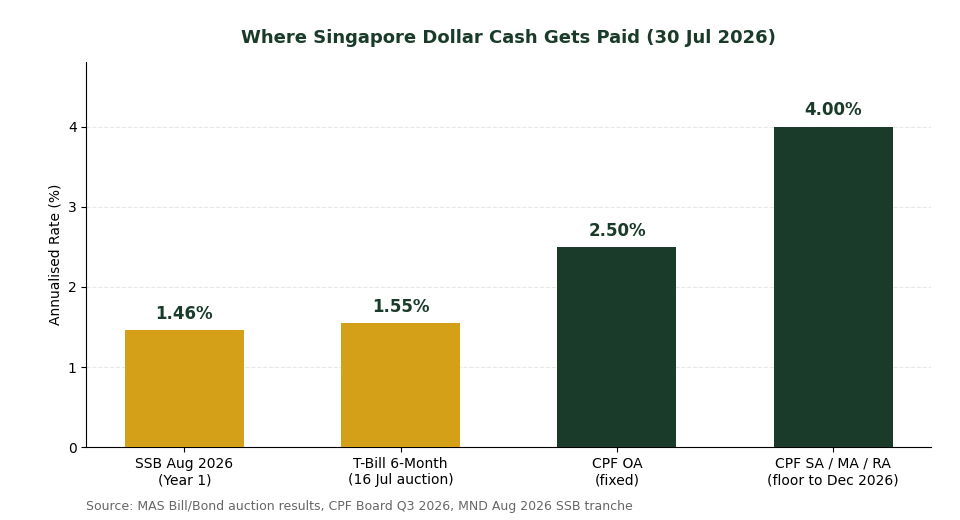
Notice something important: the 6-month T-bill yield (1.55%) still sits below CPF OA’s fixed 2.50%. That’s been true for a few months now, and this Fed decision doesn’t change it — if anything, a hawkish hold means T-bill yields are less likely to climb back above CPF OA anytime soon. The popular “shield your CPF OA money into T-bills” trade still doesn’t math out for most people right now.
CPF Special Account, MediSave Account and Retirement Account money, meanwhile, keeps earning a guaranteed 4.00% through end-2026 — a rate that’s locked in regardless of what the Fed or MAS does next. If you’re weighing a top-up, our T-Bill, SSB & Fixed Deposit Comparison Calculator lets you plug in your own amounts and time horizon rather than relying on headline rates alone. For a deeper walkthrough of where CPF money should go across OA, SA and investment options, see our CPF investment strategy guide.
Singapore Stocks Just Had Their Best Month Since 2020 — Does This Change That?
Here’s where the story gets interesting. Even as the Fed was leaning hawkish, the Straits Times Index (STI) was on track for its best month since November 2020, climbing roughly 8.6% in July 2026. Banking heavyweights DBS and OCBC did most of the heavy lifting, both posting double-digit monthly gains.
That’s not a contradiction — it’s two different forces pulling on Singapore stocks at once. Local bank earnings (DBS reported record total income in Q1 2026, driven by wealth management fees) have been strong enough to power the rally on their own, largely independent of what the Fed does. But a “higher for longer” US dollar, and the risk of two Fed hikes later this year, is a headwind for risk assets broadly — it tends to pull some capital back toward US dollar assets and away from emerging and regional markets.
The honest takeaway: don’t expect this Fed decision alone to derail a rally driven mostly by bank earnings and local capital flows. But do expect more volatility if September or December actually bring a hike — that would be a bigger surprise to markets than this hold was. If you’re building out a diversified income portfolio around this rally, our best S-REITs in Singapore for 2026 guide is a useful next read, since S-REITs (which borrow heavily and are sensitive to rates) react differently to Fed moves than bank stocks do.
What Should You Do Now?
You don’t need to overhaul your portfolio because of one FOMC vote. But three practical adjustments are worth considering.
1. Stop waiting for T-bill yields to fall further before locking in cash. With hikes now on the table, there’s a real chance T-bill and fixed deposit yields hold steady or even tick up over the next two auctions, not down.
2. Re-check your CPF OA versus T-bill math before shielding. At 1.55% versus 2.50%, T-bills are still the worse deal for OA money for most people — this hasn’t flipped.
3. Keep a cash buffer earning a real rate while you wait out the volatility. A high-interest cash account is a reasonable place to park money you might need before the September or December Fed meetings, rather than locking everything into a single T-bill tenor.
Want a cash account that still pays a competitive rate while you wait for the next Fed meeting?
Investing in US-listed assets? Compare fees with IBKR.
Prefer a managed cash & SRS strategy?
Frequently Asked Questions
Did the Fed cut, hold or raise rates on 29 July 2026?
The Fed held its benchmark rate steady at 3.50%–3.75% — the fifth consecutive meeting without a change. It did not cut or raise rates at this meeting.
Why is a “hold” decision being called hawkish?
Because of the vote split and tone, not the outcome itself. All three dissenting votes wanted to raise rates by a quarter point, not cut them, and the Fed’s statement described the economy as expanding at a solid pace — language that argues against further easing.
Will the Fed cut rates again in 2026?
Based on the July decision and vote split, a 2026 cut looks unlikely. Markets are instead pricing in the possibility of two 25-basis-point hikes, one in September and one in December, though this isn’t certain and depends on incoming inflation and jobs data.
How does this affect CPF Special Account and Retirement Account rates?
CPF SA, MediSave and Retirement Account monies are guaranteed at 4.00% through the end of 2026 regardless of Fed decisions — this rate is set by the CPF Board’s own formula, not directly by the Fed.
Should I still shield my CPF OA money into T-bills?
As at 30 July 2026, the 6-month T-bill yield (1.55%) remains below CPF OA’s fixed 2.50%, so the shielding trade still doesn’t favour most savers. A hawkish hold makes it less likely T-bill yields climb back above CPF OA in the near term.
How does a hawkish Fed affect the Singapore dollar?
A hawkish Fed typically strengthens the US dollar as higher-for-longer US rates attract capital into dollar assets. This happens alongside MAS’s own S$NEER policy, which independently manages Singapore dollar strength — the two can move in the same or different directions depending on each institution’s stance.
Does this Fed decision threaten the STI's strong July 2026 rally?
Not directly. The STI’s roughly 8.6% July gain was driven mainly by strong bank earnings (DBS and OCBC), which is largely independent of Fed policy. A hawkish Fed is more of a headwind for risk appetite broadly than a direct threat to bank-driven local gains.
Where can I read more about the lead-up to this decision?
See our Fed Decision Day preview (linked above), published before the outcome was confirmed, for the full context on why a hold was expected and what was at stake.
Not financial advice. This article is for educational and informational purposes only and reflects publicly available data as at 30 July 2026. The Kopi Notes may earn a referral fee from partner links at no extra cost to you.
Primary sources: Federal Reserve FOMC statement, 29 July 2026; Monetary Authority of Singapore; CPF Board.
This article was researched with the help of AI. While we strive to keep all information accurate and up to date, there may be errors. If you notice any discrepancies, please contact us.