Endowment Plan vs CPF Singapore 2026: Which Gives You Better Guaranteed Returns?
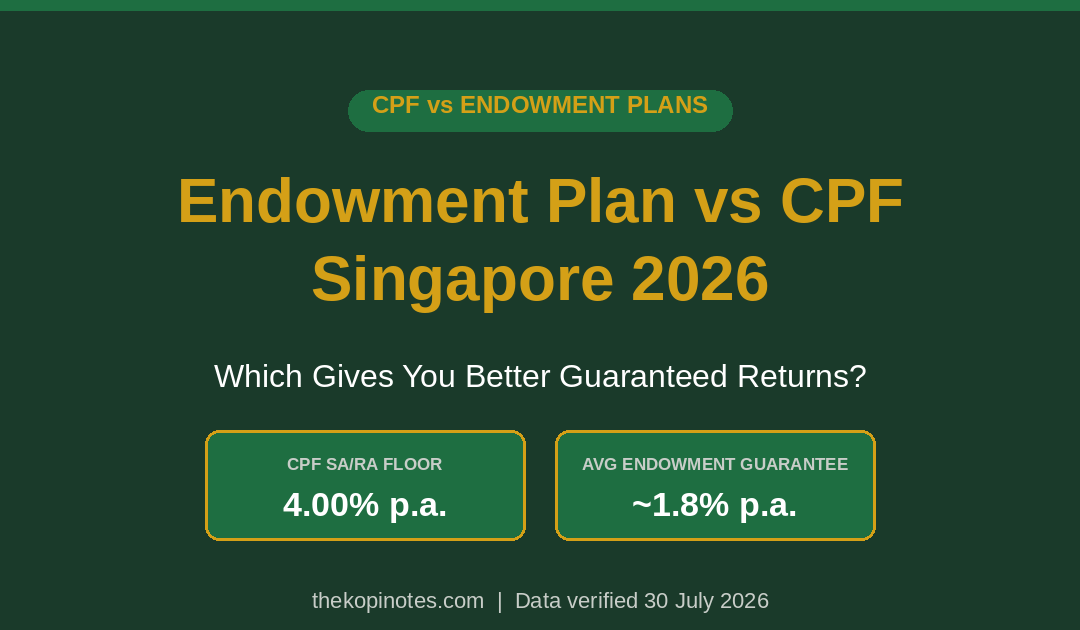
CPF’s Special/Retirement Account floor pays 4% p.a. guaranteed. The average Singapore endowment plan guarantees just 1.8%. Here’s the full breakdown — including whether you can actually use CPF to buy one.
CPF’s Special, MediSave and Retirement Account (SMRA) savings guarantee a 4% p.a. floor, while the Ordinary Account guarantees 2.50% p.a. — both unchanged for the July to September 2026 quarter. Across the 13 Singapore endowment plans we’ve individually reviewed on this site, the average published guaranteed rate is only about 1.8% p.a., ranging from 0.70% to 2.80%. If pure guaranteed return is your only criterion, CPF wins in almost every case.
Not financial advice. All figures are for educational reference only. Data verified as at 30 July 2026 against cpf.gov.sg and each insurer’s own official product pages.
- CPF’s Special/MediSave/Retirement Account (SMRA) floor is 4.00% p.a., and the Ordinary Account (OA) floor is 2.50% p.a. — both guaranteed by statute and unchanged for Jul-Sep 2026.
- The average guaranteed rate across 13 Singapore endowment plans we’ve reviewed is only ~1.8% p.a. (range: 0.70% to 2.80%), meaning CPF SA/RA beats most endowment plans’ guaranteed floor by more than double.
- Yes, you can technically use CPF (OA and SA) to buy CPFIS-approved endowment policies — but very few insurers list CPFIS-approved plans today, and doing so usually means giving up a higher guaranteed CPF rate for a lower one.
Table of Contents
Contents — Click to expand
- What CPF Actually Guarantees You
- What Singapore Endowment Plans Actually Guarantee
- Endowment Plan vs CPF: Side-by-Side Comparison
- What S$20,000 Actually Grows Into After 10 Years
- Can You Actually Use CPF to Buy an Endowment Plan?
- The Real Trade-off: Liquidity, Lock-In & Opportunity Cost
- When an Endowment Plan Might Still Make Sense
- How to Decide: A Simple 3-Step Framework
- Pros and Cons
What CPF Actually Guarantees You
Before comparing CPF to any endowment plan, it’s worth being precise about what CPF actually pays — because these are statutory floor rates, not marketing projections.
For the July to September 2026 quarter, CPF’s Ordinary Account (OA) pays a guaranteed floor of 2.50% p.a., unchanged from the previous quarter because the market-pegged rate (which tracks a formula based on bank deposit and savings rates) remains below this floor. Your Special, MediSave and Retirement Account (SMRA) savings pay a guaranteed floor of 4.00% p.a., pegged to the 12-month average yield of 10-year Singapore Government Securities plus 1%, currently also sitting below the floor — so members earn the higher floor rate instead.
On top of these base rates, CPF pays extra interest: members below 55 earn an additional 1% on the first S$60,000 of their combined CPF balances (capped at S$20,000 for OA), while members 55 and above earn an additional 2% on the first S$30,000 and 1% on the next S$30,000. If you’re under 55, your Special Account (SA) is the account earning that 4% floor; once you turn 55, SA closes and your retirement savings sit in your Retirement Account (RA) instead, which continues to earn the same 4% floor.
These rates are guaranteed by the CPF Act, reviewed quarterly, and have never gone negative since CPF’s inception — a track record no private insurer can claim for a specific product.
What Singapore Endowment Plans Actually Guarantee
Endowment plans market themselves on “guaranteed returns,” but the actual guaranteed component — as opposed to non-guaranteed bonuses illustrated at 3.00% or 4.25% p.a. scenarios — is usually much smaller than most buyers expect.
We’ve individually reviewed and fact-checked 13 endowment plans from Singapore’s major insurers against their own official product pages. Of these, 7 insurers publish a clean, comparable guaranteed percentage rate: AIA (2.80%), OCBC (~2.80%, campaign rate), Prudential (1.70%), Etiqa (1.65%), FWD (1.60%), Manulife (1.44%), and Great Eastern (0.70%). Averaging these 7 published rates gives ~1.81% p.a. — our own calculation, not a figure published by any insurer.
The remaining insurers in our silo don’t publish a single comparable guaranteed % at all: HSBC Life and China Life quote fixed-dollar or cash-benefit mechanisms instead, and Tokio Marine’s guarantee is a fixed-dollar Guaranteed Monthly Cash Payout tied to an unpublished premium quote. NTUC Income’s figure is an illustrated (non-guaranteed) scenario, not a guaranteed floor. Singlife’s Secure Saver VII, which once topped this list at 3.40% p.a. guaranteed, has been discontinued and is no longer sold as at July 2026 — we’ve kept it in our chart below for context, clearly labelled as discontinued.
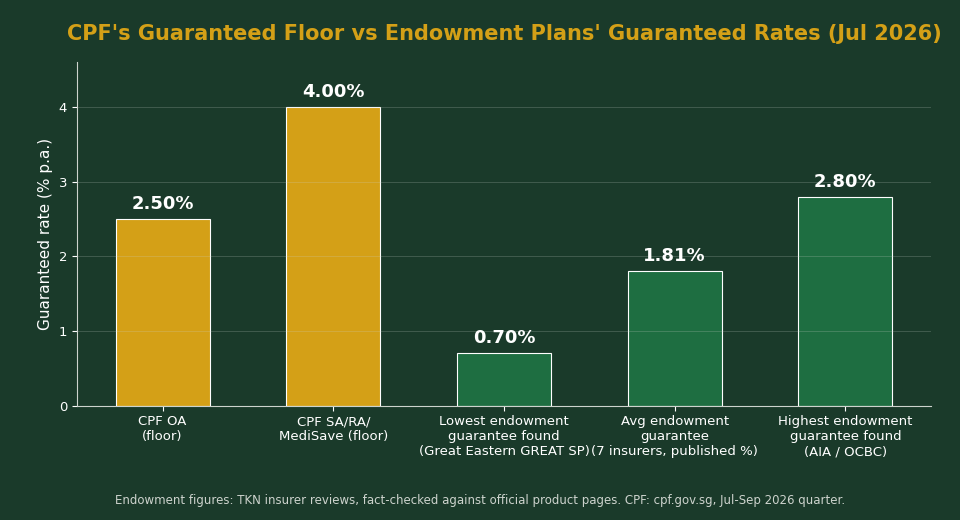
Every one of the 8 numeric guaranteed rates above (including the discontinued Singlife tranche) sits below CPF’s 4.00% SMRA floor. Even the single highest guaranteed rate we found among currently-sold plans — AIA and OCBC at ~2.80% — still trails CPF’s SA/RA floor by 1.2 percentage points, though it does beat CPF OA’s 2.50% by a small margin. For a full insurer-by-insurer breakdown with links to every individual review, see our complete endowment plan comparison guide.
Endowment Plan vs CPF: Side-by-Side Comparison
| Factor | CPF (OA / SA-RA) | Endowment Plan (typical) |
|---|---|---|
| Guaranteed rate | 2.50% (OA) / 4.00% (SA/RA) | ~1.8% average (range 0.70%-2.80%) |
| Who guarantees it | Singapore Government, by statute (CPF Act) | The insurer, backed by SDIC Policy Owners’ Protection Scheme up to prescribed limits |
| Upside beyond guarantee | None — rate is the rate | Non-guaranteed bonuses (illustrated at 3.00%-4.25% scenarios, not promised) |
| Liquidity | OA/SA locked for retirement, MA for healthcare; limited approved uses (housing, investment, education) | Locked for the policy term; early surrender usually means a loss on capital |
| Insurance component | None (CPF is a savings scheme, not insurance) | Small death benefit built in (typically 101%-105% of premium) |
| Minimum outlay | None — grows via mandatory contributions or voluntary top-ups | Typically S$5,000-S$10,000 minimum single premium |
| Forced savings discipline | Automatic via employment CPF contributions | Contractual — regular-premium plans commit you to pay or lose value |
Sources: CPF Board interest rate release (Jul-Sep 2026 quarter); endowment figures from TKN’s own fact-checked insurer reviews, linked throughout this article.
What S$20,000 Actually Grows Into After 10 Years
Percentages are easy to skim past. Here’s what the gap actually looks like in dollars, using S$20,000 as a working example (the amount you’d need to set aside in OA before investing further under CPFIS, making it a realistic illustrative figure) left untouched for 10 years at each guaranteed rate, compounded annually with no withdrawals or top-ups:
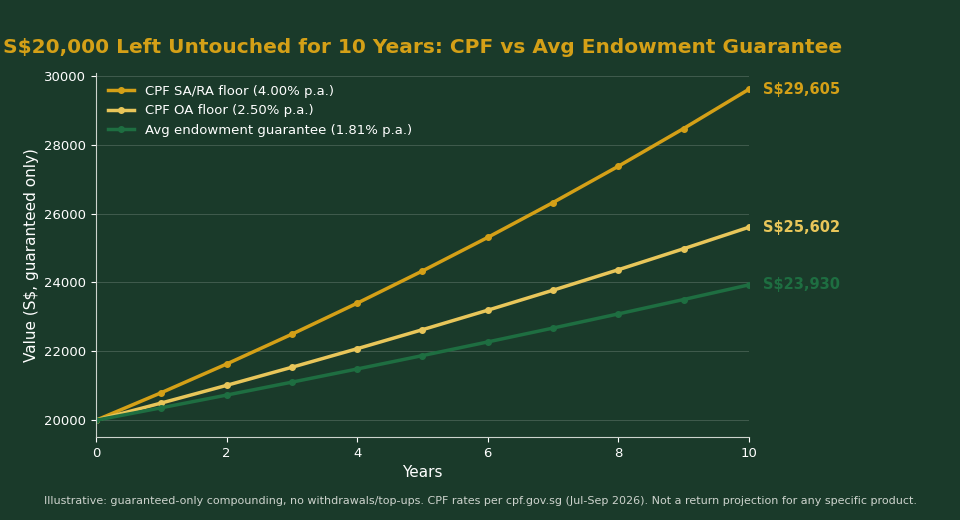
At CPF’s SA/RA floor of 4.00% p.a., S$20,000 becomes S$29,605 after 10 years — a gain of S$9,605. At CPF OA’s 2.50% p.a., it becomes S$25,602 — a gain of S$5,602. At the average endowment guaranteed rate of 1.81% p.a., it becomes S$23,930 — a gain of just S$3,930. That’s a difference of S$5,675 between CPF SA/RA and the average endowment plan’s guaranteed floor over just 10 years, on guaranteed returns alone — before any endowment plan’s non-guaranteed bonus is added back in.
To be fair to endowment plans, this comparison only looks at the guaranteed component. A participating endowment plan’s non-guaranteed bonus, if the insurer’s par fund performs well, can close or even reverse this gap — but “if it performs well” is doing a lot of work in that sentence. The guaranteed figure is the only number you can actually bank on regardless of market conditions.
Can You Actually Use CPF to Buy an Endowment Plan?
Yes — this is one of the more misunderstood corners of CPF. Endowment policies are officially listed as an included product category under the CPF Investment Scheme (CPFIS), usable from both your Ordinary Account (CPFIS-OA) and Special Account (CPFIS-SA), per CPF Board’s own published product list (last updated September 2025).
Here’s how eligibility actually works:
| Requirement | CPFIS-OA | CPFIS-SA |
|---|---|---|
| Minimum balance to set aside first | S$20,000 in OA | S$40,000 in SA |
| Need a CPF Investment Account? | Yes, opened with DBS, OCBC, or UOB | No — approach the insurer directly |
| Self-Awareness Questionnaire (SAQ) | Required | Required |
| Minimum age | 18 | 18 |
Costs matter too: CPFIS caps a Wrap Fee at 0.4% p.a. and a Total Expense Ratio at 0.35%-1.75% p.a. depending on the fund’s risk category — fees that eat into whatever return the underlying endowment plan earns, on top of the plan’s own charges.
In practice, CPFIS-approved insurance products have shrunk significantly in recent years, as insurers shifted their marketing toward cash-only and SRS-eligible single-premium plans (several of the plans in our own insurer silo, including Great Eastern’s GREAT SP and AIA’s #Wealth Savvy (IV), are cash-only, not CPFIS-listed). If you’re specifically looking for a CPFIS-SA-approved endowment plan, you’ll need to check CPF Board’s current product list directly with the insurer, since availability changes tranche by tranche.
The bigger question isn’t whether you can — it’s whether you should. Since CPF’s own SA/RA floor (4.00%) beats every guaranteed endowment rate we’ve verified, routing SA savings into a CPFIS-approved endowment plan usually means trading a higher guaranteed government rate for a lower guaranteed insurer rate, plus extra fees. That’s a difficult trade to justify on numbers alone.
The Real Trade-off: Liquidity, Lock-In & Opportunity Cost
Neither CPF nor an endowment plan is genuinely liquid, but the restrictions differ in kind. CPF savings can only be withdrawn for specific approved purposes before age 55 (housing, CPFIS investment, education, insurance premiums), and after 55, withdrawals are tied to the Retirement Sum framework and CPF LIFE. You can’t simply cash out your OA or SA on demand for everyday spending.
Endowment plans lock your capital for a fixed policy term instead — commonly 2 to 30 years depending on the product. Surrender before maturity typically returns less than what you paid in, sometimes significantly less in the early years, as detailed in our insurance surrender value guide. Unlike CPF, there’s no approved-purpose escape hatch — early exit is simply a financial loss, full stop.
The opportunity cost cuts both ways. Money committed to a low-guarantee endowment plan can’t earn CPF’s higher floor rate elsewhere. But money left in CPF also can’t be freely redirected to genuinely higher-return opportunities outside CPFIS’s approved product list, since CPF savings (other than amounts above the required minimums) aren’t available for unrestricted investment.
When an Endowment Plan Might Still Make Sense
Given CPF’s rate advantage, why would anyone still buy an endowment plan? A few genuine reasons come up repeatedly across the plans we’ve reviewed:
You’ve already maxed out your CPF top-up limits, or the money isn’t CPF money at all. Endowment plans are typically funded with cash or SRS, not CPF — if your spare savings sit outside CPF entirely, the comparison isn’t CPF vs endowment, it’s endowment vs SSB, fixed deposit, or leaving cash idle (see our dedicated endowment plan vs SSB and endowment plan vs fixed deposit comparisons for that scenario).
You want a built-in forced-savings contract with a small insurance kicker. A regular-premium endowment plan penalises you for stopping payments, which some savers deliberately use as a discipline mechanism CPF’s voluntary top-up structure doesn’t replicate for non-retirement goals like a child’s future education fund.
You’re chasing the non-guaranteed upside, not just the floor. Some plans illustrate total returns (guaranteed plus bonus) of 3.00%-4.25% p.a. at their stated scenarios — competitive with, or above, CPF’s 4.00% floor, if the insurer’s participating fund actually delivers. That’s a real possibility, not a guarantee, and past bonus cuts (2020-2022 saw several insurers reduce non-guaranteed bonuses) show it doesn’t always play out as illustrated.
You’re already 55+ and have exhausted CPF LIFE-related planning. For older savers who’ve already hit their Full Retirement Sum and aren’t adding more to CPF, a short-tenor guaranteed endowment plan can still be a reasonable place for surplus cash relative to a bank account, even if it trails what CPF itself would have paid.
How to Decide: A Simple 3-Step Framework
Step 1: Identify whose money it is. If it’s already in CPF OA or SA, compare against CPF’s own 2.50%/4.00% floor first — not against an endowment plan’s illustrated (non-guaranteed) rate. If it’s cash or SRS money that was never going into CPF, the CPF comparison doesn’t apply, and you should compare the endowment plan against SSB, fixed deposits, or T-bills instead.
Step 2: Separate the guaranteed rate from the illustrated rate. Use the insurer-by-insurer guaranteed rates covered earlier in this article (or the specific insurer’s own TKN review) to check the plan’s guaranteed floor, not its marketing headline. If the guaranteed floor is below what CPF already pays on the same money, you need the non-guaranteed bonus to actually materialise just to break even with CPF.
Step 3: Model your own numbers. Run your own premium and term through our retirement planning calculator to see how the gap compounds over your specific time horizon, since small percentage-point differences widen substantially over 10+ years, as our chart above shows.
Pros and Cons
| Choosing CPF | Choosing an Endowment Plan |
|---|---|
| + Higher guaranteed rate (2.50%-4.00% vs ~1.8% average) | + Possible non-guaranteed upside beyond the floor |
| + Government-guaranteed, no insurer credit risk | + Small built-in life insurance component |
| + Extra interest tiers boost effective returns further | + Works for cash/SRS savings that were never CPF-eligible |
| – Restricted to approved withdrawal purposes before 55 | – Guaranteed rate almost always lower than CPF’s floor |
| – CPFIS investing adds fees and gives up the floor rate | – Early surrender usually locks in a real loss |
Frequently Asked Questions
Does CPF really give a better guaranteed return than endowment plans?
In almost every case, yes. CPF’s Special/MediSave/Retirement Account floor is 4.00% p.a. and the Ordinary Account floor is 2.50% p.a. (both unchanged for Jul-Sep 2026), while the average guaranteed rate across 13 Singapore endowment plans we’ve reviewed is only about 1.81% p.a., with the highest currently-sold rate at ~2.80%. CPF SA/RA beats every guaranteed endowment rate we’ve verified; CPF OA beats most of them too.
Can I use my CPF Special Account to buy an endowment plan?
Yes, technically. Endowment policies are an approved product category under CPFIS-SA, per CPF Board’s own published investment product list. You need at least S$40,000 in your SA (which remains untouched), have completed the Self-Awareness Questionnaire, and can approach the insurer directly — no CPF Investment Account is needed for SA investments, unlike CPFIS-OA.
Should I use my CPF SA to buy an endowment plan?
Usually not, on pure numbers. Your CPF SA already earns a guaranteed 4.00% p.a. floor. Every endowment plan we’ve verified guarantees less than that (0.70%-2.80%), so moving SA money into a CPFIS-approved endowment plan typically means trading a higher guaranteed government rate for a lower guaranteed insurer rate, plus CPFIS fees (Wrap Fee up to 0.4% p.a., Total Expense Ratio 0.35%-1.75% p.a.).
What is CPF's current interest rate in 2026?
For the July to September 2026 quarter, the CPF Ordinary Account (OA) pays a guaranteed floor of 2.50% p.a., and the Special, MediSave and Retirement Accounts (SMRA) pay a guaranteed floor of 4.00% p.a. Both rates are unchanged from the prior quarter. Members also earn extra interest on top of these base rates, depending on age and account balance.
What is the average guaranteed rate on Singapore endowment plans?
Based on our fact-checked review of 13 major insurers’ endowment plans, 7 publish a clean guaranteed percentage rate, averaging approximately 1.81% p.a. (range: 0.70% at Great Eastern’s GREAT SP to 2.80% at AIA and OCBC). The remaining insurers use fixed-dollar or cash-benefit mechanisms instead of a published guaranteed %.
Why would anyone choose an endowment plan over CPF if the guaranteed rate is lower?
Common reasons include: the money is cash or SRS savings that was never eligible for CPF in the first place; the buyer wants a small built-in life insurance component alongside savings; the buyer is deliberately using a regular-premium contract as a forced-savings discipline tool; or the buyer is chasing the plan’s non-guaranteed illustrated bonus, which can exceed CPF’s floor if the insurer’s participating fund performs well (though this isn’t guaranteed).
Is my CPF money safer than money in an endowment plan?
CPF savings are guaranteed by the Singapore Government under the CPF Act. Endowment plan guarantees are backed by the individual insurer and protected under the Policy Owners’ Protection Scheme administered by the Singapore Deposit Insurance Corporation (SDIC), up to prescribed limits. Both are considered very safe in the Singapore context, but they rest on different legal guarantees.
How much does S$20,000 grow after 10 years in CPF vs an endowment plan?
At CPF’s SA/RA floor (4.00% p.a.), S$20,000 grows to S$29,605 after 10 years. At CPF OA’s floor (2.50% p.a.), it grows to S$25,602. At the average endowment plan’s guaranteed rate (1.81% p.a.), it grows to just S$23,930. This is guaranteed-only compounding with no withdrawals or top-ups, and doesn’t include any endowment plan’s non-guaranteed bonus.
Do I need a CPF Investment Account to buy an endowment plan with CPF?
Only if you’re using your Ordinary Account (CPFIS-OA) — you’d need to open a CPF Investment Account with DBS, OCBC, or UOB first. If you’re using your Special Account (CPFIS-SA) instead, no CPF Investment Account is required; you approach the insurance product provider directly.
Want More Than the Guaranteed Floor?
If you’re comparing CPF and endowment plans because you want your money to work harder, a low-cost robo-adviser lets you invest SRS or cash savings directly — with sign-up bonuses on top.
Get Free Insurance Advice
Speak with a licensed insurance advisor. No obligation, no cost.
By submitting this form, you agree to our Privacy Policy.
This article was researched with the help of AI. While we strive to keep all information accurate and up to date, there may be errors. If you notice any discrepancies, please contact us.