Suntec REIT 1H2026 Results: DPU Jumps 24.8% to 3.936 Cents (SGX: T82U)
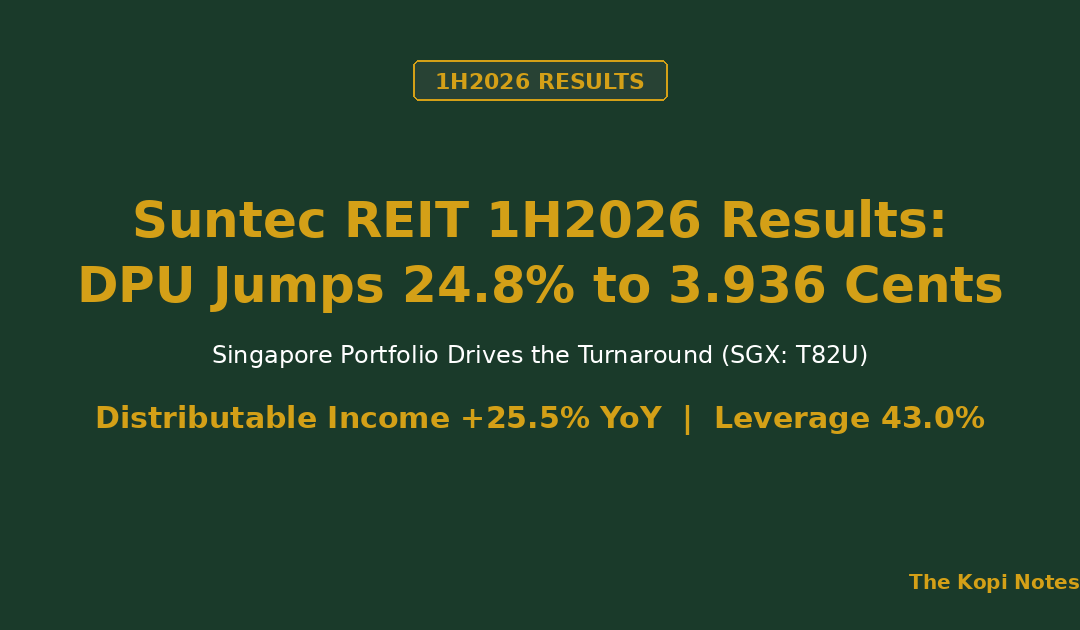
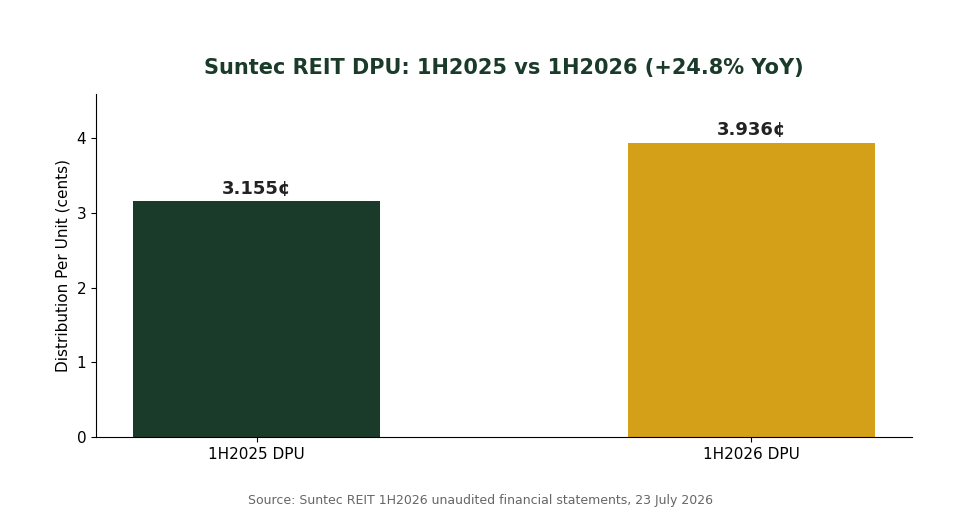
Singapore office and retail lead the recovery — here’s the full breakdown, leverage picture and what analysts think comes next.Suntec REIT (SGX: T82U) reported 1H2026 distribution per unit (DPU) of 3.936 cents, up 24.8% from 3.155 cents a year ago, after distributable income rose 25.5% to S$116.5 million. The rebound was driven mainly by stronger Singapore office and retail income and the absence of a one-off Australian tax provision. Aggregate leverage rose slightly to 43.0%.
Not financial advice. All figures are for educational reference only. Data as at 28 July 2026 unless otherwise noted.
- Suntec REIT’s 1H2026 DPU rose 24.8% year-on-year to 3.936 cents — the strongest half-year growth among major S-REITs this reporting season.
- The Singapore office and retail portfolio did the heavy lifting. Australia and the UK were broadly stable, aside from one tenant exit in London.
- Leverage crept up to 43.0%, near the higher end of what’s comfortable for a REIT, even as the cost of debt fell to 3.55%. Both DBS and OCBC raised their price targets after the results.
Table of Contents
1H2026 Results at a Glance
What's Driving the DPU Surge
Segment Performance: Singapore, Australia, UK
Capital Management & Leverage
Share Price, Yield & Analyst Views
Outlook for 2H2026
Is Suntec REIT a Buy After This Results?
FAQs
1H2026 Results at a Glance
Suntec REIT released its 1H2026 financial results on 23 July 2026, covering the six months ended 30 June 2026. The headline number is simple: distributions are growing again, and growing fast.
| Metric | 1H2026 | 1H2025 | YoY Change |
|---|---|---|---|
| Gross Revenue | S$238.9m | S$226.1m | +5.7% |
| Net Property Income | S$159.0m | S$151.1m | +5.2% |
| Distributable Income | S$116.5m | S$92.8m | +25.5% |
| Distribution Per Unit | 3.936¢ | 3.155¢ | +24.8% |
Source: Suntec REIT 1H2026 unaudited financial statements, 23 July 2026
You get paid in two chunks a year if you hold Suntec REIT. For the second quarter of 2026 (1 April to 30 June), the manager declared 2.000 cents per unit, up 3.3% from the 1.936 cents declared in the first quarter. Combined, that’s the 3.936 cents for the half. The ex-distribution date is 30 July 2026, with payment due on 28 August 2026.
What’s Driving the DPU Surge
A 24.8% jump in DPU is a big move for a REIT. Two things explain most of it.
First, the core business genuinely improved. Gross revenue rose 5.7% and net property income rose 5.2%, mostly on the back of the Singapore office and retail portfolio. Suntec REIT’s Singapore assets — One Raffles Quay, Marina Bay Financial Centre, Suntec City Mall and the Suntec Singapore Convention & Exhibition Centre — benefited from higher occupancy, positive rent reversions and lower operating expenses.
Second, last year’s numbers were held down by one-off items that didn’t repeat. In 1H2025, Suntec REIT had to set aside about S$3.4 million because of uncertainty over its Australian assets’ Managed Investment Trust (MIT) tax status. That provision wasn’t needed in 1H2026, so the full amount flows straight through to unitholders this time. On top of that, 1H2025 included a one-off compensation payment for the surrender of three floors at 177 Pacific Highway in Sydney — a payment that inflated last year’s base and made this year’s like-for-like growth look even stronger by comparison once it dropped out.
In plain terms: some of the 24.8% growth is a genuine operational win, and some of it is the year-ago period being unusually weak. Both are worth knowing before you get too excited about the headline number.
Segment Performance: Singapore, Australia, UK
Suntec REIT owns properties across three markets. Here’s how each one did in 1H2026.
| Segment | 1H2026 Performance |
|---|---|
| Singapore | Strongest contributor. Higher occupancy and positive rent reversions across both office and retail, plus lower operating expenses. One Raffles Quay saw office rent reversions of around 13% and Suntec City Mall around 15% in recent quarters. |
| Australia | Broadly stable. Key assets like 177 Pacific Highway and 21 Harris Street held high occupancy, though results were flattered last year by a one-off compensation payment that didn’t recur in 1H2026. |
| UK | Mixed. Nova Properties held steady, but The Minster Building saw higher vacancy and operating costs after a key tenant exited in June 2025. |
| Suntec Convention | Lower revenue from fewer large-scale conferences (MICE events), partly offset by more consumer events, media revenue and long-term rental income. |
Source: Suntec REIT 1H2026 unaudited financial statements, 23 July 2026
The pattern is clear: Singapore carried the REIT this half. That’s a good sign for a Singapore-focused investor, since it means the units you’re holding are being propped up by the part of the portfolio you understand best — not by a currency swing or a one-off item overseas.
Capital Management & Leverage
Here’s the part of the results that deserves more attention than the headline DPU number: leverage went up, not down.
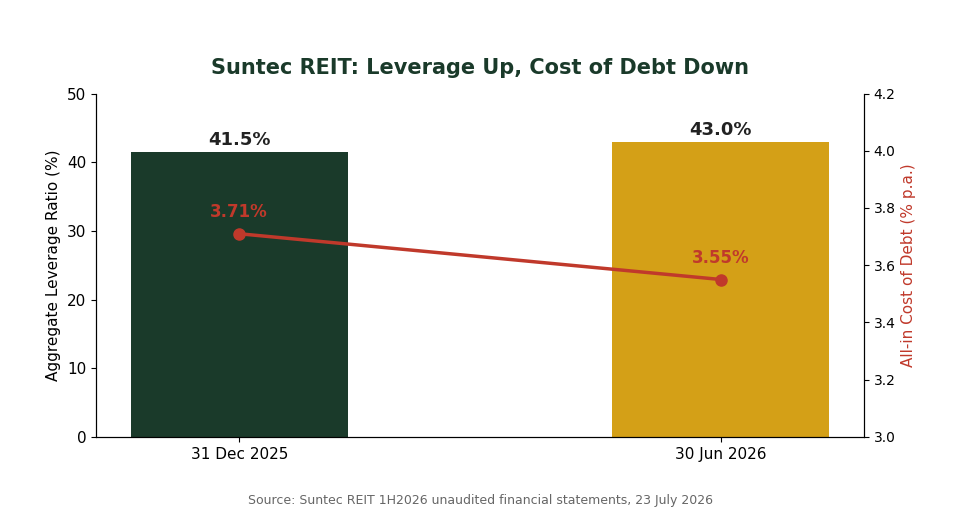
Suntec REIT’s aggregate leverage ratio (ALR) — basically how much of the REIT’s total assets are funded by debt — rose to 43.0% as at 30 June 2026, up from 41.5% at the end of December 2025. MAS caps S-REIT leverage at 50%, so Suntec REIT still has headroom. But 43% is on the higher side compared to many blue-chip S-REITs, which tend to sit in the high-30s to low-40s.
The good news is that borrowing got cheaper even as it grew. The all-in cost of debt fell to 3.55% per annum, down from 3.71% at the end of 2025. Interest coverage ratio (ICR) — how many times over the REIT’s income can cover its interest payments — improved to 2.2 times. Weighted average debt maturity stands at 2.12 years, and about 57% of borrowings are on fixed rates, with S$100 million of refinancing due to complete shortly.
If you’re the type of investor who watches gearing closely before buying a REIT, this is the one number in the results that should give you pause — not because it’s dangerous today, but because it leaves less room to absorb a shock (like a property revaluation writedown or a sharp rate spike) without needing to raise fresh equity.
Share Price, Yield & Analyst Views
Suntec REIT’s share price has been trading in the S$1.45–S$1.55 range through late July 2026, with a forward distribution yield of around 5.3% based on the improved 1H2026 payout. That’s a step up from the low-4% yields the counter offered when its DPU was still depressed by higher financing costs and the Australian tax overhang in prior years.
The results triggered a wave of analyst upgrades. DBS raised its target price to S$1.70, keeping a BUY call, citing improved earnings forecasts and resilient Singapore performance. OCBC Investment Research raised its target price to S$1.46 from S$1.45 on 27 July 2026, keeping a HOLD rating, and lifted its FY2026 and FY2027 DPU forecasts on the back of the earnings beat.
Read together, the sell side is more bullish on the earnings trajectory than on the current entry price — a common pattern after a results beat where the share price has already partly priced in the good news.
Outlook for 2H2026
Management’s guidance for the rest of the year is cautiously upbeat. In Singapore, office rent reversions are expected to stay close to 5% for the full year and retail reversions closer to 10%, supported by limited new office and retail supply. Australia should remain tenant-led but stable at the REIT’s key assets. In the UK, improved leasing interest at The Minster Building is expected to help occupancy recover in the second half. Suntec Convention has a healthy pipeline of events booked into 2H2026 and 2027.
The main swing factor to watch is interest rates. Every 10 basis-point change in rates moves DPU by roughly 0.04 cents, according to Suntec REIT’s own sensitivity disclosure for a comparable Singapore mall REIT peer — a useful rule of thumb for gauging how sensitive S-REIT payouts are to the rate environment generally. If rates fall further in 2H2026, that’s a tailwind on top of the operational improvement already showing up in the numbers.
Is Suntec REIT a Buy After This Results?
There’s a genuine case on both sides here.
The bull case: DPU growth of 24.8% is real and broad-based across Singapore office and retail. Cost of debt is falling, not rising. Two brokers raised their targets immediately after the results, and the forward yield of around 5.3% is meaningfully better than what the counter offered a year or two ago.
The bear case: a chunk of this year’s growth comes from a one-off tax provision and a one-off compensation payment dropping out of last year’s base — not something that repeats every half. Leverage at 43.0% is on the higher end for an S-REIT, and the UK portfolio still has a vacancy problem at The Minster Building that hasn’t fully healed.
If you already hold Suntec REIT, this results season gives you more reasons to stay than to sell. If you’re considering a new position, the improved fundamentals are real, but so is the higher gearing — size your position accordingly and don’t treat the 24.8% growth rate as the new normal going forward.
Suntec REIT sits within the broader best S-REITs in Singapore 2026 comparison set, alongside other office and retail names. If you want the fuller company background before deciding, our Suntec REIT complete investor guide and Suntec REIT dividend history breakdown cover the longer-term picture, while our DPU explainer is a good primer if terms like distribution per unit are still new to you.
To model how a REIT’s yield stacks up against risk-free government bonds before you commit new capital, try our free S-REIT yield vs SGS bond spread calculator. And if you’re funding a new REIT position through a robo-advisor or brokerage, check whether the Endowus referral code or Syfe referral code sign-up bonuses are still running before you open an account.
Frequently Asked Questions
What is Suntec REIT's DPU for 1H2026?
Why did Suntec REIT's distribution jump so much this half?
Is Suntec REIT's dividend sustainable at this growth rate?
What is Suntec REIT's current gearing ratio?
What do analysts think of Suntec REIT after these results?
When is the next Suntec REIT dividend payment?
Disclaimer: This article is for general informational and educational purposes only and does not constitute financial advice. The Kopi Notes is not a licensed financial adviser. Past performance and analyst forecasts are not guarantees of future results. Always do your own research or consult a licensed financial adviser before making investment decisions. The Kopi Notes may earn a referral fee if you sign up through the links in this article, at no extra cost to you.
This article was researched with the help of AI. While we strive to keep all information accurate and up to date, there may be errors. If you notice any discrepancies, please contact us.