Semiconductor ETF Singapore: The Complete 2026 Guide to SEMI & AI Chip ETFs
How to buy the iShares SEMI UCITS ETF and other chip ETFs tax-efficiently — broker steps, costs, and 2026 data for Singapore investors.
SEMI (iShares MSCI Global Semiconductors UCITS ETF) is an Ireland-domiciled ETF listed on the London Stock Exchange that gives you exposure to 260 global chip makers, from TSMC to Nvidia. Singapore investors buy it through IBKR, Saxo, or moomoo. Its edge over the US-listed SOXX or SMH: 15% dividend withholding tax instead of 30%, and zero US estate tax exposure.
Not financial advice. All figures are for educational reference only. Data verified as at 24 July 2026 unless otherwise noted.
- SEMI (LSE: SEMI) gives you diversified exposure to around 260 global semiconductor firms for a 0.35% TER — buy it via IBKR, Saxo, moomoo, or Syfe Brokerage.
- Ireland-domiciled UCITS ETFs like SEMI cut US dividend withholding tax to 15% (vs 30% for US-listed SOXX or SMH) and remove US estate tax risk entirely.
- Semiconductor ETFs are concentrated bets — the top 10 holdings can be over half the fund, so size your position with that in mind.
Table of Contents
Contents — Click to expand
- What Is a Semiconductor ETF?
- Key Facts at a Glance
- Why Semiconductor ETFs Are Trending in 2026
- Why Singapore Investors Buy Chip ETFs on the LSE
- Expense Ratio and Total Costs
- How to Buy SEMI in Singapore (Step-by-Step)
- SEMI vs VVSM vs SOXX vs SMH
- Risks to Consider
- Who Should Buy a Semiconductor ETF?
- Frequently Asked Questions
What Is a Semiconductor ETF?
A semiconductor ETF bundles together the companies that design, make, and supply the chips inside every phone, car, and AI data centre. Instead of picking single names like Nvidia or TSMC, you own a basket in one trade.
The main option for Singapore investors is the iShares MSCI Global Semiconductors UCITS ETF (SEMI). It’s an accumulating fund domiciled in Ireland and listed on the London Stock Exchange under the ticker SEMI. It tracks the MSCI ACWI IMI Semiconductors & Semiconductor Equipment ESG Screened Select Capped Index — a mouthful, but it simply means the fund holds around 260 chip-related companies worldwide, with a cap so no single stock dominates too much.
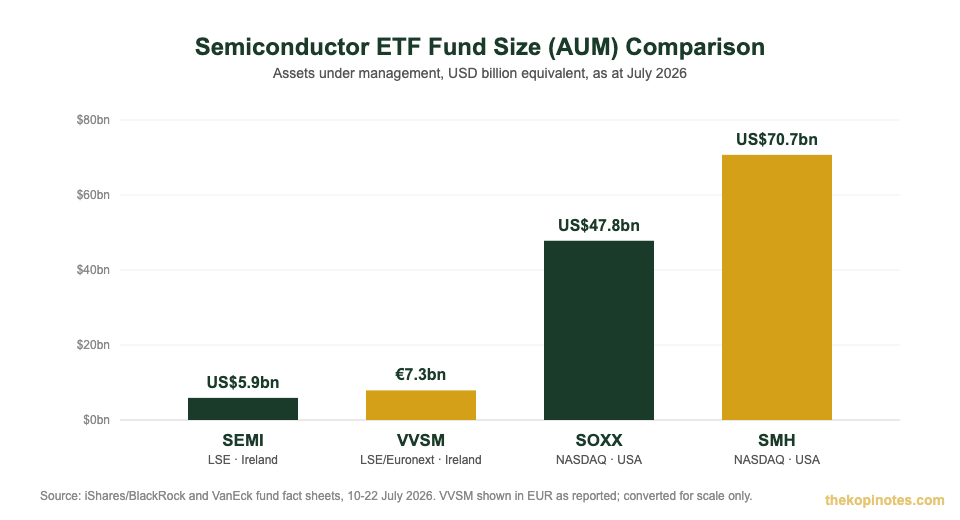
SEMI launched on 3 August 2021 and had grown to USD 5.9 billion in assets by 10 July 2026. As an accumulating (Acc) share class, it automatically reinvests any income instead of paying it out. That’s useful for compounding and slightly more convenient at tax time for you as a Singapore investor.
A second UCITS option is the VanEck Semiconductor UCITS ETF (ticker VVSM on the LSE, SMGB on Euronext). It takes a more concentrated approach, tracking the MVIS US Listed Semiconductor 10% Capped ESG Index — essentially the Ireland-domiciled, UCITS-wrapped version of the popular US-listed SMH fund. Its Ireland-domiciled fund had grown to around EUR 7.3 billion in assets.
Key Facts at a Glance
| Metric | Detail |
|---|---|
| Full Name | iShares MSCI Global Semiconductors UCITS ETF |
| Ticker (LSE) | SEMI |
| ISIN | IE000I8KRLL9 |
| Index Tracked | MSCI ACWI IMI Semiconductors & Semiconductor Equipment ESG Screened Select Capped Index |
| Domicile | Ireland |
| Structure | Accumulating (USD Acc) |
| TER (Expense Ratio) | 0.35% p.a. |
| AUM | USD 5.9 billion (as at 10 July 2026) |
| Number of Holdings | ~260 |
| Launch Date | 3 August 2021 |
| Currency | USD |
Source: BlackRock/iShares SEMI fund fact sheet and product page, data as at 10 July 2026.
Why Semiconductor ETFs Are Trending in 2026
Here’s why chip ETFs keep showing up in your news feed this year. The “Magnificent Seven” tech giants alone are on track to deploy roughly USD 527 billion in AI and data centre capital expenditure in fiscal 2026 — up USD 62 billion from earlier estimates. That spending has to flow somewhere, and a lot of it lands on chipmakers, memory suppliers, and equipment vendors.
Analysts at Gartner project a 49% jump in spending on AI-optimised servers in 2026 alone. Global semiconductor industry sales are on pace to reach roughly USD 1 trillion this year, driven by demand for AI accelerators, high-bandwidth memory, and advanced foundry capacity.
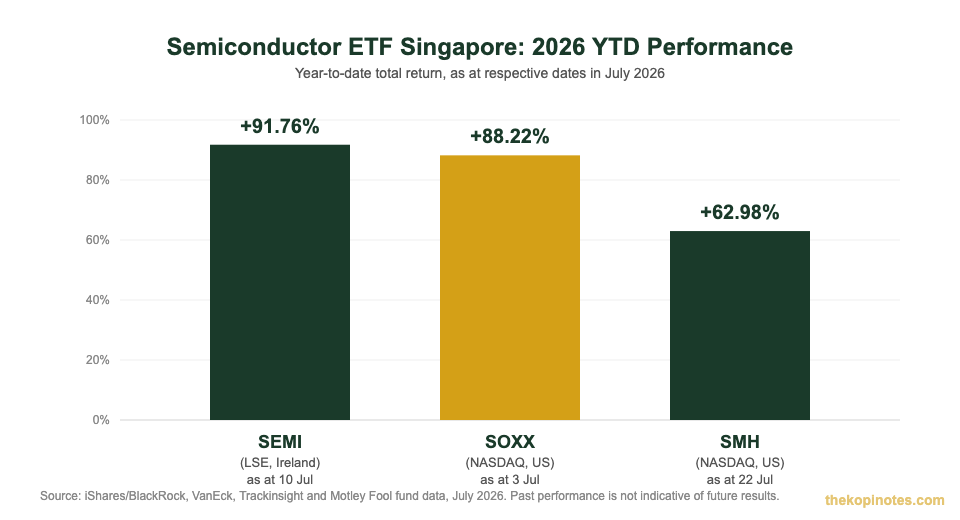
The performance has followed the spending. As at 10 July 2026, SEMI had returned 91.76% year-to-date, broadly in line with its 92.16% benchmark return. The US-listed SOXX was up 88.22% year-to-date as at 3 July 2026, and SMH had gained 62.98% year-to-date as at 22 July 2026.
However, strong recent returns cut both ways — a sector that has already run up this much can also give back gains quickly if AI capex forecasts disappoint. Treat these numbers as context, not a promise of what happens next.
Why Singapore Investors Buy Chip ETFs on the LSE
If you’re already comfortable buying US-listed ETFs, you might wonder why bother with a London-listed one. The answer comes down to two things: dividend withholding tax and US estate tax.
The US government taxes dividends paid to non-resident foreign investors. For a US-domiciled fund like SOXX or SMH, that rate is 30%. For an Ireland-domiciled UCITS ETF like SEMI or VVSM, the US-Ireland tax treaty cuts that rate to 15% on the US-sourced income the fund receives — a saving the fund passes through to you as a Singapore holder.
Semiconductor companies pay smaller dividends than, say, REITs or banks, since many reinvest cash into R&D and fabs. So the withholding tax saving is smaller in dollar terms here than on a broad dividend-paying index. The bigger issue is US estate tax.
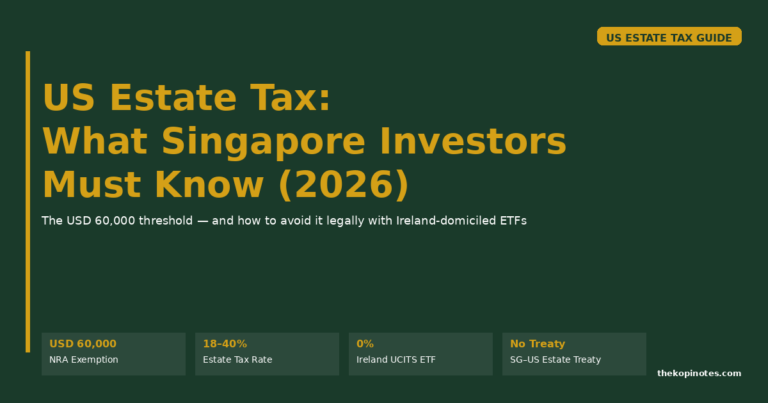
Under US estate tax rules, a non-resident alien’s US-situs assets — which include shares of US-domiciled ETFs — are exposed to US estate tax above a USD 60,000 threshold, with rates that can reach 40%. This applies to the full value of your position, not just dividends, and it applies whether or not the underlying companies pay any dividend at all. Ireland-domiciled UCITS ETFs like SEMI and VVSM are not US-situs assets, so they carry no US estate tax exposure, regardless of position size.
| ETF Type | Domicile | US Dividend WHT | US Estate Tax Risk |
|---|---|---|---|
| SEMI / VVSM (LSE) | Ireland | 15% | None |
| SOXX / SMH (NASDAQ) | USA | 30% | Yes (above USD 60k) |
Source: US-Ireland tax treaty rates and IRS non-resident alien estate tax rules, as summarised by fund providers and tax advisers. Not tax advice — consult a professional for your situation.
There’s no capital gains tax in Singapore either way, and no Singapore tax on the accumulated income inside an accumulating ETF. That part is the same whichever exchange you buy on.
Expense Ratio and Total Costs
SEMI charges a 0.35% per year TER (total expense ratio). VVSM also charges 0.35%. Their US-listed counterparts are similar: SOXX charges 0.34%, and SMH charges 0.35%. So the TER gap between UCITS and US versions is close to zero for this sector — unlike broad market ETFs, where UCITS versions sometimes cost a touch more.
Here’s the practical impact. On a SGD 50,000 SEMI position, a 0.35% TER works out to about SGD 175 a year in fund-level fees, deducted automatically from the fund’s assets — you never see a separate bill. On top of that, factor in your broker’s commission per trade and the FX spread when converting SGD to USD or GBP.
How to Buy SEMI in Singapore (Step-by-Step)
You can buy SEMI or VVSM through any broker with London Stock Exchange access. If you’re still picking a platform, our best online brokerage Singapore comparison breaks down fees and LSE access across the major players. Here’s how the main options compare.
Interactive Brokers (IBKR)
Fund your account, search “SEMI” in the trading window, and select the LSE listing (not the Amsterdam or Xetra listing, which share similar tickers). IBKR charges tiered commissions and is generally the cheapest option for larger, less frequent trades.
Saxo Markets
Saxo gives you LSE access with a clean interface, though its commission structure suits investors trading larger amounts less frequently rather than small, regular top-ups.
moomoo Singapore
moomoo added LSE trading in 2026, alongside its existing US, Hong Kong, and SGX access. It charges a flat LSE commission (around SGD 1.99 per trade, subject to promotions), which makes it workable for smaller, regular purchases. See our moomoo Singapore review for the full fee breakdown.
Syfe Brokerage
Syfe Brokerage also added LSE access in 2026, letting you buy SEMI or VVSM alongside your existing Syfe portfolio. Trading hours for LSE-listed ETFs on Syfe run from 4pm to 12:30am Singapore time on business days, and fractional orders start from as little as USD 1. If you don’t already have an account, check the Syfe sign-up bonus link at the end of this guide before you start.
Whichever broker you pick, place a limit order rather than a market order for LSE-listed ETFs — the bid-ask spread can widen outside of London’s core trading hours, and a limit order protects you from paying more than you intended.
SEMI vs VVSM vs SOXX vs SMH
All four funds give you semiconductor exposure, but they differ in concentration, domicile, and fund size. SEMI is the most diversified, holding around 260 names. VVSM and SMH are far more concentrated, tracking the same index with roughly 25-30 top holdings dominated by Nvidia, TSMC, and Broadcom. SOXX sits in between, tracking the PHLX Semiconductor Sector Index.
| ETF | Exchange | TER | Domicile | AUM | Best For |
|---|---|---|---|---|---|
| SEMI | LSE | 0.35% | Ireland | USD 5.9bn | Broad, diversified chip exposure |
| VVSM | LSE / Euronext | 0.35% | Ireland | EUR 7.3bn | UCITS version of the popular SMH strategy |
| SOXX | NASDAQ | 0.34% | USA | USD 47.8bn | Investors already trading US markets, smaller positions |
| SMH | NASDAQ | 0.35% | USA | USD 70.7bn | Largest, most liquid, but full US tax exposure |
Sources: iShares and VanEck fund fact sheets and product pages; AUM figures as at 10-22 July 2026 (dates vary by fund, see individual sections above).
The practical takeaway: if you’re a Singapore investor building a long-term position, SEMI or VVSM’s tax advantages tend to outweigh SOXX’s slightly lower TER once your position grows large enough that US estate tax becomes a real consideration. For a smaller, shorter-term trade, the difference matters less.
Risks to Consider
Semiconductor ETFs are not a substitute for a diversified core portfolio. Here’s what to watch for before you size a position.
Concentration risk. Chip ETFs are sector bets. In SEMI, the top 10 holdings — Micron, AMD, Broadcom, TSMC, Nvidia, SK Hynix, Lam Research, ASML, Intel, and Applied Materials — make up close to 60% of the fund. If AI capex spending slows or a handful of these companies stumble, the whole ETF feels it.
Cyclicality. Semiconductors have historically been a boom-and-bust industry, with multi-year down-cycles following periods of overinvestment. The current AI-driven upswing has been unusually strong, which also means the eventual correction could be sharp.
Currency risk. SEMI and VVSM are priced in USD or GBP depending on the share class and listing, so your SGD returns will move with the exchange rate as well as the underlying holdings.
Geopolitical risk. A large share of global chip manufacturing sits with a small number of companies concentrated in Taiwan, South Korea, and the US. Export controls, tariffs, or regional tensions can affect the sector disproportionately.
None of this means avoid the sector — it means size it as a satellite position around a diversified core like VWRA or CSPX, not as your entire portfolio.
Who Should Buy a Semiconductor ETF?
A semiconductor ETF like SEMI suits you if you already hold a diversified core portfolio — something like VWRA on the London Stock Exchange or CSPX — and want targeted exposure to the AI infrastructure theme on top of it. It also suits you if you’d rather own a basket of chipmakers than research and pick individual names like Nvidia or TSMC yourself.
Consider skipping it, or keeping the position small, if you’re a beginner investor without a diversified core yet, if you’re not comfortable with a sector that can swing 20-30% in a matter of months, or if your investing time horizon is short. For a wider view of the theme, our guide to the best AI ETFs for Singapore investors (linked at the end of this guide) covers software and infrastructure names alongside chipmakers.
SEMI and VVSM are not on the CPFIS list, so you can’t use your CPF Ordinary or Special Account to buy them. SRS funds can only be used if your broker offers a direct SRS-linked LSE trading account — most Singapore investors buying these funds use cash. If you’re weighing this against your broader retirement plan, the Singapore retirement calculator linked at the end of this guide can help you see how a satellite position like this fits your overall numbers.
Frequently Asked Questions
What is a semiconductor ETF and why do Singapore investors buy one?
A semiconductor ETF holds a basket of chip design, manufacturing, and equipment companies in one fund, so you don’t have to pick individual winners like Nvidia or TSMC. Singapore investors buy them to get targeted exposure to the AI and computing infrastructure theme, usually as a satellite position alongside a broader core portfolio.
Is SEMI the same as SOXX or SMH?
No. SEMI is an Ireland-domiciled UCITS ETF listed on the London Stock Exchange, tracking a broader index of around 260 global semiconductor companies. SOXX and SMH are US-domiciled ETFs listed on NASDAQ. SMH and the UCITS fund VVSM track a similar, more concentrated index of roughly 25-30 US-listed chip names. All are broadly similar in cost, but differ in domicile, concentration, and the tax treatment applied to Singapore investors.
Can I buy SEMI or VVSM using my CPF or SRS funds?
No, not directly. SEMI and VVSM are not on the CPFIS list, so you can’t use CPF Ordinary or Special Account funds to buy them. SRS funds can only be used if your broker offers a direct SRS-linked LSE trading account, which most brokers don’t for these specific funds — most investors fund purchases with cash instead.
Which broker is best for buying semiconductor ETFs in Singapore?
Interactive Brokers and Saxo Markets are the most established for LSE trades and suit larger, less frequent purchases. moomoo Singapore and Syfe Brokerage both added LSE access in 2026 and work well for smaller, regular top-ups thanks to fractional shares and lower minimums.
What is the minimum investment for SEMI?
There’s no official minimum set by the fund itself — you can buy a single unit if your broker allows it. Brokers offering fractional shares, like Syfe Brokerage, let you start from as little as USD 1. Buying whole units through IBKR or Saxo means your minimum is one share’s market price, which fluctuates with the fund’s NAV.
Are semiconductor ETFs risky? What should I watch out for?
Yes, more so than a broad market ETF. Semiconductor ETFs are concentrated in one cyclical sector, so a slowdown in chip demand or AI infrastructure spending can hit the whole fund at once. Treat a semiconductor ETF as a smaller, targeted addition to a diversified core portfolio rather than a standalone holding.
Ready to Add Semiconductor Exposure to Your Portfolio?
Open a brokerage account with LSE access and buy your first semiconductor ETF today. Use our referral links for exclusive sign-up bonuses.
This article was researched with the help of AI. While we strive to keep all information accurate and up to date, there may be errors. If you notice any discrepancies, please contact us.