Tiger Brokers Share Price 2026: Is TIGR Stock Worth Buying?
NASDAQ: TIGR — key stats, why the stock has fallen, and how Singapore investors can buy in.
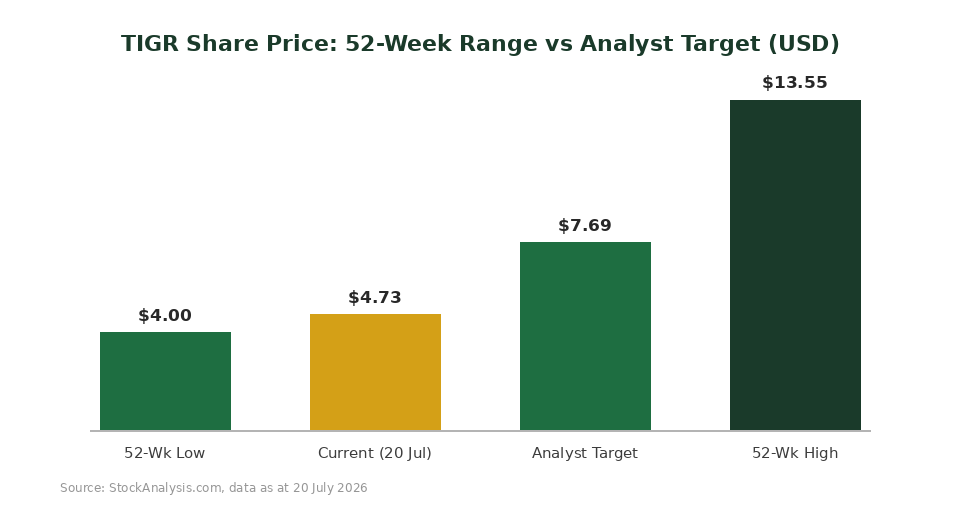
Tiger Brokers’ parent company, UP Fintech Holding Limited (NASDAQ: TIGR), traded at $4.73 on 20 July 2026, down sharply from a 52-week high of $13.55. The drop follows a China Securities Regulatory Commission (CSRC) probe and a one-time $60 million regulatory penalty in Q1 2026. Despite this, revenue grew 51.8% year-on-year and 10 analysts rate the stock a “Buy” with a $7.69 price target.
Not financial advice. All figures are for educational reference only. Data verified as at 22 July 2026 against StockAnalysis.com and official company filings.
- TIGR (UP Fintech, Tiger Brokers’ parent) trades near $4.70 — down about 65% from its 52-week high after a China regulatory probe hit the stock in May 2026.
- The business is still growing fast: revenue is up over 50% year-on-year, but a $60 million one-time penalty and an ongoing CSRC investigation are weighing on sentiment.
- You can buy TIGR shares from Singapore through the Tiger Brokers app itself, or through moomoo, IBKR, Syfe Trade, or FSMOne — just remember it is a single-stock, not a diversified fund.
Table of Contents
Contents — Click to expand
What Is Tiger Brokers (TIGR) Stock?
Here is where it gets confusing for a lot of Singapore investors. “Tiger Brokers” is the trading app you might already use to buy US and SGX stocks. But TIGR is something different — it is the stock ticker for the company that owns and runs that app.
The company is called UP Fintech Holding Limited. It is incorporated in the Cayman Islands and listed on the Nasdaq under the ticker TIGR. It IPO’d on 20 March 2019. What trades on Nasdaq is an American Depositary Share (ADS) — each ADS represents 15 Class A ordinary shares of the company.
UP Fintech runs the Tiger Trade brokerage platform across multiple markets, with meaningful operations in Singapore, Hong Kong, the US, and New Zealand. It has 1,346 employees and generates revenue mainly from trading commissions, margin financing interest, and fund distribution. So when you buy TIGR, you are not buying a diversified fund — you are betting on the fortunes of one fintech brokerage company.
TIGR Share Price 2026: Key Stats at a Glance
| Metric | Detail |
|---|---|
| Company | UP Fintech Holding Limited |
| Ticker | TIGR (Nasdaq) |
| Price (20 Jul 2026) | $4.73 (+2.60% on the day) |
| Day’s Range | $4.61 – $4.75 |
| 52-Week Range | $4.00 – $13.55 |
| Market Cap | ~$842 million |
| Revenue (TTM) | $567.9 million (+51.8% YoY) |
| Net Income (TTM) | $113.6 million (+44.2% YoY) |
| P/E Ratio | 7.35 (forward: 7.41) |
| Dividend | None |
| Analyst Consensus | Buy (10 analysts) |
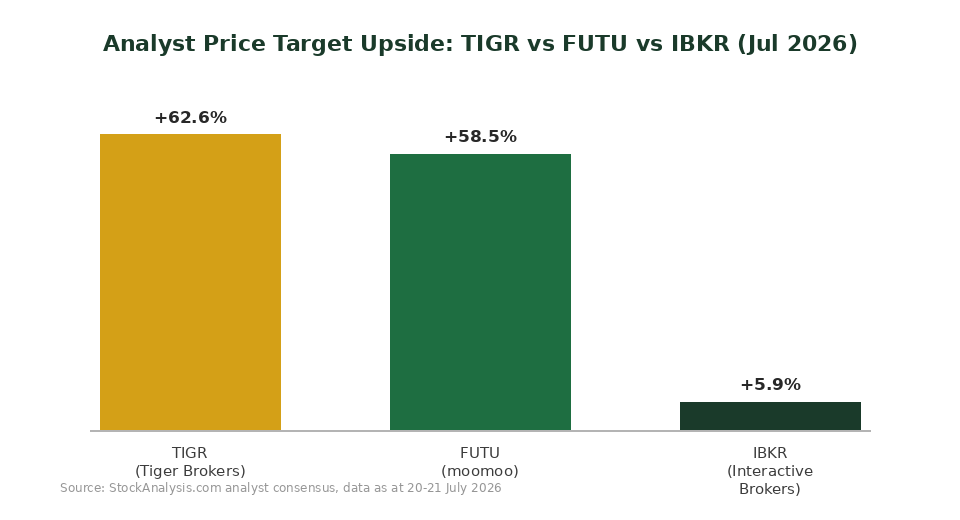
| 12-Month Price Target | $7.69 (+62.6% from current price) |
| Next Earnings Date | 26 August 2026 |
Source: StockAnalysis.com, TIGR overview, data as at 20 July 2026.
Why TIGR Stock Is Trending in Singapore in 2026
Two very different stories are playing out in TIGR right now, and that tension is exactly why Singapore investors are searching for the share price.
The growth story is genuinely strong. UP Fintech’s global client assets crossed US$60.8 billion by the end of 2025, and full-year 2025 revenue rose 62.9% to $538.7 million with earnings up 181.4%. Growth has kept going into 2026, with Q1 2026 revenue up 26% year-on-year to $155 million, driven largely by Singapore and Hong Kong client inflows.
The risk story is what has crushed the share price. On 22 May 2026, UP Fintech disclosed that certain subsidiaries had received notices from the China Securities Regulatory Commission’s Beijing Bureau regarding an investigation into cross-border securities business. Around the same time, the company took a one-time $60 million regulatory penalty that pushed Q1 2026 net income into a loss, even though underlying revenue kept growing.
TIGR was not alone. Its larger rival Futu Holdings (moomoo’s parent company, NASDAQ: FUTU) saw its stock plunge nearly 28% in a single day in May 2026 after a similar China probe, triggering multiple securities fraud class-action lawsuits from US law firms. That sector-wide shock dragged TIGR down with it.
Analysts have responded by slashing price targets sharply — Citi cut its TIGR target from $16.80 to $7.10, and BofA cut its target from $9.96 to $8.01 — while still keeping “Buy” ratings on the stock. That combination of a much lower price and still-positive ratings is what is now pulling in value-focused investors. However, the CSRC investigation’s outcome remains unresolved, so this is a genuine open risk, not a settled matter.
How to Buy TIGR Shares in Singapore
TIGR trades on the Nasdaq, so you will need a broker with US market access. Here are your main options as a Singapore-based investor.
Tiger Brokers app. Slightly ironic, but yes — you can buy TIGR shares directly through the Tiger Brokers platform you may already use. Fund your account, search “TIGR” in the app, and place a US market order.
moomoo. Tiger Brokers’ closest local rival also offers TIGR on its US market feed. If you already use moomoo for other US stocks, this is a simple add-on. You may want to first read our moomoo Singapore review if you have not opened an account yet.
Interactive Brokers (IBKR). Best for investors who want the widest market access and typically the lowest FX conversion spread when funding a US-dollar trade from SGD.
Syfe Trade and FSMOne. Both platforms also offer Nasdaq access for Singapore residents. If you are weighing up brokers more broadly, our Syfe referral code and sign-up bonus page and our FSMOne referral code page cover current promotions.
Whichever broker you use, the steps are the same: fund your account in USD or SGD, search the ticker “TIGR”, confirm you are buying the Nasdaq-listed ADS (not a similarly-named unrelated ticker), and place a market or limit order.
Two tax notes worth knowing. First, TIGR currently pays no dividend, so the usual 30% US dividend withholding tax question does not apply today — but it could in future if the company starts one. Second, because TIGR is a US-listed security, it falls under US estate tax rules for non-resident aliens, which apply above a US$60,000 threshold on US-situs assets. This is a real but often-overlooked risk for Singapore investors building a sizeable position in any single US-listed stock.
TIGR vs Other Listed Brokerage Stocks
TIGR is not the only listed brokerage stock Singapore investors can buy. Here is how it stacks up against its two closest comparisons — Futu Holdings (moomoo’s parent) and Interactive Brokers.
| Company | Ticker | Price (Jul 2026) | Market Cap | P/E | Dividend Yield | Analyst Rating |
|---|---|---|---|---|---|---|
| Tiger Brokers (UP Fintech) | TIGR | $4.73 | ~$842M | 7.35 | None | Buy |
| Futu Holdings (moomoo) | FUTU | $98.28 | ~$13.78B | 10.86 | 5.29% | Strong Buy |
| Interactive Brokers | IBKR | $94.42 | ~$42.06B | 40.54 | 0.37% | Buy |
Source: StockAnalysis.com FUTU overview and IBKR overview, data as at 20-21 July 2026.
The pattern is clear: TIGR and FUTU are both cheap on a P/E basis and carry the biggest analyst upside — but that upside exists precisely because both stocks were hit by the same China regulatory overhang. IBKR, in contrast, is a much larger, more diversified, US-regulated broker trading at a premium valuation with far less regulatory drama, but also far less re-rating upside.
Risks to Consider Before Buying TIGR
No stock is a sure thing, and TIGR carries more risk than most. Here is what you should weigh up honestly before buying.
Unresolved regulatory investigation. The CSRC probe into cross-border securities business, disclosed in May 2026, has no confirmed resolution date or outcome. This is the single biggest overhang on the stock.
Sharp price volatility. TIGR has swung from $13.55 to $4.00 within a single 52-week window — a drop of roughly 70%. That is a much wider range than most large-cap stocks and reflects genuine uncertainty, not just short-term noise.
Small size versus peers. At roughly $842 million, TIGR’s market cap is a fraction of FUTU’s ($13.78 billion) or IBKR’s ($42.06 billion). Smaller companies can be more exposed to a single adverse regulatory decision.
No dividend. Unlike FUTU (5.29% yield) or IBKR (0.37% yield), TIGR pays nothing back to shareholders today. This is a pure capital-appreciation bet, not an income holding.
Single-stock concentration. Buying TIGR means betting on one company’s regulatory and competitive outcome, rather than spreading risk across a basket of holdings the way a broad-market ETF like CSPX would.
Who Should Consider Buying TIGR?
TIGR may suit you if: you are comfortable with high volatility and single-company regulatory risk, you believe Asia’s retail brokerage growth story (rising trading volumes, more funded accounts, wealth management cross-sell) will keep outrunning the current regulatory cloud, and you are using it as a small, deliberate satellite position rather than a core holding.
Consider alternatives if: you want income rather than pure growth (IBKR’s dividend or FUTU’s 5.29% yield fit better), you want exposure to the brokerage-growth theme with more diversification and scale (FUTU or IBKR), or you simply do not want single-stock regulatory risk at all — in which case a broad ETF or a retirement calculator-guided diversified portfolio is usually the more sensible starting point for most Singapore investors.
Frequently Asked Questions
What is Tiger Brokers' stock ticker and where is it listed?
Tiger Brokers’ parent company, UP Fintech Holding Limited, trades on the Nasdaq under the ticker TIGR. Each Nasdaq-listed ADS represents 15 Class A ordinary shares of the Cayman Islands-incorporated company.
Is Tiger Brokers (TIGR) the same as the Tiger Brokers app I use to trade?
They are related but not identical. The Tiger Brokers app is the brokerage platform you use to place trades. TIGR is the Nasdaq stock ticker for UP Fintech Holding Limited, the company that owns and operates that platform. Buying TIGR shares means investing in the company itself, not just using its trading service.
Why has TIGR stock price fallen so much in 2026?
TIGR fell from a 52-week high of $13.55 to around $4.73 mainly because of a China Securities Regulatory Commission investigation into cross-border securities business, disclosed on 22 May 2026, plus a one-time $60 million regulatory penalty that pushed Q1 2026 net income into a loss. A similar probe hit rival Futu Holdings around the same time, adding sector-wide selling pressure.
Can Singapore investors buy TIGR shares using CPF or SRS?
TIGR is not on the CPF Investment Scheme (CPFIS) approved list, so you cannot use CPF Ordinary Account funds to buy it. Some brokers that support SRS-funded US stock trading may allow TIGR purchases through SRS, but you should confirm this directly with your broker before attempting an SRS-funded trade.
Does TIGR pay a dividend?
No. As at July 2026, UP Fintech Holding Limited does not pay a dividend on TIGR shares. This makes it a pure capital-appreciation investment rather than an income holding, unlike Futu Holdings (FUTU), which currently yields around 5.29%.
Is TIGR a good stock to buy in 2026?
It depends on your risk tolerance. Ten analysts rate TIGR a “Buy” with a price target implying over 60% upside, and the underlying business is growing revenue by more than 50% a year. But the stock also carries a live, unresolved regulatory investigation and has already fallen roughly 65% from its 52-week high. This is not a stock for a core, low-risk portfolio — treat it as a small, deliberate satellite position if you choose to buy at all, and never invest more than you can afford to lose on a single volatile stock.
Ready to Start Investing?
Open a brokerage account and build a diversified portfolio alongside any single-stock positions. Use our referral links for exclusive sign-up bonuses.
This article was researched with the help of AI. While we strive to keep all information accurate and up to date, there may be errors. If you notice any discrepancies, please contact us.