Critical Illness Insurance Singapore 2026: Why the New ISP Rider Rules Change the Math
How April 2026’s Integrated Shield Plan rider overhaul shifts your out-of-pocket risk — and what it means for your critical illness coverage.
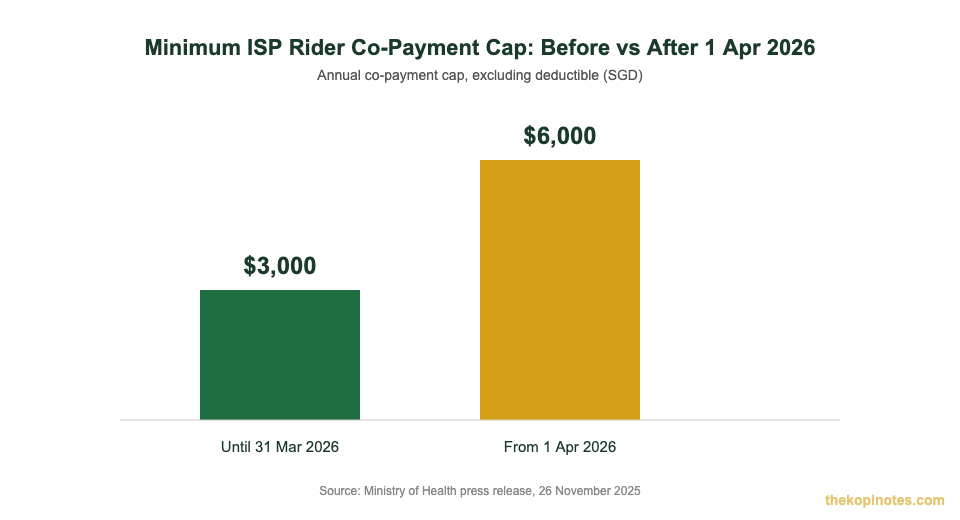
Critical illness insurance pays you a lump sum on diagnosis, separate from your Integrated Shield Plan (ISP), which reimburses hospital bills. Since 1 April 2026, MOH’s new rider rules mean ISP riders no longer cover your policy deductible and carry a higher $6,000 minimum co-payment cap. That shift raises your out-of-pocket exposure, making a critical illness lump sum a more meaningful buffer than before.
Not financial advice. All figures are for educational reference only. Data verified as at 21 July 2026 unless otherwise dated.
- From 1 April 2026, new Integrated Shield Plan riders can’t cover your deductible, and your minimum co-payment jumped from $3,000 to $6,000 a year.
- Rider premiums fell about 30% on average — but that’s a trade: lower monthly cost for higher potential out-of-pocket exposure per claim.
- Critical illness insurance pays a separate cash lump sum you control. It doesn’t replace your ISP, but it can offset the new co-payment gap and cover lost income during recovery.
Table of Contents
Contents — Click to expand
What Changed on 1 April 2026
On 26 November 2025, the Ministry of Health (MOH) announced new design rules for Integrated Shield Plan (IP) riders — the optional add-ons many Singaporeans buy to shrink their out-of-pocket hospital bills. From 1 April 2026, two things changed for every new rider sold.
First, new riders can no longer cover your policy’s minimum deductible. That’s the fixed amount you pay before insurance kicks in, and it ranges from $1,500 to $3,500 depending on your ward class. Second, the minimum annual co-payment cap — the most you share in cash before insurance covers the rest, excluding the deductible — rose from $3,000 to $6,000.
MOH’s own claims data explains why. Private hospital IP policyholders with a rider were 1.4 times more likely to make a claim, with claims 1.4 times larger on average than policyholders without one. Near-zero co-payment, in other words, was quietly driving over-servicing and over-consumption of private healthcare.
The upside: new riders are around 30% cheaper on average than the old maximum-coverage riders — roughly $600 a year cheaper for private hospital riders and $200 a year cheaper for public hospital riders. The trade-off is that you now carry more risk per claim.
Minimum IP Deductibles by Ward Class
| Ward Class Utilised | Minimum Deductible (per policy year) |
|---|---|
| Class A / Private | $3,500 |
| Class B1 | $2,500 |
| Class B2 | $2,000 |
| Class C | $1,500 |
| Day Surgery (non-subsidised / subsidised) | $2,000 / $1,500 |
Source: Ministry of Health press release, 26 November 2025
Existing rider policyholders aren’t automatically switched. Insurers are working out their own transition approach for policies bought before 27 November 2025. If you’re unsure whether your rider has changed, it’s worth checking with your insurer or financial adviser — and comparing how each insurer’s new rider stacks up in our Shield Plan Comparison Singapore 2026 guide.
What Does Critical Illness Insurance Actually Cover?
It helps to be precise about what each type of insurance does, because the rider changes only affect one piece of the puzzle.
Your ISP, with or without a rider, reimburses your hospital bill up to policy limits. It doesn’t pay you directly, and it never covers lost income, follow-up costs after discharge, or everyday expenses while you recover.
Critical illness (CI) insurance works differently. It pays you a lump sum — cash, not a bill reimbursement — the moment you’re diagnosed with a covered condition. Since July 2003, the Life Insurance Association of Singapore (LIA) has standardised the definitions of the severe stage of 37 common critical illnesses across every insurer, so “heart attack of specified severity” means the same thing whichever company you buy from. In 2025, LIA also revised several of these definitions under its CI Framework 2024 to keep pace with medical advances.
Early critical illness (early CI) cover goes a step further, paying out when a condition is caught before it reaches the severe stage — early-stage cancer, a mild heart attack, or early kidney disease, for example. Unlike the severe-stage list, early-stage definitions aren’t standardised across insurers, so coverage varies more by policy. For a full breakdown of early CI plans, costs, and top providers, see our Early Critical Illness Insurance Singapore guide.
Source: LIA Critical Illness Framework Industry FAQ, 11 October 2024
The New Out-of-Pocket Gap: Two Worked Examples
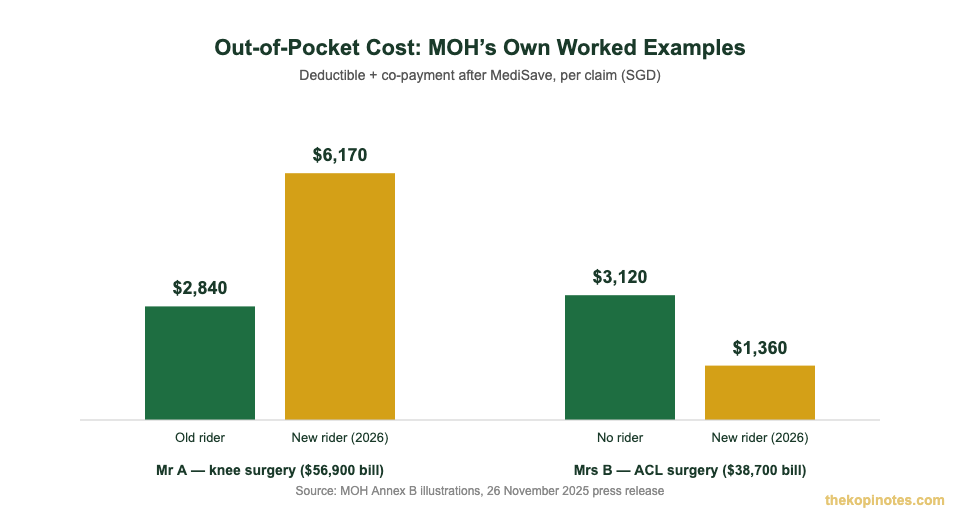
MOH published two worked examples alongside its announcement. They’re useful because they show, in real dollars, how the new rider design shifts risk onto the policyholder.
Mr A, 60 — private hospital IP with rider
Mr A switches to a new rider in April 2026 and saves 30% in premiums — $1,600 in cash that year. Three years later he has knee replacement surgery in a private hospital, with a bill of $56,900. Under the new rider, he pays the $3,500 deductible plus 5% of the rest, totalling $6,170, fully payable from MediSave. That’s $3,330 more than he’d have paid under his old rider — but he’d already banked $4,800 in premium savings over three years.
Mrs B, 40 — adds a rider for the first time
Mrs B previously skipped a rider because premiums were too high. With the cheaper new version, she adds one in April 2026, paying $500 a year less than peers who bought the old rider. In December 2026 she tears her ACL and needs surgery costing $38,700. Her deductible and co-payment total $5,260, of which $3,900 is MediSave-payable — leaving $1,360 out-of-pocket, versus $3,120 if she’d had no rider at all.
| Scenario | Bill Size | Old Setup | New Rider (2026) |
|---|---|---|---|
| Mr A — knee replacement | $56,900 | $2,840 (old rider) | $6,170 |
| Mrs B — ACL reconstruction | $38,700 | $3,120 (no rider) | $1,360 |
Source: MOH Annex B worked illustrations, 26 November 2025
Both examples involve routine surgery, not a critical illness — which is worth sitting with for a moment. If Mr A’s diagnosis had instead been a covered critical illness — major cancer requiring months of treatment, say — his ISP, rider or not, would still only reimburse the hospital bill. It wouldn’t touch his income, his family’s living expenses, or the pressure of an extended recovery. A $100,000 CI lump sum, by contrast, would cover his new $6,170 co-payment more than 16 times over, with the rest free to use however his family needs it.
Does a Cheaper Rider Mean You Need Less Critical Illness Cover?
It’s tempting to read “premiums are 30% lower” as “I need less insurance now.” That’s not quite right, and it’s worth being precise about why.
The rider saving is cash-flow relief on a bill-reimbursement product. It changes how much you pay monthly, and how much you might owe if hospitalised. It doesn’t change what happens to your income if you can’t work.
In a Great Eastern consumer survey on critical illness, close to 40% of CI survivors said they had to stop working for more than a year. Your ISP, new rider or old, was never designed to replace that income. Only a standalone payout — a CI lump sum or early CI cover — does that job.
So the honest framing is this: cheaper riders make hospitalisation cover more affordable, which frees up budget. Whether that freed-up budget should go toward critical illness cover, savings, or something else depends on the protection gaps you actually have.
Source: Great Eastern Consumer Survey on Critical Illness
How Much Critical Illness Coverage Do You Actually Need?
There’s no single right number, but a few reference points are useful.
A widely cited 2018 industry study, reported by The Straits Times, found that Singaporean working adults typically needed critical illness coverage equal to about 3.9 times their annual income to be adequately protected — yet most held far less. The figure is dated, but insurers including Great Eastern still reference it as a planning benchmark, since it accounts for both lost income during treatment and ongoing financial commitments.
A simpler, more current approach: add up what would still need paying if you couldn’t work for one to two years — your mortgage or rent, insurance premiums, your family’s living expenses, and any existing debt — then subtract what MediShield Life, your ISP, and your emergency fund would already cover. For a full worked example at different income levels, see our Critical Illness Insurance Comparison Singapore decision-framework guide.
Source: Singapore Cancer Society
Who Should Review Their Coverage Now
Not everyone needs to act. But a few groups should take a closer look given the April 2026 changes.
- Sole breadwinners who’ve never bought CI cover — the income-protection gap was always there; lower rider premiums simply free up budget to close it.
- Anyone switching to a new, cheaper rider — you’re accepting a higher co-payment ceiling ($6,000 minimum) in exchange for the savings, so it’s worth checking whether a CI lump sum makes sense as a buffer.
- Households relying only on MediShield Life, with no ISP or rider at all — this change doesn’t affect you directly, but it’s a good prompt to review your coverage generally.
- Anyone with a family history of cancer, heart disease, or stroke — the five conditions behind 90% of CI claims are covered from day one of a standard policy, and buying while young and healthy generally means lower premiums.
Use the Insurance Gap Calculator to estimate your specific shortfall, or the Life Insurance Needs Calculator if you’re reviewing your full protection stack at once. If you want a plan-by-plan comparison of what’s available, our Best Critical Illness Insurance Singapore guide covers the top providers side by side.
Frequently Asked Questions
What exactly changed with Integrated Shield Plan riders in April 2026?
From 1 April 2026, new IP riders sold in Singapore can no longer cover your policy’s minimum deductible ($1,500 to $3,500 depending on ward class), and the minimum annual co-payment cap rose from $3,000 to $6,000. In exchange, MOH expects new rider premiums to be about 30% lower on average than old maximum-coverage riders.
Does critical illness insurance cover what my ISP rider no longer covers?
Not directly — critical illness insurance pays a separate lump sum on diagnosis of a covered condition, rather than reimbursing your hospital bill. But because that payout is unconditional cash, you can use it to cover the new deductible and co-payment gap, plus anything your ISP was never designed to cover, like lost income.
If my rider premium dropped 30%, do I still need critical illness insurance?
The rider saving lowers your monthly cost and shifts more bill-sharing risk to you — it doesn’t address income loss during a serious illness. Whether you need critical illness cover depends on your existing protection gaps, not on how much your rider premium fell.
How much critical illness insurance coverage should I get in Singapore?
A commonly cited benchmark is around 3.9 times your annual income, though this 2018 figure should be treated as a rough guide. A more current approach is to add up 1 to 2 years of income, existing debt, and family expenses, then subtract what your emergency fund and existing insurance already cover.
What’s the difference between critical illness insurance and early critical illness insurance?
Standard CI insurance pays out only when a condition reaches the severe stage, using definitions standardised by LIA since 2003 for 37 common illnesses. Early CI insurance pays out sooner, at the early or intermediate stage, using definitions set individually by each insurer — coverage and cost vary more between providers as a result.
Do the new rider rules apply to my existing Integrated Shield Plan?
Not automatically. If you bought your rider before 27 November 2025, your existing terms continue to apply, and insurers are working out their own transition approach for these policies. New riders sold from 1 April 2026 must follow the updated rules.
Can I use MediSave to pay for critical illness insurance premiums?
Generally, no — MediSave can be used for MediShield Life and Integrated Shield Plan premiums, and for eligible deductibles and co-payments, but standalone critical illness insurance premiums are typically paid in cash unless bundled into a MediSave-approved whole life plan. Check your specific policy’s MediSave eligibility with your insurer.
Is critical illness insurance necessary if I already have strong savings?
If your emergency fund could comfortably cover 1 to 2 years of income plus medical costs without disrupting long-term goals, you may need less coverage than someone without that buffer. Even then, many Singaporeans use critical illness insurance to protect savings earmarked for retirement or a home, rather than draining them during a health crisis.
Ready to Review Your Protection Gap?
Run the numbers on your own coverage, or start investing the difference if your rider just got cheaper.
Get Free Insurance Advice
Speak with a licensed insurance advisor. No obligation, no cost.
By submitting this form, you agree to our Privacy Policy.
This article was researched with the help of AI. While we strive to keep all information accurate and up to date, there may be errors. If you notice any discrepancies, please contact us.