Stoneweg Europe Stapled Trust 2026: The Rebranded Cromwell European REIT Yielding 8.6% (SGX: SET)
Singapore’s only Pan-European S-REIT has a new name, a new sponsor, and a new pivot into logistics and data centres.
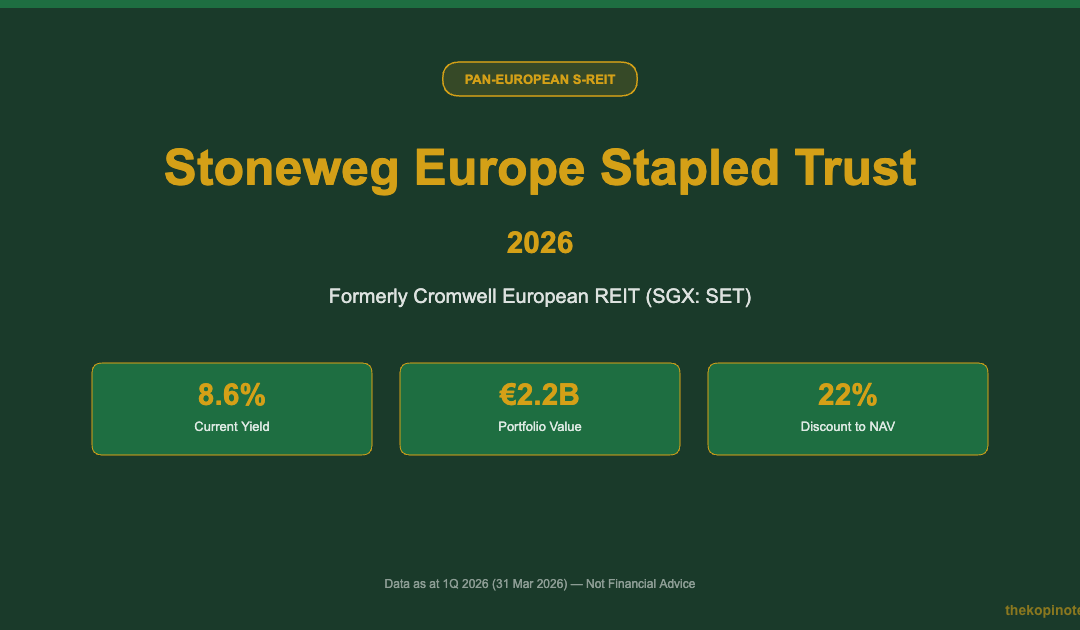
Stoneweg Europe Stapled Trust (SGX: SET/SEB) is the rebranded Cromwell European REIT — Singapore’s only Pan-European stapled REIT, holding a €2.2 billion portfolio of logistics, office and light industrial assets across nine European countries. Under new sponsor SWI Group, it now yields about 8.6% while pivoting toward logistics and data centres, and trades roughly 22% below its net asset value.
Not financial advice. All figures are for educational reference only. Data as at 1Q 2026 (31 March 2026) or as otherwise dated below.
- Cromwell European REIT renamed to Stoneweg Europe Stapled Trust (SERT) in 2025 after Switzerland’s SWI Group bought Cromwell’s European platform and a ~28% stake.
- SERT yields about 8.6% and trades at roughly a 22% discount to NAV, with 42.7% gearing — one of the highest yields and widest discounts among SGX-listed property trusts.
- It’s shifting from offices toward logistics and data centres: logistics/light industrial already makes up 61% of the portfolio, heading toward ~70% by 2028, backed by a €100 million bet on sponsor SWI’s data centre fund, AiOnX.
Table of Contents
Contents — Click to expand
- What Is Stoneweg Europe Stapled Trust (formerly Cromwell European REIT)?
- FY2025 Results: Revenue, NPI & Distribution
- Why the 8.6% Yield Comes With a 22% Discount to NAV
- The Logistics & Data Centre Pivot
- Portfolio Snapshot: Where SERT’s Properties Are
- Risks to Know Before You Buy
- How Singapore Investors Can Buy SERT
- Is SERT Worth Buying in 2026?
- FAQ
What Is Stoneweg Europe Stapled Trust (formerly Cromwell European REIT)?
If you searched for “Cromwell European REIT” and landed here, you’re in the right place. Cromwell European REIT (CEREIT) IPO’d on the SGX Mainboard in November 2017 with 74 properties worth about €1 billion. It was the first — and still the only — Singapore REIT with a purely Pan-European portfolio.
In January 2025, Switzerland-based SWI Group (a combination of Stoneweg and Icona Capital, managing about €11 billion in assets across 17 countries) bought Cromwell Property Group’s European fund management platform, along with a 27.8% stake in CEREIT. SWI became the new sponsor and manager. The trust was renamed Stoneweg European REIT, then restructured into a stapled group — Stoneweg European REIT plus a new Stoneweg European Business Trust — trading as Stoneweg Europe Stapled Trust (SERT).
The ticker changed too. What traded as SGX: CWBU became SGX: SET for euro-denominated units and SGX: SEB for Singapore-dollar-denominated units, effective 18 June 2025. It’s the same listed security (ISIN SGXC37098255) — if you held CWBU units, you now hold SET or SEB units automatically. Nothing about your ownership changed, only the name and the people running it.
Today, SWI Group holds about 28% of SERT’s stapled securities — real skin in the game, and a level of sponsor alignment most S-REIT investors don’t get.
Key Facts
| Metric | Figure |
|---|---|
| Ticker | SGX: SET (EUR) / SGX: SEB (SGD) — formerly SGX: CWBU |
| Structure | Stapled trust — Stoneweg European REIT + Stoneweg European Business Trust |
| Sector | Diversified — Pan-European logistics, office & light industrial |
| Sponsor | SWI Group (Stoneweg + Icona Capital), ~28% stake |
| Portfolio value | €2.2 billion (97 assets, ~1.6–1.8 million sqm) |
| Market cap | ~€866 million (3 Jul 2026) |
| Unit price | ~€1.55–€1.58 (Jul 2026) |
| NAV per unit | ~€1.99 (EPRA NRV €2.14) |
| Distribution yield | ~8.6% |
| Gearing | 42.7% net |
| Next results | 1H 2026, due 13 August 2026 |
Source: Stoneweg Europe Stapled Trust 1Q 2026 business update (31 Mar 2026) and market data as at 3 Jul 2026.
FY2025 Results: Revenue, NPI & Distribution
For the year ended 31 December 2025, SERT’s top line actually grew. Gross revenue rose 0.8% to €214.6 million, and net property income (NPI) — basically rental income minus property-level costs — climbed 2.5% to €134.4 million on the back of strong rental reversions.
But distributable income fell 5.7% to €74.8 million, and DPS (distribution per stapled security — the actual cash you’d receive per unit) dropped 5.1% to 13.39 euro cents. Here’s why: SERT issued €500 million of green bonds in January 2025 at a higher coupon than its old debt, and that extra interest cost ate into what’s left for unitholders after NPI.
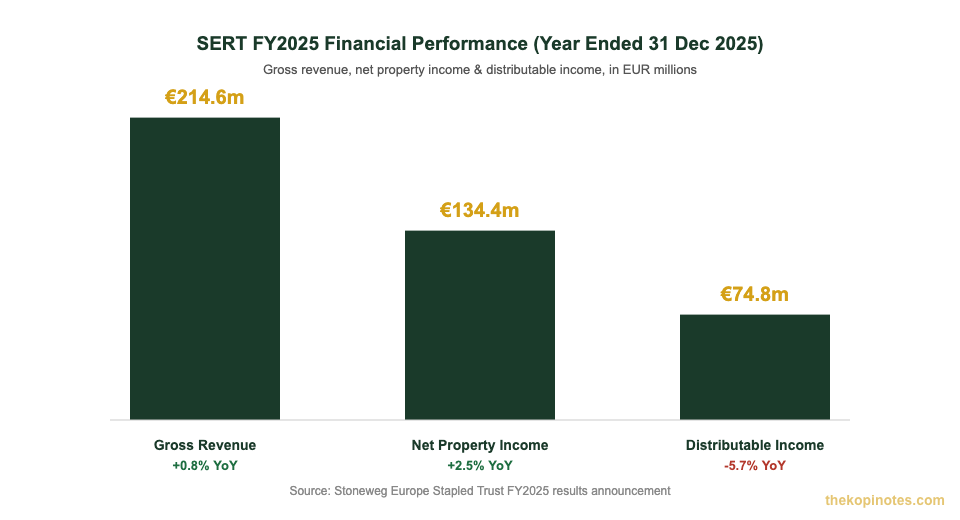
| Metric | FY2025 | YoY |
|---|---|---|
| Gross revenue | €214.6 million | +0.8% |
| Net property income | €134.4 million | +2.5% |
| Distributable income | €74.8 million | -5.7% |
| DPS (full year) | 13.39 euro cents | -5.1% |
| 1Q 2026 DPS | 3.423 euro cents (5.133 SG cents) | +1.5% |
Source: Stoneweg Europe Stapled Trust FY2025 and 1Q 2026 results announcements.
The good news: management says the distribution decline has “reset” and FY2026 DPS is expected to be broadly stable versus FY2025, helped by the AiOnX convertible loan’s immediate distribution boost and continued asset recycling into higher-yielding logistics deals. 1Q 2026’s +1.5% DPS growth is the first sign of that stabilisation.
Why the 8.6% Yield Comes With a 22% Discount to NAV
An 8.6% yield sounds great until you ask why the market hasn’t bid the price up already. For SERT, the answer is a mix of real risk and genuine mispricing.
SERT’s adjusted net asset value (NAV) is about €1.99 per unit (EPRA NRV €2.14). At a unit price of roughly €1.55–€1.58, that’s a price-to-NAV (P/NAV) ratio of about 0.78x — you’re paying 78 cents for every euro of underlying property value, a discount of roughly 22%. For comparison, most well-regarded Singapore-focused S-REITs trade close to or above 1.0x P/NAV.
Three things explain the discount:
1. Gearing is elevated. Net gearing sits at 42.7%, above management’s own 40% medium-term comfort level. For context, the Monetary Authority of Singapore (MAS) caps S-REIT aggregate leverage at 50% (up to 60% if interest coverage exceeds 2.5x), effective 28 November 2024. SERT is within the regulatory limit, but it’s carrying more debt than most SG-focused peers.
2. Five years of declining distributions. DPS has trended down since the old Cromwell-era portfolio was hit by higher European interest rates and softer office demand — only stabilising with the 1Q 2026 uptick.
3. Execution risk on the turnaround. The market wants proof the data centre pivot (below) actually delivers before it re-rates the units closer to NAV.
On the plus side, 87% of SERT’s debt is hedged or fixed until late 2027, so there’s no near-term refinancing cliff. The average interest rate on its debt was 3.84% in 1Q 2026, only slightly up from 3.66% a year earlier.
The Logistics & Data Centre Pivot
Since taking over, SWI Group has been steering SERT away from underperforming European offices and toward two sectors with stronger secular demand: logistics/light industrial and data centres.
Logistics and light industrial assets already make up 61% of portfolio value as at 31 March 2026, up from about 60% a year earlier. Management’s target is closer to 70% by 2027–2028. This mirrors a pivot you’ve likely seen in Singapore-focused industrial S-REITs too — warehouses and logistics parks have simply held up better than offices since 2023.
The more unusual bet is data centres. Europe’s data centre market is far less developed than the US, but AI and cloud demand are closing that gap fast. SERT is going after this in two ways:
Converting existing sites. Management has identified more than 10 SERT-owned sites across four countries as candidates for data centre conversion — including Parc Des Docks in Paris, which is progressing through planning with interest from hyperscale tenants. SERT keeps earning rental income from these sites while conversion plans are worked out, so there’s no income gap while waiting.
Investing in AiOnX. AiOnX is SWI Group’s dedicated European data centre development fund, with five projects (Dublin, Madrid, Varde, Milan and Cambridge) targeting 2.2GW of secured power capacity and a potential gross development value above €30 billion. The first phase — 16MW in Dublin — is expected to start earning rental income from a major US hyperscaler in late 2026.
| AiOnX Investment | Date | Amount & Structure | Terms |
|---|---|---|---|
| Tranche 1 | Jun 2025 | €50m equity (~6.7% stake) | Revalued +41% by mid-2026 |
| Tranche 2 | Mar 2026 | €50m mandatory convertible loan | 7.25% p.a. coupon, 7-year tenure, +2% DPS accretive |
Source: Stoneweg Europe Stapled Trust 1Q 2026 business update.
This gives SERT private-equity-style upside on data centre development without having to build or operate one itself — and the second tranche pays a cash coupon that’s already boosting distributions, rather than asking unitholders to wait years for a payoff.
All of this is funded through disciplined capital recycling, not new equity or excessive borrowing. Since late 2025, SERT has divested Italian, Polish, Slovakian and French assets — consistently at premiums of 3–32% above book valuation — and redeployed proceeds into logistics acquisitions like a €35 million Dutch temperature-controlled facility bought 8% below valuation at a 6.0% net yield, well above SERT’s cost of debt.
Portfolio Snapshot: Where SERT’s Properties Are
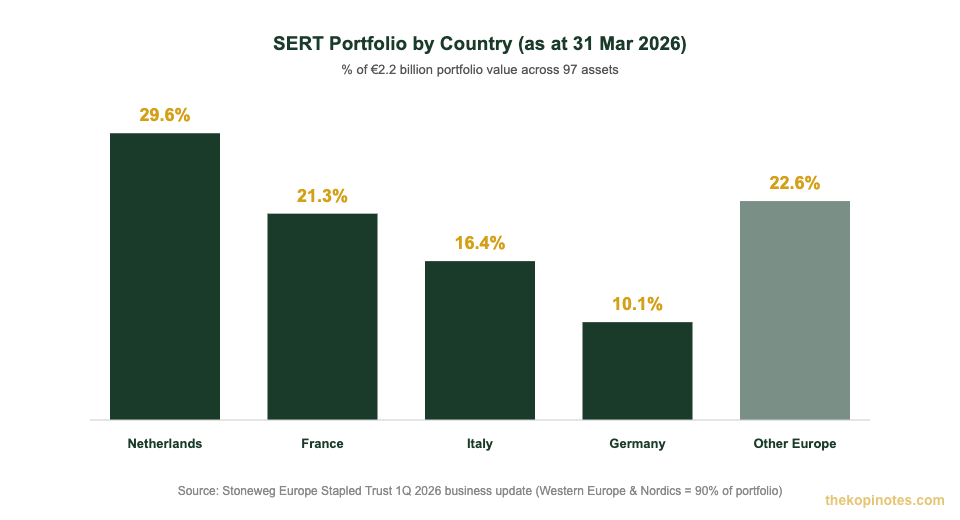
SERT’s 97 properties sit mostly in Western Europe’s strongest gateway economies. The Netherlands (29.6%), France (21.3%), Italy (16.4%) and Germany (10.1%) make up more than three-quarters of portfolio value, with the rest spread across Poland, Finland, Denmark, the Czech Republic and the UK. Western Europe and the Nordics together account for 90% of the portfolio — management has been deliberately exiting slower Central and Eastern European markets, including a full exit from Slovakia in late 2025.
Operationally, the portfolio is in decent shape. Total occupancy stood at 92.8% as at 1Q 2026, with a weighted average lease expiry (WALE — how long, on average, tenants are locked into their leases) of 5.0 years. The logistics/light industrial slice runs even hotter, at 95.1% occupancy with rent reversions of +7.6% in 1Q 2026 alone, building on FY2025’s full-year reversion of +9.8% — more than double the trust’s five-year average of 4.3%.
Tenant risk is well spread out too. SERT has more than 750 tenants, with no single tenant contributing over 4% of rental income and the top 10 tenants together making up just 21.2% of rent. Around 90% of tenants are large multinationals or government entities — the kind of tenant that doesn’t disappear in a downturn.
Leases are also structured to pass through almost all utility cost inflation to tenants, which is why SERT says recent energy shocks (Russia-Ukraine, the ongoing Iran situation) have barely dented its own cost base — utility costs it bears directly have stayed below 0.5% of total property expenses.
Risks to Know Before You Buy
SERT isn’t a typical SG-focused S-REIT, and its risk profile reflects that:
Currency risk. SERT’s properties and distributions are in euros. Whether you buy the SET (EUR) or SEB (SGD) counter, your returns move with the EUR/SGD exchange rate — buying the SGD-denominated counter only removes the hassle of converting currency yourself, not the underlying FX exposure.
Interest rate exposure is European, not local. SERT’s borrowing costs track the European Central Bank (ECB), not the US Federal Reserve or Singapore’s SORA. That’s actually a diversification benefit if you’re worried about SG/US rate moves, but it means SERT can zig when your other REITs zag.
Elevated gearing. At 42.7%, SERT has less balance sheet buffer than more conservatively geared S-REITs, even though it’s within MAS’s 50% regulatory cap.
European office softness. While SERT is shrinking its office exposure, it still owns office assets in a sector that’s structurally challenged by hybrid work across Europe, similar to trends in the US and UK.
Execution risk on the pivot. Data centre conversions need planning approvals, construction capital and hyperscale tenants to sign on — none of that is guaranteed on the timeline management is targeting.
Lower liquidity than SG blue-chip REITs. With a market cap of roughly €866 million, SERT trades far less than household names like CapitaLand Ascendas REIT or Mapletree Logistics Trust — expect wider bid-ask spreads, especially on the SEB (SGD) counter.
How Singapore Investors Can Buy SERT
SERT trades on the SGX Mainboard under two counters:
SGX: SET (euro-denominated) has the higher trading volume and tighter bid-ask spread — most active investors and bloggers covering SERT trade this counter. SGX: SEB (SGD-denominated) lets you buy and sell in Singapore dollars without a separate currency conversion step, but your return still depends on the EUR/SGD rate, since the underlying rental income and NAV are in euros.
Here’s a worked example. Say you invest S$10,000 in the SET counter at €1.58 per unit (about S$2.33 at a EUR/SGD rate of 1.475, as at mid-July 2026). That buys roughly 4,290 units. At FY2025’s DPS of 13.39 euro cents, you’d collect about €575 a year, or roughly S$848 after converting back — a gross yield of about 8.5%, before brokerage and any FX spread.
You can buy SERT through most Singapore brokers with SGX access, including brokerages linked via Syfe’s referral programme or a cash brokerage account opened through FSMOne. If you’d rather not pick individual REITs, robo-advisors accessed via Endowus offer diversified income portfolios that include European and global REIT exposure.
CPF and SRS. SERT is listed on the SGX Mainboard, which is the basic eligibility criterion for CPFIS-OA investing in S-REITs. We couldn’t independently confirm SERT’s live status on the CPF Board’s official CPFIS-included securities list at the time of writing, so check with your CPFIS agent bank or broker before assuming you can use your CPF Ordinary Account. For SRS, most SGX Mainboard-listed securities — including REITs and stapled trusts — are typically eligible, but again, confirm with your SRS operator (DBS, OCBC or UOB) before investing.
For the latest financial statements and announcements, SERT’s official investor relations page is investor.stonewegeuropestapledtrust.com.sg.
Is SERT Worth Buying in 2026?
Analyst sentiment leans positive: the most recent research call on SERT is a Buy with a target price around €1.89–€1.90 — roughly 20% above the current unit price, implying the market may be underpricing the turnaround.
| Pros | Cons |
|---|---|
| Only Pan-European REIT on SGX — genuine diversification away from SG/US property and rate cycles | Currency risk — returns move with EUR/SGD regardless of which counter you buy |
| ~8.6% yield at a ~22% discount to NAV | Gearing (42.7%) above management’s own comfort level |
| Aligned sponsor with ~28% stake and a credible logistics/data centre strategy | Data centre upside depends on planning approvals and hyperscale tenants signing on |
| Disciplined capital recycling — divesting above valuation, buying below it | Lower liquidity than large SG blue-chip S-REITs |
SERT suits investors who already have solid SG-REIT exposure and want geographic and interest-rate diversification, are comfortable holding a euro-linked asset, and can tolerate a multi-year turnaround story rather than an immediate re-rating. It’s less suited to investors who want simplicity, SGD-only exposure, or the highest possible liquidity.
The next real catalyst is SERT’s 1H 2026 results on 13 August 2026, where you’ll want to watch whether DPS keeps stabilising, whether gearing trends toward the 40% target, and any update on the Dublin data centre’s first hyperscale tenant.
If you’re building out a broader income portfolio, compare SERT against SGX’s other overseas-focused S-REITs — see our deep-dives on Elite UK REIT and Prime US REIT — or check our best S-REITs in Singapore 2026 roundup for SG-focused alternatives. You can also use our Singapore retirement calculator to see how a REIT allocation like this fits your income goals.
Frequently Asked Questions
What is Stoneweg Europe Stapled Trust?
Is Stoneweg Europe Stapled Trust the same company as Cromwell European REIT?
What is SERT's dividend yield in 2026?
What's the difference between the SGX: SET and SGX: SEB counters?
Can I buy Stoneweg Europe Stapled Trust with my CPF OA or SRS?
Why does SERT trade at such a big discount to NAV?
What is AiOnX and why is SERT investing in it?
Is SERT's gearing too high?
When are SERT's next results?
Building a Diversified Singapore Income Portfolio?
SERT is one piece of the puzzle. Compare brokers and robo-advisors to build out the rest of your REIT and dividend income strategy.
This article was researched with the help of AI. While we strive to keep all information accurate and up to date, there may be errors. If you notice any discrepancies, please contact us.