DBS CPF Investment Account (CPFIA) 2026: How to Open One & Invest in S-REITs
Eligibility, fees, investment limits, and how to use your CPF-OA to buy S-REITs directly.
A DBS CPF Investment Account (CPFIA) lets you invest CPF-OA savings above $20,000 in stocks, S-REITs, ETFs and unit trusts — instead of earning just 2.5% p.a. You open it directly with DBS, one of only three CPFIS agent banks, then link it to a DBS Vickers trading account. You can invest up to 35% of your investible savings in stocks and REITs, and 10% in gold.
Not financial advice. All figures are for educational reference only. Data as at July 2026 unless noted.
- DBS, OCBC and UOB are the only three banks that offer a CPF Investment Account (CPFIA) — you can only hold one at a time.
- You can invest CPF-OA savings above $20,000, capped at 35% of your investible savings in stocks and REITs, and 10% in gold.
- Sale proceeds and dividends flow back into your CPFIA, not your bank account — you cannot withdraw them as cash until age 55, after setting aside your Full Retirement Sum.
Table of Contents
Contents — Click to expand
- What Is a CPF Investment Account (CPFIA)?
- Who Can Open a DBS CPFIA?
- How Much of Your CPF-OA Can You Actually Invest?
- How to Open a DBS CPF Investment Account
- DBS CPFIA Fees & Charges
- Using Your CPFIA to Invest in S-REITs
- DBS CPFIA vs Robo-Advisor CPF-OA Investing
- OA-Only vs CPFIA-Invested: What Is the Real Difference?
- Risks and Common Mistakes
- Frequently Asked Questions
What Is a CPF Investment Account (CPFIA)?
A CPF Investment Account, or CPFIA, is the account you must open before you can invest your CPF Ordinary Account (OA) savings under the CPF Investment Scheme (CPFIS). Think of it as a holding account. Your OA money does not go straight into an S-REIT or ETF. It first moves into your CPFIA, and your agent bank tracks your investible balance from there.
Here is why this matters. Your CPF-OA normally earns 2.5% per year (3.5% on the first $20,000). That is a guaranteed, risk-free return. A CPFIA gives you the option to aim higher by investing in stocks, S-REITs, ETFs, bonds and unit trusts — but you take on market risk in exchange, and none of it is guaranteed.
Only three banks are licensed as CPFIS agent banks: DBS, OCBC and UOB. You can only hold one CPFIA at any point in time. This guide focuses on DBS, since it is the most commonly used CPFIA provider and links directly to DBS Vickers for stock and REIT trading.
Who Can Open a DBS CPFIA?
You need to meet all the requirements below before DBS will open a CPFIA for you. These are set by CPF Board and apply regardless of which agent bank you choose.
| Requirement | Detail |
|---|---|
| Age | 18 years old and above |
| Residency | Singapore Citizen or Permanent Resident |
| CPF-OA balance | More than $20,000 (this amount always stays untouched) |
| Existing CPFIA | None with another bank — you can hold only one CPFIA at a time |
| Bankruptcy status | Must not be an undischarged bankrupt |
| Self-Awareness Questionnaire (SAQ) | Required before your first-ever CPFIA or CPFIS-SA investment |
Source: DBS CPF Investment Account eligibility requirements, 2026.
How Much of Your CPF-OA Can You Actually Invest?
Two limits apply, and both trip people up. First, you must always leave $20,000 in your OA — only the amount above that is investible. Second, CPF Board caps how much of your investible savings can go into stocks (including REITs) and gold: 35% for stocks and REITs, 10% for gold.
Investible savings is not simply OA balance minus $20,000. CPF Board defines it as your OA balance plus any CPF you have already withdrawn for investment or education. If you have never withdrawn CPF for those purposes, your investible savings figure is just your OA balance.
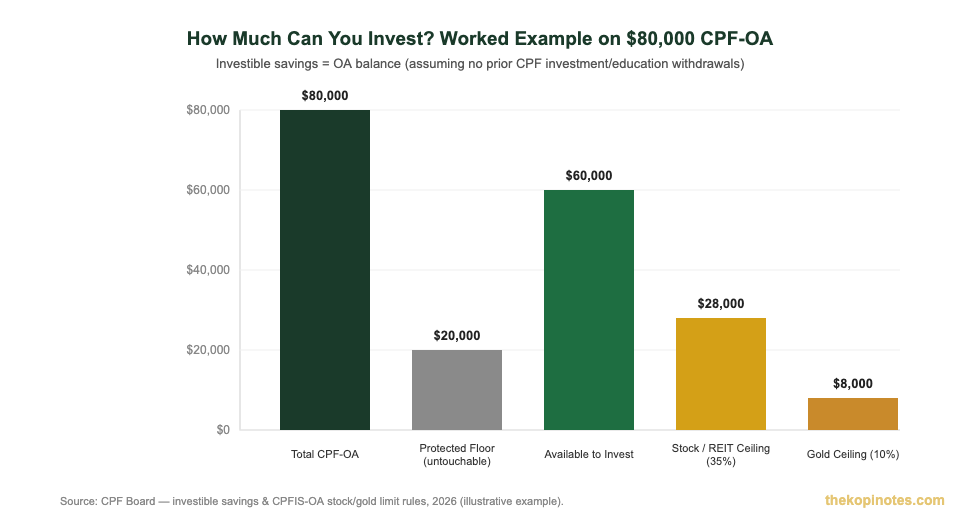
Here is a worked example. Say you have $80,000 in your OA and have never withdrawn CPF for investment or education before. Your investible savings is the full $80,000.
- Protected floor: $20,000 stays in your OA, untouched.
- Available to invest: $60,000 ($80,000 minus $20,000).
- Stock/REIT ceiling: 35% of $80,000 = $28,000.
- Gold ceiling: 10% of $80,000 = $8,000.
Because the stock/REIT ceiling ($28,000) is lower than your available balance ($60,000), it is the ceiling that actually limits you. You could still put the remaining amount into unit trusts, bonds or Singapore Government Securities (SGS), just not more than $28,000 into stocks and S-REITs specifically.
How to Open a DBS CPF Investment Account
DBS offers two ways to open a CPFIA: fully online, or in person at a branch. Most people find the online route faster.
Option 1: Apply Online via DBS digibot
- Complete the CPFIS Self-Awareness Questionnaire (SAQ) on the CPF website if you have never held a CPFIA or invested through CPFIS-SA before. Log in with Singpass, then go to Tools and Assessment Tools.
- Open DBS digibot and start the CPFIA application.
- Confirm your SAQ completion and mobile number.
- Verify your CPF account number using your NRIC.
- Select your preferred reference bank account.
- Choose how you want to receive corporate information, such as proxy voting and rights issues.
- Review and submit your application.
Option 2: Apply at a DBS Branch
Bring a completed SAQ printout and the CPF Investment Account Opening Form to any DBS branch. If you are not an existing DBS or POSB customer, you will need to open a DBS or POSB deposit account first.
Once your CPFIA is approved, link it to a DBS Vickers account, or another CPFIA-linked platform such as FSMOne, to actually place buy and sell orders. Your CPFIA itself does not let you trade directly. It is the account that holds the money and tracks your investible limits.
DBS CPFIA Fees & Charges
Fees eat into any return advantage you are hoping to gain over the 2.5% OA rate, so factor them in before you invest. DBS publishes a full schedule of charges, but the main costs are below.
| Fee Type | Amount |
|---|---|
| Transaction charge (buy/sell) | $2.50 – $30, depending on product type (stocks, bonds, funds, insurance) |
| Quarterly service charge | $2 per investment counter held, $5 minimum per quarter |
| Unit trust sales charge (DBS-distributed funds) | 0% |
| Account opening | Free |
Source: DBS CPF Investment Account Schedule of Charges, 2026.
The quarterly $2-per-counter charge is easy to miss. If you hold five different S-REITs in your CPFIA, that is $10 a quarter, or $40 a year, regardless of how well they perform. Concentrating into fewer counters can help keep this cost down if your CPFIA balance is small.
Using Your CPFIA to Invest in S-REITs
Most SGX-listed S-REITs are included under CPFIS-OA, which means you can buy them using your DBS CPFIA once it is linked to DBS Vickers. The list is not fixed forever. CPF Board and SGX periodically add counters — for example, Elite UK REIT’s Singapore Dollar counter was only added to the CPFIS-OA list on 9 June 2026.
Before you place an order, check whether the specific REIT counter you want is CPFIS-OA included. You can do this on the SGX list of stocks under the CPF Investment Scheme, or simply ask DBS Vickers or your product provider. They will block the order automatically if a counter is not eligible.
One point that surprises first-time CPFIA investors: dividends from S-REITs you hold in your CPFIA are not paid out as cash to your bank account. They are credited back into your CPFIA. From there, you can transfer the cash balance back into your OA, where it resumes earning OA interest, or reinvest it. Either way, it stays inside the CPF system until you are eligible to withdraw at 55.
This is very different from holding the same REIT in a normal cash brokerage account, where distributions land in your bank account and you can spend them immediately. If you are chasing S-REITs specifically for passive income you can use today, a CPFIA is the wrong tool. It is built for long-term retirement growth, not near-term cash flow. For a broader view of which counters currently offer the strongest yields, see our best S-REITs in Singapore 2026 roundup.
DBS CPFIA vs Robo-Advisor CPF-OA Investing
Opening a CPFIA with DBS does not lock you into DBS Vickers as your only option. You can link the same CPFIA to other CPF-OA-compatible platforms, most notably Endowus and FSMOne, each of which offers a different way to deploy the money.
| DIY via DBS Vickers | Robo / Fund Access | |
|---|---|---|
| Setup | Open CPFIA with DBS, link to DBS Vickers | Open CPFIA with any of the 3 agent banks, then link the CPFIA number to the platform |
| What you can buy | Individual S-REITs, stocks, ETFs, SGS, unit trusts | FSMOne: individual stocks, ETFs and REITs, plus 0% sales charge unit trusts. Endowus: curated, diversified CPF-OA portfolios, not single-REIT picking |
| Fees | $2.50 – $30 per trade, plus $2 per counter per quarter | Varies by platform and product. Endowus charges a flat advisory fee on managed portfolios; FSMOne charges per-trade brokerage on stocks and ETFs |
| Best for | Investors who want to pick specific S-REITs themselves | FSMOne: also DIY REIT picking with a different fee structure. Endowus: hands-off investors who want a diversified CPF-OA portfolio |
Source: DBS, FSMOne and Endowus CPF-OA linkage and fee disclosures, 2026.
If you already know which S-REIT you want and simply want the cheapest way to trade it, DBS Vickers and FSMOne both let you buy individual counters directly using your CPFIA, so compare their fee schedules before committing. If you would rather not pick individual counters at all, a managed CPF-OA portfolio through Endowus handles the diversification and rebalancing for you.
OA-Only vs CPFIA-Invested: What Is the Real Difference?
DBS publishes its own illustrative example to show the gap between leaving money in your OA versus investing it through a CPFIA. It assumes a $60,000 investible amount, comparing OA interest at 2.5% p.a. against a hypothetical 5% p.a. CPFIA return.
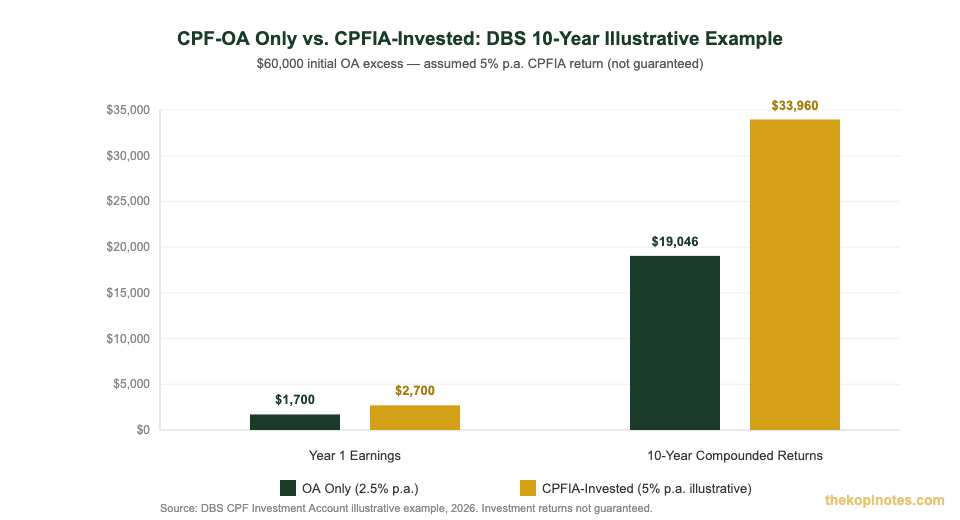
Read this example carefully. The 5% figure is illustrative only, not a promise. S-REITs, stocks and unit trusts can and do lose value, and past distributions are no guarantee of future ones. The comparison only makes sense if your realistic, after-fee return beats 2.5% consistently over your investing horizon. Otherwise you are taking on risk for nothing.
Risks and Common Mistakes
A CPFIA is a useful tool, but it comes with real trade-offs that are easy to overlook.
- Capital is not guaranteed. Unlike your OA balance, money inside a CPFIA can fall in value. A REIT can cut its distribution or its unit price can drop below what you paid.
- Fees compound against small balances. The $2 per counter quarterly charge and $2.50 – $30 trading fees matter more the smaller your CPFIA balance is.
- You lose access to the cash. Sale proceeds and dividends stay inside the CPF system. If you might need the money before 55, do not put it in a CPFIA.
- Not every counter is CPFIS-OA eligible. Always check before you buy. Some stocks and REITs are excluded, and the list changes.
- Switching agent banks is slow. An inter-bank CPFIA transfer can take up to two weeks, so pick your agent bank carefully the first time.
Next Steps
Before you open a CPFIA, run your numbers through our CPFIS Calculator to see your actual stock and gold limits, and read our CPF investment strategy guide for how a CPFIA fits into your broader retirement plan.
Frequently Asked Questions
Can I open a CPF Investment Account with any bank?
No. Only DBS, OCBC and UOB are licensed CPFIS agent banks. You can only hold one CPFIA at any point in time, though you can transfer it between banks if needed. This can take up to two weeks.
How much CPF-OA can I invest with a DBS CPFIA?
Only the amount above $20,000 in your OA. On top of that, you can invest up to 35% of your investible savings in stocks and REITs, and up to 10% in gold.
Do I need to take the SAQ before opening a DBS CPFIA?
Yes, if this is your first CPFIA or first CPFIS-SA investment. The CPF Investment Scheme Self-Awareness Questionnaire checks whether you understand the basics of investing before CPF Board lets you proceed.
Are all S-REITs CPFIS-OA eligible?
Most SGX-listed S-REITs are, but not every counter, and the list changes over time. Elite UK REIT’s SGD counter, for example, was only added in June 2026. Always check the SGX list or ask your product provider before placing an order.
What happens to REIT dividends I earn inside my CPFIA?
They are credited back into your CPFIA, not paid out as cash. You can transfer the balance to your OA, where it earns OA interest again, but you cannot withdraw it as spendable cash until age 55, after setting aside your Full Retirement Sum.
Can I use Endowus or FSMOne with a DBS CPFIA?
Yes. You still only hold one CPFIA with one agent bank, but you can link that same CPFIA number to platforms like Endowus or FSMOne to access their fund and trading options alongside, or instead of, DBS Vickers.
What are the DBS CPFIA fees?
Transaction charges range from $2.50 to $30 depending on the product, plus a quarterly service charge of $2 per investment counter held, with a $5 minimum per quarter. Account opening itself is free.
Is investing my CPF-OA worth it versus leaving it at 2.5%?
It depends on your risk tolerance, time horizon and confidence in beating 2.5% p.a. after fees. Since your OA return is guaranteed and CPFIA returns are not, only invest if you are comfortable that the investment could underperform, or even lose money, versus simply leaving it in your OA.
This article was researched with the help of AI. While we strive to keep all information accurate and up to date, there may be errors. If you notice any discrepancies, please contact us.