Manulife Endowment Plan Singapore 2026: Complete Guide & Comparison
Goal 2026, IncomeGen, IncomeSecure, GrowSecure and WealthGen compared side by side — guaranteed returns, minimum premiums and who each plan suits.
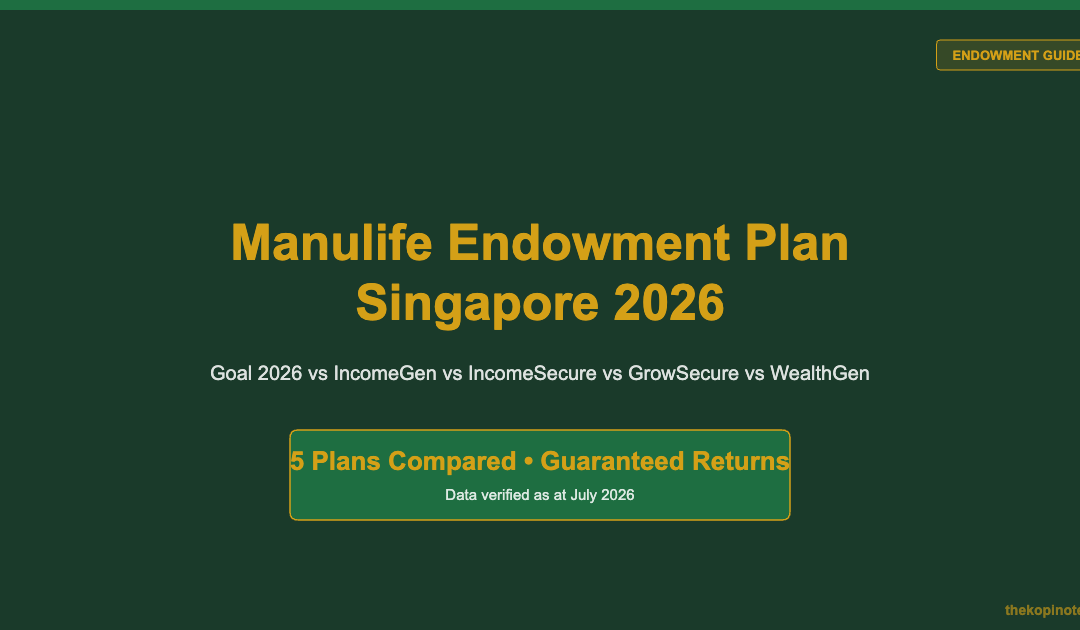
Manulife offers five main savings and endowment plans in Singapore for 2026: Goal 2026 (I), IncomeGen (II), IncomeSecure, GrowSecure and WealthGen. Goal 2026 is a 2-year single premium plan with guaranteed returns of about 1.44% p.a., rising to 1.60% p.a. with bonuses. The rest build income streams or long-term wealth with guaranteed protection.
Not financial advice. All figures are for educational reference only. Data verified as at July 2026 unless otherwise noted.
- Manulife Goal 2026 (I) is the only short-term option: 2 years, capital guaranteed, about 1.44%–1.60% p.a., from S$5,000.
- IncomeGen, IncomeSecure, GrowSecure and WealthGen are longer-horizon plans for income streams or legacy wealth, not quick parking of cash.
- For pure yield, CPF OA (2.5%), the Singapore Savings Bond (2.11% 10-year average) and T-bills (1.50%) currently beat Goal 2026’s guaranteed rate — Manulife’s edge is the built-in death coverage and no health check.
Table of Contents
Contents — Click to expand
- What Is a Manulife Endowment Plan?
- Manulife’s 2026 Savings & Endowment Plan Lineup
- Key Facts at a Glance
- Manulife Goal 2026 (I): The Short-Term Option
- IncomeGen vs IncomeSecure: Which Fits You?
- GrowSecure & WealthGen: Long-Term Wealth
- Manulife Plans vs CPF, SSB, T-Bills & Fixed Deposits
- Who Should Buy a Manulife Endowment Plan?
- How to Buy a Manulife Endowment Plan
- Frequently Asked Questions
What Is a Manulife Endowment Plan?
A Manulife endowment plan is a life insurance policy that also works as a forced savings tool. You pay premiums — either as a single lump sum or over several years — and Manulife invests part of your money in its Participating Fund, a pool of assets shared with other policyholders.
In return, you get two types of returns. Guaranteed returns are locked in from day one and do not change, no matter how the fund performs. Non-guaranteed bonuses depend on the Participating Fund’s actual investment results, so they can be higher or lower than illustrated.
Manulife (Singapore) Pte. Ltd. is one of the longest-running insurers in the local market, alongside NTUC Income, Great Eastern, AIA and Prudential. Its savings plans sit under the “Save” category on manulife.com.sg, distinct from investment-linked policies (ILPs), which put your premiums directly into unit-linked sub-funds with no capital guarantee.
The word “endowment” technically means a plan that pays a lump sum at a fixed maturity date — that’s what Manulife Goal 2026 (I) does. Manulife’s other savings plans (IncomeGen, IncomeSecure, GrowSecure and WealthGen) are closer to whole-life savings or income plans. But Singaporeans commonly search for all of them under “Manulife endowment plan,” so this guide covers the full lineup. That way you can pick the right structure for your goal, not just the plan with that exact label.
Manulife’s 2026 Savings & Endowment Plan Lineup
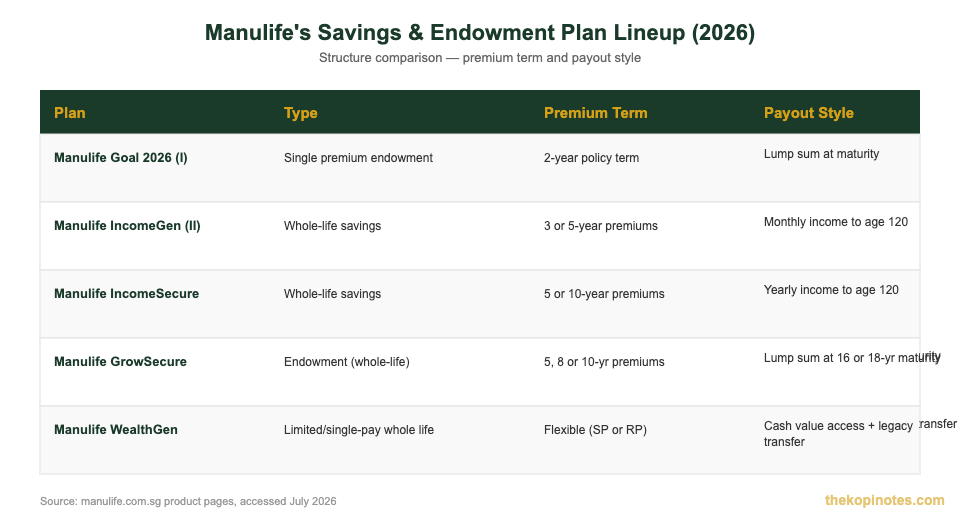
As at July 2026, Manulife Singapore actively sells five savings and endowment plans. Here’s how they differ before you dive into the numbers.
Manulife Goal 2026 (I) is the closest match to a “classic” endowment: pay once, wait two years, collect a guaranteed lump sum plus any bonus. Manulife IncomeGen (II) and Manulife IncomeSecure are whole-life plans built to generate income — monthly for IncomeGen, yearly for IncomeSecure — rather than a single payout. Manulife GrowSecure is a longer-dated endowment (16 or 18-year policy term) aimed at medium-term goals like a child’s university fees. Manulife WealthGen is the most flexible of the five: a limited-pay or single-pay whole life plan built around legacy planning, with options to split the policy, change the life insured, or pay death benefits to beneficiaries in instalments.
Manulife periodically retires and relaunches plans under new names — for example, Manulife SteadyPayout is no longer listed on the current product pages. Always check manulife.com.sg for the active version before applying, since older marketing materials may show outdated rates.
Key Facts at a Glance
| Plan | Structure | Premium Term | Min. Premium | Guarantee |
|---|---|---|---|---|
| Goal 2026 (I) | Single premium, 2-yr term | One-time | S$5,000 | 100% capital + ~1.44% p.a. |
| IncomeGen (II) | Whole life, monthly income | 3 or 5 years | Quotation-based | Guaranteed income component |
| IncomeSecure | Whole life, yearly income | 5 or 10 years | Quotation-based | Guaranteed income component |
| GrowSecure | 16 or 18-yr endowment | 5, 8 or 10 years | Quotation-based | 100% capital at maturity |
| WealthGen | Limited/single-pay whole life | Flexible | Quotation-based | Cash value access, no fixed published rate |
Source: manulife.com.sg product pages, accessed July 2026. “Quotation-based” means Manulife does not publish a fixed minimum on the public product page — your consultant provides this based on age, sum insured and premium term.
Manulife Goal 2026 (I): The Short-Term Option
If you want a short, low-risk parking spot for cash — with some life insurance thrown in — Manulife Goal 2026 (I) is Manulife’s most straightforward answer.
Here’s how it works. You pay a single premium of at least S$5,000. Manulife locks this into a 2-year policy term. At maturity, you get back 100% of your capital plus a guaranteed bonus, and possibly a further non-guaranteed bonus depending on how the Participating Fund performs.
Manulife quotes two illustrated investment rates of return (IIRR) — a standard MAS-required disclosure. At the lower IIRR of 1.75% p.a., you get the guaranteed portion only: a total maturity yield of about 1.44% p.a., with zero bonus. At the higher IIRR of 1.96% p.a., the illustrated maturity yield rises to about 1.60% p.a., including a non-guaranteed bonus of up to 0.32% of your single premium.
You’re also covered for death during the 2-year term, at the higher of 101% of your single premium. There’s no health check required, and you can pay using cash or your Supplementary Retirement Scheme (SRS) account.
On a S$20,000 single premium, your guaranteed maturity value works out to about S$20,582 after 2 years (a guaranteed 2.91% total return, non-annualised). If Manulife pays the full illustrated bonus, that rises to roughly S$20,646 — a total illustrated return of up to 1.60% p.a. Either way, your capital is protected: you cannot get back less than what you put in, provided you hold the policy to maturity and haven’t altered it. For more single-premium options beyond Manulife, see our single premium endowment plan Singapore comparison across six insurers.
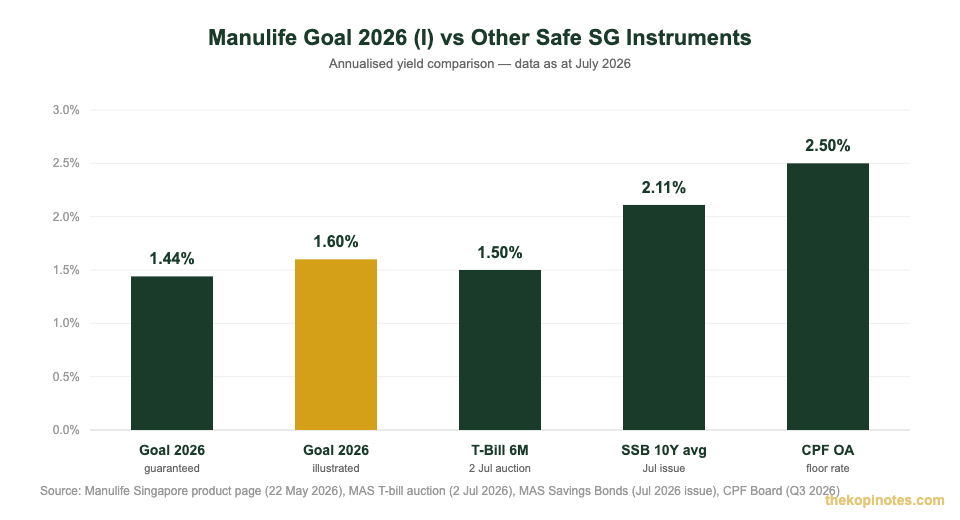
The trade-off is opportunity cost. As the chart below shows, the CPF Ordinary Account (2.5% p.a.), the July 2026 Singapore Savings Bond (2.11% p.a. 10-year average) and even 6-month T-bills (1.50% p.a. at the 2 July 2026 auction) currently pay more than Goal 2026’s guaranteed rate. Goal 2026’s advantage isn’t the yield — it’s the built-in death coverage, guaranteed acceptance, and the discipline of a fixed 2-year lock-up if you’re prone to dipping into savings.
IncomeGen vs IncomeSecure: Which Income Stream Fits You?
Manulife IncomeGen (II) and Manulife IncomeSecure both turn your premiums into a lifetime income stream, but they differ in payout frequency and timing.
IncomeGen (II) pays monthly. Choose a 3-year or 5-year premium payment term, and income starts at the end of the 49th policy month (3-year term) or the 61st policy month (5-year term) — roughly 4 or 5 years after you start paying. Income continues up to age 120. The guaranteed portion of your monthly income equals 0.81% of your sum insured, divided by 12. Manulife illustrates a non-guaranteed top-up of up to 2.43% of sum insured (at the higher 4.25% p.a. IIRR) or 1.17% (at the lower 3.00% p.a. IIRR), also divided by 12.
IncomeSecure pays yearly instead of monthly, and starts earlier if you choose the 5-year premium term — from the end of policy year 3. If you pick the 10-year premium term, income can start from year 5 or year 10. Like IncomeGen, payouts run up to age 120 and step up over time depending on your premium term and payout year.
Both plans share the same core protections: coverage against death and terminal illness till age 120, premium waiver on total and permanent disability (TPD), an additional lump sum if you’re diagnosed with terminal cancer, and the option to change the life insured after 2 policy years. Neither requires a health check-up.
In practice: pick IncomeGen if you want smaller, more frequent payouts to supplement monthly expenses — useful for retirement income planning alongside CPF LIFE. Run the numbers with our Singapore retirement calculator to see how this fits your overall plan. Pick IncomeSecure if you’d rather receive a larger sum once a year, for example to fund an annual family gift or a lump-sum expense.
GrowSecure & WealthGen: Building Long-Term Wealth
Manulife GrowSecure is built for a specific medium-term goal with a known end date — think a child turning 18 or a planned retirement age. You choose a premium payment term of 5, 8 or 10 years, and a policy term of either 16 or 18 years. Your capital is 100% guaranteed at maturity (provided the policy hasn’t been altered), and you get a premium freeze option after 2 full years of premiums if you hit a rough patch financially. GrowSecure also pays an extra 50% of total premiums paid to date if the life insured dies accidentally before age 80, and waives future premiums if they become totally and permanently disabled.
Manulife WealthGen takes a different approach: instead of a fixed maturity date, it’s designed to grow wealth up to age 120, with a suite of legacy planning tools. You can split the policy into multiple policies for different beneficiaries, nominate a contingent policy owner in case something happens to you, arrange for death benefits to be paid out over 2 to 10 years instead of as one lump sum, or change the life insured entirely. WealthGen also offers a retrenchment payout benefit and accepts SRS payments for single premium policies.
The distinction matters: GrowSecure suits a saver with a fixed target date. WealthGen suits someone thinking about multi-generational wealth transfer, where flexibility matters more than a guaranteed payout on a specific day.
Manulife Endowment Plans vs CPF, SSB, T-Bills & Fixed Deposits
Before committing to any Manulife plan, it’s worth lining up the guaranteed return against what you’d get from parking the same money elsewhere. This comparison uses Manulife Goal 2026 (I) since it’s the only plan with a clearly published guaranteed rate — the income and legacy plans depend too much on individual sum insured and age to generalise.
| Instrument | Guaranteed / Typical Return | Lock-in | Min. Amount | Protection |
|---|---|---|---|---|
| Manulife Goal 2026 (I) | ~1.44% p.a. guaranteed, up to 1.60% p.a. illustrated | 2 years | S$5,000 | Life cover + SDIC |
| CPF Ordinary Account | 2.5% p.a. (floor, Jul–Sep 2026) | Until retirement/housing use | Automatic | Government-backed |
| Singapore Savings Bond (Jul 2026) | 2.11% p.a. average over 10 yrs (1.46% Yr 1) | None — redeem any month | S$500 | Government-backed |
| 6-Month T-Bill (2 Jul 2026 auction) | 1.50% p.a. | 6 months | S$1,000 | Government-backed |
| 12-Month Fixed Deposit (typical promo) | ~2.0%–2.5% p.a. | 12 months | S$1,000–S$20,000 (varies by bank) | SDIC up to S$100,000 |
Source: Manulife Singapore (22 May 2026), CPF Board (Jul–Sep 2026), MAS (Jul 2026 SSB issue & 2 Jul 2026 T-bill auction).
The pattern is consistent: pure savings instruments from CPF, MAS and banks currently out-yield Goal 2026’s guaranteed rate. That’s normal — insurers price in the cost of life coverage, guaranteed acceptance, and profit margin. Manulife’s plans make more sense once you value the insurance component, not just the yield. If you’re shopping across insurers rather than just Manulife, our best short-term endowment plans in Singapore guide ranks six providers side by side.
Who Should Buy a Manulife Endowment Plan?
A Manulife endowment or savings plan is worth considering if you want a hands-off, capital-guaranteed way to save with life insurance attached, and you don’t already have adequate term life coverage elsewhere. It also suits savers who struggle with discipline — locking money into a fixed policy term removes the temptation to withdraw early.
Manulife Goal 2026 (I) suits someone with a 2-year time horizon and spare cash beyond their emergency fund — for example, saving toward a wedding or a home renovation. IncomeGen and IncomeSecure suit those planning retirement income 5 to 10 years out, who want predictable payouts on top of CPF LIFE. GrowSecure fits a parent saving for a child’s education with a known target date. WealthGen suits those focused on estate and legacy planning rather than short-term yield.
Consider alternatives if your primary goal is maximising yield with full liquidity — CPF OA, T-bills and SSBs will usually beat Goal 2026’s guaranteed rate, and none of them lock up your capital for years. Beyond CPF OA’s base rate, see our CPF investment strategy guide for ways to grow your CPF savings further. You should also hold off if you don’t yet have adequate term life or health insurance in place — a savings-linked death benefit is not a substitute for dedicated protection.
How to Buy a Manulife Endowment Plan in Singapore
1. Confirm your protection gaps first. Before committing cash to a savings plan, check that your term life and hospitalisation coverage are adequate — Manulife’s savings plans include only modest death benefits, not full protection.
2. Pick the plan that matches your time horizon. Use the comparison above: 2 years for Goal 2026, 5–10+ years for GrowSecure, and open-ended for IncomeGen, IncomeSecure and WealthGen.
3. Get a personalised illustration. Manulife’s product pages show generic rates, but your actual guaranteed and non-guaranteed figures depend on your age, sum insured and premium term. Request a benefit illustration from a Manulife Financial Consultant or an appointed distributor (including DBS/POSB branches) before applying.
4. Decide how to fund it. Goal 2026 and WealthGen (single premium) both accept SRS funds, which can also reduce your taxable income for the year if you have SRS contribution room left. Otherwise, pay by cash, GIRO or cheque.
5. Apply with no health check-up. All five plans currently offer guaranteed acceptance with no health questions — useful if you have pre-existing conditions that would complicate a health-underwritten policy elsewhere.
If you’re also building a broader portfolio alongside your endowment plan, platforms like Endowus and Syfe let you invest CPF, SRS or cash into globally diversified funds — a useful complement if you want higher expected returns than a capital-guaranteed endowment can offer. See the buttons below for referral sign-up bonuses on both platforms.
Frequently Asked Questions
What is a Manulife endowment plan and how does it work in Singapore?
A Manulife endowment plan is a life insurance policy where part of your premium is invested in Manulife’s Participating Fund. You get a guaranteed return locked in from day one, plus a non-guaranteed bonus that depends on the fund’s actual performance. Manulife Goal 2026 (I) is the clearest example — pay once, wait two years, and collect a guaranteed lump sum plus any bonus.
Is Manulife Goal 2026 the same as Manulife Goal from previous years?
No. Manulife periodically relaunches its short-term single premium endowment under a new version and year — for example, an earlier “Manulife Goal 2023” edition existed. Rates and terms change with each relaunch, so always check the guaranteed and illustrated rates on the current product page before applying, since older marketing materials may show outdated figures.
Can I use CPF or SRS to pay for a Manulife endowment plan?
It depends on the plan. Manulife Goal 2026 (I) and Manulife WealthGen (single premium) both accept Supplementary Retirement Scheme (SRS) funds. CPF Ordinary Account savings generally cannot be used for these particular savings plans — CPF investment is restricted to products approved under the CPF Investment Scheme (CPFIS), and Manulife’s short-term endowment and whole-life savings plans are not on that list as at July 2026. Always confirm directly with Manulife or your distributor before assuming CPF eligibility.
What happens if I surrender a Manulife endowment plan early?
You may get back less than what you paid in. Manulife states clearly that there are high costs involved in terminating a policy early, and your surrender value — if any — may be zero or less than your total premiums paid. This applies to all five plans covered in this guide. Only consider these plans with money you’re confident you won’t need before the policy term ends.
Which Manulife savings plan gives the highest guaranteed return?
Manulife Goal 2026 (I) is the only plan with a clearly published guaranteed annualised rate — about 1.44% p.a. guaranteed, rising to up to 1.60% p.a. with illustrated bonuses. IncomeGen, IncomeSecure, GrowSecure and WealthGen depend on your specific sum insured, age and premium term, so Manulife doesn’t publish one comparable rate for them — you’ll need a personalised benefit illustration to compare.
Are Manulife endowment plans protected if Manulife becomes insolvent?
Yes. All the plans in this guide are protected under the Policy Owners’ Protection Scheme, administered by the Singapore Deposit Insurance Corporation (SDIC). Coverage is automatic — you don’t need to apply for it. For the specific benefit types and coverage limits, check the SDIC or Life Insurance Association (LIA) websites.
How does a Manulife endowment plan compare to the Singapore Savings Bonds?
As at July 2026, the Singapore Savings Bond (SSB) pays a higher guaranteed-equivalent return — a 10-year average of 2.11% p.a. — than Manulife Goal 2026’s guaranteed rate of about 1.44% p.a., and SSBs let you redeem any month without penalty. The trade-off is that Manulife’s plan bundles in life insurance coverage and guaranteed acceptance with no health check, which SSBs don’t offer. If pure yield and flexibility matter most, SSBs generally win; if you want insurance bundled in, Manulife’s plan has that edge.
Compare Your Savings Options Further
See how a Manulife endowment plan stacks up against globally diversified investing, or explore more short-term savings plans.
Get Free Insurance Advice
Speak with a licensed insurance advisor. No obligation, no cost.
By submitting this form, you agree to our Privacy Policy.
This article was researched with the help of AI. While we strive to keep all information accurate and up to date, there may be errors. If you notice any discrepancies, please contact us.