S-REIT DIVIDEND DEEP DIVE · SGX: M1GU
Sabana Industrial REIT Dividend & DPU Guide 2026 (SGX: M1GU)
~8.9% Yield · Semi-Annual Distributions · Sharia-Compliant · CPFIS-OA Eligible
Sabana Industrial REIT (SGX: M1GU) is Singapore’s only Sharia-compliant industrial REIT and one of the highest-yielding S-REITs in 2026, offering an estimated trailing dividend yield of approximately 8.9% based on its FY2024 Distribution Per Unit (DPU) of 3.92 cents and a unit price near S$0.44. It pays distributions semi-annually — covering H1 (January–June) and H2 (July–December) — making it a reliable twice-yearly income source for Singapore investors seeking high passive income from industrial properties.
Not financial advice. All figures are for educational reference only. Data as at July 2026 unless noted. DPU figures are approximate; always verify the latest SGX announcement before investing.
Update (2 August 2026): Sabana Industrial REIT is now called Alpha Integrated REIT after internalising its manager in October 2025 (ticker M1GU is unchanged). See the full 1H2026 results breakdown — DPU rose 19.4% YoY to 2.03 cents.
- Sabana REIT (M1GU) FY2024 DPU was approximately 3.92¢ — roughly 8.9% yield at S$0.44/unit
- Distributions are paid semi-annually (H1 + H2). You must hold before the ex-dividend date to qualify
- CPFIS-OA eligible: you can use your CPF Ordinary Account savings to buy M1GU through FSMOne or DBS Vickers
Table of Contents
Jump to a section
- What Is Sabana Industrial REIT?
- DPU History FY2019–FY2025
- Dividend Yield 2026
- Distribution Schedule & Ex-Dividend Dates
- Peer Yield Comparison: Sabana vs Industrial REIT Peers
- Buying Sabana REIT via CPF OA or SRS
- How to Buy Sabana REIT for Dividends
- Is Sabana REIT Worth It for Dividend Investors?
- Frequently Asked Questions
What Is Sabana Industrial REIT?
Sabana Industrial REIT (SGX: M1GU) was listed on the Singapore Exchange in November 2010, making it one of the pioneer S-REITs focused on industrial real estate. It is also Singapore’s only Sharia-compliant REIT — meaning its operations, financing structures, and distributions are structured to comply with Islamic finance principles. That said, it is open to all investors regardless of religion.
The REIT’s portfolio consists entirely of Singapore industrial properties — a mix of high-tech industrial buildings, food-grade factories, chemical warehouses, and logistics facilities. Unlike some peers that have ventured overseas, Sabana remains a pure-play Singapore industrial REIT. This keeps its operations simple and its income stream tied directly to Singapore’s industrial property market.
| Parameter | Details |
|---|---|
| SGX Ticker | M1GU |
| REIT Type | Industrial (Sharia-compliant) |
| Listed | November 2010, SGX Mainboard |
| Portfolio Focus | Singapore industrial properties (hi-tech, logistics, food factory) |
| No. of Properties | ~18 properties across Singapore |
| Distribution Frequency | Semi-annual (H1 + H2) |
| Approx. Gearing | ~34% (as at 2025 annual report) |
| CPFIS-OA Eligible | Yes — CPF Ordinary Account approved |
| Manager | Sabana Real Estate Investment Management Pte. Ltd. |
Source: Sabana Industrial REIT Annual Report 2024, SGX | Data as at July 2026
Sabana REIT DPU History FY2019–FY2025
One of the most important things to check when investing in any S-REIT for dividends is whether its Distribution Per Unit (DPU) has been growing, declining, or staying flat over time. A rising DPU trend suggests a healthy, growing business — while a falling DPU is a red flag. For a full explanation of DPU and how it’s calculated, see our S-REIT DPU guide.
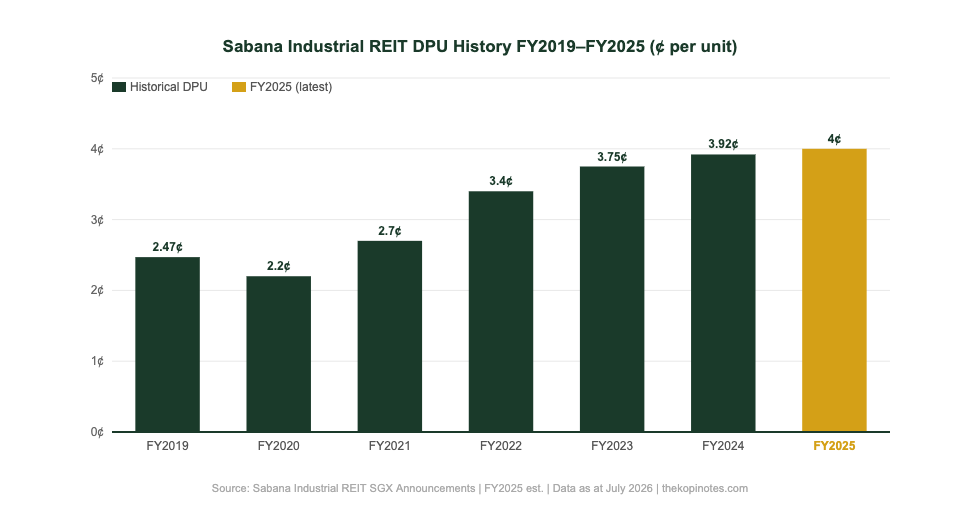
Sabana REIT’s DPU went through a difficult period during 2019–2020 when COVID-19 disrupted its tenants and some properties saw vacancies. However, the REIT has staged a strong recovery since FY2021, driven by active portfolio management, asset recycling, and the broader industrial property boom in Singapore. The chart below shows the full DPU recovery trajectory.
| Financial Year | H1 DPU | H2 DPU | Full Year DPU | YoY Change |
|---|---|---|---|---|
| FY2019 | 1.26¢ | 1.21¢ | 2.47¢ | — |
| FY2020 | 0.80¢ | 1.40¢ | 2.20¢ | −10.9% |
| FY2021 | 1.35¢ | 1.35¢ | 2.70¢ | +22.7% |
| FY2022 | 1.70¢ | 1.70¢ | 3.40¢ | +25.9% |
| FY2023 | 1.90¢ | 1.85¢ | 3.75¢ | +10.3% |
| FY2024 | 1.97¢ | 1.95¢ | 3.92¢ | +4.5% |
| FY2025 (est.) | ~2.00¢ | est. | ~4.00¢* | ~+2% |
Source: Sabana Industrial REIT SGX Announcements, Annual Reports | *FY2025 full-year DPU is estimated — verify latest SGX disclosure. Data as at July 2026.
What stands out is the sustained recovery from the FY2020 COVID trough. Since FY2021, Sabana has delivered four consecutive years of DPU growth — a positive signal for income investors. The rising DPU trend has been supported by higher occupancy rates, positive rental reversions, and disciplined capital management.
Sabana REIT Dividend Yield 2026
As at July 2026, Sabana Industrial REIT’s trailing dividend yield is approximately 8.9% — based on the FY2024 DPU of 3.92¢ and a unit price near S$0.44. Among Singapore industrial REITs, this is one of the highest yields available, making Sabana particularly attractive to income-focused investors who are comfortable with a mid-cap REIT.
To calculate your personal yield, divide the annual DPU by the price you paid per unit. For example, if you buy at S$0.42/unit and the annual DPU remains at 3.92¢, your personal yield would be approximately 9.3%. If you buy at S$0.46/unit, your yield drops to ~8.5%.
Remember: yield moves inversely with price. A higher unit price means a lower yield on your investment cost. That’s why buying at or below fair value matters for income investors. You can use our Singapore retirement calculator to see how much passive income you’d need from REITs like Sabana to cover your living expenses.
Distribution Schedule & Ex-Dividend Dates
Sabana REIT pays distributions twice a year — once for H1 (covering January–June) and once for H2 (covering July–December). You must hold units on or before the ex-dividend date to qualify for that distribution payment. Buying after the ex-dividend date means you’ll miss that round — and have to wait for the next one.
The exact ex-dividend dates are announced via SGX each time and are typically 4–6 weeks before the payment date. Check SGX’s announcements section for the latest confirmed dates when investing.
| Distribution Period | Approx. Ex-Div Month | Approx. Payment Month | DPU (FY2024 ref.) |
|---|---|---|---|
| H1 (Jan–Jun) | August | September | ~1.97¢ |
| H2 (Jul–Dec) | February | March | ~1.95¢ |
Source: Sabana Industrial REIT SGX Announcements | Months are approximate — always verify on SGX before trading. Data as at July 2026.
If you hold through both distributions, you collect income twice a year. At 3.92¢ annual DPU and 10,000 units held, that’s about S$392 per year in passive income — before any brokerage costs. To build a portfolio generating S$1,000/month, you would need approximately S$135,000 worth of Sabana units (at ~8.9% yield). Building such a portfolio requires consistent saving and investing over time — that’s where platforms like Syfe referral code and sign-up bonus and FSMOne referral code can help by reducing your transaction costs.
Peer Yield Comparison: Sabana vs Industrial REIT Peers
How does Sabana REIT’s ~8.9% yield stack up against other Singapore industrial REITs? The chart below shows the approximate trailing yields of six industrial S-REITs. Sabana offers the highest yield in this peer group — but higher yield often signals higher perceived risk or smaller market cap. It’s important to consider not just yield, but also gearing, DPU sustainability, and portfolio quality.
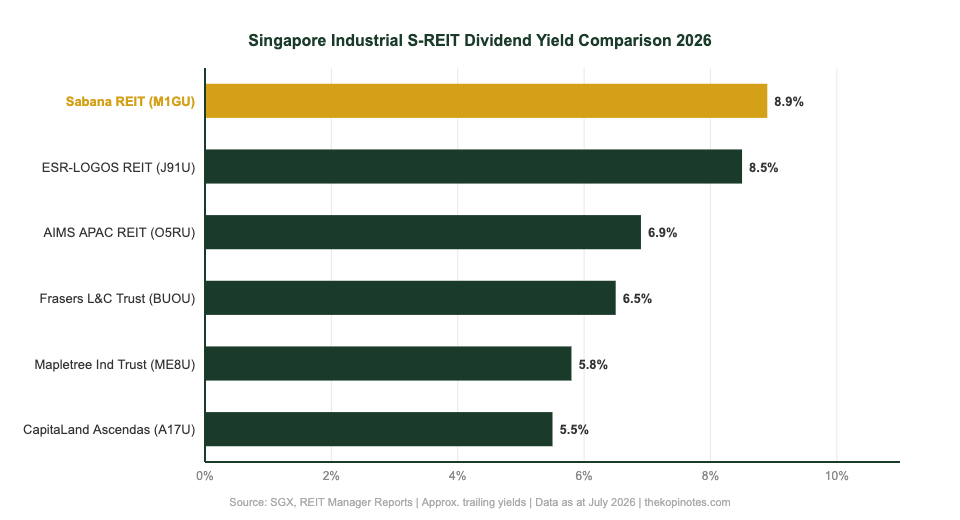
Sabana’s ~8.9% yield is notably higher than mid-cap peers like AIMS APAC REIT (~6.9%) and large-cap leaders like CapitaLand Ascendas REIT (~5.5%). This yield premium partly reflects Sabana’s smaller size and perceived liquidity risk. ESR-LOGOS REIT (~8.5%) is the closest competitor on yield, but it carries higher gearing.
For investors willing to accept mid-cap REIT risk in exchange for higher income, Sabana’s combination of a rising DPU trend, pure Singapore portfolio, and Sharia-compliant structure makes it one of the most distinctive options in the industrial REIT space. For a full look at top income REITs, see our guide to the best S-REITs in Singapore 2026 and our guide to building passive income in Singapore.
Buying Sabana REIT via CPF OA or SRS
Sabana Industrial REIT is listed under the CPF Investment Scheme (CPFIS-OA) approved securities list. This means you can use the savings in your CPF Ordinary Account (OA) — which otherwise earns a guaranteed 2.5% per year — to buy M1GU units through an approved CPFIS broker.
At an estimated yield of ~8.9%, buying Sabana REIT with CPF OA money offers a significant yield pickup over the default 2.5% CPF OA rate. Of course, CPF OA money deployed into REITs is no longer guaranteed — you take on market risk and DPU variability. Only invest what you can afford to keep locked in for the medium to long term.
You can also buy Sabana REIT through your Supplementary Retirement Scheme (SRS) account. SRS contributions reduce your taxable income in the year of contribution, so buying Sabana REIT via SRS gives you both a tax deduction upfront and ongoing dividend income — an attractive combination for higher-income earners in the 11.5%+ tax bracket.
Both CPF OA and SRS purchases must go through a CDP-linked brokerage (see broker table below). FSMOne and DBS Vickers are the two most common choices for CPFIS-approved investing in Singapore.
How to Buy Sabana REIT for Dividends
Sabana Industrial REIT (M1GU) is traded on SGX Mainboard. You can buy it through any SGX-approved brokerage. Here are the four most popular options for Singapore investors, comparing costs and key features for dividend collecting:
| Broker | Commission | CDP Ownership | CPF/SRS | Best For |
|---|---|---|---|---|
| FSMOne | 0.08% (min S$10) | ✅ Yes | ✅ Yes | CPF/SRS, lowest cost |
| DBS Vickers | 0.18% (min S$25) | ✅ Yes | ✅ Yes | Bank-backed, DBS account holders |
| IBKR (Interactive Brokers) | S$1.50 (flat, min) | ⚠️ Custodian | ❌ No | Cash account, low fees |
| Syfe Trade | 0% (first 3 trades/mo) | ⚠️ Custodian | ❌ No | Small investors, casual trading |
Source: Broker websites | Commission rates as at July 2026 | Always verify current fees before opening an account
For CPF or SRS investing, FSMOne is the most cost-efficient option with its 0.08% commission and CDP direct ownership. Use our FSMOne referral code P0544985 to get a sign-up bonus when you open an account. For cash investing, IBKR’s flat S$1.50 minimum commission is the cheapest for larger orders — use referral code jianxiong368 when signing up.
Is Sabana REIT Worth It for Dividend Investors?
The case for Sabana REIT comes down to its combination of high yield, DPU recovery, and low gearing relative to its yield peers. Here’s an honest look at the pros and cons:
| Pros ✅ | Cons ⚠️ |
|---|---|
| ~8.9% trailing yield — one of the highest among industrial S-REITs | Smaller market cap and lower trading liquidity than blue-chip peers |
| 4 consecutive years of DPU growth (FY2021–FY2024) | Singapore-only portfolio — no geographic diversification |
| Moderate gearing (~34%) — healthier balance sheet than many high-yield peers | DPU was cut significantly during COVID-19 (FY2020) |
| CPFIS-OA eligible — can use CPF savings to collect dividends | Interest rate sensitivity — higher rates increase borrowing costs, pressuring DPU |
| Sharia-compliant structure — unique in Singapore REIT market | Historical legacy issues — past proxy battles and management disputes |
| Pure-play Singapore industrial exposure — simple, transparent portfolio | Older industrial buildings may need more capital expenditure to stay competitive |
Author’s analysis based on public filings. Not financial advice. Conduct your own due diligence before investing.
For investors focused on maximising dividend income and comfortable with mid-cap REIT risk, Sabana REIT deserves a closer look. It fits well within a diversified S-REIT portfolio alongside higher-quality but lower-yielding names. If you want to see how Sabana compares alongside the broader S-REIT market, our best S-REITs in Singapore 2026 guide ranks the top picks across all sectors.
Start Collecting Sabana REIT Dividends
Ready to invest in Sabana REIT or other S-REITs for passive income? Here are the top platforms with sign-up bonuses:
Frequently Asked Questions
What is Sabana Industrial REIT's dividend yield in 2026?
How often does Sabana REIT pay dividends?
Is Sabana REIT CPFIS-OA eligible?
What is Sabana REIT's DPU history?
Is Sabana REIT Sharia-compliant?
How does Sabana REIT compare to ESR-LOGOS REIT?
What is the best broker for Sabana REIT dividends via CPF?
How do I receive Sabana REIT dividends?
Is Sabana REIT a good investment for passive income in Singapore?
Disclaimer
This article is for educational purposes only and does not constitute financial advice. DPU and yield figures are approximate estimates based on publicly available data as at July 2026 — always verify the latest SGX announcements before making any investment decision. Past DPU does not guarantee future distributions. All S-REITs are subject to market, interest rate, occupancy, and liquidity risks. Always assess your own risk tolerance and consult a licensed financial adviser if needed. TKN may earn referral fees from broker sign-ups — this does not affect our editorial independence.
This article was researched with the help of AI. While we strive to keep all information accurate and up to date, there may be errors. If you notice any discrepancies, please contact us.