Multi-Currency Credit Card Singapore: Best Zero FX Fee Cards (2026)
Compare Singapore’s best credit cards with zero foreign transaction fees — stop paying 3.25% on every overseas purchase.
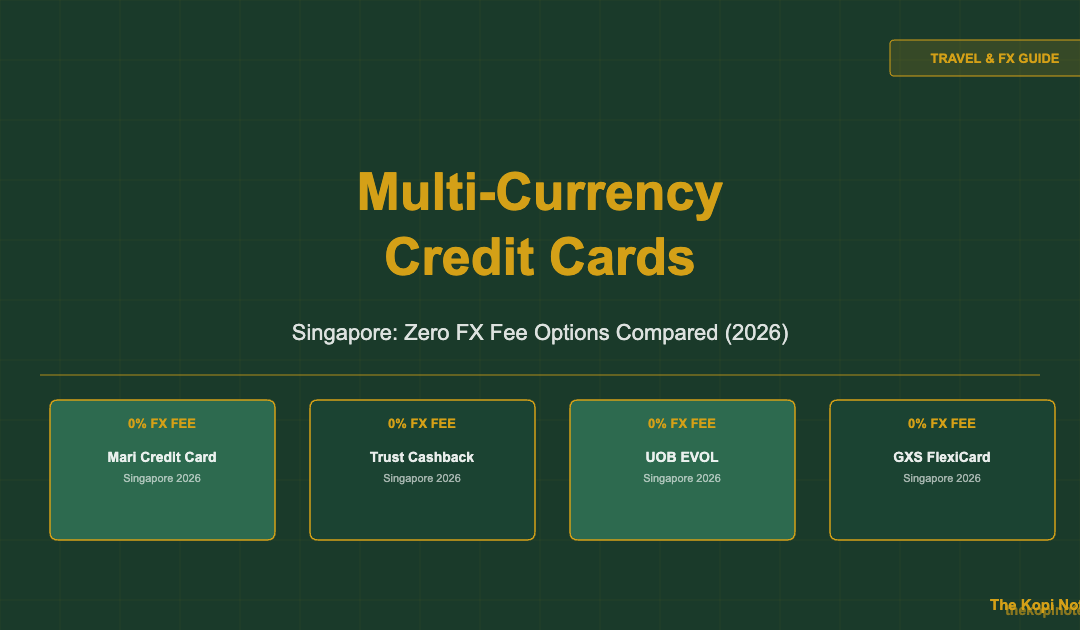
A multi-currency credit card in Singapore is a credit card that lets you spend overseas without paying the usual 3.25% foreign currency (FCY) transaction fee. As of 2026, a small but growing number of credit cards — including the Mari Credit Card, Trust Cashback Card, and UOB EVOL — charge zero FCY fees on overseas transactions, giving you better rates than most traditional bank cards.
Not financial advice. All figures are for educational reference only. Data verified as at July 2026.
- Most Singapore credit cards charge 3.25% on overseas spend — that is S$32.50 lost on every S$1,000 you spend abroad.
- The Mari Credit Card currently offers the best deal: 0% FCY fee plus 1.5% cashback on overseas spend (capped at S$1,500/month), valid until December 2026.
- If you want a simpler option with no spend cap, the Trust Cashback Card gives 0% FCY fee plus 0.5% cashback on all overseas transactions.
What Is a Multi-Currency Credit Card?
A multi-currency credit card is simply a credit card that handles overseas spending without penalising you with extra fees. When you swipe a standard DBS or OCBC card in Japan, the bank converts your yen payment to Singapore dollars and adds a 3.25% administrative fee on top. That is the FCY (foreign currency) transaction fee.
A multi-currency credit card removes that fee entirely. You pay only the Visa or Mastercard network conversion rate, which typically adds just 0.1 to 0.6% above the mid-market rate depending on the currency. That is a massive saving compared to 3.25%.
It is worth understanding what multi-currency credit cards are not. They are not the same as multi-currency prepaid wallets like YouTrip, Wise, or Revolut. Those let you hold and convert specific currencies in advance. Credit cards work differently — they simply skip the bank’s FCY fee when you pay overseas.
For Singapore travellers, this distinction matters. You are choosing between two cost-saving strategies: pay with a zero-FCY credit card and earn cashback, or load up a prepaid wallet and lock in good rates before your trip.
Understanding the 3.25% FCY Fee (And Why It Matters)
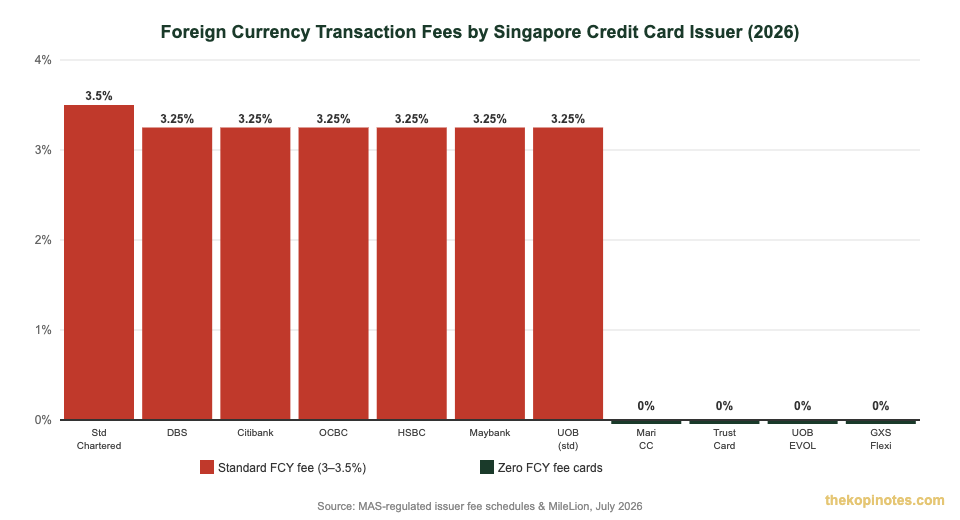
The FCY transaction fee is charged by your bank every time you spend in a foreign currency. Most Singapore banks charge 3.25%. Standard Chartered charges 3.5% — the highest in the market.
Here is the maths for a two-week Japan holiday. Say you spend SGD 5,000 in total on hotels, food, transport, and shopping. At 3.25%, your bank pockets S$162.50 in FCY fees alone. Over a year of regular travel, that easily adds up to S$500 or more.
| Card / Issuer | Network | FCY Fee | Cost on S$5,000 Overseas |
|---|---|---|---|
| Standard Chartered | Visa / MC | 3.5% | S$175 in fees |
| DBS / OCBC / Citi / HSBC / Maybank | Visa / MC | 3.25% | S$162.50 in fees |
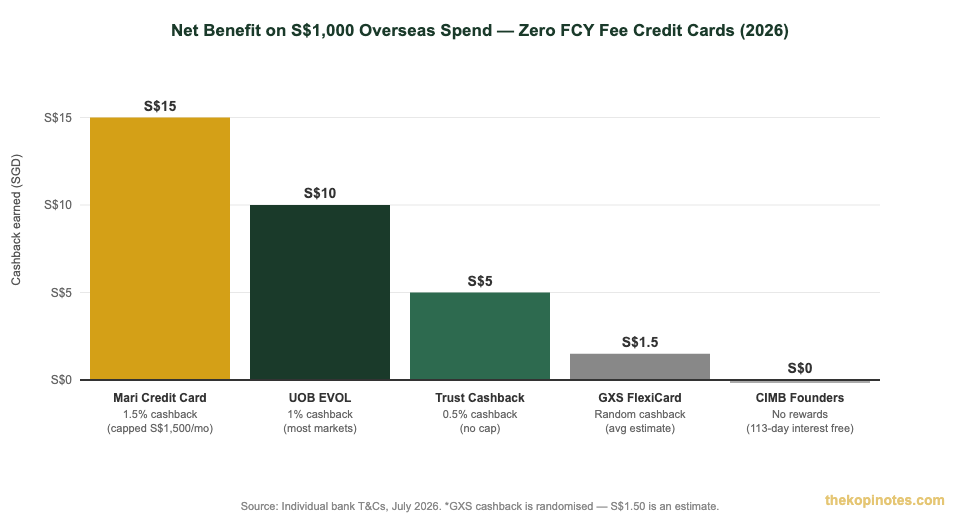
| Mari Credit Card | Mastercard | 0% | S$0 fee + S$75 cashback back |
| Trust Cashback Card | Visa | 0% | S$0 fee + S$25 cashback back |
| UOB EVOL Card | Visa | 0% | S$0 fee + S$50 cashback back |
Source: Individual bank fee schedules as at July 2026. Mari cashback based on 1.5% rate (capped); UOB EVOL based on 1% non-China/Europe rate; Trust based on 0.5% rate.
Best Zero FX Fee Credit Cards in Singapore (2026)
As of July 2026, five credit cards in Singapore waive the FCY transaction fee entirely. Here is a breakdown of each one.
1. Mari Credit Card — Best Overall for FCY Cashback
The full MariBank review Singapore covers the digital bank in detail, but the Mari Credit Card stands out specifically for overseas use. From 1 January 2026, MariBank removed its 3% FCY fee and replaced it with a flat 1.5% cashback on all foreign currency spend.
The cashback cap is S$22.50 per month, which means it applies fully for up to S$1,500 of overseas spending per month. From March 2026, the cashback posts instantly when the transaction settles. There is no minimum spend required.
The 1.5% cashback promotion is valid until 31 December 2026. Beyond that, MariBank may revise terms — so this card is particularly attractive for 2026 travel planning right now.
Best for: Travellers spending up to S$1,500 per month overseas who want instant cashback with zero complexity.
2. Trust Cashback Card — Best for No-Cap Simplicity
The Trust Cashback Card waives FCY fees entirely and earns 0.5% cashback on all overseas transactions in your non-bonus category. There is no monthly spend cap and no minimum spend required. If you spend S$10,000 overseas in a month, you still earn 0.5% on all of it.
One important nuance: Trust reduced its overseas cashback from 1% to 0.5% effective 1 March 2026. The card’s bonus category system for local spend is complex, but for overseas use it is straightforward: 0% FCY fee and 0.5% cashback, always.
The Trust Cashback Card has no annual fee. You can see how it stacks up against miles cards in the best credit card for overseas spending Singapore guide.
Best for: High-volume overseas spenders who want simple, uncapped cashback with no annual fee.
3. UOB EVOL Card — Best Balance of Cashback and No Annual Fee
The UOB EVOL Card has had zero FCY fees since June 2025 and offers tiered overseas cashback in 2026: 1% on all overseas markets except China and Europe, where the rate is 0.5%. This promotion runs until 31 December 2026. From 1 July 2026, the annual fee is permanently waived.
For most Singapore travellers — who visit ASEAN, Japan, Korea, or Australia — the 1% cashback rate applies. On a S$3,000 Japan trip, you would earn S$30 back with no fees deducted at all.
Best for: Travellers who frequently visit non-European destinations and want solid cashback with no annual fee.
4. GXS FlexiCard — Best as a Backup Card
GXS FlexiCard has no FCY fee, but its cashback mechanic is gamified: you receive a random cashback amount for each transaction of at least S$10. In practice, most users report earning a few cents per transaction. The maximum theoretical cashback per transaction is S$3.
The GXS FlexiCard charges S$54.50 annual fee (waived for year one). For most regular travellers, the Mari, Trust, or EVOL card will earn significantly more. But as a backup card with zero FCY fees for occasional small purchases, the FlexiCard works fine.
Best for: A backup card for occasional overseas trips; not recommended as a primary travel card.
5. CIMB Founders Card — Best for Cash Flow Management
The CIMB Founders Card is the oddity on this list. It charges zero FCY fees but offers no cashback or miles on overseas spend. What it does offer is up to 113 interest-free days on all retail purchases — far longer than the 50 to 55 days offered by most cards.
If you are a business owner or frequent traveller who needs to manage cash flow across large overseas expenses (trade fairs, bulk inventory purchases, extended business trips), the extended interest-free period can be worth more than any cashback rate.
Best for: Business owners needing to manage large overseas expenses with maximum cash flow flexibility.
Side-by-Side Comparison
Here is the full comparison of all five zero-FCY credit cards available to Singapore residents as at July 2026.
| Card | FCY Fee | Overseas Cashback | Cap | Annual Fee | Network |
|---|---|---|---|---|---|
| Mari Credit Card | 0% | 1.5% | S$1,500/month | Nil | Mastercard |
| UOB EVOL Card | 0% | 0.5–1% | None stated | Nil (from July 2026) | Visa |
| Trust Cashback Card | 0% | 0.5% | None | Nil | Visa |
| GXS FlexiCard | 0% | Random (min S$10 spend) | S$3 max per txn | S$54.50 (yr 2+) | Visa |
| CIMB Founders Card | 0% | None | N/A | Nil | Mastercard |
Source: Individual bank T&Cs as at July 2026. Mari and UOB EVOL overseas cashback promotions valid until 31 Dec 2026. Verify current rates directly with each issuer before applying.
Multi-Currency Credit Cards vs Prepaid Wallets
Singapore travellers often ask whether to use a zero-FCY credit card or a multi-currency prepaid card like YouTrip, Wise, or Revolut. The answer depends on what matters most to you.
The best multi-currency card Singapore guide covers prepaid and debit options in full detail. Here is a quick summary of the key differences when comparing with credit cards.
| Factor | Zero-FCY Credit Card | Prepaid Wallet (YouTrip / Wise) |
|---|---|---|
| Rate locking | No — uses spot rate at transaction time | Yes — lock in rates in advance |
| FX rate quality | Visa/MC rate (~0.1–0.6% spread) | Near mid-market on weekdays |
| Cashback / rewards | Yes — 0.5–1.5% on overseas spend | No cashback |
| Hotel / car deposits | Full credit card support | Hold deducted from your balance |
| Fraud protection | Credit card chargeback rights | Funds immediately deducted; dispute process needed |
| ATM withdrawals | High cash advance fees — avoid | Low or zero fees up to monthly limit |
| Credit history | Builds your credit score | Prepaid — no credit history impact |
Source: TKN analysis, July 2026. For individual prepaid card reviews see Revolut Singapore review 2026.
For most travellers, the practical answer is: use a zero-FCY credit card as your primary overseas payment method (for cashback and fraud protection), and pair it with a YouTrip referral code card for ATM withdrawals and large currency-rate-sensitive purchases.
Which Card Should You Pick?
Here is a simple decision guide based on your travel profile.
You spend up to S$1,500 overseas per month: Go with the Mari Credit Card. The 1.5% cashback with zero FCY fees is the best rate available right now. Check the full MariBank Singapore review before applying.
You spend more than S$1,500 overseas per month: Use the Mari Credit Card up to its cap, then switch to the UOB EVOL (1% on most markets) or Trust Cashback Card (0.5%, no cap) for remaining spend.
You travel frequently to China or Europe: The Trust Cashback Card is simpler — a flat 0.5% everywhere, with no geographic tiers to remember.
You are a business owner managing large overseas expenses: Consider the CIMB Founders Card for its 113-day interest-free period alongside one of the cashback cards above.
If you are also considering travel rewards credit cards that charge the 3.25% FCY fee but offset it with high miles earn rates, the best credit card for overseas spending Singapore guide covers those options in full.
Always check current terms before applying. The Mari 1.5% cashback and UOB EVOL overseas rate both expire 31 December 2026. Plan your card strategy before the year ends.
Frequently Asked Questions
What is a multi-currency credit card in Singapore?
A multi-currency credit card in Singapore is a credit card that waives the standard 3.25% foreign currency (FCY) transaction fee when you spend overseas. As of 2026, the main options are the Mari Credit Card, Trust Cashback Card, UOB EVOL Card, GXS FlexiCard, and CIMB Founders Card. All five charge 0% on overseas transactions, and the top three also earn cashback on top of the fee saving.
Which multi-currency credit card has the highest cashback in Singapore?
The Mari Credit Card currently offers the highest overseas cashback at 1.5% on all foreign currency spend, with no minimum spend and cashback posting instantly from March 2026. This is valid until 31 December 2026 and capped at S$1,500 of overseas spending per month. For spending above that cap, the UOB EVOL Card (1% on most markets) or Trust Cashback Card (0.5%, no cap at all) are the next best options.
Is it better to use a multi-currency credit card or YouTrip for overseas spending?
Both serve different purposes. A zero-FCY credit card like Mari or Trust Cashback gives you cashback, chargeback protection, and proper support for hotel or car rental deposits. YouTrip lets you lock in exchange rates in advance and withdraw cash cheaply from overseas ATMs. Most travellers find it practical to use both — a zero-FCY credit card for card payments, and YouTrip or Wise for ATM withdrawals and large advance purchases where locking in the rate makes sense.
Do zero FCY fee credit cards use mid-market exchange rates?
No Singapore credit card offers true mid-market rates. Zero-FCY fee cards use the Visa or Mastercard network conversion rate, which typically sits 0.1 to 0.6% above mid-market depending on the currency and day of the week. This is far better than the 3.25 to 3.5% FCY fee charged by traditional bank cards, but slightly worse than mid-market rates offered by YouTrip or Wise on weekdays for supported currencies.
Are there any catches with zero FCY fee credit cards in Singapore?
Yes — three things to watch. First, if an overseas merchant offers to charge you in SGD (called Dynamic Currency Conversion), a 1% conversion fee may still apply even on zero-FCY cards. Always choose to pay in the local currency. Second, the Mari and UOB EVOL overseas cashback promotions expire on 31 December 2026. Third, zero-FCY cards generally offer lower rewards than miles-earning cards that charge the 3.25% fee but give 4 miles per dollar in return — whether that is a better deal depends on how much you value each KrisFlyer mile.
Can I use a multi-currency credit card for overseas ATM cash withdrawals?
Technically yes, but it is a bad idea. Credit card ATM withdrawals trigger a cash advance, which accrues interest at around 28% per annum from day one — there is no interest-free period. This applies to all the zero-FCY credit cards listed here. For overseas cash withdrawals, use a multi-currency debit card like YouTrip instead, which waives ATM fees up to a monthly withdrawal limit. Keep your credit card for cashless payments only.
Ready to Stop Paying FCY Fees?
Use the right card and keep more of your money every time you travel. Compare all your multi-currency card options or grab a YouTrip referral code to get started.
This article was researched with the help of AI. While we strive to keep all information accurate and up to date, there may be errors. If you notice any discrepancies, please contact us.