Dividend Investing Singapore: The Complete 2026 Guide
Build a reliable passive income stream with dividends — covering stocks, S-REITs, and ETFs for Singapore investors.
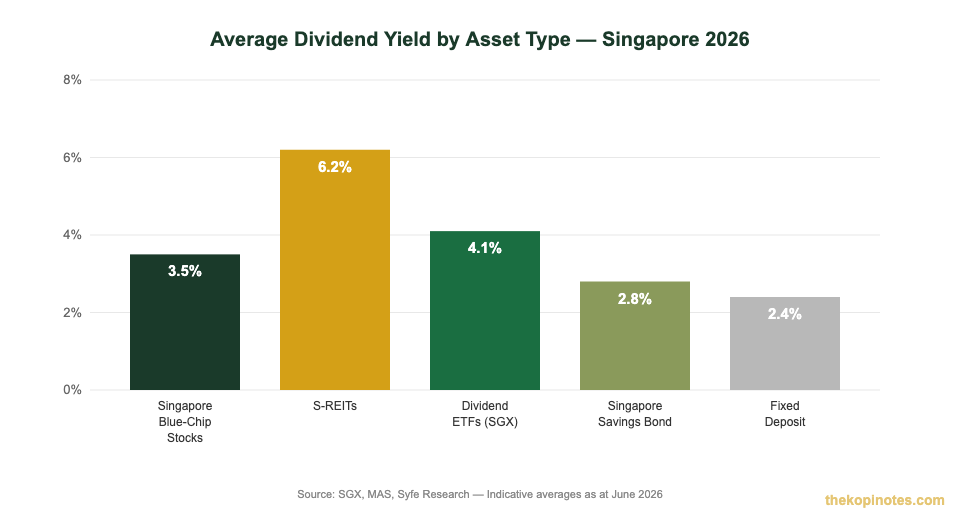
Dividend investing in Singapore means buying assets — stocks, S-REITs, or ETFs — that pay you a share of their earnings regularly in cash. Singapore investors benefit from zero dividend tax and no capital gains tax, making dividend income especially powerful here. S-REITs currently yield 5–7% annually, blue-chip stocks around 3–4%, and dividend ETFs around 4%, giving you multiple ways to build passive income without selling a single share.
Not financial advice. All figures are for educational reference only. Data as at June 2026 unless noted.
- Singapore has no dividend tax and no capital gains tax — dividend investing is highly tax-efficient here
- S-REITs offer the highest yields (5–7%), while blue-chip stocks (3–4%) and dividend ETFs (4%) offer more diversification
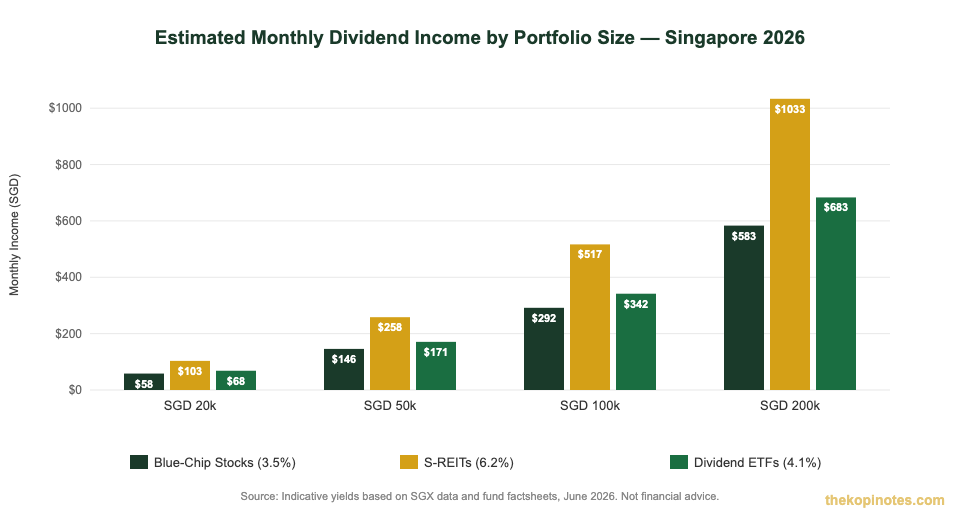
- A SGD 100,000 portfolio at 5% yield pays roughly SGD 417/month in passive income
Table of Contents
Contents — Click to expand
- What Is Dividend Investing?
- Why Dividend Investing Works So Well in Singapore
- Types of Dividend Assets in Singapore
- Dividend Yield Comparison at a Glance
- How to Start Dividend Investing in Singapore
- How Much Do You Need to Live Off Dividends?
- Risks to Know Before You Start
- Best Platforms for Dividend Investing in Singapore
- Frequently Asked Questions
What Is Dividend Investing?
Dividend investing is a strategy where you build a portfolio of assets that pay you cash regularly — called dividends or distributions — just for holding them. You don’t need to sell anything to receive this income. It arrives in your brokerage account quarterly, semi-annually, or annually depending on the asset.
Think of it like owning a rental property that pays you rent every month. Except instead of dealing with tenants and maintenance, you hold shares in companies or funds that do the hard work for you.
In Singapore, the three main asset types for dividend investing are:
- Singapore blue-chip stocks — large, stable companies like DBS, OCBC, UOB, Singtel, and Keppel that pay reliable dividends each year
- Singapore REITs (S-REITs) — real estate investment trusts that must distribute at least 90% of their taxable income to unit holders, resulting in high yields of 5–7%
- Dividend ETFs — exchange-traded funds listed on SGX or overseas exchanges that hold a basket of dividend-paying stocks or REITs
The goal is simple: accumulate enough dividend-paying assets so that your passive income covers your living expenses. This is sometimes called financial independence through dividends, or the “dividend income” approach to retirement.
Why Dividend Investing Works So Well in Singapore
Singapore is one of the best places in the world for dividend investing. Here’s why you’re at an advantage compared to investors in the US, UK, or Australia.
No dividend tax. Singapore does not tax dividends received by individual investors. If DBS pays you a SGD 500 dividend, all SGD 500 lands in your pocket. Compare this to the US, where dividends are taxed at up to 20–37% depending on income, or Australia where dividends are taxed as ordinary income.
No capital gains tax. If your DBS shares rise from SGD 30 to SGD 40 and you sell, you keep 100% of the SGD 10 gain per share. No tax owed.
Strong S-REIT ecosystem. Singapore has one of Asia’s largest and most liquid REIT markets, with over 40 REITs listed on SGX covering retail malls, logistics hubs, data centres, hospitals, and offices. Yields range from 4% to 8%, and many have track records of growing distributions over time.
CPF and SRS compatibility. You can invest in approved dividend-paying stocks and ETFs through your CPF Investment Scheme (CPFIS) or Supplementary Retirement Scheme (SRS) account, making your dividend income even more tax-efficient.
The one caveat: if you invest in overseas-listed funds or stocks, withholding tax may apply at source. For example, US stocks pay a 30% withholding tax on dividends to Singapore investors. This is why many Singapore investors prefer Ireland-domiciled ETFs listed on the London Stock Exchange — they face only 15% withholding tax under the Ireland-US tax treaty. You can read more about this in the Singapore REIT ETF guide.
Types of Dividend Assets in Singapore
1. Singapore Blue-Chip Stocks
Blue-chip stocks are shares in large, well-established companies with a history of paying stable or growing dividends. In Singapore, the Straits Times Index (STI) is dominated by blue chips. The three local banks — DBS, OCBC, and UOB — alone make up roughly 40% of the STI and are known for consistent dividends.
Typical yields for Singapore blue chips range from 2.5% to 5% depending on the company and market conditions. DBS, for instance, has increased its quarterly dividend substantially over the past five years, and paid a total annual dividend of around SGD 2.16 per share in 2025.
The trade-off is concentration risk. If you build a dividend portfolio from just 5–10 Singapore stocks, your income is highly dependent on those companies doing well.
2. Singapore REITs (S-REITs)
S-REITs are the workhorse of dividend investing in Singapore. Because they must distribute at least 90% of taxable income, their yields are consistently high — typically 5–7%, and sometimes higher for smaller or speciality REITs.
Popular S-REITs among dividend investors include CapitaLand Integrated Commercial Trust (CICT), Mapletree Logistics Trust, Frasers Centrepoint Trust, and Keppel DC REIT. Each holds a different type of property and pays quarterly or semi-annual distributions.
You can learn more about building a passive income Singapore portfolio using S-REITs in our dedicated guide. For a curated list, see the best S-REITs in Singapore 2026.
3. Dividend ETFs
Dividend ETFs pool together dozens or hundreds of dividend-paying stocks in a single fund. Instead of picking individual companies, you buy one ETF and get instant diversification across many dividend payers.
Popular options for Singapore investors include:
- SDIV (SGX) — a Singapore-listed ETF focused on high-dividend global stocks
- VHYL (LSE) — Vanguard’s FTSE All-World High Dividend Yield ETF, Ireland-domiciled, available through brokers like IBKR
- SCHD equivalent — US-listed dividend ETF but note the 30% withholding tax makes it less suitable for Singapore investors unless held in specific accounts
For most Singapore beginners, a dividend ETF is the simplest starting point. You don’t need to analyse individual company financials — just pick a well-diversified fund and invest regularly.
Dividend Yield Comparison at a Glance
| Asset Type | Indicative Yield (2026) | Dividend Tax (SG) | Payment Frequency |
|---|---|---|---|
| Singapore Blue-Chip Stocks | 3–4% | 0% | Semi-annual / Annual |
| S-REITs | 5–7% | 0% | Quarterly / Semi-annual |
| Dividend ETFs (SGX-listed) | 3.5–5% | 0% | Quarterly |
| LSE-Listed Dividend ETFs (UCITS) | 3–4.5% | 15% WHT (at fund level) | Quarterly / Semi-annual |
| Singapore Savings Bonds | ~2.8% | 0% | Semi-annual |
| Fixed Deposits | ~2.4% | 0% | Maturity |
Source: SGX, MAS, fund factsheets, and bank rates — indicative as at June 2026. Actual yields vary based on unit price and distributions declared.
How to Start Dividend Investing in Singapore
Starting is simpler than most people expect. Here’s a step-by-step path for a Singapore investor with no prior experience.
Step 1: Open a Brokerage Account
You need a brokerage account to buy dividend-paying stocks, REITs, and ETFs. For most Singapore investors, the key choice is between:
- IBKR (Interactive Brokers) — lowest fees for large portfolios, access to global markets including LSE ETFs. Use referral code jianxiong368 when signing up.
- moomoo Singapore — beginner-friendly interface, fractional shares available. Read the moomoo Singapore review for a full breakdown.
- Syfe Brokerage — good for beginners who also want a robo-advisor option. Use the Syfe referral code SRPRFFFCD for a fee waiver on first trades.
- FSMOne — great for Regular Savings Plans (RSPs) in S-REITs and ETFs. See the FSMOne referral code P0544985 for sign-up bonuses.
For pure SGX-listed stocks and S-REITs, moomoo or FSMOne are the simplest starting points. If you want to access LSE-listed dividend ETFs, IBKR is the most cost-effective choice.
Step 2: Decide Your Strategy
There are two main approaches to dividend investing, and neither is wrong:
- High yield now — Focus on S-REITs (5–7% yield). You get more cash income faster, but you’re concentrated in Singapore real estate and property sectors.
- Growing dividends over time — Focus on blue-chip stocks or dividend growth ETFs. The yield starts lower (3–4%) but dividends typically grow each year as companies earn more. Over 10–15 years, your yield on cost can climb above 7%.
A balanced approach combines both: a core of 2–3 dividend ETFs for diversification, with satellite positions in 3–5 high-conviction S-REITs for yield.
Step 3: Start Small and Invest Regularly
You don’t need a large lump sum to begin. Many SGX stocks trade at SGD 2–5 per share, and S-REITs at SGD 0.30–2.00 per unit. You can start a Regular Savings Plan through FSMOne or moomoo with as little as SGD 100/month.
Consistency matters more than timing. If you invest SGD 500/month into a portfolio yielding 5%, you’ll accumulate SGD 60,000 in a decade — paying you SGD 250/month in dividends before you even count the capital growth.
Step 4: Reinvest Dividends Early On
In the accumulation phase (before you need the income), reinvesting dividends dramatically accelerates your wealth. This is called dividend reinvestment or DReinvestment. At 5% yield with reinvestment, your portfolio grows roughly 40% more over 10 years compared to spending the dividends.
Some brokers let you set up automatic dividend reinvestment. Alternatively, manually buy more units each quarter when dividends arrive.
How Much Do You Need to Live Off Dividends?
This is the most common question from Singapore investors building toward financial independence. The answer depends on your monthly expenses and your portfolio’s yield.
Here’s a simple formula:
Example: SGD 3,000/month × 12 = SGD 36,000/year. At 5% yield, you need SGD 720,000.
| Monthly Income Target | At 4% Yield | At 5% Yield | At 6.5% Yield |
|---|---|---|---|
| SGD 1,000/month | SGD 300,000 | SGD 240,000 | SGD 185,000 |
| SGD 2,000/month | SGD 600,000 | SGD 480,000 | SGD 369,000 |
| SGD 3,000/month | SGD 900,000 | SGD 720,000 | SGD 554,000 |
| SGD 5,000/month | SGD 1,500,000 | SGD 1,200,000 | SGD 923,000 |
Source: TKN calculation — indicative portfolio sizes required at different yield levels, June 2026. Assumes stable annual distributions and does not account for distribution cuts or inflation.
These figures are large — but remember, CPF plays a major role in Singapore’s retirement planning. Your CPF LIFE payout (starting from age 65) covers a portion of expenses. The dividend portfolio fills the gap. You can estimate your total retirement needs with the Singapore retirement calculator.
For more on structuring your CPF alongside dividend investments, see the CPF investment strategy Singapore guide.
Risks to Know Before You Start
Dividend investing sounds passive, but it comes with real risks. Understanding them helps you build a more resilient portfolio.
1. Dividend Cuts
Companies and REITs can reduce or eliminate dividends at any time — especially during economic downturns. During COVID-19 in 2020, many S-REITs cut distributions by 20–50% as rental income fell. A high current yield does not guarantee future distributions.
2. Yield Trap
A high dividend yield can be a red flag. If a stock yields 10%, it might be because the share price has fallen sharply — signalling that the market expects the dividend to be cut. Always check the payout ratio (dividends paid as a percentage of earnings). Above 100% is unsustainable.
3. Concentration in Singapore
Many Singapore dividend portfolios end up heavily weighted in local banks and S-REITs. This works well when Singapore’s economy is growing, but leaves you exposed to local property cycles and interest rate changes. Diversifying with global dividend ETFs mitigates this.
4. Interest Rate Sensitivity
S-REITs are particularly sensitive to interest rates. When rates rise, REIT prices tend to fall (investors demand higher yields), and borrowing costs for the REITs increase, squeezing distributions. The 2022–2024 rate hike cycle hit S-REIT prices hard.
5. Inflation Risk
A fixed dividend amount buys less each year if inflation is running at 3–4%. Look for dividend-growers rather than high-yield stagnant payers to protect purchasing power over the long term.
Once you understand the basics, the next question is how to structure your holdings. Our dividend investing strategy framework walks through a 5-step process for picking vehicles, minimising tax drag, and diversifying properly.
>Best Platforms for Dividend Investing in Singapore
| Platform | Best For | SGX Access | LSE ETFs | Referral Bonus |
|---|---|---|---|---|
| IBKR | Large portfolios, LSE access | ✓ | ✓ | Code: jianxiong368 |
| Syfe Brokerage | Beginners, simple UI | ✓ | Limited | Code: SRPRFFFCD |
| FSMOne | Regular Savings Plans | ✓ | ✓ | Code: P0544985 |
| moomoo Singapore | Beginner-friendly, low fees | ✓ | Limited | — |
| Endowus | CPF & SRS dividend funds | ✓ | Via funds | Code: 2V343 |
Source: TKN research, platform websites — as at June 2026. Fees and features subject to change.
If you’re comparing robo-advisors for managed dividend portfolios, the syfe vs endowus 2026 comparison covers which is better for different investor profiles.
Not financial advice. All data is for educational purposes only. Data as at June 2026. TKN may earn referral fees when you sign up through our links.
Frequently Asked Questions
Is dividend income taxable in Singapore?
No. Singapore does not tax dividend income received by individual investors. Whether you receive dividends from SGX-listed stocks, S-REITs, or locally-distributed funds, you keep 100% of the payout. This is one of the most investor-friendly tax rules in Asia. The exception is if you invest in overseas assets — US stocks, for example, are subject to 30% withholding tax on dividends at source, which you cannot recover as a Singapore individual investor.
How much money do I need to start dividend investing in Singapore?
You can start with as little as SGD 100–500. Many S-REITs trade at under SGD 1.00 per unit, and several brokers offer Regular Savings Plans (RSPs) from SGD 50–100/month. That said, dividend income becomes meaningfully passive only as your portfolio grows. At a 5% yield, you need SGD 120,000 to generate SGD 500/month. Start small and build consistently — the compounding effect does the heavy lifting over 10–20 years.
What is the best dividend stock to buy in Singapore?
There is no single “best” dividend stock — it depends on your yield target, risk tolerance, and investment horizon. That said, DBS, OCBC, and UOB are the most commonly held dividend stocks among Singapore investors for their track record, liquidity, and consistent payout growth. For higher yield, S-REITs like CapitaLand Integrated Commercial Trust (CICT) and Mapletree Logistics Trust are popular choices. Diversifying across 2–3 sectors — banks, industrial REITs, and dividend ETFs — gives you a more resilient income stream than any single stock.
Can I use CPF or SRS for dividend investing?
Yes, with some restrictions. Under the CPF Investment Scheme (CPFIS), you can invest your CPF OA funds in approved Singapore-listed stocks and unit trusts that pay dividends, subject to a minimum balance of SGD 20,000 in your OA after the investment. SRS funds can be used more freely — you can invest in SGX-listed stocks, S-REITs, ETFs, and unit trusts through SRS, and all dividends earned are tax-deferred until withdrawal. Endowus is a popular platform for SRS-linked dividend fund investing.
What is the difference between dividend investing and growth investing?
Dividend investing focuses on buying assets that pay regular cash income — you profit primarily through the dividends received. Growth investing focuses on buying assets expected to increase in price — you profit when you eventually sell at a higher price. In Singapore, dividend investing is often preferred by investors who want current cash flow (passive income now), while growth investing suits those with a longer time horizon who don’t need the money yet. Many Singapore investors combine both approaches: dividend assets for income, growth ETFs like CSPX or VWRA for long-term capital appreciation.
Are S-REITs safe for dividend investing?
S-REITs are relatively stable compared to individual stocks because they hold physical properties and must distribute 90% of income. However, they are not risk-free. Rising interest rates, economic downturns, and tenant defaults can all reduce distributions. During COVID-19, many S-REITs cut distributions by 20–50%. The safest approach is to invest in diversified, large-cap S-REITs (CICT, Mapletree, Frasers) rather than smaller single-sector trusts, and to hold them as part of a broader portfolio rather than all-in.
What is a good dividend yield in Singapore?
A “good” yield depends on the asset type. For blue-chip Singapore stocks, 3–4.5% is considered healthy. For S-REITs, 5–7% is typical and sustainable. Anything above 8% warrants scrutiny — it often signals that the share price has fallen due to market concerns about future distributions. Rather than chasing the highest yield, focus on yield sustainability: check the distribution per unit (DPU) trend over the past 3–5 years. A REIT with a steady or growing DPU at 5.5% is far better than one with a 9% yield that cut dividends twice in three years.
Ready to Start Dividend Investing in Singapore?
Open an account with one of Singapore’s top platforms and start building your passive income portfolio today.
This article was researched with the help of AI. While we strive to keep all information accurate and up to date, there may be errors. If you notice any discrepancies, please contact us.