Singapore Savings Bond (SSB): Complete Guide 2026
How to buy SSB, current rates, step-up returns, and how it compares to T-bills and fixed deposits.
The Singapore Savings Bond (SSB) is a government-backed savings instrument issued monthly by the Monetary Authority of Singapore (MAS). It offers step-up interest rates — starting at 1.46% in Year 1 and rising to 2.81% by Year 10 for the July 2026 tranche — with full capital protection, no lock-in period, and interest that is completely exempt from Singapore income tax. You can invest from as little as S$500, up to a lifetime cap of S$200,000.
Not financial advice. All figures are for educational reference only. Data as at July 2026 unless noted.
- SSB July 2026 pays 1.46% in Year 1, rising to 2.81% by Year 10 — 10-year average of 2.11% p.a.
- No lock-in: redeem any month, get back full principal plus accrued interest
- Interest is tax-exempt — an advantage over T-bills and fixed deposits
Table of Contents
Contents — Click to expand
What Is the Singapore Savings Bond?
The Singapore Savings Bond is a special type of Singapore Government Security (SGS) designed specifically for individual retail investors. MAS launched the scheme in October 2015 to give everyday Singaporeans a safe, flexible, and accessible way to earn returns on their savings.
Unlike regular bonds, the SSB has no secondary market. You can only buy it from MAS during the monthly application window, and if you want out early, you redeem directly with MAS — you get back your full principal every time. There is zero capital loss risk.
Each SSB tranche lasts up to 10 years. Interest is paid every six months directly into your bank account (or SRS account if you applied using SRS funds). The interest rate steps up each year you hold — so the longer you stay invested, the higher the effective return.
The SSB is backed by the full faith and credit of the Singapore Government — the same sovereign that has maintained a AAA credit rating from all three major agencies (Moody’s, S&P, Fitch). Your money is as safe as it gets in any financial instrument globally.
July 2026 SSB Rates at a Glance
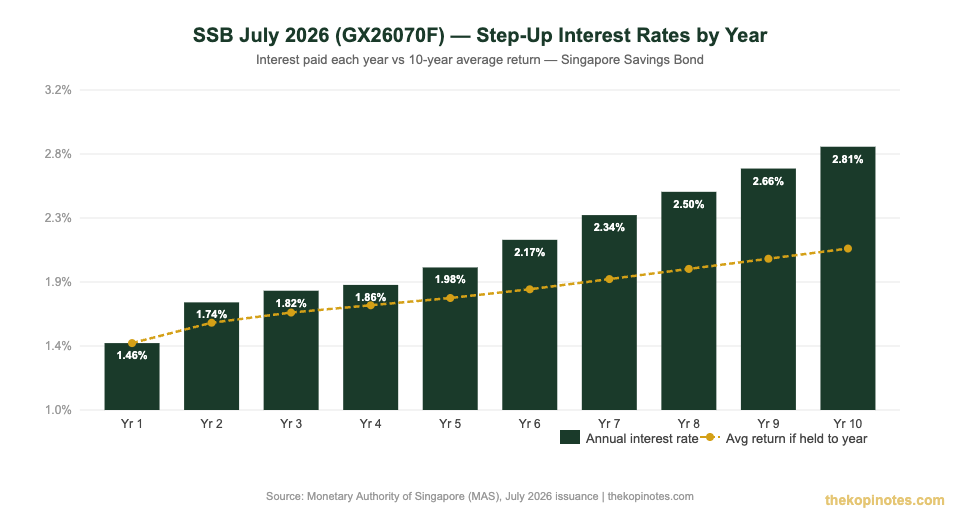
The July 2026 tranche (issue code GX26070F, also called SBJUL26) was issued on 1 July 2026 with the following step-up rates:
| Year | 1 | 2 | 3 | 4 | 5 | 6 | 7 | 8 | 9 | 10 |
|---|---|---|---|---|---|---|---|---|---|---|
| Interest % | 1.46 | 1.74 | 1.82 | 1.86 | 1.98 | 2.17 | 2.34 | 2.50 | 2.66 | 2.81 |
| Avg Return % | 1.46 | 1.60 | 1.67 | 1.72 | 1.77 | 1.83 | 1.90 | 1.97 | 2.04 | 2.11 |
Source: Monetary Authority of Singapore (MAS), July 2026 issuance GX26070F.
The application window for this tranche opened on 2 June 2026 and closed on 25 June 2026. Total demand was S$242.5 million applied, with S$221.0 million fully allotted. This means demand was within supply — all eligible applicants received their full requested amount.
Looking ahead, the August 2026 SSB application window typically opens on the first business day of July. Check MAS’s official SSB page for the latest tranche details.
How the Step-Up Interest Works
The SSB’s step-up structure is different from a standard fixed deposit. With a fixed deposit, you lock in one rate for the full term. With SSB, your interest rate increases every year you stay invested.
Here’s what that means in practice. Say you invest S$10,000 in the July 2026 SSB:
- Year 1: 1.46% = S$146 interest
- Year 3: 1.82% = S$182 interest
- Year 5: 1.98% = S$198 interest
- Year 10: 2.81% = S$281 interest
- Total 10-year return: ~S$2,110 (2.11% p.a. compounded average)
Interest is paid every six months — in January and July each year — directly to your bank account. So you receive cash twice a year, every year you hold the bond. You don’t need to wait until maturity.
The critical advantage over a standard fixed deposit: there is no penalty for early withdrawal. Redeem after Year 1, Year 2, or anytime — you always get your full S$10,000 back plus the interest you’ve earned up to that point. You simply sacrifice the higher rates of future years, not the principal.
This flexibility is what makes SSB unique among Singapore’s risk-free savings instruments. It functions like a savings account that automatically pays you more the longer you stay — without locking you in.
How to Buy SSB in Singapore (Step-by-Step)
Buying an SSB is straightforward. You need three things: a Singapore bank account with DBS/POSB, OCBC, or UOB; a CDP Securities account (or SRS account); and an ATM card or internet banking access.
Step 1 — Open a CDP Account (if you don’t have one)
Your SSB holdings are held in your Central Depository (CDP) account, linked to your bank. If you don’t have a CDP account, open one at SGX’s website — it’s free and takes about 10 minutes online. You’ll need your NRIC and bank account details.
Step 2 — Check the Application Window
Each monthly SSB tranche has a fixed application period — roughly the 1st to 4th-last business day of the month. The window for August 2026 SSB opens in early July 2026. Check the MAS SSB page for exact dates.
Step 3 — Apply via Internet Banking or ATM
You can apply through any of the three local banks:
- DBS/POSB: Log into iBanking → Invest → Singapore Savings Bonds → Apply. Select the issue code, enter amount in multiples of S$500.
- OCBC: Log into OCBC Online Banking → Invest → Singapore Savings Bonds → Apply.
- UOB: Log into UOB Personal Internet Banking → Invest/Insure → Singapore Government Securities → Apply for SSB.
- ATM: All three banks support ATM applications — go to Other Services → Investments → Singapore Savings Bonds.
Each application has a S$2 transaction fee. The minimum investment is S$500, and you can invest up to S$50,000 per tranche (with a S$200,000 lifetime limit across all tranches).
Step 4 — Wait for Allotment
Allotment happens the day after the window closes. If demand is within supply (as was the case for July 2026), you get the full amount you applied for. If oversubscribed, MAS uses a ballot/ceiling system to allocate fairly. Unsuccessful funds are returned to your bank account.
Using Your SRS Account
You can also buy SSB using Supplementary Retirement Scheme (SRS) funds — a useful strategy for higher-income earners who want to park SRS savings in a risk-free instrument while earning better returns than the default 0.05% SRS rate. Apply through your bank’s SRS portal during the application window.
For a broader view of how SSB fits into your retirement planning, see our Singapore retirement calculator — it can help you model how SSB returns compound over time.
SSB vs T-Bill vs Fixed Deposit (2026 Comparison)
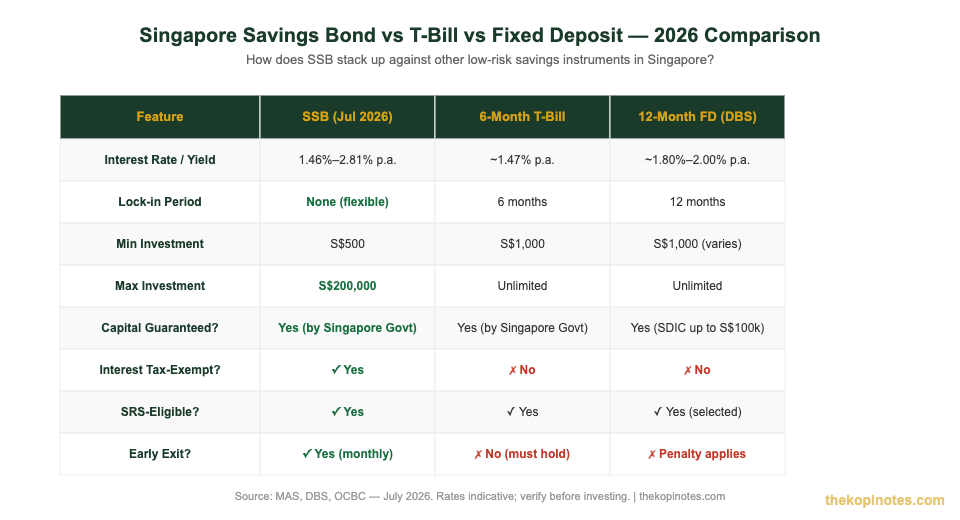
The SSB competes directly with Singapore’s other low-risk savings instruments: Treasury Bills (T-bills) and bank fixed deposits. Here’s how they stack up in July 2026:
| Feature | SSB (Jul 2026) | 6-Month T-Bill | 12-Month FD |
|---|---|---|---|
| Return (Year 1) | 1.46% p.a. | ~1.47% p.a. | ~1.80%–2.00% p.a. |
| If Held 10 Years | 2.11% avg p.a. | Must reinvest (rate varies) | Must renew annually |
| Lock-in | None | 6 months | Penalty if broken early |
| Min Investment | S$500 | S$1,000 | S$1,000 (varies) |
| Interest Tax-Exempt? | ✓ Yes | ✗ No | ✗ No |
| Capital Guaranteed | ✓ Singapore Govt | ✓ Singapore Govt | SDIC up to S$100k |
| SRS-Eligible | ✓ Yes | ✓ Yes | Selected banks only |
| Early Exit | ✓ Monthly, no penalty | ✗ Cannot exit early | ✗ Interest forfeited |
Source: MAS, DBS, OCBC — July 2026. FD rates indicative across major banks; verify before investing.
The headline takeaway: T-bills and FDs may offer slightly higher short-term rates, but SSB wins on flexibility and tax treatment. If you’re investing for 3–5+ years, SSB’s step-up rates catch up and often surpass what you’d get from rolling T-bills — especially once you factor in the tax exemption.
For context on the latest T-bill rates, see our Singapore T-bills 2026 guide.
Who Should Buy SSB?
SSB is ideal for you if:
- You want a guaranteed, risk-free return with no possibility of capital loss
- You’re unsure when you’ll need the money and want flexible redemption — no T-bill-style lock-in
- You’re in a higher income tax bracket and value the tax-exempt interest (saves you 7%–24% vs T-bill interest)
- You want to park SRS funds earning more than the 0.05% default rate, with zero risk
- You’re building a conservative core portfolio alongside S-REITs, ETFs, or stocks — see our best S-REITs in Singapore 2026 guide for higher-yield options
- You have S$10,000–S$200,000 in cash savings earning near-zero bank interest
SSB may not be the right fit if:
- You want the highest possible short-term yield and have no liquidity needs — a 6-month T-bill or 12-month FD may pay slightly more for Year 1
- You’re looking for growth rather than capital preservation — consider dividend ETFs or S-REITs for higher long-term returns via our passive income Singapore guide
- You need to invest more than S$200,000 — the lifetime cap limits very large cash positions
For CPF funds specifically: SSB is not eligible for CPF investment (CPFIS). If you want to put CPF-OA funds to work, T-bills and selected unit trusts are the main options — more on that in our CPF investment strategy Singapore guide.
How to Redeem Your SSB Early
Redeeming SSB early is just as simple as buying. Log into your bank’s internet banking during the monthly redemption window (same dates as the application window — roughly the 1st to 4th-last business day of each month).
Go to the SSB section, select the tranche you want to redeem, and enter the amount. You can redeem part of your holding (in multiples of S$500) or the full amount. Proceeds — principal plus accrued interest — are credited to your bank account by the end of the following month.
Important: a S$2 transaction fee applies to each redemption request, just like the application. There is no other penalty — your principal is fully protected regardless of when you redeem.
Tip: If you applied using SRS funds, you can only redeem back into your SRS account — not to a regular bank account. Plan accordingly if you need cash liquidity from SRS investments.
Frequently Asked Questions
What is the Singapore Savings Bond interest rate for July 2026?
The July 2026 SSB (issue code GX26070F, also called SBJUL26) offers a Year 1 interest rate of 1.46% per annum, stepping up annually to 2.81% by Year 10. If you hold for the full 10 years, you earn an average of 2.11% per annum on a compounded basis. Interest is paid every six months directly to your bank account, and all SSB interest is exempt from Singapore income tax.
Is the Singapore Savings Bond safe? Can I lose money?
The SSB is one of the safest financial instruments available to retail investors in Singapore. It is backed by the full faith and credit of the Singapore Government, which holds a AAA credit rating from all three major rating agencies (Moody’s, S&P, and Fitch). You cannot lose your principal — if you redeem early, you always receive back your full invested amount plus accrued interest. There is no market price risk because SSB is not traded on the secondary market.
Can I buy SSB with my CPF or SRS account?
You cannot use CPF funds (OA or SA) to buy SSB — SSB is not included in the CPF Investment Scheme (CPFIS). However, you can use your Supplementary Retirement Scheme (SRS) account to apply for SSB through your bank’s SRS portal during the monthly application window. This is a popular strategy for SRS holders who want a risk-free, tax-efficient return on idle SRS savings, which otherwise earn just 0.05% in the default SRS account.
What is the maximum amount I can invest in Singapore Savings Bonds?
The lifetime cap for SSB holdings is S$200,000 per person across all outstanding tranches. You can apply for up to S$50,000 in a single monthly tranche. The minimum per application is S$500, in multiples of S$500. The S$200,000 cap applies separately to your CDP account and your SRS account — so if you have both, you can technically hold up to S$400,000 in total SSB (S$200,000 via CDP + S$200,000 via SRS).
How is SSB different from Singapore Government Securities (SGS) bonds?
Both SSB and SGS bonds are issued by the Singapore Government and carry the same sovereign credit quality. The key differences: SGS bonds are fixed-rate (your rate is locked at issuance for the full tenor), tradeable on the secondary market (so their price fluctuates with interest rates), and typically available in minimum lots of S$1,000. SSB is flexible (no lock-in, redeem any time), non-tradeable (so no price risk), has a step-up rate structure, and has a S$200,000 lifetime cap per individual. For most retail investors, SSB is the better choice for a risk-free savings allocation.
Is SSB interest taxable in Singapore?
No. Interest earned on Singapore Savings Bonds is fully exempt from Singapore income tax for individual investors. This is a meaningful advantage over T-bills and bank fixed deposits, whose interest is taxable as income for Singapore tax residents. For a Singaporean in the 15% tax bracket, earning S$2,000 in SSB interest is worth the equivalent of earning ~S$2,350 in taxable T-bill interest — a significant difference on a large portfolio.
What happens to my SSB if I need money urgently?
You can redeem your SSB in any month during the monthly redemption window (same dates as the application window). Submit your redemption request via internet banking or ATM, and your full principal plus all accrued interest to date will be credited to your bank account by the end of the following month. There is no penalty fee beyond the S$2 transaction fee. This makes SSB a useful “high-yield emergency fund” layer for cash you don’t need immediately but want accessible within 1–2 months.
Want Higher Returns Beyond SSB?
SSB is great for capital preservation — but if you’re ready to earn more, explore S-REITs, ETFs, and robo-advisors with our referral bonuses.
This article was researched with the help of AI. While we strive to keep all information accurate and up to date, there may be errors. If you notice any discrepancies, please contact us.