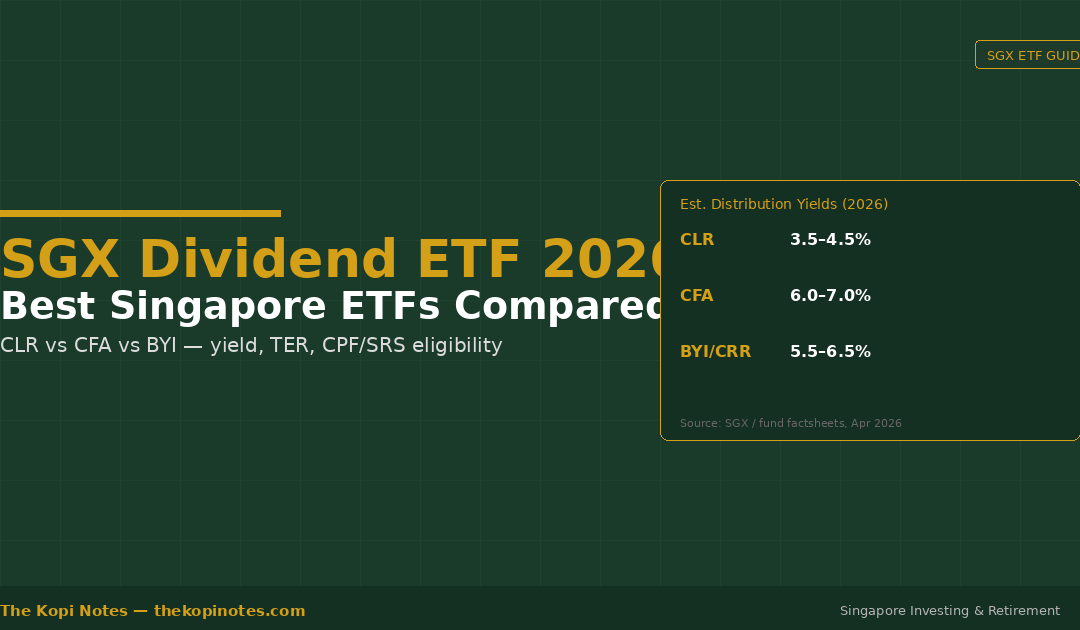
SGX Dividend ETF 2026: Best Singapore-Listed Dividend ETFs Compared
Yield, expense ratios, holdings and which ETF suits your income goals — a complete Singapore investor’s comparison for 2026.
The three main SGX dividend ETFs for Singapore investors in 2026 are the Lion-OCBC Singapore Low Carbon ETF (SGX: CLR), the CSOP iEdge S-REIT Leaders Index ETF (SGX: CFA), and the NikkoAM-StraitsTrading Asia ex Japan REIT ETF (SGX: CRR, also known as BYI). Each offers monthly or quarterly distributions, SGD-denominated units and CPF/SRS eligibility — key advantages over LSE-listed accumulating ETFs for income-focused investors seeking regular payouts from Singapore markets.
Not financial advice. All figures are for educational reference only. Data as at April 2026 unless noted.
Table of Contents
Contents — Click to expand
- What Is an SGX Dividend ETF?
- Why Choose SGX-Listed Dividend ETFs?
- Best SGX Dividend ETFs 2026: At a Glance
- Lion-OCBC Singapore Low Carbon ETF (CLR)
- CSOP iEdge S-REIT Leaders Index ETF (CFA)
- NikkoAM-StraitsTrading Asia ex Japan REIT ETF (BYI)
- Total Cost Comparison
- CPF and SRS Eligibility
- How to Buy SGX Dividend ETFs in Singapore
- Which Dividend ETF Is Right for You?
- Frequently Asked Questions
What Is an SGX Dividend ETF?
An SGX dividend ETF is an exchange-traded fund listed on the Singapore Exchange (SGX) that is specifically structured to distribute income — typically from dividends, REIT distributions or bond coupons — to unitholders on a regular basis. Unlike the popular LSE-listed accumulating ETFs such as CSPX or VWRA, which reinvest all income internally and grow in unit price, SGX dividend ETFs pay out distributions quarterly or monthly, making them popular with retirees and income investors who want a predictable cash flow without having to sell units.
Singapore investors have access to several SGX-listed dividend-focused ETFs, but the most widely traded ones in 2026 fall into two categories: REIT-focused ETFs (which hold S-REITs and yield 5–7%) and equity-income ETFs (which hold dividend-paying stocks and typically yield 3–5%). This guide covers the three most relevant options for 2026 and helps you decide which — if any — belongs in your portfolio.
Why Choose SGX-Listed Dividend ETFs?
While many sophisticated Singapore investors have shifted to LSE-listed UCITS ETFs for their tax efficiency and low TERs, SGX-listed dividend ETFs still offer several distinct advantages worth understanding:
SGD denomination: Units are priced in Singapore dollars, eliminating currency conversion costs. When you buy CSPX on the LSE, you convert SGD to GBP (and the underlying is in USD), adding 2–3 spreads. SGX ETFs are bought and sold in SGD with no FX friction.
CPF and SRS eligibility: Selected SGX ETFs are approved for CPF Investment Scheme (CPFIS) and Supplementary Retirement Scheme (SRS) investment. This is a meaningful advantage — CPF OA currently earns 2.5% per annum as a floor, while a REIT ETF yielding 6–7% can significantly enhance long-term returns if held through CPFIS. LSE-listed ETFs like CSPX and VWRA are not CPF-eligible. For a deeper look at how to put your CPF to work, see our guide to CPF investment strategy Singapore.
Regular income: For investors in the drawdown phase of retirement — or those building a passive income stream today — quarterly or monthly distributions from an SGX ETF are more convenient than manually selling units from an accumulating fund. This is especially relevant if you use a Singapore retirement calculator and find that you need income from your portfolio within the next 5–10 years.
Familiar brokers: SGX ETFs are available on every Singapore brokerage — from DBS Vickers and OCBC Securities to moomoo Singapore and Tiger Brokers — with no currency conversion needed. Minimum lot size on SGX is 100 units.
Best SGX Dividend ETFs 2026: At a Glance
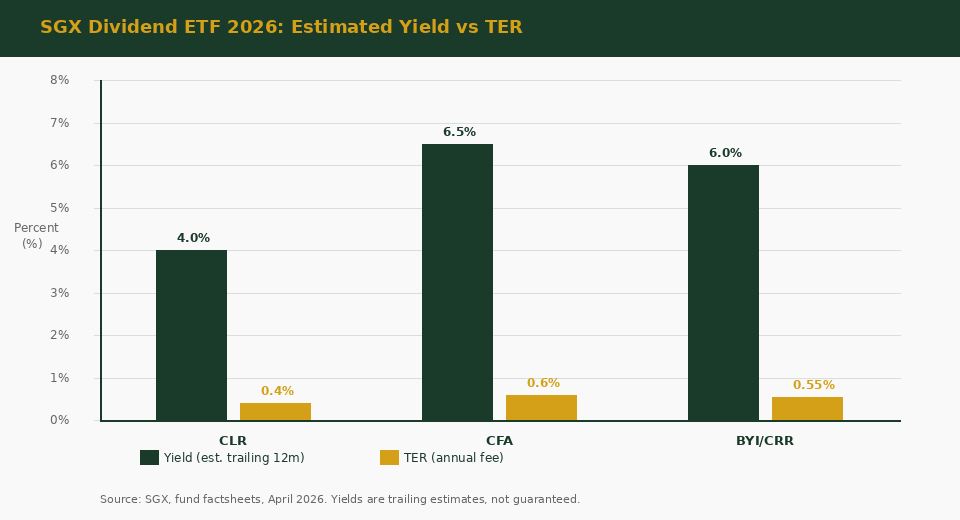
The table below summarises the key metrics for the three most-traded SGX dividend ETFs as at April 2026. All three are distributing ETFs — they pay out income rather than reinvesting it.
| ETF | Ticker | Focus | TER | Dist. Yield (est.) | Frequency | CPF/SRS |
|---|---|---|---|---|---|---|
| Lion-OCBC Singapore Low Carbon ETF | CLR | SG equities (low carbon) | 0.40% | ~3.5–4.5% | Semi-annual | SRS ✓ |
| CSOP iEdge S-REIT Leaders Index ETF | CFA | S-REITs | 0.60% | ~6.0–7.0% | Quarterly | SRS ✓ |
| NikkoAM-StraitsTrading Asia ex Japan REIT ETF | CRR / BYI | Asia ex-Japan REITs | 0.55% | ~5.5–6.5% | Quarterly | SRS ✓ / CPFIS ✓ |
Source: SGX, fund manager factsheets, April 2026. Yields are trailing 12-month estimates and will vary. Past distributions are not a guarantee of future payouts.
Lion-OCBC Singapore Low Carbon ETF (SGX: CLR)
The Lion-OCBC Singapore Low Carbon ETF was launched in 2022 by Lion Global Investors in partnership with OCBC. It tracks the iEdge-OCBC SGX Singapore Low Carbon Select 50 Capped Index, which screens the Singapore equity market for companies with lower carbon intensity relative to sector peers. The result is a portfolio of approximately 50 Singapore-listed stocks — primarily in banking, telecommunications and industrials — with a tilt away from carbon-heavy businesses.
CLR is a distributing ETF that pays semi-annual dividends. Because the underlying holdings are Singapore-listed companies rather than US-domiciled stocks, there is no US withholding tax exposure. The estimated trailing dividend yield as at Q1 2026 is approximately 3.5–4.5% per annum, somewhat lower than the pure REIT ETFs below, but with lower volatility and more exposure to Singapore’s blue-chip dividend-paying stocks (DBS, OCBC, UOB, Singtel).
Who should consider CLR: Investors who want Singapore equity exposure with an ESG tilt, semi-annual income, and lower REIT-sector concentration risk. It is SRS-eligible, and its blue-chip weighting makes it suitable for conservative income investors who do not want heavy exposure to commercial property cycles.
Key limitation: The “low carbon” screen excludes some high-yielding traditional industrials, and the semi-annual distribution frequency means cash flow is less predictable than quarterly-paying REIT ETFs. The 0.40% TER is reasonable but higher than the LSE-listed CSPX (0.07%) — though the comparison is imperfect given the different asset classes and distribution structures.
CSOP iEdge S-REIT Leaders Index ETF (SGX: CFA)
CFA, managed by CSOP Asset Management, tracks the iEdge S-REIT Leaders Index — a free-float market capitalisation-weighted index of Singapore REITs that meet minimum liquidity and market cap thresholds. The index typically contains 20–30 of the largest and most liquid S-REITs, with top holdings including CapitaLand Integrated Commercial Trust (CICT), Mapletree Pan Asia Commercial Trust (MPACT), Frasers Centrepoint Trust (FCT), and Keppel REIT.
CFA pays quarterly distributions and has delivered a trailing 12-month yield of approximately 6.0–7.0% as at April 2026 — one of the highest yields among SGX-listed ETFs. This reflects the underlying S-REIT structure, where REITs are legally required to distribute at least 90% of taxable income to maintain their REIT status and tax transparency. For investors seeking passive income in Singapore, CFA is one of the most direct vehicles available through a single SGX-listed fund.
Worked example — SGD 50,000 portfolio in CFA: At a 6.5% trailing yield with a 0.60% TER, a Singapore investor holding SGD 50,000 in CFA would receive approximately SGD 3,250 in annual distributions before the TER drag of ~SGD 300, netting roughly SGD 2,950 per year — or about SGD 737 per quarter. This is equivalent to a net 5.9% effective yield after fees, not accounting for any market price movement of units.
For a deeper dive into the individual REITs within CFA’s portfolio, see our guide to best S-REITs in Singapore 2026.
NikkoAM-StraitsTrading Asia ex Japan REIT ETF (SGX: CRR / BYI)
The NikkoAM-StraitsTrading Asia ex Japan REIT ETF — often identified by its older ticker BYI and now also trading as CRR — is managed by Nikko Asset Management in partnership with the Straits Trading Company. It tracks the FTSE EPRA Nareit Asia ex Japan Net Total Return Index (SGD Hedged), giving investors exposure to REITs across Singapore, Hong Kong, Australia, and other Asia Pacific markets outside Japan.
This broader geographic scope distinguishes BYI/CRR from CFA: while CFA is a pure S-REIT play, BYI/CRR includes Hong Kong-listed Link REIT, Australian property trusts, and other regional real estate vehicles. The portfolio typically holds 40–60 REITs across five or more countries, offering regional diversification within the REIT asset class. Trailing yield is approximately 5.5–6.5% per annum as at Q1 2026, with quarterly distributions.
BYI/CRR is eligible for both SRS and CPFIS investment — a key differentiator that makes it the only fund in this comparison that can be purchased using CPF Ordinary Account savings under the CPF Investment Scheme. For investors maximising their CPF investment strategy, this is a significant advantage given the 2.5% OA floor rate that investors are implicitly foregoing.
Key risk to note: The “SGD Hedged” designation means the fund uses currency hedging to reduce FX exposure from non-SGD assets. This adds a hedging cost (typically 0.1–0.3% p.a. depending on interest rate differentials) that is embedded in the fund’s returns, not explicitly shown in the headline TER of 0.55%.
Total Cost Comparison
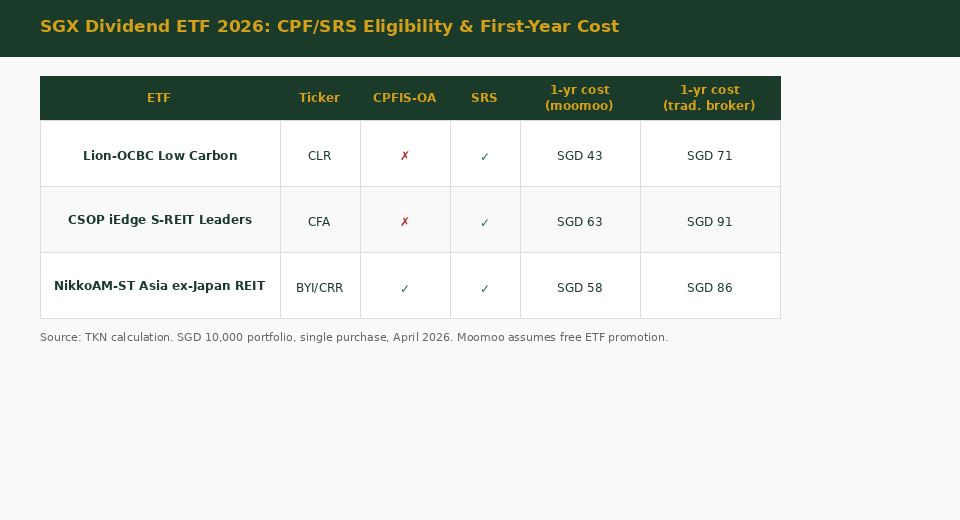
When comparing SGX dividend ETFs, it is important to look beyond the TER and consider the total cost of ownership — including brokerage commissions, bid-ask spreads, and the SGX clearing fee (0.0325% per trade, capped at SGD 600 per contract). The table below models the estimated total first-year cost for a Singapore investor making a single SGD 10,000 purchase via moomoo Singapore (SGD 0 commission for ETFs) versus a traditional broker charging 0.28% commission.
| Cost Item | CLR | CFA | BYI/CRR |
|---|---|---|---|
| TER (annual) | 0.40% = SGD 40 | 0.60% = SGD 60 | 0.55% = SGD 55 |
| Brokerage (moomoo, free ETF promo) | SGD 0 | SGD 0 | SGD 0 |
| Brokerage (traditional, 0.28%) | SGD 28 | SGD 28 | SGD 28 |
| SGX Clearing Fee (0.0325%) | SGD 3.25 | SGD 3.25 | SGD 3.25 |
| Total cost yr 1 (moomoo) | SGD 43 | SGD 63 | SGD 58 |
| Total cost yr 1 (traditional broker) | SGD 71 | SGD 91 | SGD 86 |
Source: TKN calculation based on SGD 10,000 portfolio. Assumes single purchase. TER values from fund factsheets, April 2026. Moomoo ETF commission assumes ongoing free ETF promotion — check current terms at moomoo.com.sg.
For context: using a zero-commission broker like moomoo Singapore to buy CFA reduces the first-year cost from SGD 91 to SGD 63 on a SGD 10,000 position — a saving of SGD 28 (equivalent to nearly half a month’s distribution). On larger portfolios, the ongoing TER difference between CLR (0.40%) and CFA (0.60%) matters more than the one-time brokerage cost.
CPF and SRS Eligibility
CPF and SRS eligibility is one of the most practically important factors when choosing between SGX dividend ETFs, yet it is often overlooked. The key rules as at April 2026:
CPF Investment Scheme (CPFIS-OA): Only ETFs specifically approved under CPFIS may be purchased using CPF Ordinary Account savings. As at April 2026, the NikkoAM-StraitsTrading Asia ex Japan REIT ETF (BYI/CRR) is CPFIS-OA approved. CLR and CFA are not currently on the CPFIS approved list. The CPFIS approved ETF list is maintained by CPF Board and updated periodically — always check the CPF Board’s official approved product list before investing.
Supplementary Retirement Scheme (SRS): All three ETFs (CLR, CFA, BYI/CRR) are eligible for SRS investment via standard brokerage accounts linked to your SRS account. SRS contributions reduce taxable income by the amount contributed (up to SGD 15,300 per year for Singapore Citizens and PRs), and investment returns within the SRS are tax-deferred until withdrawal after retirement age.
For retirement-focused investors, the combination of SRS tax deferral and a 6%+ yield from CFA or BYI/CRR can be a powerful strategy. Use our Singapore retirement calculator to model how SRS ETF contributions compound over 10–20 years.
How to Buy SGX Dividend ETFs in Singapore
Buying an SGX-listed dividend ETF is straightforward — any Singapore brokerage with SGX access will do. The process is the same as buying any SGX stock:
Step 1 — Open a brokerage account: You need a CDP-linked or custodian brokerage account. Popular options in 2026 include moomoo Singapore, Tiger Brokers, FSMOne, IBKR, Syfe Brokerage and the traditional bank brokers (DBS Vickers, OCBC Securities). For income investors who want lower commissions, moomoo and Tiger offer competitive rates — see our Syfe referral code if you are considering Syfe Brokerage. FSMOne is also popular for its FSMOne referral code bonus and regular savings plan (RSP) feature, which allows automatic monthly ETF purchases from as little as SGD 50.
Step 2 — Fund your account in SGD: SGX ETFs trade in SGD — no currency conversion needed. Transfer SGD from your bank account or SRS account.
Step 3 — Search for the ETF by ticker: Use CLR, CFA or CRR on your brokerage platform. All three are listed on the main SGX board. Minimum board lot is 100 units. As at April 2026, CFA trades at approximately SGD 0.90–1.00 per unit, making the minimum investment around SGD 90–100.
Step 4 — Place a limit order: Use a limit order rather than a market order to control your entry price. SGX ETFs are generally liquid but have wider bid-ask spreads than the underlying index would imply — a limit order prevents you from paying more than you intend.
Step 5 — Monitor distributions: SGX ETFs distribute via CDP or your custodian broker. Distributions are typically credited to your bank account 2–4 weeks after the ex-dividend date. Check the fund manager’s website for upcoming distribution dates and per-unit distribution amounts.
Which Dividend ETF Is Right for You?
Here is a straightforward framework based on investor profile:
Choose CFA (CSOP iEdge S-REIT Leaders ETF) if: You want the highest income yield from Singapore REITs in a single diversified ETF, you have an SRS account and want to maximise quarterly distributions, and you are comfortable with the concentration risk of holding only S-REITs. CFA is the most income-oriented choice of the three.
Choose BYI/CRR (NikkoAM-StraitsTrading Asia ex Japan REIT ETF) if: You want REIT income with broader Asia Pacific diversification, or you specifically want to use CPF OA savings (CPFIS-OA eligible). BYI/CRR is the only CPF-eligible option among the three, making it the default pick for CPFIS investors targeting REIT income.
Choose CLR (Lion-OCBC Singapore Low Carbon ETF) if: You want Singapore equity income with lower REIT-sector concentration, an ESG tilt, and exposure to Singapore’s large-cap dividend payers (banks, telcos). CLR is better suited to investors who already have REIT exposure elsewhere and want Singapore equity diversification with income.
Consider combining with LSE-listed ETFs: Many Singapore investors hold a core accumulating ETF (CSPX or VWRA) for long-term wealth building alongside a distributing SGX ETF (CFA or BYI) for current income. This “barbell” approach balances total return growth with regular cash flow. You can compare the Singapore REIT ETF guide for a broader view of how these fit into a portfolio.
What to avoid: Do not treat a high distribution yield as a proxy for total return. An ETF yielding 7% that falls 10% in unit price has delivered a negative total return. Always look at 3-year and 5-year total return data (price appreciation + distributions reinvested) alongside yield, and consider how rising interest rates affect REIT valuations.
Disclaimer: This article is for educational reference only and does not constitute financial advice. Past performance and distributions are not indicative of future results. Always conduct your own research or consult a licensed financial adviser before investing.
Frequently Asked Questions
What is the best SGX dividend ETF in Singapore for 2026?
The best SGX dividend ETF depends on your goals. For the highest income yield from S-REITs, CFA (CSOP iEdge S-REIT Leaders ETF) targets 6–7% p.a. with quarterly distributions. For CPF-eligible REIT income with Asia Pacific diversification, BYI/CRR (NikkoAM-StraitsTrading) is the only CPFIS-OA approved option. For Singapore equity income with an ESG tilt and lower REIT concentration, CLR (Lion-OCBC Singapore Low Carbon ETF) is the pick. Most income investors choose CFA or BYI depending on whether they want pure S-REIT exposure or broader regional coverage.
Can I use CPF to buy SGX dividend ETFs?
As at April 2026, the NikkoAM-StraitsTrading Asia ex Japan REIT ETF (SGX: CRR / BYI) is approved under the CPF Investment Scheme (CPFIS-OA), allowing you to invest CPF Ordinary Account savings in it. CLR and CFA are not currently CPFIS-approved. All three ETFs are eligible for SRS investment. The CPFIS approved product list is updated by CPF Board — always verify the latest list on the official CPF website before investing your CPF savings.
How often do SGX dividend ETFs pay out distributions?
Payment frequency varies by fund. CFA (CSOP iEdge S-REIT Leaders) and BYI/CRR (NikkoAM-StraitsTrading) both pay quarterly distributions, making them popular for income investors who want regular cash flow. CLR (Lion-OCBC Singapore Low Carbon ETF) pays semi-annual distributions. Note that distribution amounts are not fixed — they fluctuate based on the underlying portfolio’s income in each period. A REIT ETF may reduce its distribution if the underlying REITs cut their DPUs due to rising costs or falling occupancy.
Is the yield on SGX dividend ETFs taxable in Singapore?
Singapore does not impose income tax on dividends received by individual investors from Singapore-listed companies and REITs. Distributions from SGX-listed dividend ETFs — including CFA, BYI/CRR and CLR — are generally received tax-free in the hands of Singapore resident individual investors. This is a meaningful advantage over investing directly in US-listed dividend ETFs, which would incur a 30% withholding tax on US-sourced dividends (or 15% for Ireland-domiciled UCITS equivalents). Always verify your specific tax position with a licensed tax adviser if you have complex circumstances.
What is the minimum investment for SGX dividend ETFs?
SGX ETFs trade in minimum board lots of 100 units. As at April 2026, CFA units trade at approximately SGD 0.90–1.00, making the minimum investment roughly SGD 90–100 per lot. BYI/CRR units trade at approximately SGD 1.00–1.10 (minimum ~SGD 100–110). CLR trades at a higher unit price of approximately SGD 1.40–1.60, so the minimum board lot costs around SGD 140–160. Some brokers like FSMOne also offer Regular Savings Plans (RSPs) that allow monthly investments from SGD 50 without requiring full board lots.
How do SGX dividend ETFs compare to buying individual S-REITs?
SGX dividend ETFs like CFA offer instant diversification across 20–30 S-REITs with a single purchase, eliminating the need to research and manage individual REIT positions. The trade-off is the annual TER (0.55–0.60%), which is a cost not incurred when buying REITs directly. For investors with portfolios above SGD 50,000–100,000, buying a basket of individual REITs can be more cost-effective long-term, but requires more research and rebalancing effort. For smaller portfolios or investors who prefer simplicity, a REIT ETF is a practical starting point. See our guide to the best S-REITs in Singapore 2026 if you want to explore individual REIT investing.
Ready to Invest in SGX Dividend ETFs?
Open a brokerage account and start building your dividend income portfolio. Use our referral links for sign-up bonuses.
This article was researched with the help of AI. While we strive to keep all information accurate and up to date, there may be errors. If you notice any discrepancies, please contact us.