Shield Plan Comparison Singapore 2026: All 5 Insurers Ranked
AIA, Great Eastern, Prudential, Singlife, and NTUC Income — compared on premiums, coverage, riders, and value for money.
Singapore has five integrated shield plan (ISP) providers: AIA, Great Eastern, Prudential, Singlife, and NTUC Income. All five plans top up your mandatory MediShield Life coverage and let you claim for private hospital or restructured hospital wards above Class B2. For most Singaporeans, the difference in annual premiums between plans is under S$100 at age 30 — but coverage limits, co-insurance caps, and rider options vary significantly and can make a real difference when a large claim hits.
Not financial advice. All figures are for educational reference only. Data as at June 2026 unless noted. Always verify premiums directly with your insurer before purchasing.
- NTUC Income and Singlife tend to have the lowest base premiums at younger ages
- AIA and Prudential offer the most comprehensive rider options including pre- and post-hospitalisation coverage
- All plans cover Ward A/B1 in restructured hospitals and private hospitals (with the right plan tier); ward upgrades cost significantly more in premiums
Table of Contents
Contents — Click to expand
- What Is an Integrated Shield Plan?
- The Five ISP Providers at a Glance
- Premium Comparison: How Much Does Each Plan Cost?
- Coverage Comparison: What Each Plan Covers
- Ward Types: B1 vs A vs Private — What Should You Choose?
- Riders: The Key Differentiator Between Plans
- Out-of-Pocket Costs Without a Rider
- Which Shield Plan Is Best for You?
- How to Apply for a Shield Plan
- Frequently Asked Questions
What Is an Integrated Shield Plan?
Every Singapore citizen and Permanent Resident is covered by MediShield Life — the government’s mandatory health insurance scheme. It pays for Class B2 and below hospitalisation in restructured hospitals. The coverage is basic. If you want to stay in a higher ward (B1, A, or private), or you want higher claim limits, you need an Integrated Shield Plan (ISP).
An ISP is a private insurance policy that integrates with MediShield Life. Your ISP premium includes your MediShield Life component (paid from Medisave) plus the additional private coverage component. The five authorised ISP providers in Singapore are AIA, Great Eastern, Prudential, Singlife, and NTUC Income.
You can only hold one ISP at a time. Switching between providers is allowed but may require re-underwriting, meaning any pre-existing conditions may be excluded in the new policy.
The Five ISP Providers at a Glance
Here’s a quick overview of all five providers before we go into the details:
| Insurer | Plan Name | Top Plan Tier | Rider Available? |
|---|---|---|---|
| AIA | HealthShield Gold Max | Private Hospital (Max) | Yes — Max Essential Rider |
| Great Eastern | Supreme Health | Private Hospital (P Plus) | Yes — TotalCare Rider |
| Prudential | PruShield | Private Hospital (Premier) | Yes — PruExtra Premier CoPay |
| Singlife | Shield | Private Hospital (Plan A) | Yes — Assist Rider |
| NTUC Income | EnhancedIncomeshield | Private Hospital (Preferred) | Yes — Deluxe Care Rider |
Source: MOH approved ISP provider list, insurer product brochures, June 2026.
Premium Comparison: How Much Does Each Plan Cost?
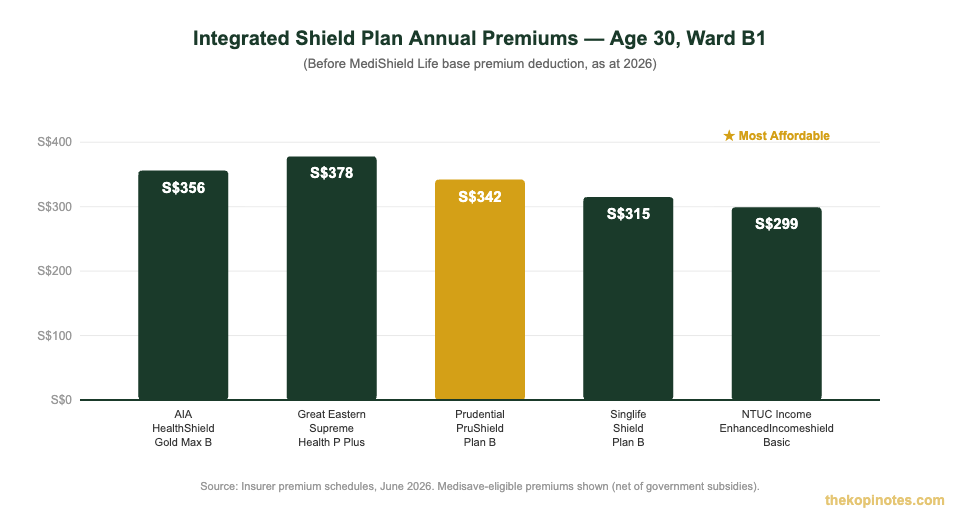
Premiums vary by age, plan tier (ward level), and health status. The table below compares indicative annual premiums for a 30-year-old Singapore citizen at the Ward B1 tier — the most popular entry tier that covers restructured hospital Ward A and B1.
Note that the Medisave-eligible portion of your premium can be paid directly from your Medisave account. You only pay cash for the portion that exceeds the Medisave withdrawal limit.
| Insurer & Plan | Age 30 | Age 40 | Age 50 | Age 60 |
|---|---|---|---|---|
| AIA HealthShield Gold Max B | S$356 | S$602 | S$1,078 | S$1,680 |
| Great Eastern Supreme Health P Plus | S$378 | S$631 | S$1,096 | S$1,710 |
| Prudential PruShield Plan B | S$342 | S$581 | S$1,053 | S$1,623 |
| Singlife Shield Plan B | S$315 | S$548 | S$1,021 | S$1,598 |
| NTUC EnhancedIncomeshield Basic | S$299 | S$524 | S$997 | S$1,562 |
Source: Insurer premium schedules (Medisave-eligible base ISP premiums), June 2026. Figures are indicative; individual premiums may vary based on health history and loading.
The premium gap between providers is small when you’re young. But it widens significantly as you age. At 60, the spread between the cheapest and most expensive Ward B1 plan can exceed S$150 per year. More importantly, premium differences compound over decades — so choosing a slightly cheaper plan early on may save thousands over a lifetime.
Coverage Comparison: What Each Plan Covers
All five ISPs cover the same core benefits as mandated by MOH — daily ward and treatment charges, surgical fees, specialist outpatient treatment, and more. The differences lie in the claim limits, pre- and post-hospitalisation coverage windows, and cancer treatment sub-limits.
| Feature | AIA Max B | GE P Plus | PRU Plan B | Singlife Plan B | NTUC Basic |
|---|---|---|---|---|---|
| Annual Claim Limit | Unlimited | Unlimited | Unlimited | Unlimited | Unlimited |
| Ward Coverage | B1 Restructured | B1 Restructured | B1 Restructured | B1 Restructured | B1 Restructured |
| Pre-hospitalisation | 100 days | 100 days | 180 days | 100 days | 100 days |
| Post-hospitalisation | 100 days | 100 days | 365 days | 100 days | 100 days |
| Deductible (B1 Ward) | S$2,000 | S$2,000 | S$2,000 | S$2,000 | S$2,000 |
| Co-insurance | 10% | 10% | 10% | 10% | 10% |
| Co-insurance Cap | S$3,000 | S$3,000 | S$3,000 | S$3,000 | S$3,000 |
Source: MOH ISP benefit tables, insurer policy documents, June 2026. All figures for Ward B1 tier base plans (without rider).
At the B1 tier, the core MOH-mandated benefits are identical across all five plans. Prudential stands out with a longer pre- and post-hospitalisation window — 180 days before and 365 days after admission versus 100 days for all others. This matters if you have complex conditions requiring lengthy specialist follow-up.
Ward Types: B1 vs A vs Private — What Should You Choose?
Each insurer offers multiple plan tiers corresponding to different ward types. Here’s what they mean in practice:
| Ward Type | What It Covers | Annual Premium (Age 30, approx.) |
|---|---|---|
| Ward B1 | 4–6 bedded ward in restructured hospital | S$299–S$378 |
| Ward A | 1–2 bedded ward in restructured hospital | S$380–S$520 |
| Private Hospital | Private hospital single/standard room, choice of specialist | S$750–S$1,200+ |
Source: Insurer premium schedules, June 2026. Ranges shown as premiums vary by provider.
Most financial advisers suggest Ward A as the sweet spot for most Singaporeans. You get a private or semi-private room in a restructured hospital, free choice of specialist, and access to subsidised public healthcare if needed — at a fraction of private hospital premiums. Private hospital plans cost 2–3x more in premiums and are best suited for those who want guaranteed access to specific private hospitals or named specialists.
You can learn more about how these plans fit into broader CPF investment strategy — particularly how Medisave funds interact with your ISP premiums over time.
Riders: The Key Differentiator Between Plans
This is where the real differences emerge. A rider is an add-on policy you buy alongside your base ISP. It covers your deductible and co-insurance, reducing your out-of-pocket costs when you make a claim. However, MOH regulations changed in 2021 — all riders must now include a co-payment element of at least 5% (capped at S$3,000 per policy year).
The 2026 ISP rider changes introduced further requirements around restructured hospital claims. You should review your rider terms carefully before assuming full coverage.
| Insurer | Rider Name | Co-pay Required | Pre/Post-hosp Covered? | Annual Rider Premium (Age 30, approx.) |
|---|---|---|---|---|
| AIA | Max Essential Rider | 5% (cap S$3,000) | Yes | ~S$480 |
| Great Eastern | TotalCare Rider | 5% (cap S$3,000) | Yes | ~S$510 |
| Prudential | PruExtra Premier CoPay | 5% (cap S$3,000) | Yes (365 days post) | ~S$490 |
| Singlife | Assist Rider | 5% (cap S$3,000) | Yes | ~S$440 |
| NTUC Income | Deluxe Care Rider | 5% (cap S$3,000) | Yes | ~S$410 |
Source: Insurer rider product summaries, June 2026. Rider premiums are indicative for a 30-year-old male non-smoker at Ward B1 level.
All riders since 2021 require at least a 5% co-payment, capped at S$3,000 per year. This means even with the best rider, you still pay at least 5% of your eligible claim. For a S$20,000 hospital bill, that’s S$1,000 out of pocket — not zero. Plan accordingly.
If you’re evaluating robo-advisor platforms to help manage the cash component of your healthcare planning, see our best robo-advisor Singapore guide for options that pair well with ISP planning.
Out-of-Pocket Costs Without a Rider
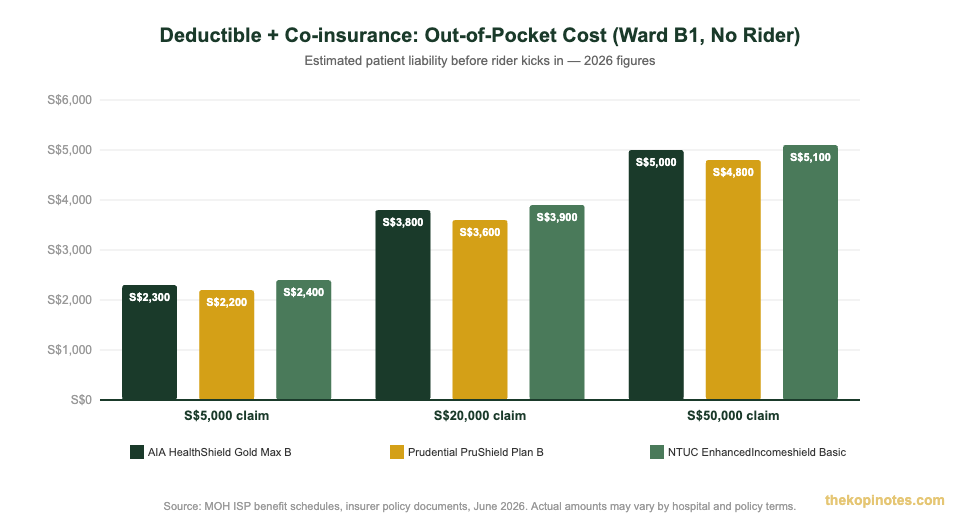
Many Singaporeans hold a base ISP without a rider to keep premiums low. Here’s what you’d actually pay at the point of claim (Ward B1, restructured hospital) with no rider:
- Deductible: S$2,000 (you pay this first, before insurance kicks in)
- Co-insurance: 10% of the claimable amount above the deductible, capped at S$3,000
- Maximum out-of-pocket per admission: S$2,000 + S$3,000 = S$5,000
This S$5,000 cap applies regardless of how large your hospital bill is. For a S$50,000 surgery, your ISP covers S$45,000 and you pay S$5,000. That said, S$5,000 is still a meaningful sum — which is why many people add a rider to reduce it further.
Using a Singapore retirement calculator to model healthcare costs over your lifetime helps you decide whether the rider premium is worth paying today.
Which Shield Plan Is Best for You?
The honest answer: most people overestimate how different the plans are. At the B1 level, coverage is nearly identical. The real decision comes down to three factors:
Choose NTUC Income or Singlife if: you want the lowest base premium and are happy with basic restructured hospital coverage. These two plans consistently price below the competition, especially at younger ages.
Choose Prudential PruShield if: you want the longest pre- and post-hospitalisation coverage window (180 days pre, 365 days post). If you have chronic conditions requiring extensive outpatient follow-up, this is a meaningful differentiator.
Choose AIA or Great Eastern if: you have existing ISP coverage with these providers and switching would trigger re-underwriting with pre-existing condition exclusions. Brand familiarity and existing advisor relationships also matter.
Consider upgrading to Ward A or Private if: you have a strong preference for single-room accommodation, want guaranteed choice of specialist, or have a family history of conditions requiring specialist care. The premium difference is S$100–S$200/year at age 30 — quite affordable.
For a detailed breakdown of integrated shield plan comparison across all tiers, including private hospital plan analysis, see our full comparison guide.
How to Apply for a Shield Plan
You can apply for an ISP directly with the insurer or through a licensed financial adviser. Here’s what the process looks like:
Step 1: Choose your plan tier and provider. Use the comparison above to shortlist 2–3 providers. Decide whether you need a rider upfront — it’s easier to add a rider when you first apply than later (underwriting may apply at renewal).
Step 2: Apply online or through an adviser. All five providers accept online applications. You’ll need to answer a health declaration form. Disclose all pre-existing conditions honestly — failure to disclose is grounds for claim rejection.
Step 3: Set up Medisave payment. Designate your Medisave account to pay the Medisave-eligible portion of your premium. The insurer handles this directly with CPF Board. Any excess premium must be paid by cash or GIRO.
Step 4: Review your policy document. Check your ward entitlement, deductible amount, any exclusions, and the premium schedule for future ages. Premiums increase significantly at each age band — know what you’re committing to.
If you want to compare how ISP costs fit alongside other passive income strategies, our guide on passive income Singapore gives a broader financial context.
Planning to use Endowus (referral code: 2V343) or Syfe (referral code: SRPRFFFCD) to grow your cash savings to cover ISP costs and deductibles? Both platforms offer cash management products that can help your healthcare emergency fund earn a higher return while staying liquid.
Frequently Asked Questions
Which integrated shield plan is the cheapest in Singapore?
NTUC Income EnhancedIncomeshield and Singlife Shield consistently offer the lowest base premiums, especially at younger ages. For a 30-year-old at Ward B1 level, NTUC Income charges approximately S$299/year and Singlife approximately S$315/year — both below the other three providers. However, the cheapest plan is not always the best value; always compare coverage terms and rider options alongside premiums.
Can I have more than one integrated shield plan?
No. You can only hold one integrated shield plan at a time in Singapore. All five ISPs integrate with MediShield Life, and MOH regulations do not permit duplicate ISP coverage. However, you can have a separate private hospitalisation or critical illness plan on top of your ISP — these are distinct products and can co-exist.
What is the difference between an ISP and a rider?
Your base integrated shield plan covers most of your hospitalisation bill after the deductible (S$2,000 for Ward B1) and co-insurance (10%, capped at S$3,000). A rider is a separate add-on that covers the deductible and co-insurance, reducing your out-of-pocket cost. From 2021, MOH requires all riders to include a minimum 5% co-payment (capped at S$3,000/year) — so you can never have zero out-of-pocket with any rider.
Is Great Eastern Supreme Health better than AIA HealthShield Gold Max?
At the B1 tier, both plans are very similar in core coverage. AIA tends to be slightly cheaper at most age bands; Great Eastern’s TotalCare rider is competitively priced. The main reason to choose one over the other is usually your existing insurance relationship, your financial adviser, or whether you have pre-existing conditions that might be excluded upon switching. If you are starting fresh with no pre-existing conditions, compare premiums across all five providers before deciding.
Can I switch my integrated shield plan to a different insurer?
Yes, you can switch ISP providers. However, the new insurer will typically require you to complete a new health declaration. Any pre-existing conditions not covered under your current plan may be excluded by the new insurer. If you are in good health, switching for a lower premium makes sense. If you have ongoing health issues, weigh the risk of exclusions carefully before switching.
Does my ISP cover pre-existing conditions?
The MediShield Life component of your ISP covers pre-existing conditions with a 30% loading for the first 10 years. The additional private insurance component provided by the insurer may exclude pre-existing conditions altogether, or may include them with a loading. Conditions must be declared at application, and non-disclosure can void your claim. Check your policy document’s list of exclusions carefully.
What ward type should I choose for my integrated shield plan?
For most Singaporeans, Ward A in a restructured hospital offers the best balance of cost and quality. You get a semi-private room, choice of doctor, and access to specialist care — without paying private hospital premiums. Ward B1 is a good budget option if you are comfortable with a 4–6 bedded ward. Private hospital plans make sense if you specifically want access to private hospitals or named specialists, and can afford premiums 2–3x higher than a B1 plan.
Need Help Choosing the Right Shield Plan?
Compare all providers and make an informed decision. Use our tools and referral links to get started with bonuses.
Not financial advice. Speak to a licensed financial adviser for personalised recommendations.
Get Free Insurance Advice
Speak with a licensed insurance advisor. No obligation, no cost.
By submitting this form, you agree to our Privacy Policy.
This article was researched with the help of AI. While we strive to keep all information accurate and up to date, there may be errors. If you notice any discrepancies, please contact us.