Critical Illness Insurance Singapore 2026: Early CI vs Multi-Pay vs Standalone — Which Plan Do You Actually Need?
A plain-English comparison of every CI plan type available in Singapore — with real premium estimates, worked examples, and a decision framework.
Most Singaporeans are dangerously underinsured for critical illness. The average working adult has a CI protection gap of about $265,000 — meaning if cancer, a heart attack, or a stroke hits tomorrow, that shortfall comes straight out of your savings. The problem is not a lack of CI plans on the market. It is that most people do not understand the difference between early-stage CI, multi-pay CI, standalone CI, and CI riders — and end up buying the wrong type, or not enough of it.
Not financial advice. All figures are for educational reference only. Data as at June 2026 unless noted.
- CI insurance pays a lump sum on diagnosis — it replaces your income while you recover, not your hospital bills (that is what your Integrated Shield Plan does).
- Early CI plans pay at early-stage diagnosis and are cheapest. Multi-pay plans pay multiple times across stages and offer the most comprehensive cover. Standalone CI pays a single lump sum for severe-stage illness. CI riders are the cheapest but are tied to your life insurance policy.
- Most financial advisers recommend CI coverage of 3.5–5× your annual income. For someone earning $5,000/month, that is $210,000–$300,000.
Table of Contents
Contents — Click to expand
What Is Critical Illness Insurance?
Critical illness (CI) insurance pays you a lump sum when you are diagnosed with a covered serious illness. That is it. You get the money and you decide how to spend it — on medical bills your Integrated Shield Plan does not cover, on living expenses while you cannot work, on alternative treatments, or even on taking your family on a holiday while you recover.
The payout is not tied to hospital receipts. It is not reimbursement. It is cash in your hand when you need it most.
In Singapore, the Life Insurance Association (LIA) standardises the definitions of 37 severe-stage critical illnesses. This means whether you buy a policy from AIA, Great Eastern, Prudential, or any other insurer, conditions like “Major Cancer,” “Heart Attack of Specified Severity,” and “Stroke with Permanent Neurological Deficit” are defined the same way across the industry.
However — and this catches many people off guard — the 37 standardised definitions only cover severe-stage conditions. Early-stage and intermediate-stage definitions are left to each insurer to define. That is why two “early CI” plans from different insurers can cover very different things.
A common question many Singaporeans ask is whether they even need CI insurance if they already have hospitalisation cover. The short answer: yes, because they serve completely different purposes. More on that in the CI + ISP section below.
The 3 Types You Need to Understand
The CI insurance market in Singapore has evolved significantly. You are no longer choosing between “CI plan or no CI plan.” You are choosing between fundamentally different plan structures. Here is what each one does.
1. Early-Stage Critical Illness (Early CI) Plans
Early CI plans pay out when you are diagnosed with a critical illness at its early stage — before it progresses to the severe stage covered by traditional CI plans. This includes conditions like early-stage cancer (carcinoma in situ), minor heart attack, and early-stage stroke.
The typical payout is 20–50% of your sum assured per early-stage claim. For example, if you have $200,000 in coverage and are diagnosed with Stage 1 cancer, you might receive $40,000–$100,000 immediately. You can read our detailed breakdown in the early critical illness insurance Singapore guide.
Why does this matter? Because medical screening technology has improved dramatically. Cancers are now caught earlier. Heart conditions are detected before full cardiac events. If your CI plan only pays at the severe stage, you might survive a health scare, rack up expenses during treatment and recovery, but never receive a cent because your condition was caught “too early” to qualify.
Pros: Lowest premiums among standalone CI plans. Pays when you actually need money — at early diagnosis when treatment is most effective. Covers the gap that traditional severe-stage CI plans miss.
Cons: Limited coverage scope — only covers early-stage conditions, not severe-stage. Lower payout percentages (20–50% of sum assured). You still need separate severe-stage CI coverage.
2. Multi-Pay Critical Illness (MPCI) Plans
Multi-pay CI plans are the most comprehensive option. They cover you across all stages — early, intermediate, and late — and allow multiple claims for different conditions or recurring conditions over your lifetime.
The best multi-pay plans on the market in 2026 offer total payouts of up to 500–900% of your sum assured. For instance, Singlife’s Multipay Critical Illness II covers 135 conditions and allows claims up to 900% of the basic sum assured. AIA’s Ultimate Critical Cover covers 150 conditions with unlimited claims for major-stage critical illnesses.
Here is the real-world value: suppose you are diagnosed with early-stage breast cancer at age 40. Your multi-pay plan pays out 25% of your $200,000 coverage — $50,000. Five years later, you suffer a heart attack. Your plan pays another 100% — $200,000. Without multi-pay, a single-claim plan would have ended after the first event.
Pros: Most comprehensive protection. Multiple claims across different illnesses and stages. Covers early, intermediate, and late-stage conditions. Many plans waive premiums after a severe-stage claim.
Cons: Highest premiums — roughly 50% more than single-pay early CI plans. Complexity — more conditions and terms to understand. Overkill if you are young, healthy, and on a tight budget.
3. Standalone CI vs CI Rider
This distinction confuses many people. A standalone CI plan is its own policy — you buy it separately, it stands on its own, and a claim does not affect any other policy you hold.
A CI rider is an add-on attached to an existing life insurance policy (usually term life or whole life). It is cheaper, but it comes with a major catch: when you claim on the CI rider, the payout typically reduces your life insurance death benefit by the same amount. In some cases, a CI claim terminates the entire life policy.
Many Singaporeans wonder whether a CI rider is sufficient. If you already have a term life insurance policy and your budget is limited, a CI rider adds a layer of protection at minimal cost. However, if you want dedicated CI coverage that does not erode your death benefit, a standalone policy is the better choice.
Important note: You cannot use CPF (Ordinary Account, Special Account, or MediSave) to pay for CI insurance premiums — whether standalone or rider. CI premiums are a cash-only expense.
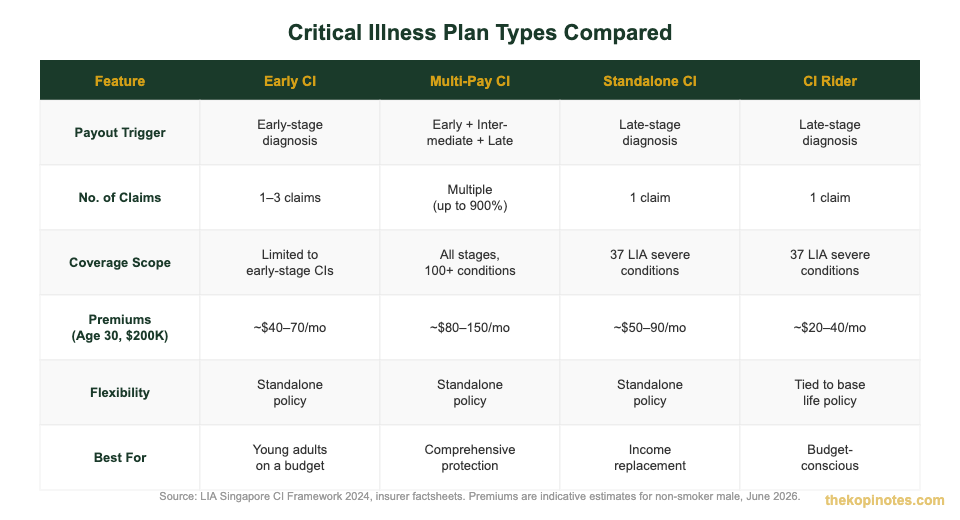
Side-by-Side Comparison: Early CI vs Multi-Pay vs Standalone vs CI Rider
This is the table that should clear up the confusion. Here is how the four main CI plan structures compare across every factor that matters.
| Feature | Early CI | Multi-Pay CI | Standalone CI | CI Rider |
|---|---|---|---|---|
| Payout trigger | Early-stage diagnosis | Early + intermediate + late stage | Severe-stage (LIA 37) | Severe-stage (LIA 37) |
| Number of claims | 1–3 (depending on plan) | Multiple (up to 500–900% of SA) | 1 claim, then policy ends | 1 claim, reduces/ends life cover |
| Conditions covered | Early-stage cancers, minor heart attack, early stroke, angioplasty | 100–187 conditions across all stages | 37 severe-stage LIA conditions (some insurers add more) | 37 severe-stage LIA conditions |
| Payout amount | 20–50% of sum assured per claim | 25–100% per event, cumulative up to 900% | 100% of sum assured | 100% of CI rider amount (reduces death benefit) |
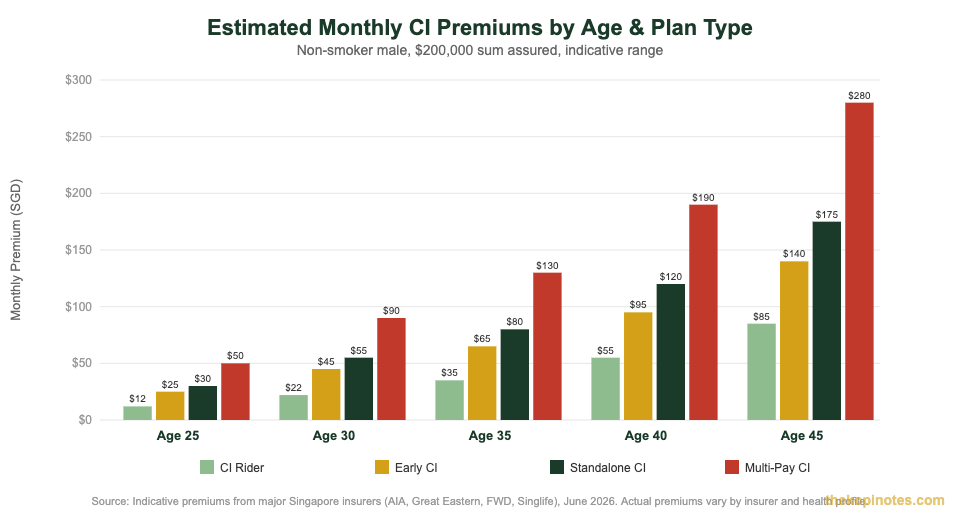
| Premium range (age 30, $200K) | ~$40–70/month | ~$80–150/month | ~$50–90/month | ~$20–40/month |
| Affects other policies? | No — standalone | No — standalone | No — standalone | Yes — reduces or terminates base life policy |
| Premium waiver on claim? | Rarely | Yes (most plans waive after severe-stage claim) | Policy ends after claim | Depends on base policy |
| Best for | Young adults wanting affordable early detection cover | Comprehensive, long-term protection across all stages | Dedicated income replacement for severe illness | Budget-conscious individuals adding CI to existing life cover |
Source: LIA Singapore CI Framework 2024, insurer product disclosures. Premiums are indicative estimates for non-smoker male. Actual premiums vary by insurer, health profile, and payment term.
How Much CI Coverage Do You Actually Need?
This is where most people get stuck. Many Singaporeans wonder how much critical illness coverage is actually enough. The general guideline from financial advisers and the LIA is 3.5–5× your annual income.
Why this range? Because the average recovery period from a critical illness is approximately five years, according to industry data. During that time, you may not be able to work at all, or you may only be able to work part-time. Your CI payout needs to cover your living expenses, outstanding debts, and ongoing medical costs for that recovery period.
Here is a simple way to calculate your CI coverage need:
Worked calculation: If your monthly household expenses (including mortgage, bills, food, transport, and children’s costs) total $4,000, you need $4,000 × 12 × 4 = $192,000 at minimum. Add outstanding debts and you are looking at $200,000–$250,000.
The problem? The LIA’s 2022 Protection Gap Study found that the average Singaporean working adult has only about $60,000 in CI coverage — against a recommended need of roughly $317,000. That is a gap of $257,000. You can use our Singapore retirement calculator to stress-test how a CI event would impact your long-term financial plan.
| Monthly Income | 3.5× Annual Income | 5× Annual Income | Typical Existing Coverage | Estimated Gap |
|---|---|---|---|---|
| $3,000 | $126,000 | $180,000 | ~$45,000 | $81,000–$135,000 |
| $5,000 | $210,000 | $300,000 | ~$60,000 | $150,000–$240,000 |
| $8,000 | $336,000 | $480,000 | ~$80,000 | $256,000–$400,000 |
| $12,000 | $504,000 | $720,000 | ~$100,000 | $404,000–$620,000 |
Source: LIA Protection Gap Study 2022, TKN estimates. “Typical Existing Coverage” based on LIA average figures for economically active adults in Singapore.
CI + ISP: Do You Need Both?
This is one of the most common questions Singaporeans ask: “I already have an Integrated Shield Plan. Do I still need critical illness insurance?”
The answer is yes — and here is why they are completely different products that serve completely different purposes.
Your ISP (whether it is AIA HealthShield Gold Max, Great Eastern Supreme Health, Prudential PRUShield, or any other plan) covers your hospitalisation and treatment bills. If you are admitted to hospital, your ISP pays the eligible medical expenses — surgery, ward charges, specialist fees, and so on. It is a reimbursement product. It pays the hospital, not you.
CI insurance, on the other hand, pays you directly. It is a lump sum that goes into your bank account. You use it however you need — income replacement while you cannot work, mortgage payments, children’s school fees, hiring a caregiver, or funding treatments that your ISP does not cover (like traditional Chinese medicine, overseas second opinions, or experimental therapies).
Think of it this way: your ISP handles the medical bills inside the hospital. CI insurance handles everything outside the hospital — your life, your family, your finances while you recover.
In practice, most financial planners in Singapore recommend having both. Your ISP with a rider handles the healthcare costs. Your CI plan (whether early CI, multi-pay, standalone, or rider) handles the income and lifestyle costs. Without CI, you are dipping into your savings and investments — potentially derailing your passive income plans and retirement timeline.
Worked Example: 35-Year-Old Earning $5,000/Month
Let us walk through a real scenario to show how each plan type plays out differently.
Profile: Wei Ming, 35, non-smoker, earns $5,000/month. Monthly expenses: $3,500 (including $1,500 HDB mortgage). No dependants yet. Has an ISP with rider. No existing CI coverage.
Recommended CI coverage: $210,000–$300,000 (3.5–5× annual income of $60,000).
Scenario: Diagnosed with Stage 1 breast cancer at age 42. Successfully treated. Two years later, suffers a minor heart attack.
Option A: Early CI Plan ($200,000 coverage, ~$55/month premium)
Stage 1 cancer payout: 25% of $200,000 = $50,000. Wei Ming uses this for income replacement during 3 months of treatment. Two years later, minor heart attack: another 25% payout = $50,000. Total received: $100,000. Remaining coverage: $100,000 (for severe-stage claim).
Option B: Multi-Pay CI Plan ($200,000 coverage, ~$110/month premium)
Stage 1 cancer payout: 25% = $50,000. Minor heart attack two years later: 25% = $50,000. If (touch wood) a severe-stage cancer occurs later: 100% = $200,000. Premiums waived after severe-stage claim. Total potential: up to $500,000+ across all stages. This is the most comprehensive protection.
Option C: Standalone CI Plan ($200,000 coverage, ~$65/month premium)
Stage 1 cancer: $0 payout — the condition does not meet severe-stage definition. Minor heart attack: $0 payout — also below severity threshold. Wei Ming gets nothing despite two health crises. She only receives the $200,000 if diagnosed with a severe-stage condition later. The coverage gap is real.
Option D: CI Rider on Term Life ($200,000 rider, ~$28/month additional premium)
Same outcome as Option C for early-stage events — $0 payout. If a severe-stage illness eventually occurs, she receives $200,000, but her term life death benefit is reduced by $200,000. Her family loses that protection.
The worked example makes the trade-off clear. Early CI and multi-pay plans pay when you actually get sick — at stages where modern medicine increasingly catches conditions. Traditional standalone and rider plans only pay at severe stage, which means you might fight two health battles and receive nothing.
Common Mistakes to Avoid
After speaking with many Singaporeans about their insurance, certain mistakes come up again and again. Here are the ones that cost people the most.
1. Buying too little coverage
A $50,000 CI plan sounds like a lot — until you realise that a cancer diagnosis can keep you out of work for 1–3 years. At $4,000/month in expenses, you burn through $50,000 in just over a year. Most people need $200,000–$300,000 in CI coverage. Yes, the premiums are higher. But a $50,000 plan gives you a false sense of security.
2. Not understanding staging definitions
Many Singaporeans assume that any cancer diagnosis triggers their CI payout. It does not. Your traditional CI plan requires the cancer to meet the LIA’s “Major Cancer” definition — which explicitly excludes carcinoma in situ, early-stage thyroid cancers (T1N0M0), and early-stage prostate cancers (Gleason score ≤ 6). If your doctor catches cancer early (which is the goal of screening), your severe-stage-only plan may not pay out.
3. CI rider expiring with the base policy
If your CI coverage is a rider on a term life policy, it expires when the term life expires. Many term life policies end at age 65 or 70. But CI risk increases dramatically after 60. You might find yourself without CI coverage precisely when you need it most — and at an age where buying new coverage is either very expensive or impossible due to pre-existing conditions.
4. Not disclosing medical history
This is how claims get rejected. If you fail to declare a pre-existing condition during application and later make a claim related to that condition, the insurer has grounds to void your policy entirely. Full, honest disclosure at the point of application is non-negotiable. Even conditions you think are minor — like a benign cyst, elevated cholesterol, or a previous mental health consultation — must be declared.
5. Confusing CI with hospitalisation insurance
As covered above, your Integrated Shield Plan covers hospital bills. Your CI plan replaces your income. They are not substitutes. Having one without the other leaves a significant gap in your protection.
6. Ignoring the claims process
CI payouts require specific medical documentation. A diagnosis alone is not always enough — the medical report must confirm that the condition meets the policy’s exact definition. Keep copies of all medical reports, specialist letters, biopsy results, and imaging scans. Notify your insurer as soon as possible after diagnosis. Delays in claims submission can create unnecessary complications.
Which Plan Suits You? A Decision Framework
Rather than asking “which is the best CI plan?”, ask “which CI plan structure matches my situation?” Here is a simple framework.
If you are budget-conscious and already have life insurance: Start with a CI rider on your existing term life policy. It is the cheapest way to add CI coverage. You can upgrade to a standalone plan later when your budget allows. If you are comparing term life options, check our best term life insurance Singapore comparison.
If you want comprehensive, long-term protection: A multi-pay standalone CI plan is your best bet. Yes, premiums are higher — roughly $80–$150/month for a 30-year-old with $200,000 coverage. But you are covered across all stages, can claim multiple times, and most plans waive your premiums after a severe-stage claim. For anyone with dependants or a family history of cancer, heart disease, or stroke, this is the strongest choice.
If you are young, healthy, and want affordable entry: An early CI standalone plan offers the best value for young adults in their 20s and early 30s. Premiums are low, and you get coverage for early-stage conditions that are increasingly caught through routine screening. Pair it with a standalone severe-stage CI plan later if budget permits.
If you already have an ISP and are wondering “what else?”: You still need CI for income replacement. Your ISP handles medical bills. CI handles everything else — mortgage, groceries, transport, your children’s tuition. The two work together, not as alternatives. Consider building an overall financial plan using our retirement planning calculator to see how CI coverage fits into your broader financial picture.
If you want the most cost-effective combination: Pair an early CI standalone plan with a CI rider on your term life. The early CI plan covers early-stage events (which are increasingly common with better screening). The CI rider covers severe-stage events at a low additional cost. Total premium: roughly $60–$100/month for a 30-year-old — significantly less than a full multi-pay plan, with coverage across both early and severe stages.
Regardless of which structure you choose, the most important thing is to actually have CI coverage. The worst plan is no plan at all. If you are exploring platforms to manage your insurance and investment portfolio alongside each other, our reviews of Endowus and Syfe cover how robo-advisory platforms can complement your insurance planning with a disciplined investment strategy.
Not financial advice. Always consult a licensed financial adviser for personalised recommendations based on your specific situation, health profile, and financial goals.
Frequently Asked Questions
Is critical illness insurance worth it in Singapore?
Yes. Cancer, heart attack, and stroke are the three most common critical illnesses in Singapore, and treatment can keep you out of work for one to five years. Your Integrated Shield Plan covers hospital bills, but CI insurance replaces your income during recovery. With a CI protection gap of $265,000 per working adult in Singapore (LIA, 2022), most Singaporeans are significantly underinsured for this risk.
What is the difference between early CI and multi-pay CI plans?
Early CI plans pay out only at the early stage of a critical illness — typically 20–50% of the sum assured per claim. Multi-pay CI plans cover all stages (early, intermediate, and late) and allow multiple claims across different or recurring conditions over your lifetime, with total payouts of up to 500–900% of the sum assured. Multi-pay premiums are roughly 50% higher than early CI plans, but the coverage is approximately 300% more comprehensive.
Can I use CPF or MediSave to pay for critical illness insurance?
No. You cannot use CPF Ordinary Account, Special Account, or MediSave to pay for critical illness insurance premiums — whether standalone or as a rider. CI insurance premiums are a cash-only expense. MediSave can only be used for MediShield Life and approved Integrated Shield Plans, not for CI-specific coverage.
How much critical illness coverage do I need in Singapore?
The general recommendation is 3.5–5 times your annual income. For someone earning $5,000/month ($60,000/year), that works out to $210,000–$300,000 in CI coverage. This accounts for approximately 3.5–5 years of income replacement during recovery. Factor in your monthly expenses, outstanding debts, and the number of dependants relying on your income when deciding where in this range to aim.
Do I need critical illness insurance if I already have an Integrated Shield Plan?
Yes. Your ISP covers hospitalisation and treatment bills. CI insurance provides a lump-sum cash payout for income replacement, mortgage payments, daily living costs, and expenses your ISP does not cover (like alternative therapies or caregiving costs). They serve completely different purposes. Most financial planners in Singapore recommend having both for comprehensive protection.
What are the 37 critical illnesses covered by Singapore CI plans?
The Life Insurance Association of Singapore (LIA) standardises the definitions for 37 severe-stage critical illnesses, including major cancer, heart attack of specified severity, stroke with permanent neurological deficit, kidney failure, major organ transplant, coronary artery bypass surgery, and others. These 37 definitions are the same across all LIA member insurers. However, many plans now cover additional conditions beyond the 37 — some covering up to 150–187 conditions when early and intermediate stages are included.
What happens if my CI claim is rejected?
The most common reason for CI claim rejection is that the medical diagnosis does not meet the policy’s exact definition of the covered condition. For example, early-stage cancer or a mild heart attack may not qualify under a severe-stage-only CI plan. Other reasons include non-disclosure of pre-existing conditions during application and claims submitted outside the policy’s coverage period. To avoid rejection, ensure full medical disclosure at application, understand your plan’s staging definitions, and keep detailed medical documentation.
Should I choose a standalone CI plan or a CI rider on my life insurance?
A CI rider is cheaper and convenient if you already have life insurance, but claiming on it typically reduces your death benefit. A standalone CI plan costs more but does not affect any other policy. If budget is tight, start with a CI rider and upgrade later. If you have dependants who rely on your life insurance payout, a standalone CI plan protects both your CI coverage and your death benefit independently.
Ready to Review Your Insurance Coverage?
Use our tools and guides to build a complete financial protection plan — from CI insurance to investments.
Get Free Insurance Advice
Speak with a licensed insurance advisor. No obligation, no cost.
By submitting this form, you agree to our Privacy Policy.
This article was researched with the help of AI. While we strive to keep all information accurate and up to date, there may be errors. If you notice any discrepancies, please contact us.