Integrated Shield Plan Comparison 2026: After the April Rider Changes
Which plan is best now that MOH has changed the deductible rules? Here’s the complete Singapore guide.
From 1 April 2026, Singapore’s Integrated Shield Plan (ISP) rider rules changed. New riders can no longer cover the minimum deductible ($1,500–$3,500 depending on ward class), and the annual co-payment cap doubled from $3,000 to $6,000. In return, new rider premiums are about 30% lower on average. This guide compares all six ISP insurers — AIA, NTUC Income, Great Eastern, Singlife, Raffles, and Prudential — so you can pick the right plan for your needs.
Not financial advice. All figures are for educational reference only. Data as at June 2026 unless noted.
- New ISP riders (from Apr 2026) are ~30% cheaper but require you to pay your deductible out-of-pocket first.
- MediSave can cover most or all of your deductible and co-payment for typical hospitalisations.
- Great Eastern froze its base plan premiums for all of 2026 — good news if you’re on GreatEasternSupreme Health.
Table of Contents
Contents — Click to expand
What Changed in April 2026
In November 2025, the Ministry of Health (MOH) announced sweeping changes to ISP rider design. The rules took effect on 1 April 2026.
The trigger? Data showing that private hospital policyholders with full riders are 1.4 times more likely to make a claim — and their average claim is 1.4 times larger — than those without riders. This drove rising premiums across the board. MOH’s solution: make policyholders share more of the smaller costs, while still protecting them from catastrophic bills.
Here’s what changed in plain terms. Before April 2026, you could buy a rider that covered almost everything — your deductible, your co-payment, right down to near zero out-of-pocket. From April 2026, new riders can no longer cover the minimum IP deductible. You pay that yourself first. Only after you’ve paid the deductible does your rider start covering the rest.
The good news: because coverage is reduced, premiums drop by about 30% on average. For a 60-year-old on a private hospital plan, that’s roughly $1,600 saved per year in cash.
New Deductibles and Co-Payment Rules Explained
A deductible is the fixed amount you must pay before your insurance kicks in. It resets every policy year. Under the new rules, your rider cannot cover this deductible — you pay it out of pocket (or from MediSave).
The minimum deductible depends on which ward class you use:
| Ward Class Used | Minimum Deductible (from Apr 2026) |
|---|---|
| Private / Class A | $3,500 per policy year |
| Class B1 | $2,500 per policy year |
| Class B2 | $2,000 per policy year |
| Class C | $1,500 per policy year |
Source: MOH, November 2025. Minimum deductibles may be updated over time.
After the deductible, the 5% co-payment still applies — that hasn’t changed. What doubled is the annual co-payment cap: from $3,000 to $6,000. This cap applies to the co-payment portion only, excluding your deductible. It only applies if you use a panel doctor or get pre-authorisation from your insurer.
So in the worst case under the new rider, you pay: $3,500 (deductible) + up to $6,000 (co-payment cap) = up to $9,500 per year from your own funds before the rider covers everything else. Most of this can be covered by MediSave — more on that below.
ISP Insurer Comparison 2026
All six ISP insurers launched compliant new riders by 1 April 2026. The core deductible and co-payment rules are the same for all — that’s set by MOH. What differs is the base plan premium trajectory and the specific rider products each insurer offers.
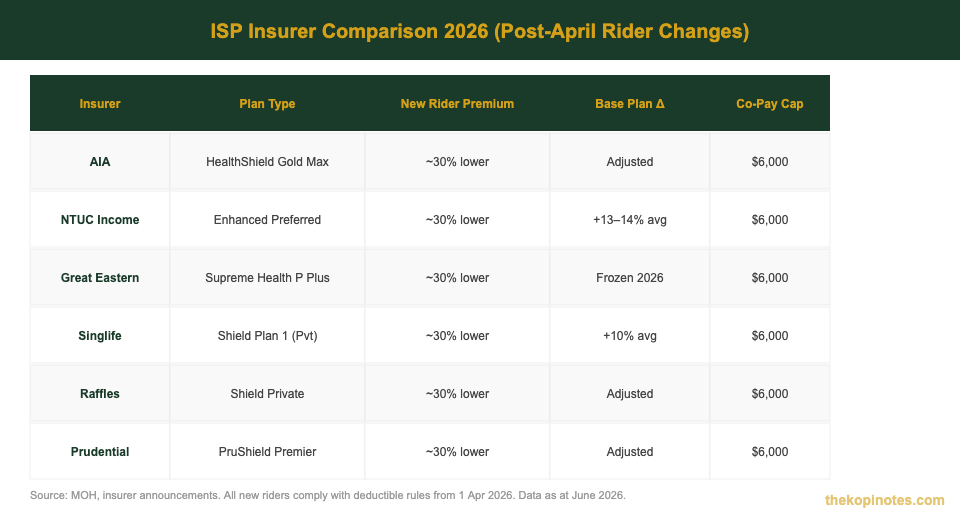
| Insurer | Private Hospital Plan | Base Plan Premium Δ | Key Note for 2026 |
|---|---|---|---|
| AIA | HealthShield Gold Max A/B | Adjusted (age-based) | New Max rider launched Apr 2026; check for Max A vs B plan differences |
| NTUC Income | Enhanced Preferred / Advantage | +13–14% avg (Preferred/Advantage) | Enhanced Basic plan up only ~7%; old riders discontinued from Apr 2026 |
| Great Eastern | Supreme Health P Plus / P | Frozen all of 2026 | Only insurer to freeze base premiums — standout value for existing policyholders |
| Singlife | Shield Plan 1 | +10% avg (Plan 1) | Old Private Prime rider saw +78% increase; new rider is ~30% cheaper |
| Raffles | Shield Private | Adjusted | Old Key Rider saw up to +155% — switching to new rider gives biggest savings here |
| Prudential | PruShield Premier | Adjusted | PruExtra Premier rider replaced by new compliant design from Apr 2026 |
Source: Individual insurer announcements; MOH press release Nov 2025. All new riders comply with Apr 2026 deductible rules. Premiums vary by age, plan tier, and individual underwriting.
What’s the same across all insurers: Every new rider now follows the same MOH-mandated deductible structure. The 5% co-payment is unchanged. The $6,000 annual co-payment cap (excluding deductible) applies universally for eligible claims.
What differs: Base plan premium increases, the specific rider product names, panel doctor networks, pre-authorisation processes, and how each insurer handles claims. Great Eastern’s premium freeze stands out as the most policyholder-friendly move in 2026.
Real Cost Scenarios: What You Actually Pay
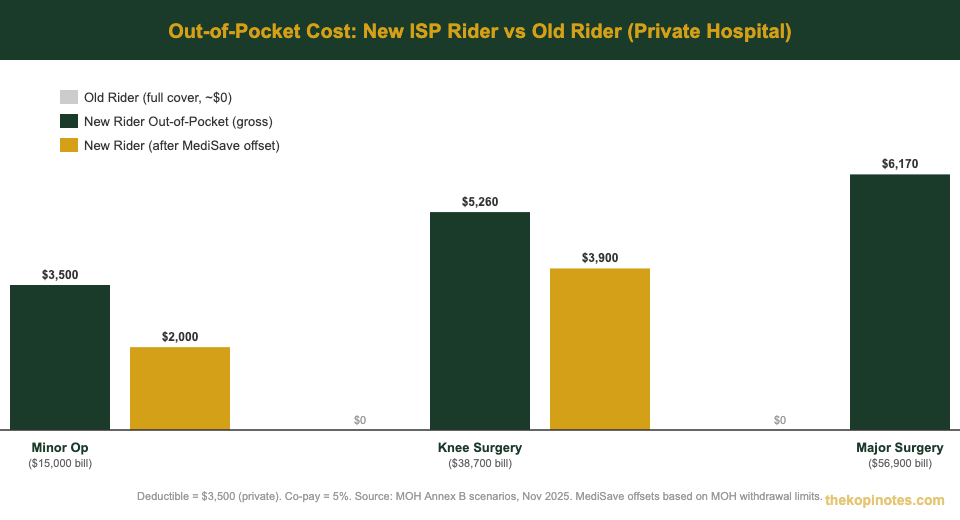
Numbers mean more than percentages. Here’s what the new rider looks like for three real private hospital scenarios, based on MOH’s own worked examples from the November 2025 announcement.
Scenario 1 — Minor operation, $15,000 bill (private hospital):
You pay the $3,500 deductible first. Then 5% co-payment on the remaining $11,500 = $575. Total out-of-pocket: $4,075. MediSave can cover up to the prevailing withdrawal limit, potentially bringing your cash outlay to near zero for a straightforward procedure.
Scenario 2 — Knee ACL reconstruction, $38,700 bill (private hospital):
Deductible: $3,500. Co-payment: 5% of remaining $35,200 = $1,760. Total before MediSave: $5,260. MediSave can cover up to ~$3,900 based on MOH limits. Your actual cash out-of-pocket: ~$1,360.
Scenario 3 — Knee joint replacement, $56,900 bill (private hospital):
Deductible: $3,500. Co-payment: 5% of remaining $53,400 = $2,670. Total: $6,170 — entirely within MediSave withdrawal limits for this procedure. Cash out-of-pocket: $0.
The key takeaway: for major surgeries, the new rider still provides near-total protection. The difference is most felt on smaller bills where MediSave limits may not fully cover the deductible.
Should You Keep Your Old Rider or Switch?
This depends on when you bought your rider and how much you value certainty over cost savings.
If you bought your rider before 27 November 2025: Your existing rider contract is unchanged for now. You keep the old benefits — full deductible coverage, $3,000 co-pay cap. Your insurer may encourage you to switch voluntarily, but there’s no forced transition yet. If you’re comfortable with higher premiums for near-zero out-of-pocket costs, you may prefer to stay.
If you bought your rider between 27 November 2025 and 31 March 2026: Your rider will be automatically converted to the new design at your first policy renewal after 1 April 2028. You have time to review your options before then.
If you’re buying a new rider from April 2026 onwards: You get the new design — lower premiums, but you’re on the hook for the deductible. There’s no way to buy the old-style rider anymore.
Switching to the new rider does not require fresh medical underwriting. Your existing conditions remain covered. This removes one major reason people were reluctant to switch.
A practical way to think about it: if you’re hospitalised once every 5–10 years (typical for a healthy working-age adult), the cumulative premium savings from the new rider will likely exceed the higher deductible you’d pay in a single hospitalisation. If you have chronic conditions and hospitalise frequently, keeping the old rider’s broader coverage may make more sense — check with a financial adviser for your specific situation.
For a broader view of how ISPs fit into your overall health coverage strategy, see our passive income Singapore overview and the Singapore retirement calculator to factor healthcare costs into your long-term plan.
How MediSave Reduces Your Out-of-Pocket
MediSave is your CPF healthcare savings account. The good news: both the deductible and co-payment under the new rider can be paid using MediSave, subject to MOH’s prevailing withdrawal limits.
For most common hospitalisations, MediSave limits are generous enough to cover the deductible entirely. For example:
- ACL reconstruction ($38,700 bill): MediSave covers ~$3,900 of your $5,260 share — leaving only $1,360 in cash.
- Knee replacement ($56,900 bill): MediSave covers the full $6,170 — cash out-of-pocket is $0.
MediSave limits vary by procedure, patient age, and hospitalisation type. MOH updates these periodically. Always check the MOH MediSave page for the latest withdrawal limits before your hospitalisation.
Also worth knowing: if you have CPF investment strategy goals, your MediSave balance earns 4% p.a. guaranteed — so money sitting in MediSave is not idle. Using it to offset a hospital deductible is an efficient deployment of those funds.
Which ISP is Best for You in 2026?
There’s no single “best” ISP — it depends on your ward preference, age, health status, and how much premium-versus-coverage trade-off you’re comfortable with. Here’s a quick framework:
| If you… | Consider… |
|---|---|
| Want the lowest base plan premium increase in 2026 | Great Eastern Supreme Health (premiums frozen all 2026) |
| Are already on an old full-coverage rider and want to minimise disruption | Stay on your existing rider for now; review before your 2028 renewal |
| Are buying a new plan and prioritising premium savings | Any insurer’s new rider — all offer ~30% savings; compare panel networks |
| Have chronic conditions or hospitalise frequently | Consider keeping old rider (if eligible) for zero-deductible coverage |
| Want treatment at Raffles Hospital | Raffles Shield Private — note the old Key Rider saw large increases; new rider much cheaper |
Source: TKN analysis of insurer announcements and MOH requirements, June 2026. Individual circumstances will vary.
Regardless of which insurer you pick, use a panel doctor and get pre-authorisation before non-emergency treatment. This is the fastest way to qualify for the $6,000 co-payment cap and the most predictable claims experience.
For a detailed look at individual insurer plans, see our Singapore REIT ETF guide for a broader investment context, and the Singapore Savings Bonds guide for safe, low-risk assets to fund your healthcare emergency buffer alongside your ISP.
If you’re reviewing your full financial plan alongside your ISP decision, check our moomoo Singapore review for low-cost investing, or compare platforms with our Syfe vs Endowus 2026 breakdown.
Not financial advice. Speak to a licensed financial adviser for personalised recommendations. All figures are as at June 2026 and subject to change.
Frequently Asked Questions
What is an Integrated Shield Plan (ISP) in Singapore?
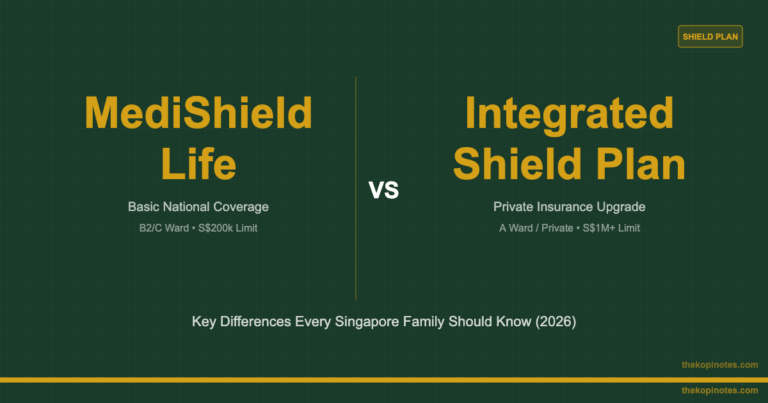
An Integrated Shield Plan (ISP) is a type of health insurance in Singapore that combines MediShield Life (the government’s basic hospitalisation insurance) with additional private insurance coverage. It is offered by six private insurers — AIA, NTUC Income, Great Eastern, Singlife, Raffles, and Prudential. ISPs allow you to stay in higher ward classes (Class A, B1, or private) and receive larger payouts for hospital bills than MediShield Life alone provides.
What changed about ISP riders in April 2026?
From 1 April 2026, new ISP riders are no longer allowed to cover the minimum IP deductible (ranging from $1,500 to $3,500 depending on ward class). This means you must pay the deductible yourself before your rider kicks in. The annual co-payment cap also doubled from $3,000 to $6,000. In exchange, new rider premiums are approximately 30% lower than the old full-coverage riders. The 5% co-payment requirement is unchanged.
Does the April 2026 change affect my existing ISP rider?
If you bought your rider before 27 November 2025, your existing contract continues unchanged for now — your insurer cannot unilaterally remove deductible coverage without notifying you. If you bought a rider between 27 November 2025 and 31 March 2026, it will transition to the new design at your first renewal after 1 April 2028. Riders bought from 1 April 2026 onwards already follow the new rules.
Which ISP insurer has the lowest premium increase in 2026?
Great Eastern stands out for freezing its base plan premiums for the entirety of 2026 — meaning no base plan premium increase this year. NTUC Income’s Enhanced Basic plan saw a modest ~7% average increase. NTUC Income’s Enhanced Preferred and Advantage plans saw larger increases of 13–14% on average. Singlife’s Plan 1 (private hospital) increased by ~10% on average. AIA, Raffles, and Prudential have also made adjustments. Note that all insurers offer new riders that are ~30% cheaper — so your total premium impact depends on whether you switch riders.
Can MediSave cover the new deductible under ISP riders?
Yes. Both the deductible and co-payment under new ISP riders can be paid using MediSave, subject to MOH’s prevailing withdrawal limits. For most common procedures, MediSave limits are generous enough to cover the full deductible. For example, for a knee joint replacement at a private hospital (bill: ~$56,900), the total deductible and co-payment of ~$6,170 can be fully offset by MediSave — meaning your cash out-of-pocket is $0. Limits vary by procedure; check the MOH website for the latest figures.
Should I switch from my old ISP rider to the new one?
Switching to the new rider saves you ~30% in rider premiums annually (~$600/year for a private hospital plan on average, more for older policyholders). Switching does not require fresh medical underwriting — your existing conditions remain covered. The trade-off is paying the deductible ($1,500–$3,500) out-of-pocket (or from MediSave) when hospitalised. If you’re generally healthy and hospitalise infrequently, the cumulative premium savings will likely outweigh the occasional higher deductible. If you have chronic conditions and are hospitalised regularly, consider staying on the old rider while it remains available.
What is the difference between the ISP deductible and co-payment?
The deductible is a fixed amount you pay first, before insurance pays anything. It applies once per policy year — so multiple hospitalisations in the same year contribute to the same deductible. The co-payment is 5% of your bill after the deductible, and continues for every claim. The co-payment cap ($6,000 from Apr 2026) is the maximum co-payment you pay in one year, but only applies if you use a panel doctor or get pre-authorisation. The deductible is NOT counted towards the co-payment cap.
Review Your Full Financial Plan
Your ISP is one piece of the puzzle. Use our tools and guides to build a complete picture.
Get Free Insurance Advice
Speak with a licensed insurance advisor. No obligation, no cost.
By submitting this form, you agree to our Privacy Policy.
This article was researched with the help of AI. While we strive to keep all information accurate and up to date, there may be errors. If you notice any discrepancies, please contact us.