CPF Salary Ceiling $8,000: What It Means for Your Take-Home Pay & Retirement (2026)
From 1 January 2026, the CPF Ordinary Wage ceiling rose from $7,400 to $8,000. Here’s exactly how it affects your monthly take-home pay, your CPF savings, and your long-term retirement strategy.
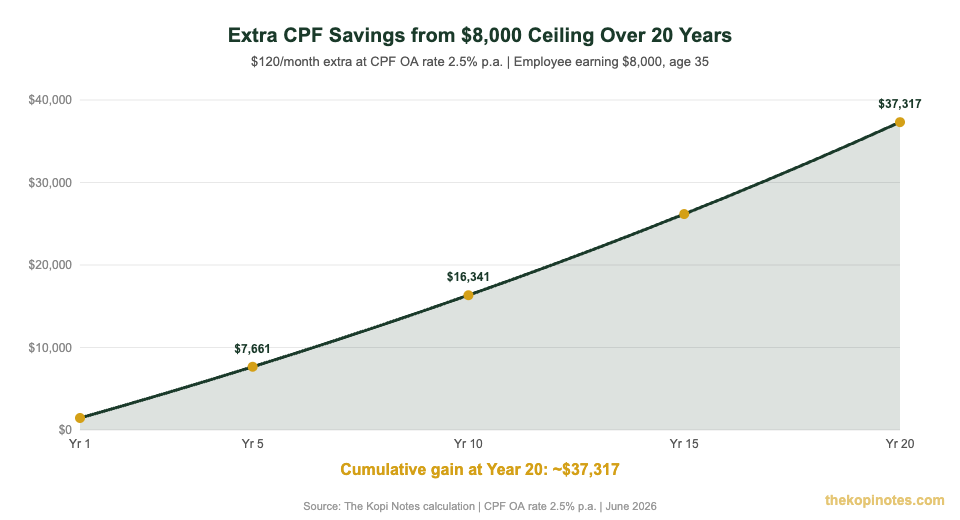
From 1 January 2026, Singapore’s CPF Ordinary Wage (OW) ceiling increased from S$7,400 to S$8,000 per month. If you earn S$8,000 or more, you and your employer now contribute CPF on the full S$8,000. That means S$120 less in take-home pay each month — but S$740 more flowing into your CPF accounts. Over a 20-year career, this single change could add over S$30,000 to your retirement savings.
Not financial advice. All figures are for educational reference only. Data as at June 2026 unless noted.
- CPF OW ceiling is now $8,000/month — effective 1 Jan 2026, the final step of a multi-year increase.
- If you earn $8,000+, your take-home pay drops by $120/month but your CPF gets $740 more monthly.
- Use the extra OA inflow strategically — invest via CPFIS, or pair it with SRS for maximum retirement savings.
Free download: The Singapore Money Playbook — 7 money mindset shifts written for Singapore, with the CPF-adjusted retirement number most guides get wrong (PDF + Notion).
Table of Contents
What Changed on 1 January 2026
The CPF Ordinary Wage (OW) ceiling sets the maximum monthly salary on which you and your employer must make CPF contributions. Before 2026, that ceiling was S$7,400. From 1 January 2026, it moved to S$8,000.
This is the final step in a gradual increase that began in 2023. The Government phased it in over several years to give both employers and employees time to adjust. If you earn below S$7,400, this change has zero impact on you. The shift only affects Singaporeans and PRs earning S$7,400 or more per month.
The OW ceiling caps your monthly salary for CPF purposes. It is separate from the Annual Wage (AW) ceiling of S$102,000, which remains unchanged. Your bonuses and variable pay are still subject to CPF up to that annual limit.
How It Affects Your Pay: Salary-by-Salary Breakdown
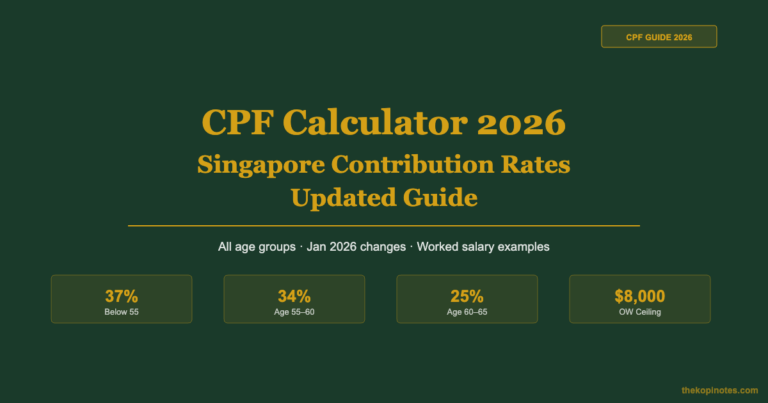
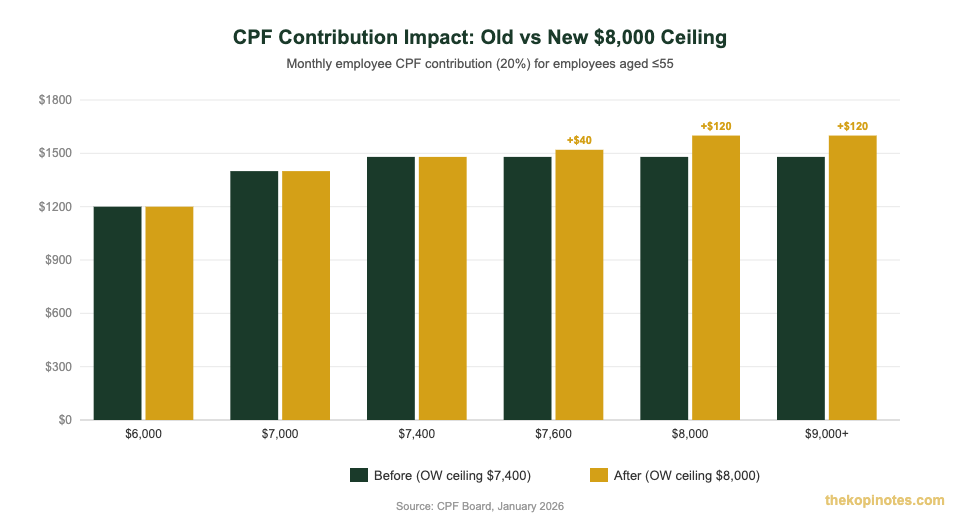
For employees aged 55 and below, the total CPF rate is 37% — you contribute 20% and your employer contributes 17%. On the extra S$600 of wages now captured under the ceiling, here is the exact monthly impact:
| Monthly Salary | Employee CPF Change | Employer CPF Change | Take-Home Pay Change |
|---|---|---|---|
| Below $7,400 | No change | No change | No change |
| $7,400–$7,999 | +20% of excess above $7,400 | +17% of excess above $7,400 | Slightly reduced |
| $8,000 and above | +$120/month | +$102/month | -$120/month |
| $8,000 total CPF monthly | $1,600 employee | $1,360 employer | $2,960 total |
Source: CPF Board, January 2026. Rates apply to employees aged 55 and below.
In plain terms: if you earn exactly S$8,000 a month, your take-home pay goes down by S$120. But your CPF balance grows by S$740 — your S$120 employee contribution plus your employer’s S$102 contribution, multiplied across the full S$600 wage base. For a 35-year-old, approximately S$370 of this flows to the Ordinary Account (OA), S$90 to the Special Account (SA), and S$140 to MediSave (MA). Use the Singapore retirement calculator to model your personal scenario.
Why This Change Matters for Retirement
S$120 a month may feel like a small cut to take-home pay. Over a 20-year working career, that extra S$120 compounding at the CPF OA rate of 2.5% per year adds up to more than S$30,000. Factor in your employer’s matching S$102 contribution and the total CPF gain exceeds S$55,000 over 20 years for a consistently high earner.
More CPF in your OA also opens up additional options. You can service your HDB mortgage, invest through the CPF Investment Scheme (CPFIS) in approved unit trusts and SGX-listed ETFs, or simply let it compound at 2.5% risk-free — which beats most fixed deposits in the current rate environment.
Senior Workers: Extra Rate Changes Too
The wage ceiling change is not the only CPF update effective 1 January 2026. Employees aged 55 to 65 also saw their contribution rates increase. This is part of the ongoing effort to improve retirement adequacy for older workers.
| Age Group | Employee Rate 2025 | Employee Rate 2026 | Employer Rate 2026 |
|---|---|---|---|
| 55 and below | 20% | 20% | 17% |
| Above 55 to 60 | 15% | 16% | 16% |
| Above 60 to 65 | 9.5% | 10.5% | 12.5% |
| Above 65 to 70 | 7.5% | 7.5% | 9% |
Source: CPF Board, January 2026. All rates are % of Ordinary Wages subject to the OW ceiling.
If you are aged 55 to 65, the combined effect of the higher wage ceiling AND the higher contribution rates means a meaningful monthly uplift to your CPF. For most in this age group, the additional contributions go directly to the Retirement Account (RA) up to the Full Retirement Sum (FRS). Once the FRS is met, excess flows to the OA. This change pairs well with reviewing your fixed-income allocations — our Singapore Savings Bonds guide covers low-risk options for surplus OA funds.
Smart Strategies to Maximise the New Ceiling
The CPF wage ceiling increase is mandatory — you can’t opt out. But you can position the rest of your financial plan around it. Here are four strategies that work well with the new ceiling:
1. Let OA savings work harder via CPFIS. If your OA is building up faster than you’re drawing it down for housing, invest via the CPF Investment Scheme. You can invest OA savings above S$20,000 in approved ETFs, unit trusts, and Singapore Government Bonds. Browse the Singapore REIT ETF guide for CPFIS-eligible options.
2. Pair CPF with SRS contributions. The Supplementary Retirement Scheme (SRS) lets you contribute up to S$15,300 per year (Singapore citizens and PRs), with every dollar reducing your chargeable income. You can invest SRS funds in REITs, ETFs, or low-cost robo-advisors like Endowus (Endowus referral code) and Syfe (Syfe referral code). It’s the most tax-efficient supplement to CPF for middle- and higher-income earners.
3. Recalibrate your monthly budget. If you earn exactly S$8,000, your net pay is now S$120 lower. Revisit your fixed costs — mortgage, insurance, subscriptions. Automate the S$120 difference into an investment account to maintain your savings rate rather than letting lifestyle spending absorb the gap.
4. Voluntary top-ups for extra tax relief. Voluntary top-ups to the Retirement Account under the Retirement Sum Topping-Up Scheme earn up to S$8,000 tax relief for yourself and S$8,000 for a qualifying family member. Combined with SRS deductions, this can meaningfully reduce your chargeable income if you’re in a higher tax bracket. See our passive income Singapore guide for the full picture on building tax-efficient retirement income streams.
What Employers Need to Know
For every employee earning S$8,000 or more per month, your employer CPF obligation increases by S$102 per month (17% of the extra S$600). That’s S$1,224 extra per year, per affected employee. For a company with 50 high-income staff, this adds roughly S$61,200 in annual payroll costs.
The Annual Wage ceiling (S$102,000) and Annual CPF Contribution Limit (S$37,740) are unchanged for 2026. Only the monthly OW ceiling has moved. Verify your payroll system correctly draws this distinction when processing bonuses and variable components. Non-compliance with CPF submission rules carries interest penalties.
Disclaimer: This article is for general information only and does not constitute financial, tax, or legal advice. Consult a licensed professional for advice specific to your situation. All CPF figures are based on CPF Board data as at January 2026.
Frequently Asked Questions
What is the CPF salary ceiling in 2026?
The CPF Ordinary Wage (OW) ceiling in 2026 is S$8,000 per month, effective from 1 January 2026. This is an increase from the previous ceiling of S$7,400. The ceiling means CPF contributions are only calculated on monthly salary up to S$8,000. Salary above this amount does not attract mandatory CPF contributions, though it may still be subject to the annual Additional Wage ceiling of S$102,000.
How much less take-home pay will I receive due to the new $8,000 CPF ceiling?
If you earn S$8,000 or more per month, your take-home pay decreases by S$120 per month (S$1,440 per year). This is because the employee CPF contribution rate for those aged 55 and below is 20%, and the extra wage base is S$600 (S$8,000 minus S$7,400). If you earn between S$7,400 and S$8,000, your reduction is smaller — calculated as 20% of your salary above S$7,400. If you earn below S$7,400, there is no change.
Does the CPF salary ceiling change affect self-employed people?
Self-employed persons (SEPs) are not subject to the same mandatory CPF OW ceiling rules as employees. SEPs must make MediSave contributions based on net trade income, but there is no mandatory OA or SA contribution. However, SEPs can make voluntary CPF contributions, and the $8,000 OW ceiling is relevant as a cap on the amount eligible for CPF contributions. Check the CPF Board website for the latest rules on voluntary contributions for self-employed individuals.
Should I increase my SRS contributions alongside the CPF ceiling change?
Yes — this is one of the most tax-efficient moves you can make. The Supplementary Retirement Scheme (SRS) allows contributions up to S$15,300 per year for Singapore citizens and PRs, with every dollar reducing your chargeable income. Pairing mandatory CPF growth with voluntary SRS contributions gives you both compulsory and tax-advantaged voluntary retirement savings. Platforms like Endowus and Syfe allow you to invest SRS funds across diversified portfolios of ETFs and REITs.
What happens to CPF contributions for employees aged 55 to 65 in 2026?
Employees aged 55 to 65 saw a double impact in January 2026: both the wage ceiling and contribution rates increased. For those aged above 55 to 60, combined rates rose — employer contributions moved to 16% and employee contributions to 16%. For those aged above 60 to 65, the combined rate rose by 1.5 percentage points. Additional contributions for this age group go directly to the Retirement Account (RA) up to the Full Retirement Sum (FRS). Once the FRS is reached, excess contributions flow to the Ordinary Account.
Can I invest my additional CPF OA savings in ETFs or REITs?
Yes, you can invest CPF OA savings above the first S$20,000 through the CPF Investment Scheme (CPFIS). Approved investments include unit trusts, Singapore Government Bonds, and selected SGX-listed ETFs such as the Nikko AM STI ETF and the Lion-Phillip S-REIT ETF. LSE-listed ETFs like CSPX or VWRA are not CPFIS-eligible — those require a cash brokerage or SRS account. Review the full CPFIS-approved list on the CPF Board website before investing.
Is the CPF Annual Wage ceiling also changing in 2026?
No. Only the Ordinary Wage (OW) monthly ceiling changed from S$7,400 to S$8,000. The Annual Wage (AW) ceiling remains at S$102,000, and the CPF Annual Limit stays at S$37,740. These annual caps affect how bonuses and variable components are treated for CPF purposes. The AW ceiling is calculated as S$102,000 minus the total OW contributed for the year — so the higher monthly OW ceiling slightly reduces the remaining headroom for bonus CPF contributions.
Maximise Your Retirement Savings in 2026
CPF is the foundation. Build on it with SRS investments, S-REITs, and ETFs through low-cost platforms.
This article was researched with the help of AI. While we strive to keep all information accurate and up to date, there may be errors. If you notice any discrepancies, please contact us.