Best Brokerage Account Singapore (2026): Compared by Fees, Features & Safety
A Singapore investor’s complete guide — commissions, platform safety, account types, and which broker suits your portfolio size and strategy in 2026.
The best brokerage account in Singapore for most investors in 2026 is Interactive Brokers (IBKR) for low-cost global investing, or Syfe Trade for beginners who want commission-free US stock trades. The right choice depends on your portfolio size, trading frequency, and whether you prioritise cost, simplicity, or access to global markets. This guide compares the top six Singapore brokers on fees, safety, and features — with real SGD cost scenarios.
Not financial advice. All figures are for educational reference only. Data as at June 2026 unless noted.
Table of Contents
Contents — Click to expand
- Why Your Broker Choice Matters
- Quick Comparison: Top Brokers at a Glance
- Interactive Brokers (IBKR) — Best for Low Fees
- Syfe Trade — Best for Beginners
- MooMoo Singapore — Best for Active Traders
- Saxo Markets — Best for Variety
- FSMOne — Best for Fund Investors
- DBS Vickers — Best for Convenience
- How to Choose the Right Broker for You
- Are Singapore Brokers Safe?
- Frequently Asked Questions
Why Your Broker Choice Matters
For a Singapore investor, the brokerage account you choose directly affects your long-term returns — more than most people realise. Even a difference of SGD 20 per trade, made 12 times a year, compounds into thousands of dollars over a decade. Beyond commissions, your broker determines which markets and asset classes you can access, whether your uninvested cash earns interest, and how your assets are protected if the brokerage fails.
In 2026, Singapore investors have more choice than ever. The Monetary Authority of Singapore (MAS) licenses all legitimate brokers operating here, providing a regulatory floor that protects retail investors. But MAS licensing alone doesn’t tell you which broker is cheapest or most feature-rich for your strategy — that’s what this guide is for.
Key factors to evaluate when choosing the best brokerage account in Singapore: commission structure (flat fee vs tiered vs percentage), minimum funding requirements, markets accessible (SGX, NYSE, LSE, Hong Kong), custodian vs nominee structure, SRS eligibility, and customer support quality.
Quick Comparison: Top Brokers at a Glance
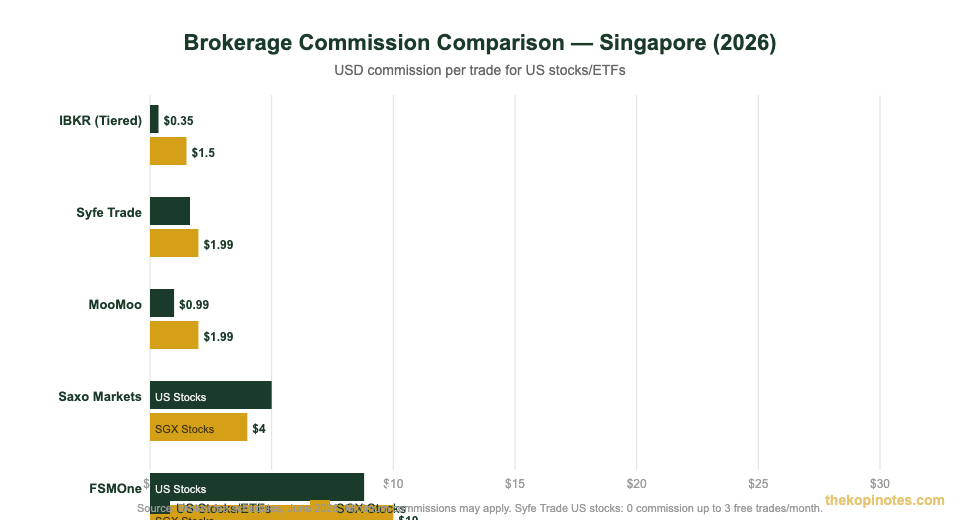
| Broker | US Stocks | SGX Stocks | Min. Deposit | SRS | Best For |
|---|---|---|---|---|---|
| IBKR | $0.35 min | $1.50 min | None | ✗ | Low-cost global investing |
| Syfe Trade | FREE (3/mo) | $1.99 | None | ✗ | Beginners & passive investors |
| MooMoo | $0.99 | $1.99 | None | ✗ | Active traders, data tools |
| Saxo Markets | $5.00 min | $4.00 min | SGD 3,000 | ✓ | Wide market access |
| FSMOne | $8.80 min | $10.00 min | None | ✓ | Funds & bonds, SRS investing |
| DBS Vickers | $25.00 min | $25.00 min | None | ✓ | Existing DBS/POSB users |
Source: Broker fee schedules, June 2026. US stock commissions shown are minimum or per-trade figures. Check broker websites for full tiered schedules.
Interactive Brokers (IBKR) — Best for Low Fees
Interactive Brokers is consistently the lowest-cost broker for Singapore investors trading US stocks and ETFs. Under the tiered pricing model, commissions start at USD 0.0035 per share, with a minimum of USD 0.35 per trade. For a Singapore investor buying 10 shares of CSPX (priced around GBP 90 each), that’s less than SGD 0.50 in commission — a fraction of what local banks charge.
IBKR also pays interest on uninvested cash balances above USD 10,000 — at approximately 4–5% p.a. as at June 2026 (tied to the Fed Funds Rate). For investors holding SGD 50,000 or more in cash while waiting to deploy, this alone can offset platform fees at competing brokers.
Key facts (June 2026):
- MAS-licensed: Yes (Capital Markets Services licence)
- Custody structure: IBKR is the custodian; assets held in your name
- Markets: NYSE, NASDAQ, LSE, SGX, Hong Kong, and 150+ markets globally
- SRS eligibility: No
- Minimum deposit: None (but platform fee waived with USD 100,000+ or 1 trade/month)
- FX conversion: Automatic at interbank rates + USD 2 commission per currency conversion
- Referral code: Use code jianxiong368 when signing up for IBKR
Best for: Long-term passive investors buying global ETFs (especially CSPX, VWRA, and LSE-listed UCITS ETFs), and anyone with SGD 50,000+ who wants to minimise total cost of ownership. Not ideal for beginners who find the interface complex, or for SRS account investing.
Syfe Trade — Best for Beginners
Syfe Trade offers 3 commission-free US stock trades per month — making it effectively free for a Singapore investor who buys one ETF position monthly and rebalances quarterly. Beyond the free tier, US stock trades cost USD 0.99 each, which is still among the cheapest in Singapore. Use our Syfe referral code when opening an account to receive a cash bonus.
Syfe Trade’s clean interface is designed for investors rather than traders — there’s no complex order types, no overwhelming charting tools, just a straightforward buy/sell experience with fractional shares available for US stocks. Fractional shares mean a Singapore investor can start with SGD 50 in any US stock or ETF, lowering the barrier to beginning.
Key facts (June 2026):
- MAS-licensed: Yes
- Markets: NYSE, NASDAQ, SGX
- SRS eligibility: No
- Minimum deposit: None
- Fractional shares: Yes (US stocks)
- Cash interest: Syfe Cash+ earns competitive yields on uninvested SGD balances
Best for: Beginners investing monthly in US ETFs like CSPX or VWRA (via Syfe Trade’s LSE access), or investors who make fewer than 3 US stock trades per month. For more advanced passive income strategies, explore the passive income Singapore guide alongside your brokerage setup.
MooMoo Singapore — Best for Active Traders
MooMoo (operated by Futu Singapore) is the go-to platform for Singapore investors who want institutional-grade charting tools and real-time Level 2 market data at low cost. US stock commissions are USD 0.99 minimum per trade, and the platform offers free real-time quotes for US, HK, and SGX markets — data that costs extra on many competing platforms.
MooMoo regularly runs promotions offering free shares, cash vouchers, and zero-commission periods for new account holders. For a Singapore investor who actively monitors positions and wants options trading capability alongside their stock portfolio, MooMoo offers the best feature-to-cost ratio in 2026. Read the full moomoo Singapore review for a detailed breakdown.
Key facts (June 2026):
- MAS-licensed: Yes (Futu Singapore Pte Ltd)
- Markets: NYSE, NASDAQ, HKEX, SGX, US options
- SRS eligibility: No
- Minimum deposit: None
- Data: Free real-time Level 2 quotes for US and HK markets
Saxo Markets — Best for Wide Market Access
Saxo Markets is the broker of choice for Singapore investors who want access to markets beyond US and SGX — including European exchanges, bonds, CFDs, and ETFs listed on the LSE, Euronext, and Deutsche Börse. Saxo also accepts SRS funds, making it useful for retirement-oriented investors who want LSE-listed UCITS ETFs in their SRS portfolio.
The trade-off is higher minimum commissions: USD 5.00 for US stocks and SGD 4.00 for SGX stocks. For investors making small trades (under USD 1,500 per trade), this fee percentage is disproportionate. Saxo works best for investors consolidating a significant portfolio — typically SGD 50,000+ — where the flat minimum fee is a small fraction of the trade size. For a Singapore investor’s CPF-adjacent retirement planning, consider the CPF investment strategy guide alongside Saxo’s SRS offering.
Key facts (June 2026):
- MAS-licensed: Yes
- Minimum deposit: SGD 3,000 (Classic account)
- SRS eligibility: Yes
- Markets: 70,000+ instruments across 60+ exchanges globally
- LSE access: Yes (CSPX, VWRA, and full LSE ETF range)
FSMOne — Best for Fund and Bond Investors
FSMOne (operated by iFAST Financial, an MAS-licensed financial advisory firm) is Singapore’s leading platform for unit trusts, bond investments, and Regular Savings Plans (RSPs). While its stock trading commissions are higher than IBKR or MooMoo, FSMOne’s strength lies in its breadth of funds — over 1,000 unit trusts available with no sales charge on many — and its SRS-compatible brokerage account.
Singapore investors using FSMOne for a Regular Savings Plan in global ETFs like the Infinity Global Stock Index Fund can automate monthly contributions from as little as SGD 50. Use our FSMOne referral code (P0544985) when opening an account. FSMOne also offers Singapore Savings Bonds and T-bills directly — check our Singapore Savings Bonds guide for the latest yield data.
Key facts (June 2026):
- MAS-licensed: Yes (iFAST Financial Pte Ltd)
- SRS eligibility: Yes
- Minimum deposit: None
- RSP minimum: SGD 50/month
- Unit trusts: 1,000+ with 0% sales charge platform promotions
- Referral code: P0544985
DBS Vickers — Best for DBS/POSB Existing Customers
DBS Vickers is the most expensive broker in this comparison for active investors, with minimum commissions of SGD 25 per trade for both US and Singapore stocks. However, for an investor who already banks with DBS or POSB and wants a single integrated platform, the convenience of linking a brokerage account to their existing savings account — with same-day settlement and no fund transfer needed — has real value.
DBS Vickers also supports CPF Investment Scheme (CPFIS) and SRS accounts, making it one of the few brokers where a Singapore investor can consolidate their DBS savings, brokerage, CPF-OA investments, and SRS in one place. For investors making infrequent large trades (e.g., a single SGD 20,000 annual lump sum into an ETF), the SGD 25 minimum represents just 0.125% of the trade — acceptable for those who prioritise convenience over cost.
How to Choose the Right Broker for You
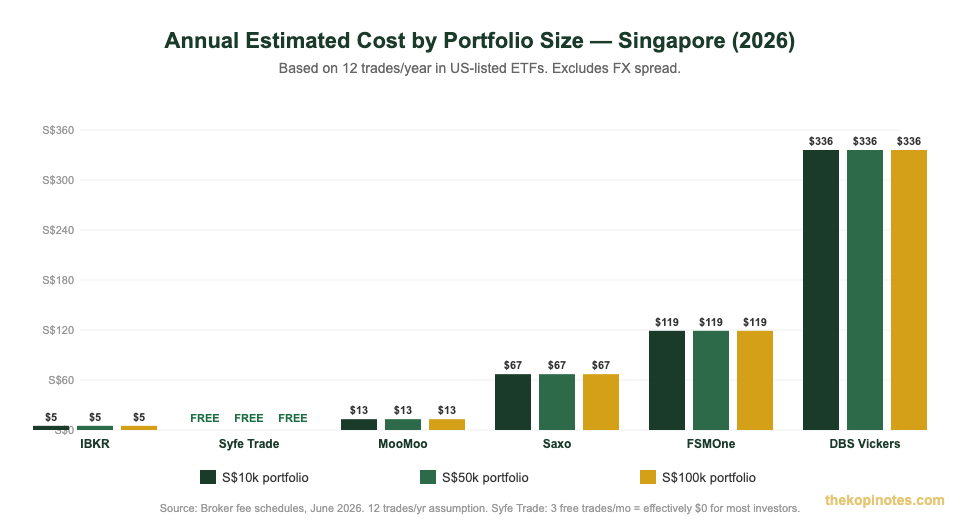
The best brokerage account in Singapore depends on four things: portfolio size, trading frequency, asset types you want to buy, and whether you need SRS compatibility. Here is a practical decision framework:
| Your Situation | Recommended Broker | Reason |
|---|---|---|
| Starting out, SGD < 10,000 | Syfe Trade | Free trades, fractional shares, simple interface |
| Passive ETF investor, SGD 10k–100k | IBKR | Lowest commissions, interest on cash, full LSE access |
| Active trader, frequent US/HK trades | MooMoo | Best data tools, low commissions, options capability |
| Need SRS + LSE ETF access | Saxo Markets | SRS compatible, widest global market access |
| Fund/bond investor, RSP strategy | FSMOne | 1,000+ funds, SRS, RSP from SGD 50/month |
| DBS banker wanting one platform | DBS Vickers | CPF + SRS + DBS integrated, same-day settlement |
Source: The Kopi Notes analysis, June 2026.
Many experienced Singapore investors use two brokers: IBKR for their core ETF portfolio (where commission cost matters most), and either FSMOne or DBS Vickers for their SRS account (where ETF access and regulatory compliance matter more than cost). This dual-broker strategy optimises cost across different account types. Use our Singapore retirement calculator to estimate how much your brokerage cost difference compounds over your investment horizon.
Are Singapore Brokers Safe? What You Need to Know
All six brokers in this guide are regulated by the Monetary Authority of Singapore (MAS) under the Securities and Futures Act. MAS regulation means each broker must maintain minimum capital requirements, segregate client assets from their own balance sheet, and adhere to rules designed to protect retail investors.
Key safety considerations for Singapore investors:
- Asset segregation: Your stocks and cash must be held separately from the broker’s own assets. In the event of broker insolvency, your securities are not part of the broker’s estate. All MAS-licensed brokers are required to do this.
- CDP (Central Depository) vs custodian accounts: SGX-listed stocks bought through DBS Vickers, FSMOne, or Saxo can be held directly in your CDP account — meaning they’re in your name at the central registry, with no counterparty risk to the broker. IBKR, Syfe, and MooMoo use a custodian/nominee structure — your shares are technically held in the broker’s nominee account, though ring-fenced for your benefit.
- SIPC protection (IBKR): As IBKR is a US-regulated broker, US accounts may benefit from SIPC coverage up to USD 500,000 for securities. Singapore accounts under IBKR Singapore Pte. Ltd. are covered by MAS rules rather than SIPC.
- MAS Investor Protection: Singapore does not have a deposit insurance scheme for brokerage accounts (unlike bank deposits under SDIC). However, MAS rules require client asset segregation, which is the primary protection mechanism.
For a Singapore investor building a long-term ETF portfolio, all brokers in this comparison are considered safe and well-regulated. The CDP-direct structure of local brokers offers a slightly different risk profile than the custodian model of IBKR, but both are widely used and accepted by Singapore’s financial system. For related retirement planning considerations, see our guide on Singapore T-bills 2026 — a risk-free complement to equity investing.
Not financial advice. All figures are for educational reference only. Data as at June 2026. Always verify current fees directly with your broker before trading.
Frequently Asked Questions
What is the best brokerage account in Singapore for beginners?
For beginners in Singapore, Syfe Trade is the best starting broker because it offers 3 commission-free US stock trades per month, fractional shares from SGD 50, and a clean interface with no complex features to navigate. Once your portfolio grows past SGD 20,000 and you’re making more frequent trades, consider migrating your active ETF buying to Interactive Brokers for lower per-trade costs. Many investors keep both accounts — Syfe for simplicity and IBKR for cost efficiency at scale.
Which Singapore brokerage has the lowest fees?
Interactive Brokers (IBKR) has the lowest commissions for US stocks and global ETFs, with trades from USD 0.35 per order. Syfe Trade is technically cheaper (free) for up to 3 US trades per month. For SGX stocks, MooMoo charges SGD 1.99 minimum — among the lowest for local shares. Avoid banks like DBS Vickers for regular trading, as their SGD 25 minimum makes small, frequent trades expensive.
Can I use my SRS account with any Singapore broker?
Not all brokers accept SRS (Supplementary Retirement Scheme) funds. Among the brokers in this guide, Saxo Markets, FSMOne, and DBS Vickers all support SRS accounts. IBKR, Syfe Trade, and MooMoo do not accept SRS funds as at June 2026. If you want to invest in global ETFs with your SRS money, Saxo is the best option as it offers LSE-listed UCITS ETFs like CSPX and VWRA via SRS — giving you the Ireland-domicile withholding tax advantage even inside your SRS account.
Is Interactive Brokers safe to use in Singapore?
Yes. Interactive Brokers Singapore Pte. Ltd. is licensed by MAS (Capital Markets Services licence) and is required to segregate client assets from the firm’s own. IBKR is one of the world’s largest and most financially stable brokerages, with over 40 years of operating history and publicly listed on NASDAQ (ticker: IBKR). Your assets are held in a custodian/nominee structure — your shares are ring-fenced in your name within IBKR’s nominee account, meaning they are not part of IBKR’s balance sheet in the event of insolvency.
What is the difference between a CDP account and a custodian account?
A CDP (Central Depository) account holds your SGX-listed shares directly in your name at the Singapore Exchange’s central registry — there is no broker in between. If your broker closes, your shares remain safely in your CDP account. A custodian or nominee account (used by IBKR, Syfe, and MooMoo) holds shares in the broker’s nominee company on your behalf. Your shares are ring-fenced and segregated from the broker’s own assets under MAS rules, but they are not directly registered at CDP. For SGX shares, many conservative investors prefer CDP-linked brokers (DBS Vickers, FSMOne, Saxo) for this reason. For US/global ETFs, CDP is not relevant — all US holdings are custodian-held regardless of broker.
Can I open multiple brokerage accounts in Singapore?
Yes, there is no restriction on the number of brokerage accounts a Singapore resident can hold. Many investors use two or more brokers for different purposes — for example, IBKR for core ETF investing (lowest cost), FSMOne for their SRS account (SRS-compatible with fund access), and a local bank broker like DBS Vickers for SGX blue-chip shares with CDP custody. Each account requires its own KYC/onboarding process, but there are no regulatory limits on account quantity.
Ready to Open Your Brokerage Account?
Use our referral links to get exclusive sign-up bonuses when you open an account today.
This article was researched with the help of AI. While we strive to keep all information accurate and up to date, there may be errors. If you notice any discrepancies, please contact us.