Retirement Age 64 Singapore: How It Changes Your Investment Strategy (2026)
A complete guide for Singapore workers and investors — CPF changes, ETF strategy, and SRS planning as the retirement age rises to 64 from 1 July 2026.
Singapore’s retirement age rises to 64 and re-employment age to 69 from 1 July 2026 — the latest step toward age 65 and 70 by 2030. For investors, this creates a longer earning window and materially changes CPF contribution timelines, SRS withdrawal planning, and when you should de-risk your ETF portfolio. Here’s what every Singapore worker and investor needs to know.
Not financial advice. All figures are for educational reference only. Data as at June 2026 unless noted.
Free download: The Singapore Money Playbook — 7 money mindset shifts written for Singapore, with the CPF-adjusted retirement number most guides get wrong (PDF + Notion).
Table of Contents
Contents — Click to expand
What Changed: Retirement Age 64 from 1 July 2026
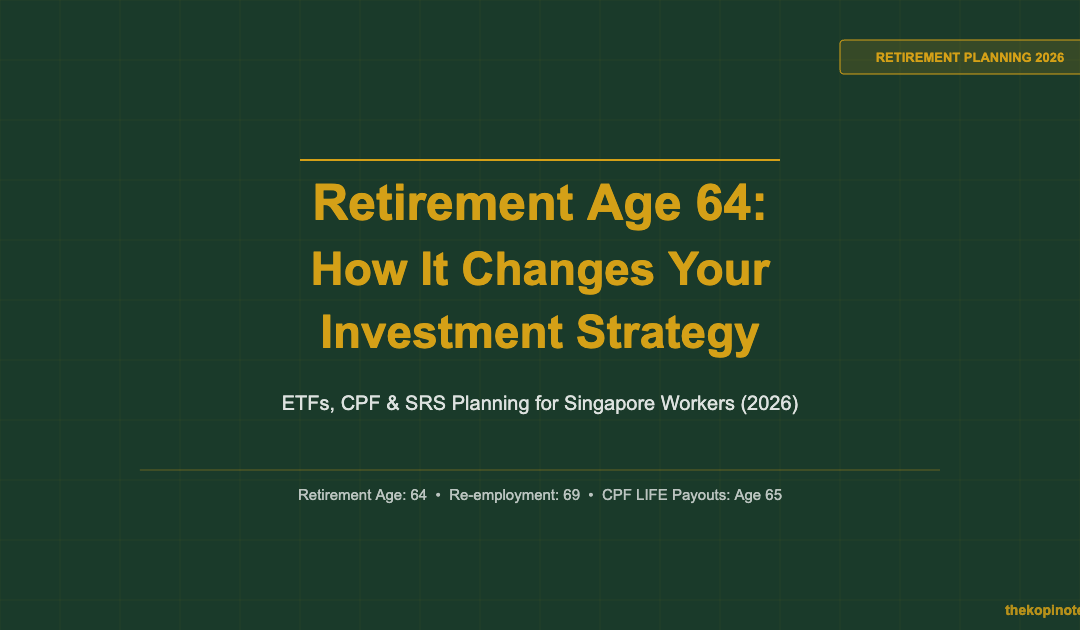
Singapore’s Ministry of Manpower (MOM) officially raised the retirement age from 63 to 64 and the re-employment age from 68 to 69, effective 1 July 2026. This was announced at the Committee of Supply 2026 debate and forms part of the government’s roadmap to reach retirement age 65 and re-employment age 70 by 2030.
The practical implication: employers cannot compulsorily retire employees before age 64. Workers who wish to continue beyond 64 may be offered re-employment contracts up to age 69. The CPF payout eligibility age remains at 65 — it is not linked to the retirement age — so your CPF LIFE monthly payouts still begin from age 65 regardless of when you formally retire.
Here’s a snapshot of the key age milestones that now govern a Singapore investor’s retirement timeline:
| Milestone | Age | What Happens |
|---|---|---|
| CPF Withdrawal (partial) | 55 | Can withdraw OA/SA savings above the Full Retirement Sum (S$213,000 in 2026) |
| Retirement Age | 64 (from 1 Jul 2026) | Employer cannot compulsorily retire you before this age |
| CPF LIFE Payouts Begin | 65 | Monthly CPF LIFE payouts begin — unaffected by retirement age change |
| Re-employment Age | 69 (from 1 Jul 2026) | Employer may offer re-employment contracts up to this age |
| SRS Penalty-Free Withdrawal | 62 | Withdraw SRS funds penalty-free (50% taxable); 10-year window until 72 |
Source: MOM, CPF Board, IRAS — June 2026
CPF Impact: Higher Contributions, Longer Runway
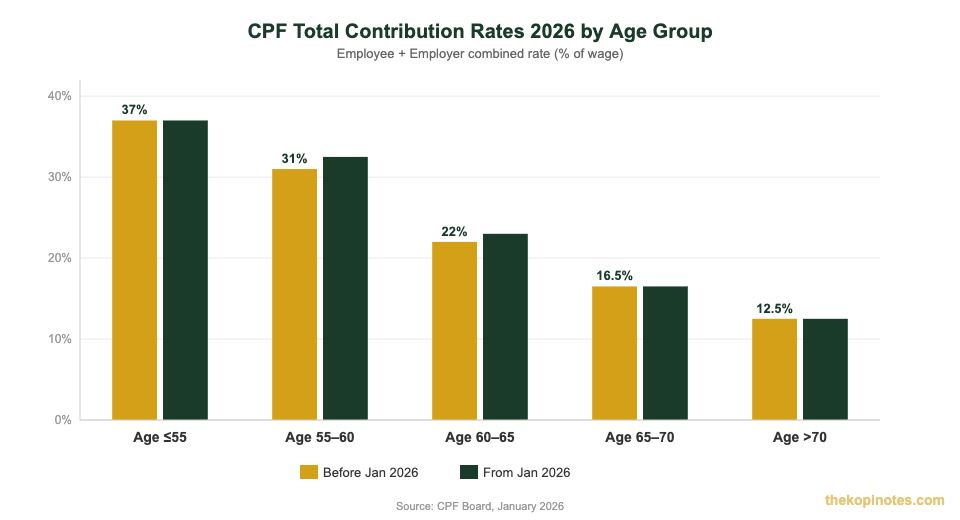
The retirement age change arrives alongside significant CPF contribution rate increases effective January 2026. Workers aged 55 to 65 now see a total contribution rate increase of 1.5 percentage points, meaning more money flows into CPF each month — boosting the balance available for CPF LIFE. A further 1.5 percentage point increase for the 55–60 age group and 1.0 percentage point for the 60–65 age group is planned from 2027.
For a worker earning S$6,000 per month aged 58, the 2026 increase adds approximately S$90 per month to total CPF contributions. Over the remaining years to retirement age 64, that compounds meaningfully within the 4–5% interest CPF Ordinary Account and Special Account earn. The CPF Board’s new Life-Cycle Investment Scheme, launching by 2028, will also allow members to invest CPF savings on a glide-path model — automatically shifting from equities to bonds as retirement approaches.
The Extended Senior Employment Credit (SEC) supports employers hiring workers aged 60 and above, with the highest support tier of 7% for workers aged 69 and above. This makes it financially attractive for employers to keep experienced workers on longer.
ETF Investment Strategy by Age Group
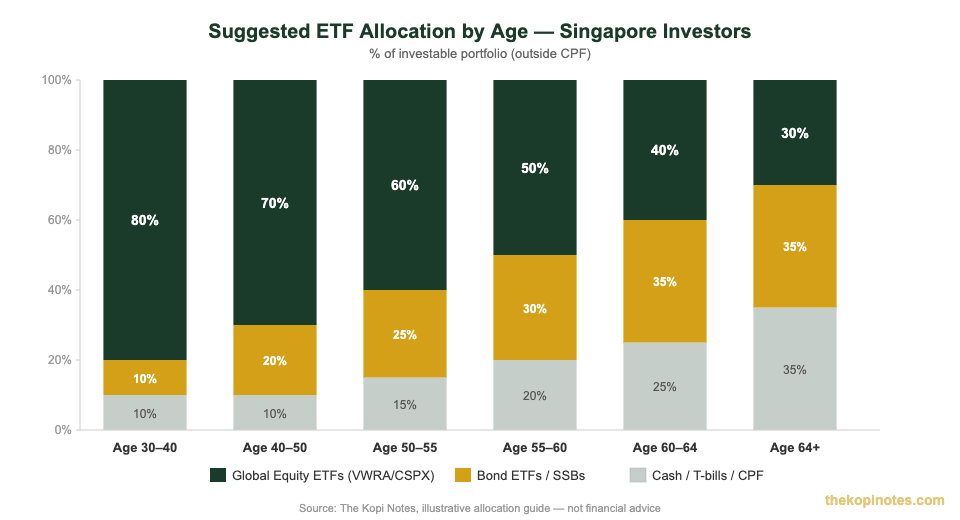
The retirement age rising to 64 means Singapore workers now have a potentially longer earning window — which directly affects how aggressively you should invest your non-CPF savings. The general principle is simple: the further you are from retirement, the more risk (equities) you can afford; the closer you are, the more you want capital preservation (bonds, T-bills, cash).
For most Singapore investors, the practical ETF portfolio for non-CPF savings looks like this — with the year 2026 data for reference ETFs:
| Age Group | Equity ETFs | Bond ETFs / SSBs | Cash / T-bills | Suggested ETFs |
|---|---|---|---|---|
| 30–40 | 80% | 10% | 10% | VWRA, CSPX |
| 40–50 | 70% | 20% | 10% | VWRA, CSPX, AGGG |
| 50–55 | 60% | 25% | 15% | VWRA, CSPX, SSBs |
| 55–60 | 50% | 30% | 20% | VWRA, SSBs, T-bills |
| 60–64 | 40% | 35% | 25% | VWRA, AGGG, T-bills |
| 64+ | 30% | 35% | 35% | Income ETFs, SSBs |
Source: The Kopi Notes illustrative guide — not financial advice. VWRA = Vanguard FTSE All-World Acc (LSE); CSPX = iShares Core S&P 500 Acc (LSE); AGGG = iShares Core Global Aggregate Bond ETF (LSE)
Why LSE-listed ETFs? Singapore investors overwhelmingly prefer Ireland-domiciled ETFs listed on the London Stock Exchange over US-listed equivalents like VOO or VTI. The reason comes down to two structural tax advantages: Ireland-domiciled ETFs pay only 15% withholding tax on US dividends (vs 30% for US-domiciled ETFs), and they carry no US estate tax risk — a critical consideration given the IRS imposes estate tax on non-US persons holding US assets above USD 60,000 at death. On a retirement portfolio of S$300,000 in US-domiciled ETFs, this exposure is significant. VWRA and CSPX eliminate it entirely.
For Singapore investors who prefer a managed approach to de-risking, platforms like Syfe referral code offer automated portfolio rebalancing — including income-focused portfolios that automatically shift toward bonds and dividend assets as you age. This mirrors the glide-path logic of the upcoming CPF Life-Cycle Scheme, but available today. Similarly, Endowus referral code gives access to institutional-class funds through both SRS and cash accounts, making it one of the most efficient ways to deploy retirement savings.
SRS Withdrawal Planning with the New Timeline
The Supplementary Retirement Scheme (SRS) is one of the most tax-efficient tools for Singapore investors approaching retirement. Contributions are fully deductible against taxable income, and withdrawals from the statutory retirement age (currently 62 for SRS purposes — set when you first opened your account) are only 50% taxable. You have a 10-year withdrawal window starting from age 62 to spread withdrawals and minimise tax each year.
With the retirement age now rising to 64 (and eventually 65 by 2030), many workers will continue earning and accumulating SRS contributions for longer than previously planned. A worked example:
A 55-year-old Singapore PR earning S$120,000 per year contributes the annual SRS cap of S$15,300 per year. Under the old timeline (retire at 63), they had 8 years of remaining contributions — S$122,400 in total. Under the new timeline (retire at 64), they now have 9 years — S$137,700. Invested in a global equity ETF like VWRA returning 7% p.a., the additional year of contributions and growth adds approximately S$22,000 to the final SRS balance. Spread over 10 withdrawal years, that’s an extra S$2,200 per year of 50%-taxable income — at S$1,100 effectively taxable, this likely falls within the zero-tax band, making it entirely tax-free in practice.
If you are currently investing your SRS through a robo-advisor, consider reviewing the asset allocation — many default SRS portfolios are overly conservative for investors still 10+ years from their SRS withdrawal age. Platforms offering SRS-compatible ETF portfolios include Endowus and Syfe, both of which allow you to invest in diversified ETF baskets through your SRS account. For a deeper comparison of these platforms, see our syfe vs endowus 2026 guide.
Best Brokers for ETF Investing in Singapore
If you are investing directly in LSE-listed ETFs like VWRA or CSPX rather than through a robo-advisor, choosing the right broker matters. Here is a 2026 comparison of the main options available to Singapore retail investors:
| Broker | Commission (LSE) | FX Spread | Min. Deposit | Best For |
|---|---|---|---|---|
| IBKR (Interactive Brokers) | ~USD 1–3 per trade | ~0.002% | None | Lowest cost, portfolios S$30k+ |
| Saxo Markets | 0.08% (min GBP 8) | ~0.25% | None | Good UI, wider ETF range |
| moomoo Singapore | USD 0.99 flat | ~0.2% | None | Beginners, small trades |
| Syfe Brokerage | 0.06% (min SGD 1.98) | ~0.3% | None | SRS-compatible, simple UI |
Source: Broker websites, as at June 2026. Commission and FX spread estimates — verify current rates before trading.
For most Singapore investors building a passive ETF portfolio for retirement, Interactive Brokers (IBKR) offers the lowest total cost of ownership, especially for portfolios above S$30,000 where the per-trade commission becomes negligible relative to assets. New users can sign up using referral code jianxiong368 for bonus rewards. For those who prefer a simpler, automated experience — particularly for SRS deployment — Syfe or Endowus are the go-to options. Use our FSMOne referral code if you prefer FSMOne’s unit trust and ETF platform, which also supports SRS contributions.
For a broader look at building passive income streams in retirement, our guide to passive income Singapore covers REITs, dividend ETFs, and fixed-income options alongside your ETF portfolio.
Retirement Investment Checklist (Age 55 to 64)
With retirement age now at 64, here is a practical checklist for Singapore workers in their final decade of full-time employment. This is designed to help you arrive at retirement with the right CPF balance, investment portfolio, and drawdown plan in place.
- ✅ Age 55: Check CPF balance — ensure you meet the Full Retirement Sum (S$213,000 in 2026). Withdraw excess OA/SA above FRS if needed. Consider whether to top up RA to Enhanced Retirement Sum (S$426,000) for higher CPF LIFE payouts.
- ✅ Age 55–60: Continue maximising SRS contributions (S$15,300/yr for PRs and citizens). Review ETF portfolio allocation — begin gradual shift from 100% equities toward a 60/40 equity-bond split. Use our Singapore retirement calculator to project your income needs at 65.
- ✅ Age 60–62: Review SRS withdrawal strategy — you can begin penalty-free withdrawals from the statutory retirement age stated in your SRS account (likely 62). Plan annual withdrawal amounts to stay within the lowest tax bracket.
- ✅ Age 62–64: Consider shifting equity ETF holdings toward income-generating ETFs or S-REITs to begin building a passive income stream before CPF LIFE kicks in. Review whether to top up CPF RA with cash top-ups for additional CPF LIFE payouts — eligible for S$8,000 per year tax relief. See CPF investment strategy Singapore for detailed guidance.
- ✅ Age 64 (retirement): CPF LIFE payouts begin at 65 — ensure bridge funding for the gap year. Assess whether your investment portfolio can generate sufficient passive income to supplement CPF LIFE.
For investors with significant S-REIT exposure in their retirement portfolio, our best S-REITs in Singapore 2026 guide provides an updated yield and financial health analysis of the major trusts — helpful for building an income-generating core alongside your global ETF allocation.
Frequently Asked Questions
What is Singapore's retirement age in 2026?
Singapore’s retirement age is 64 from 1 July 2026, raised from the previous 63. This means employers cannot compulsorily retire employees before age 64. The re-employment age has also risen to 69, allowing workers to continue employment beyond 64 on re-employment contracts. The government has committed to raising these to 65 and 70 respectively by 2030.
Does the retirement age change affect when CPF LIFE payouts begin?
No — CPF LIFE payouts still begin at age 65, regardless of the statutory retirement age. The CPF payout eligibility age is not linked to the retirement or re-employment age. If you retire at 64 under the new rules, you will have a one-year gap before CPF LIFE payouts begin at 65. It is important to ensure you have sufficient bridge funding (cash, SRS withdrawals, or ETF income) to cover this gap year.
How does the retirement age change affect my CPF contributions?
The retirement age change itself does not directly alter CPF contribution rates. However, from 1 January 2026, CPF contribution rates for workers aged 55 to 65 increased by 1.5 percentage points in total (employee + employer). A further increase is planned from 2027. Working longer (to 64 instead of 63) means an additional year of CPF contributions at these higher rates — which compounds within CPF’s 4–5% interest to meaningfully boost your CPF LIFE payout at 65.
What ETFs should a Singapore investor hold approaching retirement age 64?
For Singapore investors within 5–10 years of retirement, a balanced approach works well: approximately 40–50% in global equity ETFs (VWRA or CSPX listed on the London Stock Exchange for tax efficiency), 30–35% in bond ETFs or Singapore Savings Bonds, and 15–25% in cash or T-bills. Both VWRA and CSPX are Ireland-domiciled UCITS ETFs, which means no US estate tax risk and only 15% withholding tax on US dividends — significantly better than US-domiciled equivalents. Use a robo-advisor like Syfe or Endowus for automated rebalancing if you prefer a hands-off approach.
Can I invest my SRS savings in ETFs in Singapore?
Yes — SRS savings can be invested in unit trusts, ETFs (through some brokers), and other instruments to grow your balance before withdrawal. Platforms like Endowus and Syfe support SRS account linkage and offer diversified ETF portfolios or managed funds through your SRS. SRS withdrawals from age 62 (the statutory retirement age recorded when you opened your SRS account) are only 50% taxable — meaning careful planning can result in very low or zero tax on retirement income drawn from SRS.
Should I still invest in REITs as part of my retirement portfolio in Singapore?
S-REITs can play a useful income-generating role in a retirement portfolio, offering dividend yields of 5–7% and quarterly distributions. However, they carry more volatility and sector concentration risk than a diversified global ETF. For most Singapore investors approaching retirement age 64, S-REITs are best used as a supplementary income layer — perhaps 10–20% of the portfolio — rather than a core holding. Use a broad global equity ETF like VWRA as the core, and allocate a portion to REITs for yield. Refer to our guide on the best S-REITs in Singapore for up-to-date yield and balance sheet data before selecting individual trusts.
Plan Your Retirement Investment Strategy
Use our tools and referral links to start building your retirement portfolio today.
This article was researched with the help of AI. While we strive to keep all information accurate and up to date, there may be errors. If you notice any discrepancies, please contact us.