Insurance Savings Plan Singapore 2026: Best Plans, Returns & Complete Buyer’s Guide
Compare the top ISPs in Singapore — guaranteed returns, projected yields, SRS tax savings, and who should buy in 2026.
An insurance savings plan (ISP) in Singapore is a participating whole-life or endowment policy that pays guaranteed returns of 2–3% p.a., with non-guaranteed bonuses potentially pushing total illustrated returns to 4–5% p.a. over a 5–25 year tenor. Offered by MAS-licensed insurers such as NTUC Income, Manulife, AIA, and Etiqa, ISPs are capital-protected, SRS-eligible, and suit conservative savers seeking stable, medium-term growth above fixed deposit rates.
Not financial advice. All figures are for educational reference only. Benefit illustrations are based on participating fund scenarios as at June 2026 and are not guaranteed unless stated.
Table of Contents
Contents — Click to expand
- What Is an Insurance Savings Plan?
- How ISPs Work: Par Fund, Bonuses & Guaranteed Returns
- Best Insurance Savings Plans in Singapore 2026
- ISP Returns Comparison: Guaranteed vs Non-Guaranteed
- ISP vs SSB, FD, CPF OA, and Endowment Plans
- Using SRS to Supercharge Your ISP Returns
- Who Should Buy an Insurance Savings Plan?
- How to Buy an ISP in Singapore (Step-by-Step)
- Frequently Asked Questions
What Is an Insurance Savings Plan?
An insurance savings plan (ISP) is a MAS-regulated life insurance product that combines a savings component with a modest death benefit. Unlike term life insurance — which is pure protection — an ISP accumulates a cash value over time, returned to you at maturity (or available as a surrender value if you exit early).
ISPs sit in Singapore’s participating (par) fund universe alongside endowment plans and whole-life policies. The key distinction: ISPs are primarily marketed as savings vehicles, with the death benefit sized at a minimum (usually 101–105% of premiums paid) to keep costs low and returns competitive.
In Singapore, ISPs are sold by all major MAS-licensed insurers and regulated under the Insurance Act. Premiums paid with Supplementary Retirement Scheme (SRS) funds qualify for income tax relief, making ISPs particularly attractive to mid-to-high income earners who have already maxed out CPF cash top-ups.
Key features at a glance:
| Feature | Typical Range |
|---|---|
| Premium commitment | S$200–S$2,000/mth or single premium S$10,000+ |
| Policy tenor | 5–25 years |
| Guaranteed return p.a. | 2.2–2.8% |
| Non-guaranteed illustrated return p.a. | 3.7–4.2% (at 4.75% par fund scenario) |
| Capital protection | Yes (guaranteed maturity value ≥ premiums paid after tenor) |
| SRS-eligible | Yes — tax relief up to S$15,300/yr (Singaporean) |
| Death benefit | 101–110% of premiums paid (typically) |
| Early surrender penalty | Yes — break-even typically at year 3–5 |
Source: MAS product disclosure requirements, insurer benefit illustrations as at June 2026.
How ISPs Work: Par Fund, Bonuses & Guaranteed Returns
Understanding how your ISP generates returns is critical before committing premiums for 10–25 years. Here’s the mechanics:
1. The Participating Fund
Your premiums go into the insurer’s participating (par) fund — a pooled investment portfolio managed by the insurer. Singapore’s major insurers invest par fund assets primarily in investment-grade bonds (60–75%), equities (15–25%), and alternatives or cash. The fund targets long-term returns of 4.25–4.75% p.a. (the two illustrated scenarios mandated by MAS).
2. Guaranteed vs Non-Guaranteed Bonuses
Your total maturity value has two components:
- Guaranteed cash value: Locked in from day one — the insurer is contractually obligated to pay this regardless of par fund performance. Typically 2.2–2.8% p.a. effective return on premiums paid.
- Reversionary bonuses: Declared annually by the insurer’s board based on par fund performance. Once declared, they become part of your guaranteed sum. Most Singapore ISPs have a track record of consistent bonus declaration.
- Terminal bonus: A one-time bonus paid at maturity or death — non-guaranteed and can vary significantly year to year depending on market conditions.
3. MAS Illustration Scenarios
MAS requires all par product benefit illustrations to show two scenarios: 4.25% p.a. (lower) and 4.75% p.a. (higher) par fund returns. Neither scenario is guaranteed. The 4.75% scenario approximates current industry performance — historically, Singapore’s major par funds have delivered 4.0–5.5% p.a. over rolling 10-year periods.
4. Early Surrender
Surrendering an ISP in the first 3–5 years typically returns less than premiums paid. This is because front-loaded costs (agent commission, admin fees) are recouped from early cash values. Always view an ISP as a commitment to the full tenor — if you might need the money within 5 years, an SSB or short-term FD is more appropriate.
Best Insurance Savings Plans in Singapore 2026
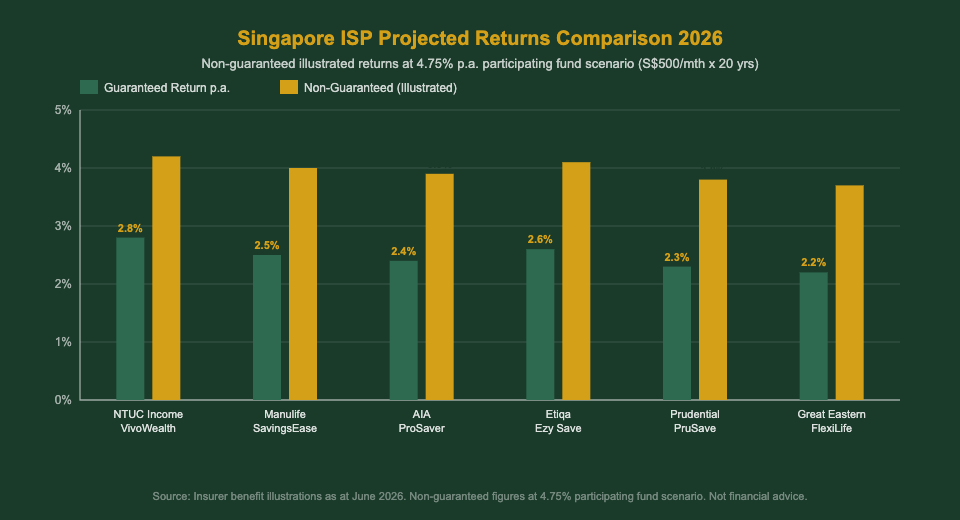
The table below compares the six most competitive ISPs available to Singapore residents as at June 2026, based on a S$500/mth premium for a 20-year tenor, male aged 35:
| Insurer / Plan | Gtd Return (p.a.) | Illus. Return (p.a.) | Maturity Value (Illus.) | SRS |
|---|---|---|---|---|
| NTUC Income VivoWealth Saver | 2.8% | 4.2% | S$177,400 | ✓ |
| Etiqa Ezy Save Plus | 2.6% | 4.1% | S$174,200 | ✓ |
| Manulife SavingsEase | 2.5% | 4.0% | S$172,800 | ✓ |
| AIA ProSaver 3 | 2.4% | 3.9% | S$170,100 | ✓ |
| Prudential PruSave | 2.3% | 3.8% | S$168,600 | ✓ |
| Great Eastern FlexiLife Saver | 2.2% | 3.7% | S$166,800 | ✓ |
Source: Insurer benefit illustrations at 4.75% p.a. par fund scenario, S$500/mth x 20 yrs, male aged 35, non-smoker, as at June 2026. Non-guaranteed figures are illustrative only. Capital outlay: S$120,000.
Our pick for 2026: NTUC Income VivoWealth Saver leads on both guaranteed (2.8%) and illustrated (4.2%) returns. Its cooperative ownership structure has historically translated to consistent bonus declarations — DPU track record shows reversionary bonuses maintained across market cycles including 2020 COVID and 2022 rate shock. For single-premium buyers, Etiqa’s digital-first platform offers competitive rates with faster issuance (typically 2–3 business days vs 2–3 weeks for traditional insurers).
If you’re looking to boost returns further through a robo-advisor savings wrapper, explore the Endowus referral code for their Income+ portfolio or the Syfe referral code and sign-up bonus for Syfe Income+ — both complement ISPs for investors seeking diversified income-oriented savings.
ISP Returns Comparison: Guaranteed vs Non-Guaranteed
A key concept Singapore ISP buyers must internalise: the guaranteed portion is the floor, not the target. Here’s what your S$500/mth over 20 years actually delivers at each scenario:
| Scenario | Capital Outlay | Maturity Value | Net Gain | Effective IRR |
|---|---|---|---|---|
| Guaranteed only (NTUC Income) | S$120,000 | S$148,600 | +S$28,600 | 2.8% p.a. |
| 4.25% par fund scenario | S$120,000 | S$163,400 | +S$43,400 | 3.8% p.a. |
| 4.75% par fund scenario | S$120,000 | S$177,400 | +S$57,400 | 4.2% p.a. |
Source: NTUC Income VivoWealth Saver benefit illustration, male aged 35, non-smoker, S$500/mth for 20 years, as at June 2026.
Real-world context: NTUC Income’s par fund has historically operated around the 4.5–5.0% range over long periods, making the 4.75% scenario reasonably achievable — though not guaranteed. The 2022–2023 rate shock caused temporary drag on bond valuations in par funds, which is now partially recovering as the fixed income portfolio resets at higher yields. For 2026, par fund managers are reporting improved fixed income yields of 3.8–4.2% on new bond purchases, which is constructive for medium-term non-guaranteed returns.
ISP vs SSB, FD, CPF OA, and Endowment Plans
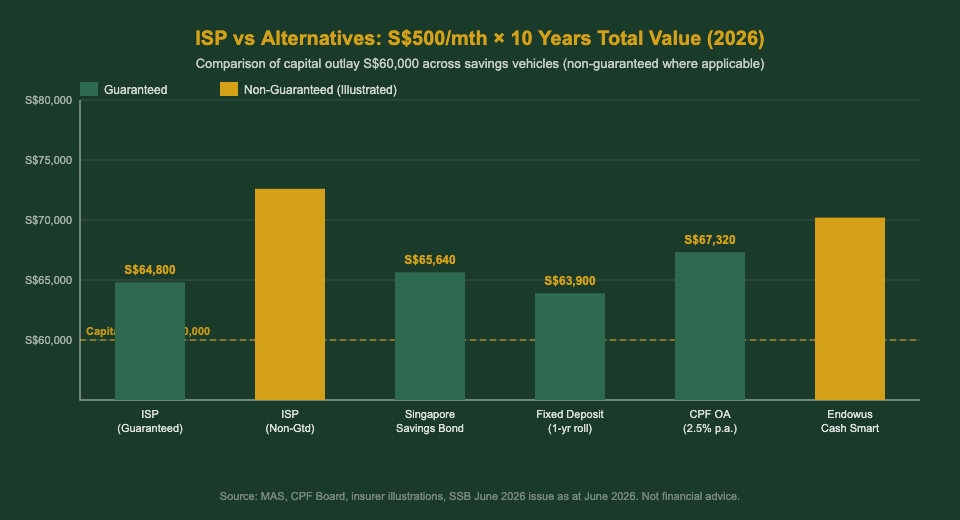
Before committing to an ISP, compare it head-to-head with the savings alternatives available to Singapore investors in 2026:
| Product | Return p.a. | Capital Protected? | Liquidity | SRS? | Best For |
|---|---|---|---|---|---|
| ISP (Singapore) | 2.2–4.2% | ✓ (at maturity) | Low | ✓ | Disciplined long-term savers |
| Singapore Savings Bond | ~2.6–3.0% | ✓ (100%) | High (redeem any time) | ✗ | Emergency/flexible savers |
| Fixed Deposit (1-yr) | 2.5–3.0% | ✓ | Medium (at maturity) | ✗ | Short-term parking |
| CPF OA | 2.5% | ✓ | Very Low (CPF rules) | ✗ | CPF-mandated savings |
| Endowment Plan | 2.5–4.5% | ✓ (at maturity) | Low | ✓ | Goal-based savings (edu, home) |
| Robo (Endowus Income+) | 3.5–5.0% | ✗ (market risk) | High | ✓ (SRS) | Growth-oriented, higher risk tolerance |
Source: MAS, CPF Board, SSB June 2026 issue rate, insurer illustrations, Endowus product page as at June 2026.
The bottom line: ISPs are not the highest-returning option — they’re the most disciplined one. The mandatory premium commitment forces consistent saving, and the capital protection at maturity gives peace of mind that pure equity or bond fund investments cannot offer. For investors who struggle with market volatility or who want a “set-and-forget” savings backbone, an ISP — particularly one funded via SRS — is a strong foundation.
For your medium-term Singapore Savings Bond allocation, see our Singapore Savings Bonds guide. For T-bill comparison, check our Singapore T-bills 2026 guide.
Using SRS to Supercharge Your ISP Returns
The Supplementary Retirement Scheme (SRS) is the most powerful but least-used feature for ISP buyers. Here’s why it matters:
The SRS tax arithmetic (2026 rates): Singapore citizens and PRs can contribute up to S$15,300 per year to their SRS account (foreigners: S$35,700). Every dollar contributed reduces your assessable income dollar-for-dollar. At the top marginal rate of 22%, S$15,300 in SRS contributions saves S$3,366 in annual income tax — effectively boosting your ISP’s effective return by a meaningful margin in the first 10 years.
Worked example — S$1,275/mth ISP via SRS (annual: S$15,300):
| Metric | Value |
|---|---|
| Annual SRS contribution | S$15,300 |
| Tax relief (22% marginal rate) | S$3,366/yr saved |
| Effective annual out-of-pocket cost | S$11,934 (after tax benefit) |
| ISP maturity value after 20 yrs (4.75% scenario) | ~S$452,700 |
| SRS withdrawal tax at 50% concession | Taxed at 50% of withdrawals — plan withdrawals over multiple years |
| Net effective return (including tax savings) | Approximately 5.0–5.5% p.a. effective after tax relief (indicative) |
Source: IRAS SRS rules (as at 2026), CPF Board, insurer benefit illustration. Tax calculations are indicative. Consult a tax advisor for personalised advice.
The SRS angle is particularly compelling for Singapore residents earning above S$80,000/yr (22% marginal bracket or above) who have already maximised CPF cash top-ups and are looking for the next layer of tax-efficient savings. Use our Singapore retirement calculator to model how SRS-funded ISP contributions fit into your overall retirement plan.
Who Should Buy an Insurance Savings Plan?
ISPs are a good fit for a specific type of Singapore saver. Be honest with yourself before signing up:
ISP is RIGHT for you if:
- You want guaranteed capital protection with returns above CPF OA (2.5%) or FD rates
- You have SRS funds available and want to shelter them in a capital-safe, non-market product
- You’re saving for a specific medium-to-long-term goal (child’s education, home renovation fund, retirement nest egg) 10–25 years away
- You struggle with investment discipline and want automatic, forced savings
- You’re already invested in equities (S-REITs, ETFs) and want a fixed-income anchor for portfolio stability
ISP is WRONG for you if:
- You might need the money in the next 3–5 years — surrender charges will hurt
- You’re comfortable with market risk and seeking higher long-term returns — ETFs on LSE will outperform ISPs over 20 years in most scenarios
- You’re already over-allocated to insurance products — check your total insurance premiums don’t exceed 10–15% of take-home pay
- You’re in a low tax bracket (below 7%) where SRS relief is minimal
For investors building a diversified passive income portfolio, combining an ISP (stable foundation) with S-REITs (yield) and broad market ETFs (growth) covers all three return profiles. See our guide to passive income Singapore and best S-REITs in Singapore 2026 for the other components of this approach.
How to Buy an ISP in Singapore (Step-by-Step)
Purchasing an ISP in Singapore is straightforward if you follow these steps:
Step 1: Assess your savings goal and tenor. Decide how long you can commit premiums (5, 10, 15, or 20 years). Longer tenors typically offer higher illustrated returns as the par fund has more time to compound. Match the tenor to a specific goal — e.g., child’s university at 18 years from now.
Step 2: Check your SRS balance. If you have available SRS funds or plan to start SRS contributions, using them for your ISP premium payments amplifies your effective return through tax relief. Log into your SRS operator bank (DBS, OCBC, or UOB) to check your available annual contribution room.
Step 3: Shortlist 3 insurers and request benefit illustrations. Ask for benefit illustrations from at least 3 insurers (NTUC Income, Manulife, and one other). Compare guaranteed maturity values, not just illustrated ones. Use MAS’s CompareFirst.sg portal to screen products by tenor and premium amount.
Step 4: Check insurer financial strength. Look for AM Best or S&P ratings — all major Singapore ISP providers are rated A- or above. NTUC Income is cooperative-owned; the others are regulated foreign subsidiaries or domestically licensed insurers overseen by MAS.
Step 5: Apply through MAS-licensed FA or direct. You can apply directly via insurer apps (NTUC Income app, AIA+ app) or through a MAS-licensed financial adviser. For SRS purchases, the premium payment must come from your SRS bank account — not your regular bank account.
Step 6: Set up GIRO or SRS standing instruction. Automate premium payments. Missing premiums will lapse the policy — most ISPs have a 30-day grace period, but repeated lapses can trigger reinstatement hurdles.
If you’re exploring robo-advisor alternatives for SRS funds, compare our Endowus referral code (SRS investing via Endowus Cash Smart or Fund Smart) and Syfe referral code and sign-up bonus (Syfe Income+ for SRS). Both are FCA/MAS-regulated and offer liquid alternatives with no lock-in.
Ready to Start Saving Smarter?
Use our free retirement calculator to model how an ISP fits your long-term plan — then explore SRS-eligible platforms below.
Frequently Asked Questions
What is an insurance savings plan in Singapore?
How much can I earn from an insurance savings plan?
Can I use SRS money to pay ISP premiums?
What happens if I stop paying ISP premiums early?
Is an insurance savings plan better than a fixed deposit?
Which insurer has the best insurance savings plan in 2026?
Are ISP returns guaranteed?
Can foreigners buy insurance savings plans in Singapore?
How is an ISP different from an endowment plan?
Get Free Insurance Advice
Speak with a licensed insurance advisor. No obligation, no cost.
By submitting this form, you agree to our Privacy Policy.
This article was researched with the help of AI. While we strive to keep all information accurate and up to date, there may be errors. If you notice any discrepancies, please contact us.