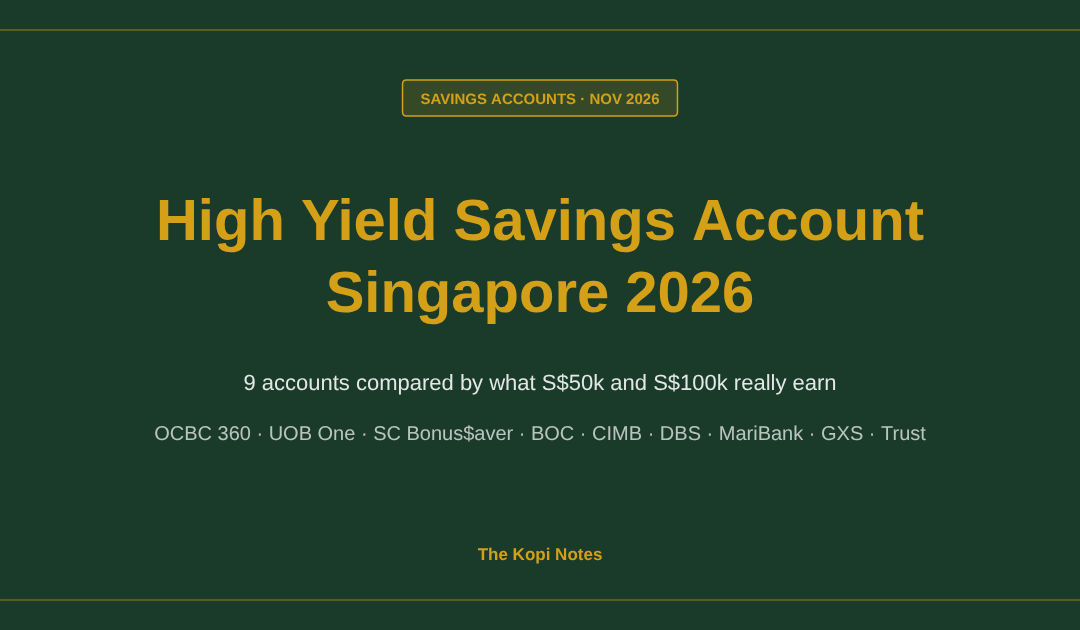
High Yield Savings Account Singapore (November 2026): 9 Accounts Compared by What You Actually Earn
Headline rates of 3% to 7% look great on a banner. Here is what nine Singapore savings accounts really pay on S$50,000 and S$100,000, with every rate checked against the bank’s own page.
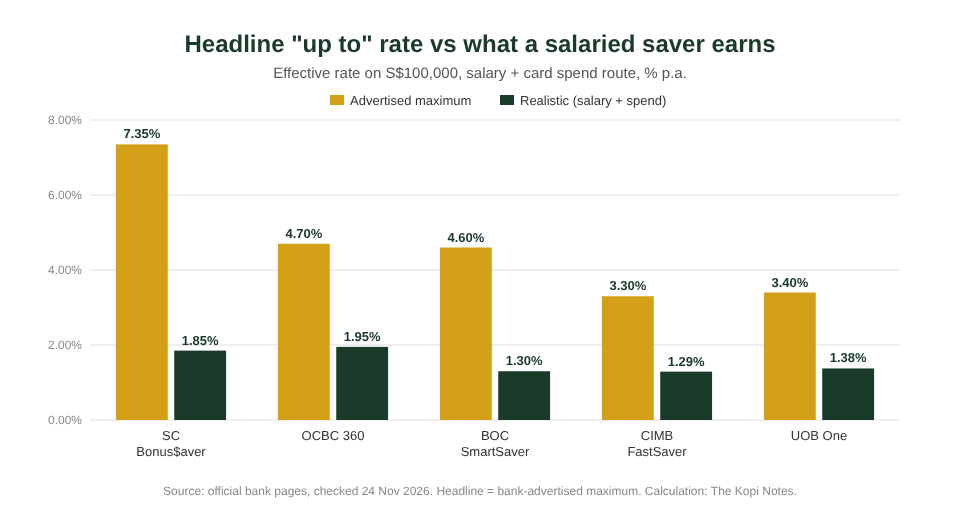
The best high yield savings account in Singapore for most salaried savers in November 2026 pays about 1.3% to 1.95% p.a. on S$100,000, not the 3% to 7% headline. OCBC 360 (1.95%) and Standard Chartered Bonus$aver (1.85%) lead on salary plus card spend, UOB One reaches 1.90% only at S$150,000, and no-hoops digital banks pay 0.88% base.
Not financial advice. Data verified as at 24 November 2026 against each bank’s official website. Rates can change without notice; confirm with the bank before moving money.
Table of Contents
Contents — Click to expand
- High Yield Savings Accounts at a Glance (November 2026)
- How High Yield Savings Accounts Work in Singapore
- Bank Bonus-Interest Accounts Compared
- Digital Bank Savings Accounts: No Hoops, Lower Rates
- Worked Example: What S$50,000 and S$100,000 Earn
- Promotions Ending Soon (November 2026)
- How to Choose the Right High Yield Savings Account
- Frequently Asked Questions
High Yield Savings Accounts at a Glance (November 2026)
A “high yield savings account” in Singapore usually means one of two things. The first is a bank bonus-interest account such as OCBC 360, UOB One or Standard Chartered Bonus$aver, where you earn a tiny base rate and stack bonus interest each month for crediting your salary, spending on the bank’s card, or buying insurance and investments. The second is a digital bank account from MariBank, GXS or Trust, which pays a lower flat rate with few or no conditions.
We read each bank’s official page on 24 November 2026 and only kept numbers we could see there. The table below shows the advertised maximum next to what a typical salaried saver, who credits a salary and puts a few hundred dollars a month on the bank’s card, would really earn on S$100,000.
| Account | Advertised maximum | Realistic rate on S$100k* | Main conditions | Bonus applies to |
|---|---|---|---|---|
| OCBC 360 | 4.70% p.a. EIR (with Save promo to 31 Dec 2026) | 1.95% | Salary min. S$1,800; Save (ADB up S$500); Spend S$500 | First S$100,000 |
| Standard Chartered Bonus$aver | 7.35% p.a. | 1.85% | Salary min. S$3,000; card spend min. S$1,000 | First S$100,000 |
| UOB One | 3.40% p.a. (S$125k–S$150k band); max EIR 1.90% | 1.375% | Card spend S$500 + salary S$1,600 (or 3 GIRO debits) | Up to S$150,000 |
| BOC SmartSaver | 4.60% p.a. | 1.30% | Avg balance S$1,500; salary S$3,000; card S$750; 3 bills | First S$100,000 |
| CIMB FastSaver | 3.30% p.a. on first S$25,000 | 1.29% | Salary/GIRO S$1,000; card spend S$800 | Bonuses on first S$25,000 |
| DBS Multiplier | 4.1% p.a. | 2.1%–2.5% (DBS’s own examples) | Income + spend, insure, invest or home loan | First S$100,000 |
| Trust (Flex plan) | 2.40% p.a. | About 1.00% | Pick 3 of 8 bonuses (salary, balance, card spend…) | See Trust app |
| MariBank | 3.08% p.a. (incl. 30-day welcome bonus) | 0.88% base | None for base rate | Whole balance |
| GXS Main Account | Boost Pocket up to 2.0% p.a. | 0.88% base | None for base rate | Whole balance |
Source: OCBC, Standard Chartered, UOB, Bank of China, CIMB, DBS, Trust, MariBank and GXS official websites, checked 24 November 2026. *Realistic rate = salary credit plus card spend route on S$100,000, standard (non-promo) rates, calculated by The Kopi Notes. DBS figure is from the worked examples on DBS’s Multiplier page.
The gap between column two and column three is the whole story of high yield savings in Singapore. The top headline rates need you to buy insurance or invest tens of thousands of dollars through the bank, and those bonuses usually last only six months.
How High Yield Savings Accounts Work in Singapore
Almost every bonus-interest account follows the same pattern, so once you understand one you can read them all.
1. A low base rate on everything
OCBC 360, UOB One and Standard Chartered Bonus$aver all pay 0.05% p.a. base interest. Bank of China’s SmartSaver pays a prevailing rate of 0.10% p.a. If you miss every condition in a month, this is what you earn.
2. Bonus interest for “doing more” with the bank
Each month you meet a condition, the bank adds bonus interest. The common categories are salary credit (usually via GIRO, FAST or PayNow with the “SALA” reference), card spend on the bank’s own credit or debit card, bill payments or GIRO debits, a growing balance, and insurance or investment purchases.
3. A cap on how much money earns the bonus
Bonuses only apply to a slice of your balance. OCBC 360, SC Bonus$aver, BOC SmartSaver and DBS Multiplier cap it at the first S$100,000. UOB One pays bonuses up to S$150,000, and CIMB FastSaver’s salary and card bonuses apply to the first S$25,000 only. Money above the cap earns the base rate or a low tier rate, which is why “effective” rates fall as your balance grows.
4. Tiers inside the cap
Some banks pay more on the later slices. OCBC 360 splits the first S$100,000 into the first S$75,000 and the next S$25,000, with the second slice earning double for salary. UOB One pays its top 3.40% only on the band from S$125,000 to S$150,000. That is why the “up to” figure applies to a small part of your money.
Bank Bonus-Interest Accounts Compared
OCBC 360
OCBC’s page says you can “earn up to 1.95% a year on your first S$100,000 when you credit your salary, save and spend”. That is the most useful number on the page for an ordinary saver. During the Save bonus promotion (1 August to 31 December 2026) the Save category rises to 0.65% effective, which lifts the salary, save and spend combination to 2.20% on S$100,000. The 4.70% maximum also needs the Insure, Invest and Grow bonuses.
| OCBC 360 bonus | First S$75,000 | Next S$25,000 | Effective on first S$100,000 |
|---|---|---|---|
| Salary (min. S$1,800) | 1.00% | 2.00% | 1.25% |
| Save (ADB up min. S$500), standard | 0.40% | 0.40% | 0.40% |
| Save, promo 1 Aug–31 Dec 2026 | 0.50% | 1.10% | 0.65% |
| Spend (min. S$500 on OCBC cards) | 0.25% | 0.25% | 0.25% |
| Insure / Invest (each) | 1.00% | 2.00% | 1.25% |
| Grow (ADB min. S$250,000) | 1.20% | 1.20% | 1.20% |
| Base interest | 0.05% | 0.05% | 0.05% |
Source: OCBC 360 Account page and 360 Save Bonus Promotion T&Cs, checked 24 November 2026. All rates p.a.
The Save bonus needs your average daily balance to grow by at least S$500 every month, so it rewards people who keep adding money. OCBC charges a S$2 fall-below fee under a S$3,000 average daily balance, waived for the first year. Our full OCBC 360 interest rate breakdown walks through every tier.
UOB One
UOB One uses one rate table with three columns, and card spend of at least S$500 is required on every route. With salary credited, UOB states the maximum effective rate is 1.90% p.a. at exactly S$150,000, worth S$2,850 a year. At S$100,000 the same route works out to about 1.375%.
| UOB One balance band | Card spend only | Card spend + 3 GIRO debits | Card spend + salary |
|---|---|---|---|
| First S$75,000 | 0.65% | 1.00% | 1.00% |
| Next S$50,000 | 0.05% | 2.00% | 2.50% |
| Next S$25,000 | 0.05% | 0.05% | 3.40% |
| Above S$150,000 | 0.05% | 0.05% | 0.05% |
Source: UOB One Account page, checked 24 November 2026. Total interest p.a. (base plus bonus). Card spend min. S$500 a month; salary min. S$1,600.
The 3.40% “up to” rate only applies to the S$25,000 slice between S$125,000 and S$150,000. Our UOB One interest rate guide shows what each balance really earns.
Standard Chartered Bonus$aver
Bonus$aver has the biggest headline, “up to 7.35% p.a.”, but the bulk of that comes from a 2.50% insurance bonus (S$24,000 annual premium on an eligible Prudential policy, for 6 months), a 1.50% invest bonus (S$30,000 unit trust subscription or buy trades in a month, for 6 months) and a further 1.50% new-to-Bonus$aver invest bonus for 3 months. For everyday savers the two bonuses that matter are salary (min. S$3,000, +0.90%) and card spend (min. S$1,000 a month, +0.90%). With the 0.05% base, that is 1.85% on the first S$100,000. The catch is the S$1,000 monthly card spend, double what OCBC and UOB ask for.
Bank of China SmartSaver
BOC’s rates have been effective since 1 November 2025. The 0.10% prevailing rate applies to the whole balance, and bonuses on the first S$100,000 need a monthly average balance of at least S$1,500. Bonuses are 0.60% for card spend of S$750 to under S$2,500 (0.90% at S$2,500 and above), 0.50% for a salary of S$3,000 or more, and 0.10% for three bill payments of at least S$30 each. A household spending S$750 a month earns 1.30%; one spending S$2,500 earns 1.60%. The headline 4.60% needs the 3.00% wealth bonus, which requires a large insurance purchase. More detail is in our BOC SmartSaver interest rate guide.
CIMB FastSaver
CIMB has no fall-below fee and pays a prevailing rate that rises across tiers: 0.50% on the first S$25,000, 1.08% on the next S$25,000, 1.58% on the next S$25,000 and 0.50% above S$75,000. On the first S$25,000 only, it adds 0.50% for a salary or GIRO standing instruction of at least S$1,000 and 1.00% for S$800 of monthly CIMB Visa Signature spend. Until 30 November 2026 there is also a bonus of up to 1.30% on at least S$10,000 of fresh funds, which is how CIMB gets to its 3.30% headline. Because the bonuses stop at S$25,000, CIMB works best as a second account rather than the home for a large balance.
DBS Multiplier
DBS advertises up to 4.1% p.a. on the first S$100,000, based on your total monthly “eligible transactions” (income plus card spend, insurance, investments or a home loan). DBS’s own worked examples on its page show 2.1% to 2.5% on S$100,000 for people crediting income plus two or three categories. Adults aged 18 to 29 without income can earn 1.5% p.a. on the first S$50,000 with any PayLah! or card spend. DBS did not show a full SGD tier table in text on its page when we checked, so we have not calculated our own DBS figures here.
Digital Bank Savings Accounts: No Hoops, Lower Rates
Singapore’s digital banks pay less than the big-bank maximums, but they ask for little or nothing in return. If you do not want to move your salary or chase card spend, these are the simplest high yield options.
MariBank
The Mari Savings Account pays a 0.88% p.a. base rate with no minimum deposit and no minimum spend. MariBank advertises up to 3.08% p.a., which it breaks down as the 0.88% base, a 1.60% new-user bonus for the first 30 days after opening, 0.40% for ShopeeVIP members and 0.20% for crediting your salary. After the first month, the most you can earn from those components is 1.48%. Our MariBank referral code (2DCT80WQ) page covers the current sign-up offer.
GXS Bank
The GXS Main Account pays 0.88% p.a., credited daily. GXS’s Boost Pocket locks money for a fixed term and pays the 0.88% base plus a bonus at maturity: 0.13% for 1 month, 0.62% for 3 months, 0.72% for 4 months, 0.82% for 8 months, 0.87% for 12 months and 1.12% for 18 months. You can hold up to eight Boost Pockets, with no salary or spend requirement. See our GXS Bank referral code page before you sign up.
Trust Bank
Trust’s savings account offers three plans. Zen pays a flat 0.40%. Signature pays up to 1.00%. Flex pays up to 2.40% if you pick three of eight monthly bonuses, such as crediting a salary of at least S$1,500 via GIRO (+0.45%), keeping an average daily balance of S$100,000 (+0.30%), or making five card spends of S$30 (+0.20% for NTUC Union members, +0.10% otherwise). The biggest Flex bonus, +1.20%, needs you to refer a new credit card customer who gets approved in the month, so it is not repeatable for most people. A salaried saver with S$100,000 who picks salary, balance and union card spend would earn about 1.00%. Our Trust Bank referral code page has the sign-up details.
For a full comparison of the digital banks beyond interest, read our best digital bank in Singapore guide.
Worked Example: What S$50,000 and S$100,000 Earn
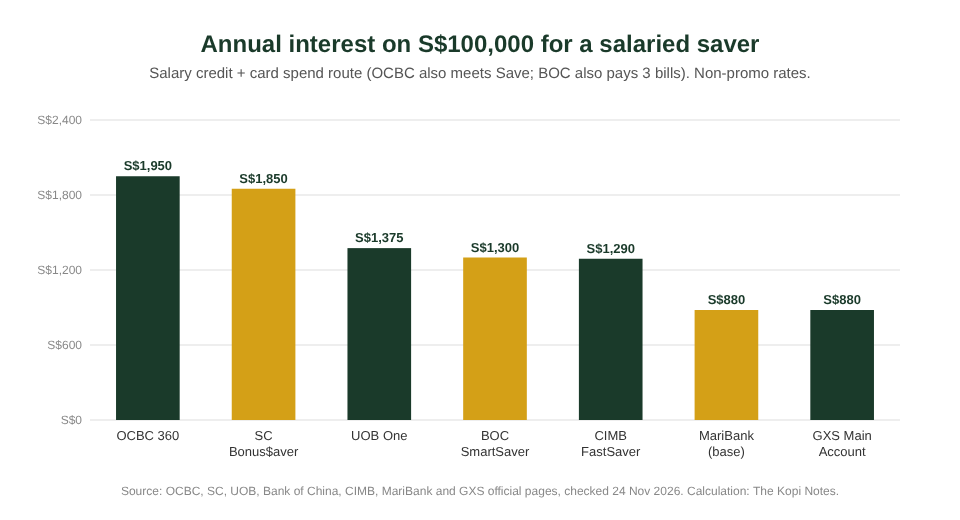
To compare like with like, we assumed a saver who credits a salary to the account every month and puts the minimum required spend on the bank’s own card, but does not buy insurance or investments through the bank. We used standard rates, not promotions that end in the next few weeks.
| Account (salary + card spend route) | Rate on S$50,000 | Interest on S$50,000 | Rate on S$100,000 | Interest on S$100,000 |
|---|---|---|---|---|
| OCBC 360 (salary + save + spend, standard) | 1.70% | S$850 | 1.95% | S$1,950 |
| SC Bonus$aver (salary S$3,000 + spend S$1,000) | 1.85% | S$925 | 1.85% | S$1,850 |
| UOB One (spend S$500 + salary) | 1.00% | S$500 | 1.375% | S$1,375 |
| BOC SmartSaver (salary + S$750 spend + 3 bills) | 1.30% | S$650 | 1.30% | S$1,300 |
| CIMB FastSaver (salary/GIRO + S$800 spend) | 1.54% | S$770 | 1.29% | S$1,290 |
| Trust Flex (salary + union card + PayNow / balance) | 0.85% | S$425 | 1.00% | S$1,000 |
| MariBank (base rate only) | 0.88% | S$440 | 0.88% | S$880 |
| GXS Main Account (base rate) | 0.88% | S$440 | 0.88% | S$880 |
Source: official bank pages checked 24 November 2026; calculations by The Kopi Notes using standard (non-promotional) rates and a constant balance for 12 months. Trust: S$50,000 uses salary, union card spend and PayNow bonuses; S$100,000 swaps PayNow for the S$100,000 balance bonus. Interest is simple, before compounding.
Three things stand out. First, OCBC 360 and SC Bonus$aver are close at S$100,000, but OCBC needs only S$500 of card spend against SC’s S$1,000, and OCBC’s Save bonus needs your balance to grow each month. Second, CIMB beats UOB at S$50,000 because its tiered prevailing rate rises on the second S$25,000, but it falls behind as the balance grows. Third, a no-hoops digital bank at 0.88% earns S$880 on S$100,000, about S$1,000 less than the best bonus account, which is the price of not moving your salary.
Promotions Ending Soon (November 2026)
Several limited-time offers change the picture for fresh money in the next few weeks. These are short promotions, so we kept them out of the worked example above.
- Trust Level Up: 2.2% p.a. guaranteed on S$100,000 or more of fresh funds and 2.0% p.a. on S$25,000 to S$99,999.99, from 1 November 2026 to 31 January 2027. You must create a pot named “Level Up” by 30 November 2026, and fresh funds are measured against your October 2026 average daily balance (Trust Level Up terms).
- GXS Holiday Boost: 2.3% p.a. on a 3-month Boost Pocket and 2.4% p.a. on a 4-month Boost Pocket, for S$10,000 to S$100,000 of fresh funds. Part of the return (0.8% p.a.) is paid as cashback. Offer ends 30 November 2026 (GXS Savings Account page).
- CIMB FastSaver fresh funds bonus: up to 1.30% p.a. on at least S$10,000 of incremental fresh funds topped up from 1 to 30 November 2026 (CIMB FastSaver page).
- OCBC 360 Save bonus: the Save category pays 0.65% effective instead of 0.40% until 31 December 2026.
- Standard Chartered Bonus$aver: an account-opening offer runs from 16 October 2026 to 1 February 2027 (SC Bonus$aver page).
Promotional rates usually apply only to new money and for a fixed period. Once they end, your balance drops back to the standard rates in the tables above.
How to Choose the Right High Yield Savings Account
Start with where your salary goes. Salary credit is the single biggest bonus at OCBC, UOB, SC and BOC. You can only credit your salary to one bank, so pick the account that pays most on your balance with the card spend you already do.
Match the card spend threshold to your real spending. UOB and OCBC need S$500 a month, BOC S$750, CIMB S$800 and SC S$1,000. Spending extra just to hit a bonus usually costs more than the interest you gain.
Check your balance against the cap. Below about S$75,000, OCBC 360 and SC Bonus$aver are strong. Between S$125,000 and S$150,000, UOB One’s 3.40% band starts to pay off. Above S$150,000, every bonus account pays very little on the extra money, so look at fixed deposits, T-bills or Singapore Savings Bonds for the rest.
Keep the SDIC limit in mind. SGD deposits at SDIC scheme members are insured up to S$100,000 per depositor per bank (SDIC FAQ). If you hold more than that, splitting it across banks gives you both protection and a second set of bonus caps.
Do not want hoops? Use a digital bank. MariBank and GXS both pay 0.88% with no conditions, and you can withdraw any time. If you are setting cash aside for the long term, our Singapore retirement calculator shows how much your savings need to grow, and our guide to the best savings account without salary credit goes deeper on the no-salary options.
Frequently Asked Questions
What is the highest interest savings account in Singapore right now?
On advertised rates, Standard Chartered Bonus$aver leads at up to 7.35% p.a., followed by OCBC 360 at 4.70% EIR during its Save promotion. For a salaried saver who does not buy insurance or investments, OCBC 360 (1.95% on S$100,000) and SC Bonus$aver (1.85%) pay the most, as at 24 November 2026.
Which high yield savings account has no conditions?
MariBank and GXS both pay 0.88% p.a. on the main account with no salary, spend or minimum balance requirement. Trust’s Zen plan pays a flat 0.40% p.a.
Is a high yield savings account better than a fixed deposit?
A savings account lets you withdraw any time, while a fixed deposit locks money for a set term. If you can meet the bonus conditions, a bonus account often pays more than a fixed deposit on the first S$100,000. Above the bonus cap, a fixed deposit, T-bill or Singapore Savings Bond is usually better for the extra money.
Why do I not get the advertised 'up to' rate?
The headline rate usually needs every bonus category, including large insurance or investment purchases, and often applies only to one slice of your balance. Most savers meet salary and card spend only, which pays roughly 1.3% to 1.95% on S$100,000.
Is my money safe in a high yield savings account?
SGD deposits in savings accounts at SDIC scheme member banks, including the digital banks covered here, are insured up to S$100,000 per depositor per bank.
Can I have more than one high yield savings account?
Yes. Many savers credit their salary to one bonus account and keep extra cash in a second account, such as CIMB FastSaver or a digital bank, to stay under each account’s bonus cap and the S$100,000 SDIC limit.
Do I need to credit my full salary to qualify?
No, you only need to meet the bank’s minimum: S$1,600 for UOB One, S$1,800 for OCBC 360, S$3,000 for SC Bonus$aver and BOC SmartSaver, S$1,000 (or a GIRO standing instruction) for CIMB, and S$1,500 via GIRO for Trust Flex. The transfer usually needs the SALA reference.
How often do these interest rates change?
Banks can change rates at any time, and several promotions on this page end on 30 November or 31 December 2026. We check official bank pages before each update and date every figure.
Disclaimer: This article is for general information only and is not financial advice. Rates were read from each bank’s official website on 24 November 2026 and can change at any time. Calculations are illustrative, assume a constant balance and standard rates, and ignore compounding. Always confirm rates and terms with the bank. The Kopi Notes may earn referral fees from some links on this site. This article was researched and drafted with the help of AI tools and reviewed against primary sources.
Comparing Where to Park Cash?
See how Singapore’s digital banks stack up for savings, and plan the long game with our calculator.
This article was researched with the help of AI. While we strive to keep all information accurate and up to date, there may be errors. If you notice any discrepancies, please contact us.