Credit Card for Foreigners in Singapore (2026): Income Rules, Documents and Which Banks Say Yes
What Employment Pass and S Pass holders need to get approved: minimum income by bank, documents, and options if you fall short.
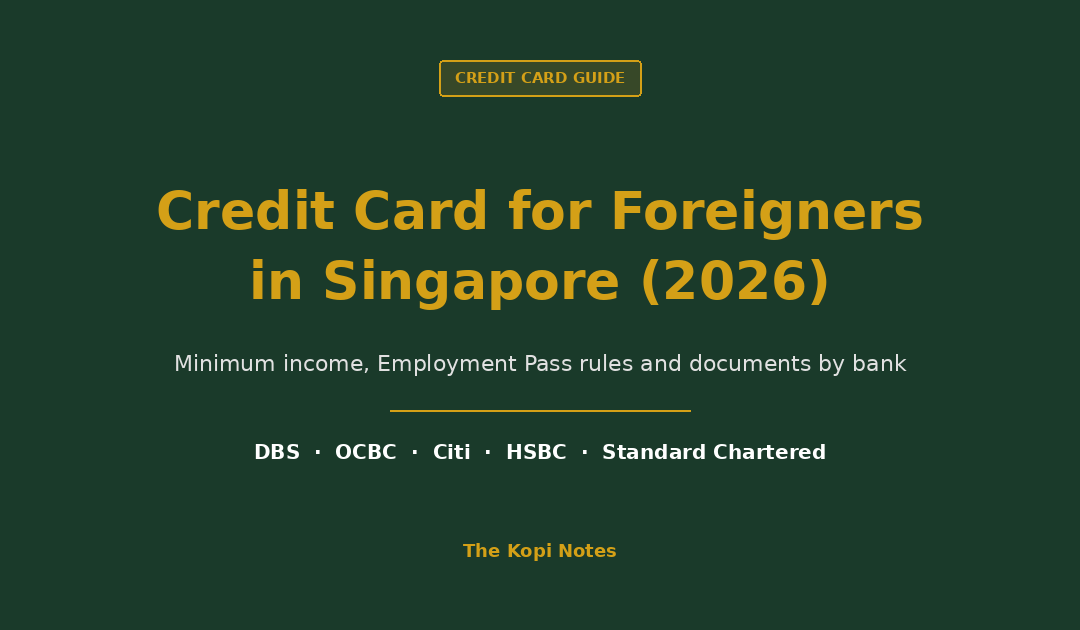
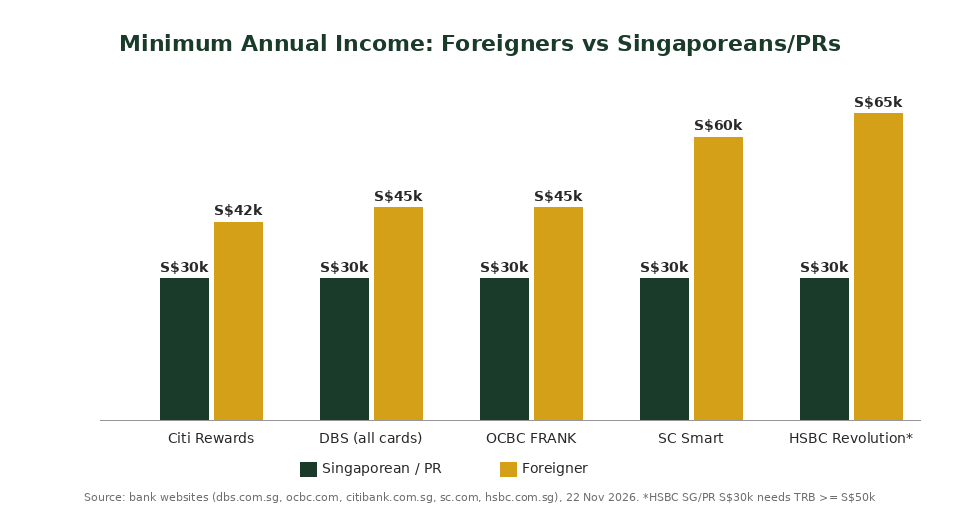
Foreigners can get a credit card in Singapore, but the income bar is higher. DBS and OCBC ask foreigners for at least S$45,000 a year (vs S$30,000 for Singaporeans and PRs), Citi Rewards asks for S$42,000, Standard Chartered S$60,000 with an Employment Pass, and HSBC Revolution S$65,000. You also need a passport and work pass valid for at least six months.
Not financial advice. Data verified as at 22 November 2026 against each bank’s official card or eligibility page. Bank criteria change without notice, so confirm on the bank’s site before you apply. The Kopi Notes may earn referral fees from some links.
Can Foreigners Get a Credit Card in Singapore?
Yes. Every major bank in Singapore issues credit cards to foreigners who live and work here, and you do not need to be a Singapore Citizen or Permanent Resident. What changes is the bar you have to clear. Banks see a foreigner’s income as less certain, because a work pass can be cancelled and the holder can leave the country with an unpaid balance. So they ask for a higher minimum income and for proof that your pass is valid for a while yet.
DBS spells this out more plainly than most. Its card eligibility page sets a S$30,000 minimum for Singaporeans and PRs aged 55 and below, and S$45,000 for foreigners. It also lists the passes it accepts: Employment Pass, S Pass, Personalised Employment Pass, Long Term Visit Pass with a Letter of Consent, Tech.Pass and International Organisation Pass. If your pass type is not on a bank’s list, assume the application will be rejected however much you earn.
The age floor is the same for everyone. You must be at least 21 to hold a principal card at every bank covered here. Some banks also set an upper limit; DBS states 21 to 75, and Standard Chartered lists 21 to 65 on its card list page.
Minimum Income for Foreigners by Bank (November 2026)
The table below compares the minimum annual income each bank published for foreigners against the figure for Singaporeans and PRs. We only list numbers we could read on the bank’s own website this month. Where a bank’s pages contradicted each other, or the page would not load, we left the figure out rather than guess.
| Bank / card | Singaporean / PR (min. income) | Foreigner (min. income) | Extra condition for foreigners |
|---|---|---|---|
| DBS (all credit cards) | S$30,000 (age 55 and below) | S$45,000 | Eligible work pass, 6+ months valid |
| OCBC FRANK / INFINITY Cashback | S$30,000 (age 21 to 55) | S$45,000 | Employment Pass, 6+ months valid (FRANK page) |
| Citi Rewards | S$30,000 | S$42,000 | Passport and work permit, 6+ months valid |
| Standard Chartered Smart | S$30,000 | S$60,000 | Must hold an Employment Pass |
| Standard Chartered Visa Infinite | S$150,000 (all other customers) | S$60,000 | Foreigners with Employment Pass |
| HSBC Revolution | S$30,000 (TRB S$50,000+) / S$65,000 (new) | S$65,000 | Same S$65,000 for new and existing customers |
Source: DBS, OCBC, Citibank Singapore, Standard Chartered Singapore and HSBC Singapore official card pages, accessed 22 November 2026. TRB = total relationship balance with HSBC.
Two patterns stand out. First, Citi Rewards has the lowest published foreigner threshold of the group at S$42,000, a little below DBS and OCBC at S$45,000. Second, Standard Chartered’s Visa Infinite is unusual: an Employment Pass holder qualifies at S$60,000, while the published minimum for other customers is S$150,000. That makes it one of the few premium cards where a foreigner’s bar is lower than a local’s, unless the local has a Priority Banking or similar relationship.
HSBC works differently from the rest. For Singaporeans and PRs, the Revolution card’s S$30,000 minimum applies only to existing customers with at least S$50,000 in total relationship balance; new local customers need S$65,000, the same as foreigners. If you are weighing HSBC, our HSBC credit card Singapore comparison covers each card’s fee and earn rate.
Documents Foreigners Need to Apply for a Credit Card
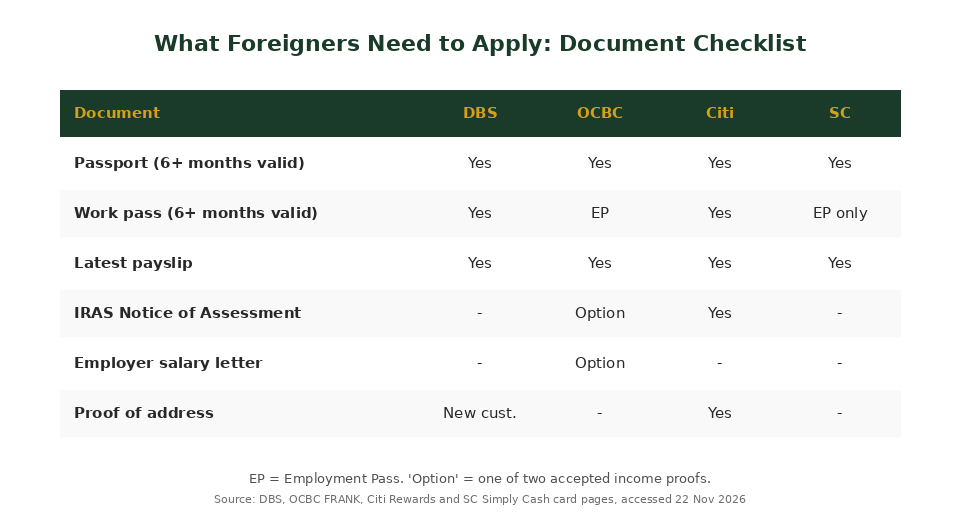
Foreigners cannot use Myinfo the way citizens and PRs do, so most applications need uploaded documents. The core set is the same across banks: a passport, a work pass and proof of income. The details differ, and getting them wrong is the most common reason an otherwise eligible application stalls.
| Bank | Passport | Work pass | Income proof |
|---|---|---|---|
| DBS | Copy, at least 6 months validity | Front and back, at least 6 months validity | Latest 3 months’ computerised payslips preferred; at least the latest 1 month |
| OCBC (FRANK) | Passport | Employment Pass, at least 6 months validity | Latest payslip and IRAS Notice of Assessment, or original employer letter stating employment and salary |
| Citi (Rewards) | Copy of passport | Work permit, at least 6 months validity | IRAS Notice of Assessment and latest computerised payslip, plus proof of address |
| Standard Chartered (Simply Cash) | Copy, at least 6 months validity, incl. address page where applicable | Employment Pass, at least 6 months validity | Latest computerised payslip |
Source: DBS card application documents page, OCBC FRANK card page, Citi Rewards card page and Standard Chartered Simply Cash card page, accessed 22 November 2026.
The six-month rule matters more than it looks. If your Employment Pass expires in four months and your renewal is still being processed, a bank following these rules will not approve you, even if you earn well above the minimum. Apply right after renewal, when your pass has the most time left on it.
New arrivals have a second hurdle. Citi’s Notice of Assessment requirement assumes you have filed at least one Singapore tax return, which someone in their first year may not have. OCBC lets you use an employer letter instead, which helps if you have only just started work here. DBS asks new bank customers for proof of address as well, so it is easier to open a DBS or POSB account first and then apply for the card.
Which Credit Card Suits Which Foreigner?
Your income decides which banks will consider you. Your spending decides which of those cards is worth having. Here is how the verified options line up.
Earning S$42,000 to S$45,000
Citi Rewards is the only card in our verified set that you clear at this level. Its published annual fee is S$196.20 including 9% GST. Check Citi’s card page for the current bonus categories before you apply, since they decide whether the card fits how you spend.
Earning S$45,000 to S$60,000
DBS and OCBC open up at S$45,000. On the OCBC side, both FRANK and the INFINITY Cashback card carry an annual fee of S$196.20 including GST. OCBC waives FRANK’s fee for the first two years and INFINITY’s for the first year; after that, spending S$10,000 within a year on the card gets the fee waived, according to OCBC’s card pages. INFINITY is an unlimited cashback card, which makes it the simpler pick if you do not want to track spending categories. For a wider list, see our best cashback credit cards in Singapore roundup.
Earning S$60,000 and above, with an Employment Pass
Standard Chartered becomes available at S$60,000, provided you hold an Employment Pass (S Pass holders do not qualify under the wording on its card list). The Visa Infinite stands out for expatriates who travel often: its published annual fee is S$558.50 including GST, and the foreigner bar sits well below the S$150,000 Standard Chartered lists for other customers. At S$65,000 you also clear HSBC Revolution. If lounge access matters, compare it with the cards in our credit cards with lounge access guide.
A worked example. Priya moves to Singapore on an Employment Pass earning S$4,000 a month, or S$48,000 a year. She clears Citi (S$42,000), DBS and OCBC (S$45,000), but not Standard Chartered (S$60,000) or HSBC Revolution (S$65,000). If she spends S$1,000 a month on the card, that is S$12,000 a year, above the S$10,000 OCBC needs for a fee waiver after the free period. So an OCBC card would likely cost her nothing in fees if she uses it as her main card. Her best move in month one is to open a bank account, get her first payslip, then apply with the employer letter route OCBC accepts.
Earning Below S$42,000? Your Options
Many S Pass holders and foreign fresh graduates earn less than the foreigner minimums. You still have three ways to get card-like spending power.
1. A secured credit card backed by a fixed deposit
DBS states that you can get a card without meeting the income test if you keep an SGD fixed deposit of at least S$10,000 with the bank. The deposit backs your credit limit, so the bank takes very little risk. Our secured credit card Singapore guide explains how these limits are set and what happens to the deposit while the card is open.
2. A prepaid or debit card
Prepaid and multi-currency debit cards need no income check at all. You load money first and spend it, so there is no credit line and no credit history built. They are useful for overseas spending in the meantime; our prepaid credit card Singapore guide compares the main ones.
3. A digital bank account while you wait
Digital banks such as Trust, GXS and MariBank have their own eligibility rules for non-residents, which change often, so check in the app before you apply. If you open a Trust account, the Trust Bank referral code HTWYQP95 gives you the current sign-up reward. Our best digital bank in Singapore comparison sets out how the three differ.
How to Improve Your Approval Odds as a Foreigner
Banks rarely explain a rejection, but the published rules point to the usual causes. Apply after your work pass renewal so it has well over six months left. Upload computerised payslips rather than handwritten or PDF-edited ones; DBS and Standard Chartered both specify “computerised”. Use the same name and address format as on your passport. Do not apply to four banks in the same week, because credit enquiries show up on your Credit Bureau Singapore report and a burst of them can look like financial stress. Finally, banks generally treat existing customers more kindly: HSBC’s own table is proof, with a lower bar for locals who already hold S$50,000 with the bank.
Once you have the card, pay the full statement balance every month. Singapore card interest is high, and late fees and interest can wipe out the value of any rebate. If you want to see how a card’s fee fits your budget over the long run, our Singapore retirement calculator shows how small yearly costs add up.
This article was researched with AI assistance and checked against each bank’s official website on 22 November 2026. It is general information, not financial advice. Eligibility, fees and card features change; confirm with the bank before applying. Sources: DBS eligibility, DBS documents, OCBC FRANK, OCBC INFINITY Cashback, Citi Rewards, Standard Chartered card list, Standard Chartered Simply Cash, HSBC Revolution.
Frequently Asked Questions
Can foreigners get a credit card in Singapore?
Yes. Foreigners with an eligible work pass can apply at all the major banks. The published minimum income for foreigners is higher than for locals: S$42,000 for Citi Rewards, S$45,000 for DBS and OCBC, S$60,000 for Standard Chartered and S$65,000 for HSBC Revolution, as at 22 November 2026.
What is the minimum salary for a foreigner to get a credit card in Singapore?
Among the banks we checked, the lowest published foreigner minimum is S$42,000 a year for the Citi Rewards card. DBS and OCBC require S$45,000. Below that, a fixed-deposit-backed secured card or a prepaid card is the usual route.
Can S Pass holders get a credit card in Singapore?
DBS lists the S Pass among its eligible work passes, so an S Pass holder earning at least S$45,000 can apply. Standard Chartered’s card list says foreigners must hold an Employment Pass, so S Pass holders do not qualify there.
What documents does a foreigner need to apply for a credit card in Singapore?
Expect to provide a passport and a work pass, each valid for at least six months, plus proof of income such as a computerised payslip. Citi also asks for an IRAS Notice of Assessment and proof of address, while OCBC accepts an employer letter in place of the payslip and Notice of Assessment.
Can I get a credit card in Singapore without income as a foreigner?
Not a normal one. DBS lets you get a card without meeting the income test if you keep an SGD fixed deposit of at least S$10,000 with the bank. Prepaid and debit cards need no income check but do not give you credit.
Do Dependant's Pass holders qualify for a Singapore credit card?
DBS’s list of eligible passes names the Long Term Visit Pass with a Letter of Consent but does not name the Dependant’s Pass, so confirm with the bank before applying. Without a qualifying income of your own, a supplementary card on the main pass holder’s account is the simplest option.
Why is the income requirement higher for foreigners?
A work pass can be cancelled and the holder can leave Singapore, which makes unpaid balances harder for a bank to recover. Banks offset that risk by asking for a higher income and a work pass with at least six months of validity left.
Waiting on a Card? Open a Digital Bank Account First
Get started with a digital bank while your card application is processed.
This article was researched with the help of AI. While we strive to keep all information accurate and up to date, there may be errors. If you notice any discrepancies, please contact us.