FSMOne CPFIS Guide 2026: How to Invest Your CPF OA Savings
FSMOne is a CPF Investment Scheme (CPFIS) approved agent that lets you invest CPF Ordinary Account savings in SGX stocks, ETFs and over 1,000 unit trusts at 0% sales charge, once you keep the mandatory $20,000 floor in your OA and open a CPF Investment Account with DBS, OCBC or UOB.
Not financial advice. All figures are for educational reference only. Data as at Nov 2026 unless otherwise noted.
Table of Contents
Contents — Click to expand
What Is CPFIS and Why Use FSMOne for It?
CPFIS-OA Eligibility: Who Can Invest Their CPF OA?
How Much of Your CPF OA Can You Invest?
How to Open a CPF Investment Account for FSMOne
FSMOne CPFIS Fees: What You Actually Pay
What You Can Buy With CPF OA on FSMOne
FSMOne CPFIS vs Bank-Sold Unit Trusts
Risks and Who Should Think Twice
FSMOne Referral Code
FAQ
What Is CPFIS and Why Use FSMOne for It?
The CPF Investment Scheme (CPFIS) lets CPF members invest part of their Ordinary Account (OA) and Special Account (SA) savings in approved products — shares, unit trusts, ETFs, Singapore Government Securities (SGS) bonds and Treasury Bills — instead of leaving everything to earn the OA’s 2.5% floor rate. According to the CPF Board, as at 30 September 2025 members held $21.4 billion of OA and SA savings in CPFIS investments.
FSMOne (formerly Fundsupermart, now part of iFAST Corporation) is one of a small number of CPFIS-OA approved agents. Its main edge for CPF investors is cost: FSMOne charges 0% sales charge on all unit trusts on its platform, versus the 3%–5% front-load that traditional bank-sold funds often carry. On a $20,000 CPF OA fund purchase, that is a $600–$1,000 saving on day one, before the fund has even started compounding.
This guide walks through CPFIS-OA eligibility, how much of your CPF you can actually invest, the exact steps to open a CPF Investment Account, FSMOne’s fee schedule for CPF holdings, and how it compares with going through a bank’s own CPFIS counter. If you would rather have a robo-advisor manage CPF money for you instead of picking funds yourself, see our CPF investment strategy guide for the managed-portfolio route.
CPFIS-OA Eligibility: Who Can Invest Their CPF OA?
Before FSMOne (or any CPFIS agent) will let you invest, the CPF Board requires you to meet all of the following, per its official CPFIS eligibility criteria:
| Requirement | Detail |
|---|---|
| Age | At least 18 years old |
| Bankruptcy status | Not an undischarged bankrupt |
| OA balance (for CPFIS-OA) | More than $20,000 in your OA |
| SA balance (for CPFIS-SA) | More than $40,000 in your SA |
| Self-Awareness Questionnaire | Must have completed the CPF Board’s SAQ before investing |
Source: CPF Board, cpf.gov.sg, Nov 2026
Note the important structural difference: CPFIS-OA investing goes through a CPF Investment Account at one of three agent banks (covered below), while CPFIS-SA investing does not need a CPF Investment Account at all — you deal with the product provider directly for SA-based purchases.
How Much of Your CPF OA Can You Invest?
Meeting the $20,000 eligibility floor does not mean all of the excess is free to invest however you like. The CPF Board caps how much of your “investible savings” (your OA balance plus any CPF already withdrawn for investment or education) can go into the riskier product categories:
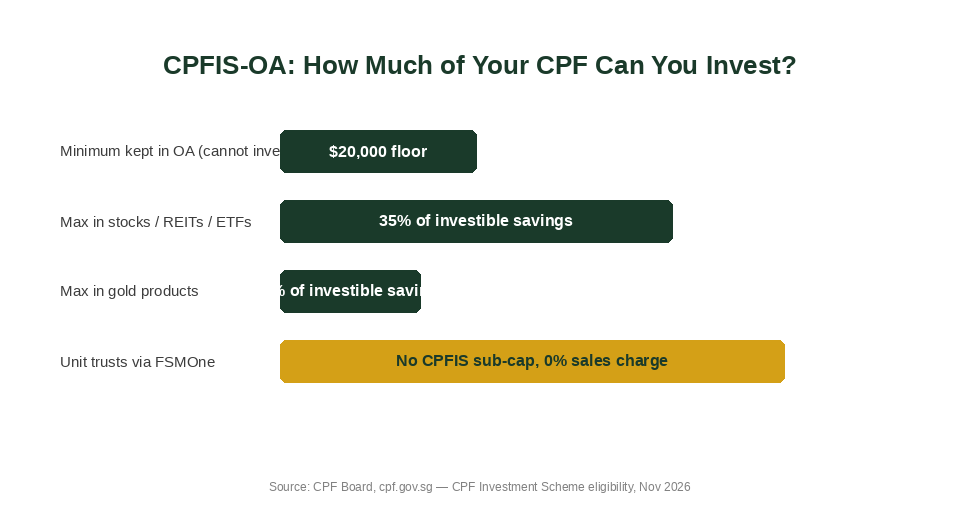
- Stocks, REITs, corporate bonds and ETFs: capped at 35% of investible savings
- Gold products: capped at 10% of investible savings
- Unit trusts: no CPFIS-specific sub-cap on this category, though the fund’s own minimum initial sum applies
Worked example: a member with $80,000 in their OA keeps the mandatory $20,000 floor untouched, leaving $60,000 of investible savings. At the 35% stock/ETF/REIT cap, up to $21,000 of that could go into SGX-listed shares, REITs or ETFs through FSMOne; up to $6,000 (the 10% cap) could go into gold products. The remainder can go into eligible unit trusts, which carry no CPFIS percentage cap.
There are also ongoing costs to budget for on top of FSMOne’s own fees. CPF’s own CPFIS cost guidance flags a Wrap Fee capped at 0.4% p.a. (where applicable to a managed portfolio) and a Total Expense Ratio of 0.35%–1.75% p.a. depending on fund risk category — these are fund-level costs, separate from FSMOne’s own platform charges below.
How to Open a CPF Investment Account for FSMOne
To invest CPF OA savings through FSMOne, you first need a CPF Investment Account (CPFIA) — FSMOne itself is the trading and fund platform, but the CPFIA that holds your OA investment funds must be opened with one of three CPF Board-appointed agent banks:
- DBS — apply via the DBS website or iBanking
- OCBC — apply via the OCBC website or the OCBC mobile app
- UOB — apply via the UOB online investment application form
Steps in order:
- Complete the CPF Board’s Self-Awareness Questionnaire (SAQ) if you have not already done so.
- Open a CPF Investment Account with DBS, OCBC or UOB (you can only hold one CPFIA at a time across all three banks).
- Open or log in to your FSMOne account and link it for CPF OA transactions.
- Place your buy order for an eligible unit trust, ETF or SGX stock using your CPF OA funds through the CPFIA.
- Monitor your holdings; when you sell or a holding matures, CPF guidance recommends transferring proceeds back into your CPF accounts if you are not reinvesting, so the funds resume earning CPF interest rather than sitting idle in the CPFIA.
FSMOne’s own unit trust settlement for CPF-OA purchases generally completes on a T+4 business day basis — slower than a cash account purchase, so factor this into any time-sensitive fund switches.
FSMOne CPFIS Fees: What You Actually Pay
FSMOne’s fee structure for CPF OA investors mirrors its cash-account pricing in most respects, with one standout difference on unit trusts:
| Fee Type | FSMOne CPF-OA Rate | Notes |
|---|---|---|
| Unit trust sales charge | 0% | Applies to all unit trusts on the platform, CPF or cash |
| Fund switching fee | 0% | Free switching between eligible funds |
| SGX stock/ETF/REIT commission | 0.08% (min S$10) | Same rate as cash-account SGX trades |
| Platform access fee (SGX) | S$3/quarter | Waived with 1+ trade/quarter or S$1,000+ SGX holdings |
| Fund management fee | Fund-dependent, ~0.5%–2% p.a. | Charged by the fund manager, not FSMOne, and within CPF’s own TER cap |
Source: FSMOne fund and brokerage fee schedule, as summarised in The Kopi Notes’ FSMOne fees breakdown, Nov 2026
The practical upshot: for unit trust investors, FSMOne functionally charges no separate platform fee on CPF-OA fund holdings beyond the fund’s own built-in management fee — a point we cover in more depth on our FSMOne referral code page, which also lists current sign-up incentives.
What You Can Buy With CPF OA on FSMOne
Not every product on FSMOne is CPFIS-OA eligible — only funds and instruments on the CPF Board’s approved list qualify. Broad categories available through FSMOne’s CPF OA facility include:
- CPFIS-included unit trusts: over 1,000 funds are on FSMOne’s shelf, a meaningful subset of which carry CPFIS-OA approval — equity, balanced, bond and money market funds across global and Asia-Pacific mandates
- SGX-listed shares and REITs within the 35% stock cap, including many S-REITs; see our best S-REITs in Singapore 2026 roundup for yield comparisons before committing CPF money to any single counter
- SGX-listed ETFs, also subject to the 35% cap since they sit in the same risk bucket as shares
- Gold ETFs and gold products within the separate 10% cap
Singapore Savings Bonds and SGS Treasury Bills are not bought through FSMOne at all — CPF guidance notes these are applied for via ATM or internet banking channels directly, not through a CPFIS agent’s platform.
FSMOne CPFIS vs Bank-Sold Unit Trusts
CPFIS-OA investors aren’t limited to FSMOne — the three agent banks (DBS, OCBC, UOB) also sell their own curated shelf of CPFIS-approved unit trusts directly, and many retail banks still charge a traditional front-load sales charge on these funds.
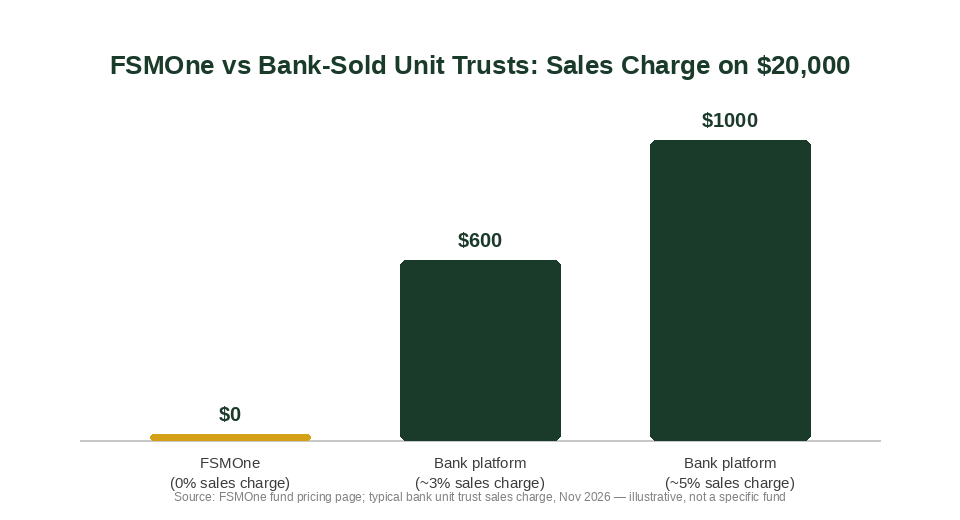
On a $20,000 CPF OA unit trust purchase, a typical 3%–5% bank sales charge works out to $600–$1,000 paid upfront before a single dollar has had the chance to grow. FSMOne’s 0% sales charge structure means that entire amount stays invested from day one. Over a multi-year CPF investment horizon, that upfront saving compounds alongside the rest of the position — it is not just a one-time convenience.
The trade-off is that FSMOne is a self-directed platform: there is no dedicated relationship manager picking funds for you the way some bank CPFIS counters position their service. If you would rather have professional fund selection and auto-rebalancing handled for you on CPF money, a robo-advisor such as Endowus (also CPFIS-approved, CMS101051) is the more hands-off alternative — see our Endowus referral code page for its CPF fee tiers.
Risks and Who Should Think Twice
CPFIS investing is not risk-free, and the CPF Board is explicit that it does not endorse any specific CPFIS product or provider. Before moving OA savings into FSMOne-held investments, consider:
- You could underperform the OA floor rate. CPF OA otherwise earns a guaranteed, risk-free rate; any CPFIS investment needs to beat that after all fees just to break even in real terms.
- You need time and the inclination to monitor holdings. CPF’s own guidance recommends CPFIS only for members who can afford to lose part of their investment, have savings beyond their basic retirement needs, and have the time and expertise to monitor positions.
- Settlement is slower than a cash brokerage account. T+4 settlement on CPF-OA unit trust trades means less flexibility to react quickly to market moves.
- Selling and not reinvesting means remembering to transfer funds back. Money left sitting in the CPFIA after a sale does not earn CPF interest until it is moved back into your OA.
If you are unsure, CPF’s own position is straightforward: you do not have to invest at all, and leaving CPF savings untouched lets them continue compounding at the guaranteed CPF interest rate. For a wider view of where CPF investing fits into a full retirement plan, our retirement planning calculator can help model both paths side by side, and our passive income Singapore guide covers cash-account alternatives if you’d rather not touch CPF money at all.
FSMOne Referral Code
If you decide FSMOne’s 0%-sales-charge structure suits your CPF OA (or cash/SRS) investing plan, use the referral code below when signing up.
FAQ
Is FSMOne CPFIS approved?
Yes. FSMOne is an approved CPF Investment Scheme (CPFIS) agent for CPF Ordinary Account investing, offering unit trusts, SGX stocks, ETFs and gold products on an approved-product list set by the CPF Board.
How much CPF OA can I invest through FSMOne?
You must keep at least $20,000 in your OA before investing any excess. Of the remaining investible savings, stocks, REITs, corporate bonds and ETFs are capped at 35%, and gold products are capped at 10%. Unit trusts carry no CPFIS-specific percentage sub-cap.
Do I need a separate account to invest my CPF OA on FSMOne?
Yes. You need a CPF Investment Account (CPFIA) opened with DBS, OCBC or UOB before you can route CPF OA funds into FSMOne purchases. You can only hold one CPFIA at a time.
Does FSMOne charge a platform fee on CPF OA unit trusts?
FSMOne charges 0% sales charge on unit trusts regardless of funding source, and does not add a separate CPFIS platform fee on top — you still pay the underlying fund’s own management fee, which is set by the fund manager, not FSMOne.
Can I use CPF OA to buy Singapore Savings Bonds or T-bills through FSMOne?
No. Singapore Savings Bonds and SGS Treasury Bills are applied for directly via ATM or internet banking channels, not through FSMOne or any CPFIS agent’s trading platform.
What happens to my CPF money if I sell an investment and don't reinvest?
CPF Board guidance recommends transferring the sale proceeds from your CPF Investment Account back into your CPF savings accounts if you do not plan to reinvest, since funds sitting in the CPFIA do not earn CPF interest.
Related reading: Endowus vs FSMOne 2026 · Endowus CPFIS 2026 CPF OA guide · FSMOne fees breakdown 2026
This article was researched with the help of AI. While we strive to keep all information accurate and up to date, there may be errors. If you notice any discrepancies, please contact us.