Medisave Limit 2026: Cataract Surgery in Singapore — What You Actually Pay With and Without a Rider
From the Medisave withdrawal limit to your final out-of-pocket cost — a complete 2026 guide for Singapore patients planning cataract surgery.
The Medisave withdrawal limit for cataract surgery in Singapore is S$2,380 per eye from 1 April 2025 (TOSP Table 4A, procedure codes SL808L and SL809L). MediShield Life adds a claim limit of S$2,310 per eye from 1 June 2026. At a public subsidised hospital these two coverages typically meet the full bill, leaving near-zero out-of-pocket costs. At a private clinic, where bills commonly reach S$7,100–S$10,100 per eye, the gap can exceed S$6,000 in cash — unless you hold an Integrated Shield Plan (ISP) rider that covers private hospital charges.
Not financial advice. All figures are for educational reference only. Data as at November 2026 unless otherwise noted.
Table of Contents
Contents — Click to expand
- What Is Cataract Surgery and Why Does the Medisave Limit Matter?
- Cataract Surgery Costs in Singapore (2026)
- The Medisave Withdrawal Limit for Cataract Surgery
- What MediShield Life Pays Towards Cataract Surgery
- What an ISP Rider Changes — The 5% Co-Payment Rule
- Bill Worked Examples: What You Actually Pay
- When to Review Your ISP Before Surgery
- Frequently Asked Questions
What Is Cataract Surgery and Why Does the Medisave Limit Matter?
Cataracts — the clouding of the eye’s natural lens — affect roughly one in three Singaporeans over the age of 60. Surgery to remove the cataract and implant a new artificial lens (phacoemulsification) is one of the most commonly performed day surgical procedures at both public and private healthcare facilities in Singapore.
Because it is classified as a day surgery rather than an inpatient overnight procedure, cataract surgery falls under a specific set of Medisave and MediShield Life rules that differ from hospitalisation claims. The applicable limits come from the Table of Surgical Procedures (TOSP) published by the Ministry of Health and CPF Board. Getting these limits wrong — for example, expecting the hospitalisation limit to apply — leads to unexpected out-of-pocket costs at the billing counter.
Knowing the medisave limit 2026 that applies to cataract surgery, and how your Integrated Shield Plan fits in, is therefore a practical piece of financial planning for anyone approaching their 60s. Our MediSave cataract surgery Singapore guide covers how to maximise your Medisave claim; this article focuses on the final number that matters most: what you will actually pay.
Cataract Surgery Costs in Singapore (2026)
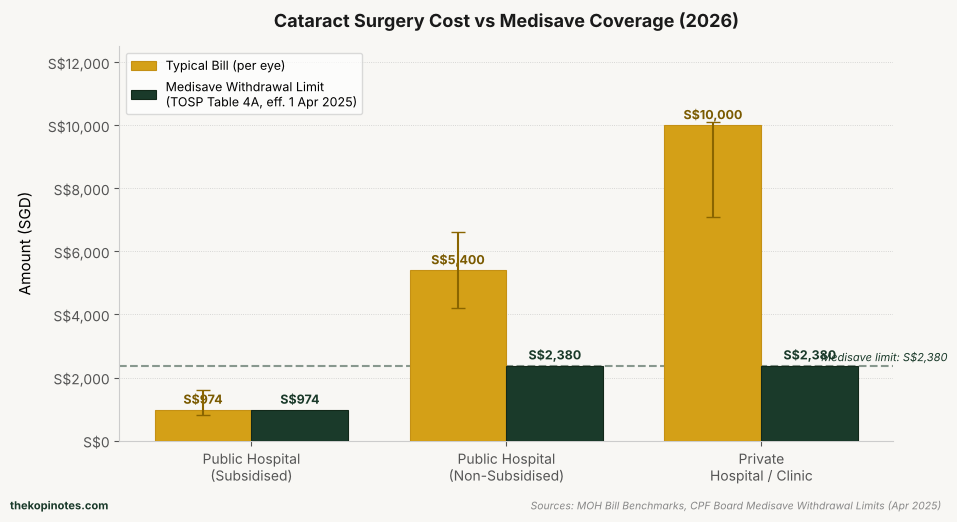
Surgery fees vary significantly depending on where you go, your subsidised status, and whether you choose a standard monofocal lens or a premium multifocal implant. The figures below are approximate ranges drawn from MOH bill benchmarks and published clinic and hospital fee schedules.
| Setting | Typical Bill Range (per eye) | Notes |
|---|---|---|
| Public hospital (subsidised) | S$800 – S$1,600 | SGH, Tan Tock Seng, SNEC; standard lens |
| Public hospital (non-subsidised / Class A or B1) | S$4,200 – S$5,400 | Same hospitals, unsubsidised ward class |
| Private hospital | S$7,500 – S$10,000 | Mount Elizabeth, Gleneagles, Parkway; standard lens |
| Private clinic | S$7,100 – S$10,100 | Specialist eye clinics; may use premium lens |
Sources: MOH Bill Benchmarks, Health365, hospital published fee schedules, 2026
Premium lens implants (multifocal, extended depth-of-focus, or toric lenses) add S$1,000–S$3,000 per eye on top of these ranges. These premium lenses are typically not covered by Medisave or ISP riders — only the standard monofocal lens procedure is claimable.
For more context on day surgery Medisave limits across different procedures, see our Medisave limit 2026 day surgery guide.
The Medisave Withdrawal Limit for Cataract Surgery (2026)
Cataract surgery is assigned TOSP codes based on which eye is operated on and whether both eyes are done in a single session. The code determines which TOSP table applies, and that table specifies both the Medisave withdrawal limit and the MediShield Life claim limit.
| TOSP Code | Procedure | TOSP Table | Medisave Limit |
|---|---|---|---|
| SL808L | Cataract extraction + lens implant, left eye | Table 4A | S$2,380 |
| SL809L | Cataract extraction + lens implant, right eye | Table 4A | S$2,380 |
| SL807L | Bilateral cataract, both eyes in one session | Table 5A | S$2,610 |
Source: CPF Board, Medisave Withdrawal Limits (effective 1 April 2025)
A few important points on how these limits work:
- Per-eye limits are independent. If you have each eye operated on in separate sessions (the most common approach), you can claim up to S$2,380 from Medisave per session — a total of up to S$4,760 across two sessions if both eyes need surgery.
- Bilateral in one session is different. If both eyes are done simultaneously (SL807L), the single-session limit is S$2,610 — higher than a single eye but lower than two separate sessions. Most surgeons prefer to do eyes on separate occasions to monitor recovery.
- The limit covers surgeon and anaesthetist fees. There is a separate Medisave sub-limit for day surgery facility charges (up to S$300 per day, as at 2026). This applies in addition to the TOSP surgical limit.
- Premium lenses are not claimable. The Medisave limit applies only to the standard monofocal lens procedure. The upgrade cost for premium lenses must be paid in cash.
For a deeper dive into how Medisave applies to hospitalisation versus day surgery, our Medisave hospitalisation guide 2026 is a useful companion read.
What MediShield Life Pays Towards Cataract Surgery (2026)
MediShield Life is the national basic health insurance scheme that every Singapore resident is enrolled in. It has its own claim limits for surgical procedures, independent of (but linked to) the Medisave withdrawal limits above. From 1 June 2026, the MediShield Life claim limits for cataract surgery are:
| TOSP Table | Procedure | MediShield Life Claim Limit (eff. 1 Jun 2026) |
|---|---|---|
| Table 4A | Standard cataract, one eye (SL808L / SL809L) | S$2,310 |
| Table 5A | Bilateral cataract (SL807L) | S$2,700 |
Source: CPF Board, MediShield Life Claim Limits (effective 1 June 2026)
How MediShield Life calculates its actual payout on a cataract surgery claim:
- Deductible. An annual deductible (the amount you pay before MediShield Life kicks in) applies per policy year. For day surgery, the deductible is shared with inpatient admissions within that year — if you have already been hospitalised earlier in the year and paid your deductible, cataract surgery later that same year may face a reduced or zero deductible.
- Co-insurance. After the deductible, MediShield Life pays 90% of the remaining claimable amount (you pay 10% co-insurance).
- Pro-ration at private hospitals. When you undergo surgery at a private hospital or clinic, MediShield Life applies a pro-ration factor that reduces the eligible claim amount proportionally. This is because MediShield Life is calibrated to subsidised public hospital rates. As a result, MediShield Life’s payout on a S$10,000 private clinic bill can be substantially lower than on a S$1,000 subsidised public hospital bill — even though both procedures carry the same S$2,310 claim limit.
For a detailed comparison of MediShield Life and ISP coverage structures, see our MediShield Life vs Integrated Shield Plan guide.
What an ISP Rider Changes — The 5% Co-Payment Rule
An Integrated Shield Plan (ISP) is a private health insurance policy that wraps around your MediShield Life cover and extends it — typically to cover private hospital bills, Class A wards at public hospitals, and the deductible and co-insurance gaps that MediShield Life leaves. For cataract surgery, an ISP with private hospital coverage is what determines whether a S$10,000 bill becomes a S$500 out-of-pocket cost or a S$6,000+ cash expense.
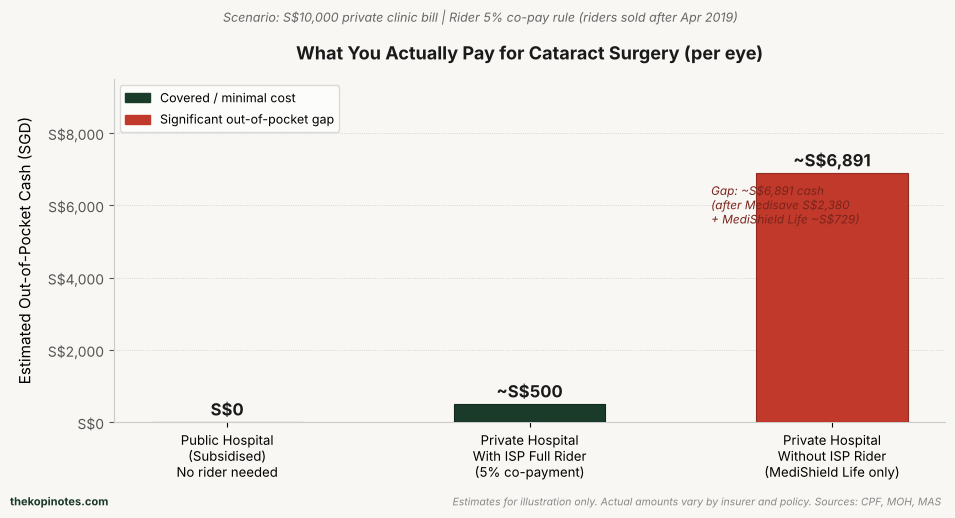
Since April 2019, the Ministry of Health (MOH) has required that all ISP riders sold or renewed include a minimum co-payment of 5% of the claimable bill, subject to a maximum of S$3,000 per policy year. The intent is to keep policyholders cost-conscious rather than fully shielded from bills. For a S$10,000 cataract surgery bill, your minimum cash exposure with a modern ISP rider is therefore 5% × S$10,000 = S$500.
Key things to know about ISP riders and cataract surgery:
- Coverage scope matters. An ISP that covers up to private hospital bills will typically cover private clinic day surgery too — but always check your specific policy’s terms. Some lower-tier ISPs only cover up to Class B1 at public hospitals and would not cover the full private clinic bill for cataract surgery.
- The 5% co-payment can often come from Medisave. Since S$500 is well within the S$2,380 Medisave withdrawal limit for cataract surgery, most patients can use their Medisave account to pay the co-payment, leaving zero cash outlay from their wallet.
- Pre-authorisation is advisable. For planned elective surgery such as cataract removal, contacting your ISP provider beforehand to get pre-authorisation ensures your claim is in order and prevents disputes at billing.
- Riders sold before April 2019 may have zero co-payment. If you hold a “full rider” sold before the MOH rule change took effect, you may face zero co-payment on cataract surgery — though these plans are increasingly expensive to maintain as premiums have risen.
For more on how to evaluate whether your ISP is comprehensive enough for private hospital coverage, see our MediShield Life upgrade guide.
Bill Worked Examples: What You Actually Pay
The following three scenarios illustrate how Medisave, MediShield Life, and an ISP rider interact for a typical cataract surgery bill. Figures are approximate and for illustration only — actual amounts depend on your insurer, the specific procedure performed, the facility fee charged, and whether you have met your annual deductible for that policy year.
| Scenario | Total Bill | MediShield Life pays | Medisave | Estimated Cash |
|---|---|---|---|---|
| Public subsidised (no ISP needed) | ~S$974 | Most or all after deductible | Covers remainder | ~S$0 |
| Private clinic, with ISP full rider (5% co-pay) | ~S$10,000 | ISP covers gap; MediShield Life base applies | Covers 5% co-pay (S$500) | ~S$0 |
| Private clinic, without ISP rider | ~S$10,000 | ~S$729 (after pro-ration, deductible, 10% co-ins) | Up to S$2,380 | ~S$6,891 |
Estimates for illustration only. MediShield Life payout on private clinic bill based on approximate pro-ration and deductible calculations. Actual amounts vary. Sources: CPF Board, MOH, insurer policy terms
The key takeaway: at a public subsidised hospital, Medisave and MediShield Life together are designed to cover most or all of your cataract surgery bill. At a private facility, without an ISP rider, the out-of-pocket gap is substantial — roughly S$6,000–S$7,500 in cash for a standard S$10,000 bill. An ISP rider with private hospital coverage reduces this to the 5% minimum co-payment (S$500), which can itself typically be paid from Medisave.
When to Review Your ISP Before Cataract Surgery
Cataract surgery is typically an elective procedure — the vision deterioration happens gradually and surgery can be planned in advance. This window is valuable: it gives you time to review and, if necessary, upgrade your ISP before the surgery date.
A few steps to consider if you or a family member is approaching cataract surgery:
- Check your current ISP tier. Does your plan cover private hospital day surgery, or only public hospital Class B1? If you want to use a private eye specialist, confirm coverage first.
- Consider upgrading if you’re on a basic plan. An ISP with private hospital coverage typically adds S$1,500–S$3,000 to your annual premium. For a bilateral cataract surgery costing S$20,000 total at a private clinic, that upgrade can save you S$12,000+ in cash outlay in the year of surgery alone.
- Check waiting periods. Most ISPs have a waiting period of 30–90 days for pre-existing conditions and 1–2 years for specific conditions (sometimes including pre-existing eye conditions). Upgrading the week before scheduled surgery will likely trigger a waiting-period exclusion.
- Get pre-authorisation before surgery day. Contact your ISP provider to initiate a pre-authorisation request with the surgeon’s referral. This protects you from billing surprises and ensures the procedure is covered under your policy terms.
Disclaimer: The figures and worked examples in this article are for educational reference only. Insurance coverage terms, Medisave withdrawal limits, and MediShield Life claim limits are subject to change by CPF Board and MOH. Always verify current limits at cpf.gov.sg and your ISP’s policy terms before making healthcare decisions. The Kopi Notes does not provide financial or medical advice.
Frequently Asked Questions
What is the Medisave limit for cataract surgery in 2026?
The Medisave withdrawal limit for standard cataract surgery (TOSP Table 4A, codes SL808L and SL809L) is S$2,380 per eye, effective 1 April 2025. If both eyes are operated on in a single session under code SL807L (bilateral cataract, TOSP Table 5A), the limit is S$2,610 for that one session. Each eye done in a separate session has its own S$2,380 limit, so bilateral surgery across two sessions can claim up to S$4,760 total from Medisave.
Does MediShield Life cover cataract surgery in Singapore?
Yes. MediShield Life covers cataract surgery up to a claim limit of S$2,310 per eye (Table 4A, effective 1 June 2026) or S$2,700 for bilateral in one session (Table 5A). After deducting your applicable annual deductible and 10% co-insurance, MediShield Life’s net payout on a subsidised public hospital bill can largely cover the total bill. At private hospitals, a pro-ration factor is applied that reduces the eligible amount, so the payout on a S$10,000 private bill is significantly lower — typically a few hundred dollars after deductibles and co-insurance.
How much does cataract surgery cost out-of-pocket without an ISP rider?
At a public subsidised hospital, Medisave and MediShield Life together typically cover most or all of a S$800–S$1,600 bill, leaving close to S$0 in cash out-of-pocket. At a private hospital or clinic (typical bill S$7,100–S$10,100 per eye), the picture is very different. MediShield Life pays a small portion after pro-ration, deductible and co-insurance (roughly S$600–S$800), and Medisave covers up to S$2,380 more. The remaining gap — often S$6,000–S$7,500 — must be paid in cash. This is the gap an ISP rider is designed to fill.
If I have an ISP rider, what do I pay for cataract surgery at a private clinic?
With an ISP rider that covers private hospital day surgery, your out-of-pocket cost is typically the 5% minimum co-payment required by MOH for all ISP riders sold after April 2019. On a S$10,000 cataract surgery bill, this co-payment works out to S$500. Crucially, this S$500 is usually within your Medisave withdrawal limit (S$2,380), so you can pay it entirely from your Medisave account, leaving zero cash outlay. For riders sold before April 2019 that had no co-payment clause, the out-of-pocket cost may be zero.
Can I do cataract surgery on both eyes and claim Medisave for each?
Yes, if the two eyes are operated on in separate sessions (which is the most common practice, allowing recovery monitoring between surgeries), each session is treated as a separate claim. Each session can draw up to S$2,380 from Medisave (TOSP Table 4A), giving a combined maximum of S$4,760 across both sessions. If both eyes are operated on in the same session under code SL807L (bilateral cataract), the single-session limit is S$2,610 from TOSP Table 5A.
Should I upgrade my ISP before scheduled cataract surgery?
If your current ISP covers only up to Class B1 at public hospitals and you plan to use a private clinic or hospital for cataract surgery, upgrading to private hospital coverage before surgery can save you significantly. However, most ISP upgrades carry a waiting period of 30–90 days (and longer for pre-existing conditions), so upgrading a week before surgery is unlikely to cover that procedure. The best time to review your ISP coverage is at least 3–6 months before any planned elective surgery. See our ISP upgrade guide for a step-by-step comparison of the main Singapore ISP plans.
Planning Cataract Surgery? Know Your ISP Cover First.
An ISP rider with private hospital coverage can reduce a S$10,000 cataract surgery bill to just your 5% co-payment. Use our guides to compare plans and understand your coverage options.
Get Free Insurance Advice
Speak with a licensed insurance advisor. No obligation, no cost.
By submitting this form, you agree to our Privacy Policy.
This article was researched with the help of AI. While we strive to keep all information accurate and up to date, there may be errors. If you notice any discrepancies, please contact us.