Group Life Insurance Singapore: What Your Employee Benefits Actually Cover (2026 Guide)
Group life insurance in Singapore comes in two main forms: the government-mandated Dependants’ Protection Scheme (DPS), which provides S$70,000 coverage for CPF members aged 21–59, and employer-provided group term life, which typically adds 1–3× annual salary. While both reduce your out-of-pocket insurance costs, most Singaporean employees are significantly underinsured — coverage ends the moment you change jobs or retire.
Not financial advice. All figures are for educational reference only. Data as at November 2026 unless noted.
Table of Contents
Table of Contents
- What Is Group Life Insurance in Singapore?
- DPS: Singapore’s Mandatory Group Coverage Explained
- Employer Group Term Life: What’s Typical
- Coverage Comparison Table
- The Coverage Gap: Why Group Benefits Are Often Not Enough
- What Happens When You Leave Your Job?
- How to Top Up Your Group Coverage
- Frequently Asked Questions
What Is Group Life Insurance in Singapore?
Group life insurance is life coverage provided to a group of people — typically employees of the same company — under a single master policy. Unlike individual life insurance that you buy privately, group coverage is arranged by an employer or the government on your behalf, often at no or low cost to you.
In Singapore, group life insurance broadly covers two layers:
- Mandatory layer (DPS): Every CPF member aged 21–59 is auto-enrolled in the Dependants’ Protection Scheme (DPS) unless they opt out. This is administered by Great Eastern Life under a government contract valid until September 2028.
- Voluntary employer layer: Many Singapore employers — particularly MNCs, government-linked companies, and large local firms — offer group term life insurance as part of their employee benefits package. Coverage levels, waiting periods, and portability rights vary significantly by employer.
Understanding what you have, and crucially what you don’t, is the first step to building a comprehensive protection plan. Your Singapore retirement calculator can help you model how much coverage you need based on your financial goals.
DPS: Singapore’s Mandatory Group Coverage Explained
The Dependants’ Protection Scheme (DPS) is a term life insurance policy that covers CPF members in the event of death, Terminal Illness, or Total Permanent Disability (TPD). It is NOT optional by default — you are automatically enrolled when your CPF account first receives contributions, unless you actively opt out.
DPS Coverage Amounts (November 2026)
Coverage under DPS depends on your age bracket:
| Age Group | DPS Sum Assured | Annual Premium (from CPF) |
|---|---|---|
| 21–34 years | S$70,000 | S$18/year |
| 35–39 years | S$70,000 | S$30/year |
| 40–44 years | S$70,000 | S$60/year |
| 45–49 years | S$70,000 | S$102/year |
| 50–54 years | S$70,000 | S$186/year |
| 55–59 years | S$70,000 | S$298/year |
| 60–64 years | S$55,000 | S$298/year |
Source: CPF Board, DPS premium schedule, November 2026. Premiums deducted from CPF Ordinary or Special Account.
Crucially, DPS coverage automatically terminates at age 65, and it also terminates if you stop making CPF contributions (e.g., you leave employment and do not make voluntary contributions). This is a key reason why DPS alone is insufficient for comprehensive retirement planning — it disappears exactly when your accumulation phase ends.
DPS is currently administered by Great Eastern Life under a government contract that runs until September 2028. As a Singapore-incorporated insurer regulated by MAS, Great Eastern’s obligations are backed by the Policy Owners’ Protection (PPF) Scheme, covering up to S$500,000 per life assured for death and TPD benefits.
Employer Group Term Life Insurance: What’s Typical
Beyond DPS, many Singapore employers offer group term life (GTL) insurance as part of their benefits package. Unlike DPS, this coverage is entirely at the employer’s discretion — there is no MOM regulation requiring Singapore employers to provide life insurance for local employees. Some sectors, particularly the civil service and statutory boards, have more standardised coverage; private companies vary widely.
Typical Group Term Life Coverage Levels in Singapore
Based on industry benchmarks and benefits surveys, most Singapore employers offering GTL provide:
- Coverage amount: 1× to 3× annual salary (2× is most common for mid-sized companies)
- Who is covered: All full-time permanent employees; contract staff coverage varies by employer
- Waiting period: Usually nil or 1–3 months from date of hire for death/TPD; some policies have longer waiting periods for critical illness riders
- Premium paid by: Fully employer-funded in most cases; some companies offer a voluntary top-up at group rates
- Notable exception: MINDEF and MHA enhanced their group term life coverage to S$350,000 for active servicemen and officers, effective November 2025
It’s worth noting that group term life is a pure protection policy — it has no cash value, no investment component, and no savings element. When you leave the company, the coverage simply ends.
Coverage Comparison: DPS vs Group Term vs Personal Term
How do the different coverage layers stack up for a typical Singapore professional? The table below compares coverage amounts for three common employment scenarios.
| Coverage Type | Coverage Amount | Cost to Employee | Portable? |
|---|---|---|---|
| DPS (govt mandatory) | S$70,000 (up to age 59) | S$18–S$298/yr (from CPF) | Yes (follows CPF) |
| Employer group term life | 1–3× annual salary (varies) | Usually nil (employer-paid) | No — ends at resignation |
| Personal term life (private) | Flexible (you choose) | From ~S$200–S$800/yr | Yes — stays with you |
Source: CPF Board, MOM, LIA Singapore, November 2026. Personal term indicative for 30-year-old, non-smoker, S$500k sum assured, 20-year term.
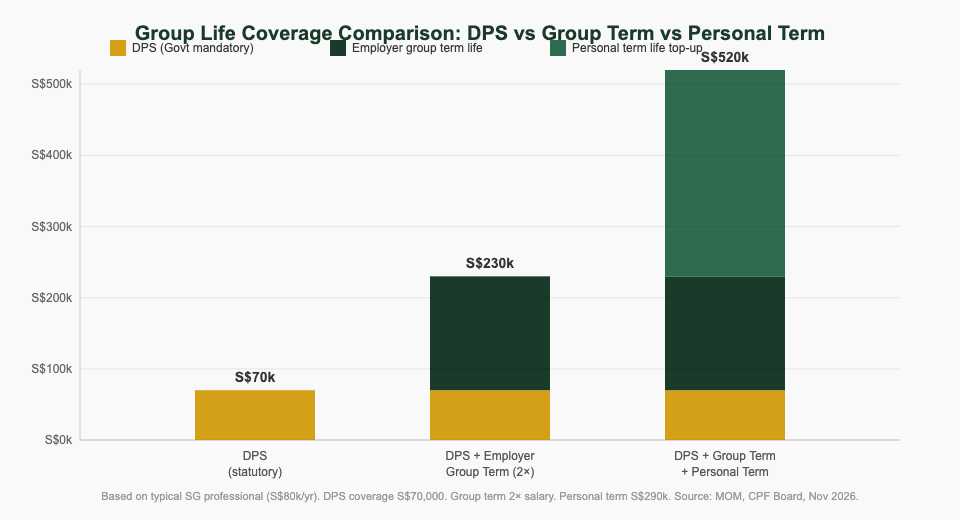
Chart: Total coverage stacking for a Singapore professional earning S$80k/year. DPS + group term (2× salary) + personal term top-up. Source: TKN analysis, Nov 2026.
The Coverage Gap: Why Group Benefits Are Often Not Enough
Financial planners and the Life Insurance Association of Singapore (LIA) recommend a minimum of 9–10× annual income in life coverage to adequately protect dependants. This accounts for income replacement, mortgage payoff, children’s education costs, and final expenses.
When you map DPS (S$70,000) and typical group term life (2× salary) against this benchmark, the shortfall becomes stark — especially at higher income levels:
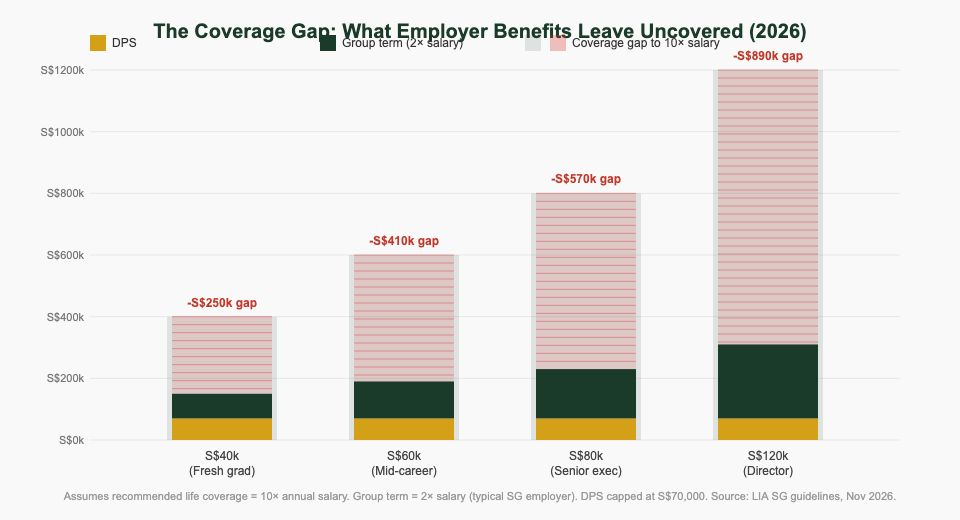
Chart: Employer group benefits (DPS + 2× salary group term) vs 10× salary recommendation across income levels. The red-hatched area is the coverage gap. Source: LIA SG guidelines, TKN analysis, Nov 2026.
A Singapore employee earning S$80,000 per year with standard group benefits has approximately S$230,000 in coverage (DPS S$70k + group term S$160k) — only about 29% of the recommended S$800,000. The gap of S$570,000 is what a personal term life policy needs to fill.
This gap typically widens as your income grows, since group term coverage is capped by most employer policies at 3× salary regardless of income level. High earners face proportionally larger shortfalls and should model their needs against their actual liabilities — mortgage balance, dependants’ needs, and retirement income gap. Consider using our retirement planning calculator to work through your personal numbers.
Building passive income in Singapore through dividend-paying assets or S-REITs can also reduce your effective life insurance need over time, by lowering your dependence on earned income.
What Happens When You Leave Your Job?
This is the most overlooked aspect of group insurance: your employer group term life coverage ends the day your employment ends. Whether you resign, are retrenched, or retire, the group policy lapses for you immediately.
Here is what each coverage type does when you change jobs:
- DPS: Remains active as long as you have a CPF account with contributions. If you become self-employed, freelance, or take a career break without making voluntary CPF contributions, DPS may also lapse. It’s worth checking your DPS status directly with Great Eastern Life if you go through any employment gap.
- Employer group term life: Terminates immediately on your last day. Some generous employers offer a 30-day extension, but this is not standard. If you join a new employer, you will re-enter their group plan from your start date, potentially with a fresh waiting period.
- Personal term life: Continues uninterrupted as long as you pay premiums. This portability is the core argument for maintaining your own private policy in parallel with group benefits.
The “Protection Gap” During Career Transitions
The highest-risk period for many Singaporean professionals is the gap between leaving one employer and starting with another. If you resign without having a personal term policy in place, you are temporarily relying solely on DPS (S$70,000) — far below most households’ actual needs. If you become ill or suffer an accident during this window, you may also find yourself unable to obtain new individual coverage at standard rates.
This is especially relevant given Singapore’s growing gig economy and the trend toward freelance and contract work. Understanding your CPF investment strategy and ensuring your protection layer is portable is a key part of financial planning for the self-employed.
How to Top Up Your Group Coverage with a Personal Term Life Policy
The most cost-effective way to close your coverage gap is through a personal term life insurance policy purchased directly. Here’s how to approach it:
Step 1: Calculate Your Total Coverage Need
As a rule of thumb, multiply your annual income by 9–10. Deduct your existing coverage (DPS + group term). The remainder is your personal term life target sum assured.
Example: You earn S$80,000/year. Need: S$800,000. Have: S$70,000 (DPS) + S$160,000 (2× group term) = S$230,000. Personal policy target: S$570,000.
Step 2: Choose a Policy Tenure
Personal term life policies in Singapore typically come in level-premium terms of 10, 15, 20, 25, or 30 years, or up to age 65/70/99. For most working Singaporeans, covering up to age 65–70 (when retirement income and CPF Life payouts kick in) is appropriate. If you have a mortgage, ensure the term aligns with your loan tenure.
Step 3: Compare Insurers
Singapore’s major life insurers — including AIA, Prudential, Great Eastern, Manulife, and Income Insurance — all offer term life products. Premiums are broadly comparable for standard lives. Key differentiators to compare include:
- Premium level and payment frequency
- TPD and Terminal Illness definitions (some are broader than standard)
- Convertibility option (ability to convert to whole life without fresh underwriting)
- Riders available: Critical illness rider, disability rider
For hands-off investing to build a financial buffer alongside your life insurance, platforms like Syfe and Endowus allow you to invest your excess savings in diversified portfolios — Syfe Income+ focuses on dividend income, while Endowus focuses on CPF-integrated investment options.
Building Singapore T-bills or dividend-paying S-REITs alongside life insurance creates a holistic financial safety net that reduces reliance on any single protection layer.
Frequently Asked Questions: Group Life Insurance Singapore
Is group life insurance mandatory for employees in Singapore?
No — with one exception. The Dependants’ Protection Scheme (DPS) is automatic for all CPF members aged 21–59, but employer-provided group term life insurance is not legally required by MOM for local private-sector employees. It is offered at the employer’s discretion as a benefit. Many MNCs and statutory boards provide it, but smaller local employers may not.
How much does DPS cover and who administers it?
DPS covers S$70,000 for CPF members aged 21–59, reduced to S$55,000 for ages 60–64. It covers death, Terminal Illness, and Total Permanent Disability. As of 2026, DPS is administered by Great Eastern Life under a contract valid until September 2028. Premiums are deducted from your CPF account and range from S$18/year (ages 21–34) to S$298/year (ages 55–64).
What happens to my group life insurance when I resign?
Your employer’s group term life coverage ends on your last day of employment. You will not receive any cash value or payout — it is a pure protection policy with no savings component. DPS, however, continues as long as you have CPF contributions. During any employment gap, you should check that DPS is still active and consider whether a personal term life policy is needed to bridge the gap.
How much life coverage do I need in Singapore?
The standard recommendation from LIA Singapore is 9–10 times your annual income. Adjust this based on your specific liabilities: outstanding mortgage, number of dependants, existing assets, and expected future income. For a family with young children and a large mortgage, 10–12× income may be more appropriate. Use our retirement and income calculator to model your specific numbers.
Can I convert my employer group life insurance to a personal policy?
Some employer group policies include a conversion option that lets departing employees convert their group coverage to an individual policy without fresh medical underwriting, within a specified window (usually 30 days of leaving). This is valuable if you have a pre-existing condition. Check your employee benefits handbook or HR department to see if this option exists in your company’s group policy — it is not universal.
Is employer group life insurance the same as the DPS?
No — they are separate policies. DPS is a government-mandated scheme administered by Great Eastern Life and deducted from your CPF. Employer group term life is a commercial insurance product your company buys from a private insurer to cover its employees. You can have both simultaneously. Most Singapore employees earning CPF wages automatically have DPS, and may additionally have an employer group term policy on top of that.
Build Your Financial Safety Net Beyond Group Insurance
Group life coverage is a starting point — not a complete solution. Use these resources to close your protection and investment gaps.
Get Free Insurance Advice
Speak with a licensed insurance advisor. No obligation, no cost.
By submitting this form, you agree to our Privacy Policy.
This article was researched with the help of AI. While we strive to keep all information accurate and up to date, there may be errors. If you notice any discrepancies, please contact us.