Endowment Plan vs Bond Ladder Singapore 2026: Which Strategy Wins for Guaranteed Income?
Compare guaranteed returns, liquidity and risk — data-driven guide for Singapore investors.
Both endowment plans and bond ladders offer Singapore investors guaranteed or near-guaranteed returns without stock market risk. Endowment plans deliver a fixed guaranteed sum at maturity with built-in life coverage, while a bond ladder uses Singapore Government Securities — T-bills, SSBs and SGS bonds — with staggered maturities for predictable liquidity windows. In 2026, the right choice comes down to how long you can lock away capital and whether you need a death benefit.
Not financial advice. All figures are for educational reference only. Data verified as at 12 November 2026.
What Is an Endowment Plan?
An endowment plan is a life insurance product that doubles as a savings vehicle. You pay premiums for a fixed term — typically 2 to 25 years — and receive a guaranteed maturity payout plus any non-guaranteed bonuses when the policy matures.
There are two main types in Singapore:
- Participating (par) plans: Your premiums go into the insurer’s par fund, which invests across bonds, equities and other assets. You participate in returns through reversionary and terminal bonuses. The LIA requires insurers to illustrate projections at 3.00% and 4.25% p.a. gross — these are prescribed illustration rates, not predictions.
- Non-participating (non-par) plans: All returns are fixed at inception. No upside above the guaranteed rate, but no downside either. Most short-term endowment plans (2–3 year) in Singapore are non-par.
All endowment plans include a death benefit — a key advantage over T-bills and SSBs. For a detailed breakdown of what is and is not guaranteed, see our guide to endowment plan guaranteed vs non-guaranteed returns Singapore.
Endowment Plan Guaranteed Rates: Singapore Market (Q3 2026)
| Plan Type | Tenor | Guaranteed Return (p.a.) | Projected Total Return |
|---|---|---|---|
| Short-term non-par (2-year) | 2 years | ~1.60% p.a. | ~1.60% p.a. (fixed) |
| Short-term non-par (3-year) | 3 years | ~3.00–3.40% p.a. | ~3.00–3.40% p.a. (fixed) |
| Medium-term par plan | 5–10 years | ~2.00–3.00% p.a. | ~3.00–4.25% p.a. (LIA illustration) |
| Long-term par plan | 15–25 years | ~1.50–2.50% p.a. | ~3.00–4.25% p.a. (LIA illustration) |
Source: LIA Singapore prescribed illustration rates (3.00%/4.25%); insurer product pages Q3 2026. Rates are tranche-specific — always request the latest Product Summary and Benefit Illustration. LIA illustration rates are not guaranteed.
What Is a Bond Ladder?
A bond ladder is a fixed-income strategy where you hold multiple bonds or government securities maturing at regular intervals. Instead of putting all your money into a single instrument with one maturity date, you stagger maturities to create predictable liquidity windows throughout your holding period.
How a Singapore bond ladder works: With S$50,000, rather than buying a single 5-year endowment plan, you split across five S$10,000 tranches at 1-, 2-, 3-, 4- and 5-year maturities. Each year one tranche matures. You either spend that cash or reinvest it at the prevailing yield — which may be higher or lower.
Singaporeans typically use three government instruments:
- T-bills (6-month or 1-year): Auctioned bi-weekly by MAS. The 6-month T-bill cut-off yield was 1.92% p.a. at the 24 September 2026 auction. Minimum S$1,000; tradeable on SGX. See our Singapore T-bills 2026 guide for step-by-step buying instructions.
- Singapore Savings Bonds (SSBs): Step-up coupon bonds issued monthly by MAS; guaranteed by the Singapore government. Minimum S$500. Can be redeemed with 1 month notice at any time — the most liquid rung. See our Singapore Savings Bonds 2026 guide for current rates.
- SGS bonds (1–30 years): Longer-tenor government bonds available via ATM or online banking. Tradeable on SGX. Useful for the longer rungs of a 5–10 year ladder.
The key advantage of a bond ladder is liquidity: capital always matures within the next 6–12 months. The key risk is reinvestment risk — if yields fall by the time a rung matures, your next rung earns less than projected.
Head-to-Head Comparison: Endowment Plan vs Bond Ladder
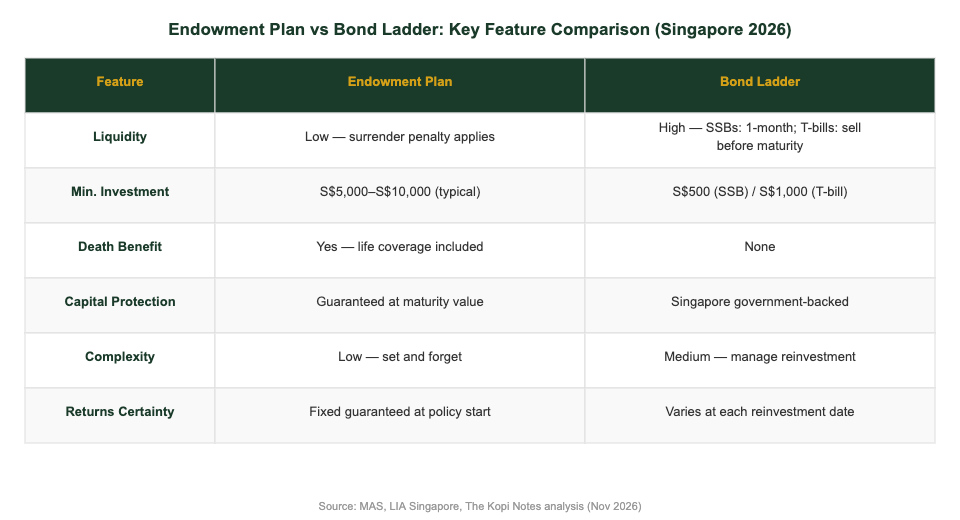
| Feature | Endowment Plan | Bond Ladder |
|---|---|---|
| Instrument type | Insurance + savings | T-bills / SSBs / SGS bonds |
| Tenor | 2–25 years (fixed) | 1–10 years (flexible) |
| Guaranteed returns | 1.60–3.40% p.a. (tranche-specific) | ~1.92% p.a. (T-bill, Sep 2026) |
| Projected total return | 3.00–4.25% p.a. (par plan, LIA illustration) | 2.00–3.00% (rolling reinvestment) |
| Liquidity | Low — surrender penalty before maturity | High — SSBs: 1 month; T-bills: tradeable |
| Capital protection | Yes — guaranteed maturity value | Yes — Singapore government obligation |
| Death benefit | Yes — life insurance component | None |
| Minimum investment | S$5,000–S$10,000 (typical) | S$500 (SSB); S$1,000 (T-bill) |
| Tax treatment (SG) | Tax-free | Tax-free |
| Complexity | Low — set premium and forget | Medium — reinvestment decision at each maturity |
| Deposit/insurer protection | SDIC up to S$100,000 per insurer | Direct Singapore govt obligation (no SDIC needed) |
Source: MAS, LIA Singapore, SDIC (Nov 2026). Endowment rates vary by insurer and tranche — always request the latest Benefit Illustration. Comparison is illustrative.
Returns Comparison 2026: Which Earns More?
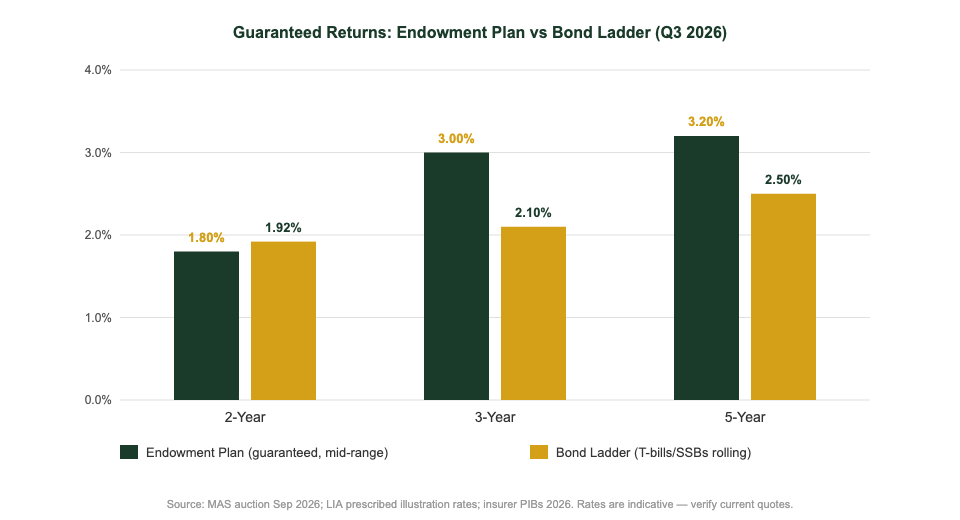
At the 2-year mark, the bond ladder (T-bill at 1.92% in Sep 2026) edged ahead of some short-term endowment plans (e.g. the Manulife Goal at 1.60% p.a. guaranteed). However, at the 3-year and 5-year tenors, non-par endowment plans offering 3.00–3.40% guaranteed outpaced rolling T-bill or SSB reinvestment strategies, which depend entirely on future auction yields.
Important caveat on bond ladders: You lock in today’s rate only on today’s rung. When a rung matures in 2–3 years, you reinvest at whatever yield MAS auctions then. T-bill yields have dropped from ~3.7% in late 2023 to ~1.92% by September 2026. If yields continue to drift lower, your bond ladder earns significantly less than projected. Endowment plans lock in the guaranteed rate from day one.
Illustrative Scenario: S$50,000 Invested Over 3 Years
| Strategy | Assumed Rate | Est. Maturity Value | Total Return |
|---|---|---|---|
| 3-year non-par endowment (3.00% guaranteed) | 3.00% p.a. (locked in) | ~S$54,636 | S$4,636 (9.3%) |
| 3-year non-par endowment (3.40% guaranteed) | 3.40% p.a. (locked in) | ~S$55,274 | S$5,274 (10.5%) |
| Bond ladder (T-bills rolling at 1.92% all 3 years) | 1.92% p.a. (assumed constant) | ~S$52,939 | S$2,939 (5.9%) |
| Bond ladder (SSBs at ~2.50% average) | 2.50% p.a. (assumed) | ~S$53,836 | S$3,836 (7.7%) |
Source: Illustrative only. Endowment figures based on non-par 3.00%–3.40% (Q3 2026 market). T-bill figure uses Sep 2026 cut-off yield held constant — actual reinvestment rate will differ. All figures gross of charges. Always obtain a formal Benefit Illustration before purchasing any endowment plan.
Many investors combine both strategies — using short-term endowment plans as the guaranteed rungs and SSBs as the flexible rungs. See our guide to the endowment plan laddering strategy Singapore for how to structure this.
Liquidity and Flexibility: A Critical Difference
Endowment plans are designed to be held to maturity. If you surrender early, you typically receive only the surrender value — which in the first 1–3 years is often below total premiums paid. For 2–5 year non-par plans, surrender value breakeven is usually around year 2–3. For longer-term par plans, surrendering in years 1–5 may mean receiving significantly less than premiums paid, as insurers front-load distribution costs and insurance charges.
Bond ladders are fundamentally different:
- T-bills: Sell your T-bill position on the SGX secondary market before maturity, at a small discount depending on remaining time. For the 6-month T-bill, liquidity events naturally occur every 6 months.
- SSBs: Redemption within any calendar month — submit by the second-last business day of the month, receive capital and accrued interest by the first business day of the following month. No penalty. This makes SSBs the most liquid rung in any Singapore bond ladder.
- SGS bonds: Trade on SGX like shares. Liquid but subject to market price, so selling before maturity may mean selling at a discount if interest rates have risen.
If you have any realistic scenario where you might need the money before the stated end-date, a bond ladder offers a material safety net an endowment plan cannot match. This is especially relevant for Singaporeans building an emergency top-up fund or saving for a purchase with a flexible timeline.
For a single-tenor comparison, see our direct analysis of endowment plan vs Singapore Savings Bonds 2026.
Who Should Choose Which Strategy?
Choose an Endowment Plan If:
- You have dependants and want life coverage built in. The death benefit means your nominated beneficiary receives the guaranteed maturity value (or more) even if you pass away during the policy term — no T-bill or SSB provides this.
- You want to automate savings without managing renewals. Premium payment is automatic; there is no reinvestment decision to make every 6 or 12 months. For busy professionals, this removes the temptation to spend maturing T-bill proceeds.
- You are confident you will not need the capital for 3+ years. The longer you can commit, the more competitive the par plan projected rates become relative to rolling government securities.
- You want the highest guaranteed rate on a 3-year horizon. At Q3 2026, select 3-year non-par plans offered guaranteed returns of 3.00–3.40% p.a. — above rolling T-bill yields of ~1.92%.
Choose a Bond Ladder If:
- You may need some or all of the capital before the stated horizon. Surrender penalties make endowment plans punishing for early exit; SSBs and T-bills are virtually penalty-free.
- You want to benefit from rising rates. If T-bill and SSB yields climb — as they did sharply in 2022–2023 — each reinvestment tranche captures the new, higher rate. An endowment plan locks you into the rate prevailing at inception.
- You are investing for the first time and prefer low minimum amounts. You can start a bond ladder with as little as S$500 in SSBs, then add T-bills and SGS bonds as savings grow. Endowment plans typically require S$5,000–S$10,000 upfront or as a regular premium commitment.
- You already have adequate life insurance coverage elsewhere. If you hold term life insurance, the death benefit of an endowment plan adds little incremental value — and you effectively pay a cross-subsidy for insurance you do not need.
The Middle Path: Hybrid Strategy
Many Singapore investors use both. A common approach: allocate 60–70% of your savings goal to a 3–5 year endowment plan for the guaranteed rate, and hold 30–40% in a SSB/T-bill ladder for liquidity. This gives you guaranteed returns on the core capital while keeping liquid access to a meaningful cash reserve.
Use our Singapore retirement calculator to model how both instruments compound towards your target. For a hands-off approach to the bond ladder component, robo-advisors like Endowus (referral code 2V343) and Syfe (referral code SRPRFFFCD) offer fixed income and income portfolios that effectively replicate a managed bond ladder with daily liquidity.
Frequently Asked Questions: Endowment Plan vs Bond Ladder Singapore
Is a bond ladder safer than an endowment plan in Singapore?
Can I do both a bond ladder and an endowment plan at the same time?
What happens if I need to exit an endowment plan early?
Are Singapore T-bill yields likely to rise from the current 1.92% level?
Which endowment plans in Singapore offer the highest guaranteed return in 2026?
How many rungs should a Singapore bond ladder have?
Verdict: Endowment Plan vs Bond Ladder Singapore 2026
If you can commit capital for 3+ years and want the highest guaranteed rate with built-in life coverage, a non-par endowment plan currently edges ahead on locked-in returns — select 3-year plans guarantee 3.00–3.40% p.a. versus rolling T-bill yields of ~1.92%. If liquidity matters — if any scenario exists where you might need the money before the stated end-date — a bond ladder using T-bills and SSBs is the more flexible strategic choice.
For most Singapore households, the answer is a hybrid: anchor your planned savings in an endowment plan, hold a T-bill/SSB ladder as the flexible reserve. Use our Singapore retirement calculator to model what allocation makes sense for your timeline and goals.
Get Free Insurance Advice
Speak with a licensed insurance advisor. No obligation, no cost.
By submitting this form, you agree to our Privacy Policy.
This article was researched with the help of AI. While we strive to keep all information accurate and up to date, there may be errors. If you notice any discrepancies, please contact us.