Endowment Plan for Retirees Singapore 2026: Is It Worth It?
An endowment plan is a life insurance savings product that pays out a lump sum at the end of a fixed tenure — typically 5 to 25 years — with a guaranteed return component that is contractually locked in by the insurer. For Singapore retirees aged 55 to 75, endowment plans can serve as disciplined savings vehicles with partial capital protection, but their low liquidity and limited tenure make them a secondary tool at best, not a replacement for CPF LIFE or Singapore Savings Bonds.
Not financial advice. All figures are for educational reference only. Data verified as at November 2026.
What Is an Endowment Plan?
An endowment plan in Singapore is a participating life insurance policy that combines savings with insurance coverage. You pay premiums over a fixed period (or as a single lump sum), and in return, the insurer guarantees you a minimum payout at maturity — plus any non-guaranteed bonuses declared by the insurer’s participating (par) fund.
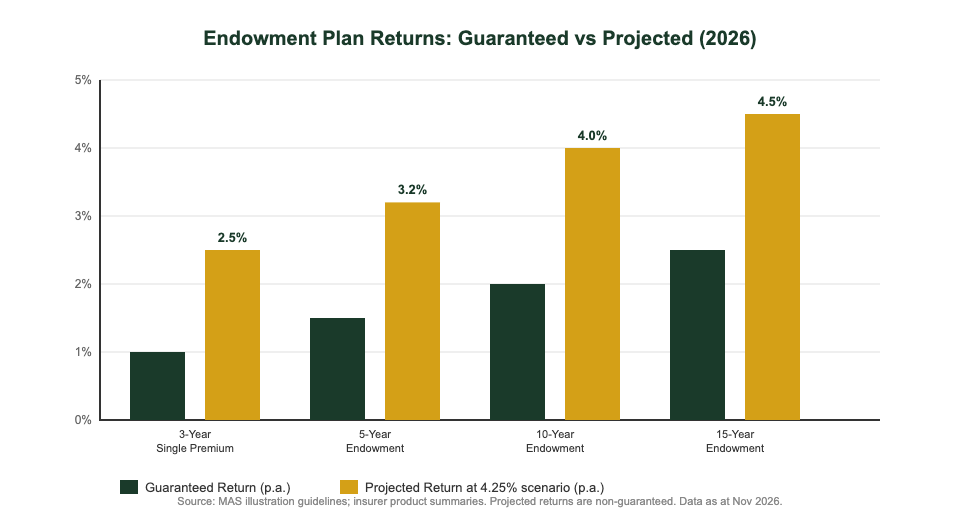
Under MAS regulations, all Singapore insurers must illustrate endowment plan projections using two benchmark scenarios: 3.00% p.a. and 4.25% p.a.. The 3.00% scenario is closer to what many plans guarantee, while 4.25% represents the projected upside if the par fund performs well. It is critical to note: only the guaranteed portion of the return is contractually locked in. Everything above that figure is non-guaranteed and depends on how the insurer invests the par fund.
Typical endowment plan guaranteed returns in Singapore range from approximately 1.0% to 2.5% p.a. depending on the insurer, the product tier, and the tenure. Single-premium short-term plans (3–5 years) often offer lower guaranteed rates, while longer-tenure plans (10–15 years) may offer slightly higher guaranteed returns.
For more detail on how par fund bonuses are declared and what affects your actual payout, see our guide on endowment plan cash value and bonus declarations.
Why Singapore Retirees Consider Endowment Plans
Retirement in Singapore creates a specific set of financial anxieties: outliving your savings, the erosion of purchasing power due to inflation, and the need to generate a steady income from a fixed pool of capital. Endowment plans address some of these concerns — but not all.
Here are the most common reasons retirees in Singapore look at endowment plans:
1. Capital Preservation With a Guaranteed Floor
Unlike equity investments, endowment plans guarantee a minimum payout. For a risk-averse retiree who cannot afford to lose principal, the guaranteed component provides psychological comfort. A retiree investing SGD 100,000 into a 5-year endowment with a 2.0% p.a. guaranteed rate knows they will receive at least SGD 110,408 at maturity — regardless of market conditions.
2. Disciplined Savings Mechanism
Some retirees find it difficult to avoid dipping into a savings account. The surrender penalty structure of an endowment plan — which makes early withdrawal costly — acts as an enforced savings discipline. This is particularly useful for retirees managing a large CPF drawdown who want to ringfence a portion of their savings.
3. Legacy and Insurance Coverage
Endowment plans include a sum assured payable upon death during the policy term. For retirees with dependants or who wish to leave a structured inheritance, this coverage provides a way to combine savings and legacy planning in one product.
4. SRS Integration
Some endowment plans can be purchased using Supplementary Retirement Scheme (SRS) funds. This allows retirees to defer income tax on SRS withdrawals while growing those funds in a capital-protected structure. The tax deferral can be meaningful for retirees who withdraw SRS funds gradually over 10 years.
Pros and Cons of Endowment Plans for Retirees
Not every characteristic of an endowment plan is retirement-friendly. The table below gives an honest assessment of what works for retirees and what doesn’t:
| Factor | Pro for Retirees | Con for Retirees |
|---|---|---|
| Guaranteed Return | Provides a capital floor; no market risk on guaranteed portion | 1.0–2.5% p.a. guaranteed is modest; inflation may erode real value |
| Liquidity | Forces capital discipline; avoids impulsive withdrawals | Surrender penalty in early years can wipe out gains; illiquid for medical emergencies |
| Tenure | Shorter 3–5 year plans fit medium-term cash flow planning | Longer tenures risk outliving the payout or needing funds before maturity |
| Insurance Cover | Sum assured provides legacy/estate benefit | Retirees with no dependants may not need coverage — paying for insurance they don’t need |
| Income Generation | Some plans offer annual or quarterly bonus payouts | Not designed for regular monthly income — CPF LIFE serves that purpose better |
| Inflation Protection | Non-guaranteed bonuses may outpace inflation in strong par fund years | No guaranteed inflation adjustment; real returns can be negative if inflation runs above 2.5% |
Source: The Kopi Notes analysis based on MAS product disclosure guidelines and insurer product summaries. Data as at November 2026.
Key Considerations Before You Buy
1. Tenure vs Life Expectancy
A 70-year-old retiree purchasing a 15-year endowment plan would not receive the payout until age 85. If the retiree needs funds earlier — for healthcare, a home downsize, or family support — they face a painful choice between surrendering early (at a loss) or leaving capital locked up. As a general rule, retirees should not commit to tenures that extend beyond their expected high-spending years.
Short-term single-premium endowment plans (3–5 years) are more practical for most retirees because the payout horizon is predictable and matches medium-term cash flow planning.
2. Surrender Penalties Are Steep
If you surrender an endowment plan in the first few years, you will typically receive less than what you paid in premiums. The policy’s cash surrender value only breaks even — roughly recovering all premiums paid — after several years. For retirees on a fixed income, this illiquidity risk is significant.
Always request the policy’s surrender value table before signing. Ask: “If I need this money in Year 2, what do I get back?” If the insurer cannot provide a clear answer, treat that as a red flag. You can also check our guide on understanding endowment plan cash values for more detail on how surrender values are calculated.
3. The Non-Guaranteed Bonus Is Not a Promise
When an insurer presents a “projected return” of 4.25% p.a., that entire projected figure includes non-guaranteed bonuses. The insurer can reduce or even suspend bonuses in years when the par fund underperforms — which typically occurs during market downturns, exactly when retirees most need stability. Plan only around the guaranteed portion; treat anything above it as a bonus, not a baseline.
4. Understand the Insurance Component
Every endowment plan charges a cost of insurance (COI) that is deducted from your premiums before they go into savings. For older retirees, COI can be higher, which reduces the effective savings rate. Request a benefit illustration that breaks out the insurance and savings components separately to understand what you are actually paying for coverage.
5. Use Your Singapore retirement calculator First
Before allocating capital to any endowment plan, model your overall retirement cash flow. How much monthly income do you need? How much does CPF LIFE already provide? What is your existing savings runway? Only commit to an endowment plan with capital that you are truly comfortable locking up for the full tenure.
Endowment Plan vs CPF LIFE vs SSB for Retirees
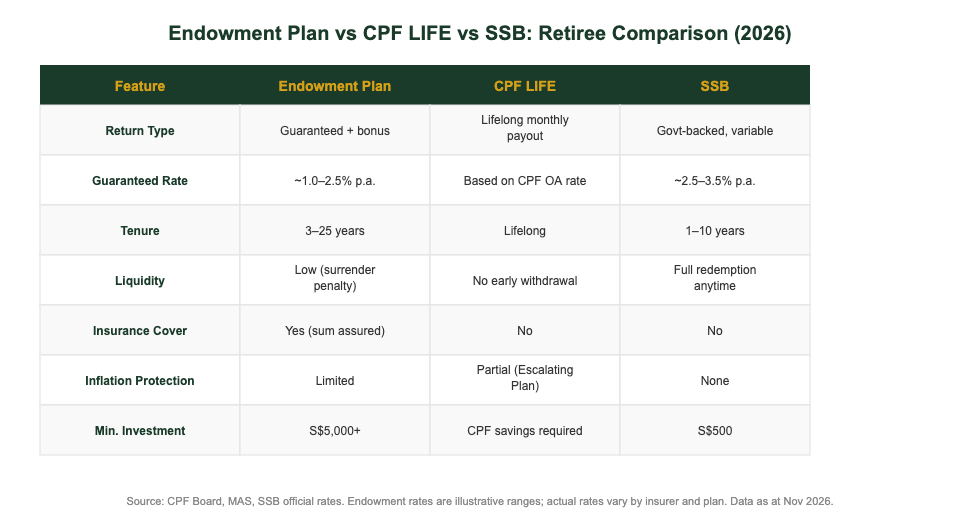
Retirees in Singapore typically have three main capital-protected savings tools available: endowment plans, CPF LIFE, and Singapore Savings Bonds (SSB). Each serves a different purpose.
CPF LIFE: The Primary Retirement Income Engine
CPF LIFE is Singapore’s national longevity insurance scheme. It converts your CPF Retirement Account (RA) savings into monthly payouts for life — no matter how long you live. For most Singapore retirees, CPF LIFE should be the foundation of their retirement income, not an endowment plan.
The key advantage of CPF LIFE over an endowment plan: it eliminates longevity risk (the risk of outliving your savings). An endowment plan pays out at maturity and then stops. If you live 20 years beyond maturity, you are on your own. CPF LIFE continues paying until death.
For more on integrating CPF into your retirement strategy, see our article on CPF investment strategy for Singapore investors.
Singapore Savings Bonds: The Flexible Alternative
SSBs offer government-backed returns that step up annually (the longer you hold, the higher the effective yield), and you can redeem them in full at any time with no penalty — interest accrues monthly. This liquidity makes SSBs far more retirement-friendly than endowment plans for most retirees.
For a retiree who wants safe, flexible savings without locking up capital, SSBs are generally the better choice over short-term endowment plans. The main disadvantage of SSBs: the monthly investment cap (S$200,000 total per person) and the absence of insurance coverage.
See our full guide: Singapore Savings Bonds 2026 — rates, limits and how to invest.
Where Endowment Plans Win
Endowment plans are superior in one specific scenario: when a retiree wants to combine a guaranteed savings component with life insurance coverage, especially for estate planning or for a spouse who is a financial dependant. In this niche, neither SSBs nor CPF LIFE provides the same integrated product.
Endowment plans also win when a retiree has SRS savings to deploy — the tax deferral benefit of SRS pairs well with an endowment’s structured tenure, particularly for retirees in a lower marginal tax bracket during retirement.
When an Endowment Plan Makes Sense for Retirees
Not every retiree should buy an endowment plan — but for a specific subset, they can be a useful complement to CPF LIFE and SSBs. The chart below shows how guaranteed returns vary across different endowment plan types:
Based on the analysis in this guide, an endowment plan is worth considering for a Singapore retiree if the following conditions apply:
| Scenario | Endowment Plan Suitable? | Recommended Approach |
|---|---|---|
| Have excess SRS funds to deploy | Yes | Use SRS to purchase a 5–10 year endowment for tax-deferred growth |
| Have a spouse who is a financial dependant | Yes | Nominate spouse as beneficiary; short-term plan with sum assured as estate buffer |
| CPF LIFE provides sufficient monthly income | Maybe | Only if excess capital exceeds SSB cap and you want insurance coverage |
| CPF LIFE payout is insufficient; need top-up income | No | Top up CPF RA first; maximise CPF LIFE payout before considering endowment plans |
| No liquidity reserve; all savings tied up | No | Build 12–24 months of emergency cash first; SSB or money market fund for liquidity |
Source: The Kopi Notes analysis. Individual suitability depends on personal financial circumstances; consult a MAS-licensed financial adviser for personalised guidance. Data as at November 2026.
The golden rule: endowment plans should be a supplementary tool for retirees, never the primary retirement income vehicle. Use our Singapore retirement calculator to map out your CPF LIFE payouts and cash flow needs before committing any capital to an endowment plan.
Retirees interested in generating passive income in Singapore through diversified streams — including S-REITs, dividend stocks, and bonds — may find that an endowment plan is a small but useful component of a broader income portfolio, rather than a standalone solution.
For a deeper comparison of how our previous analysis on endowment plan vs CPF LIFE breaks down the numbers on a SGD 200,000 retirement portfolio, that article is a recommended companion read.
Frequently Asked Questions
Is an endowment plan a good investment for retirees in Singapore?
At what age should a retiree stop buying endowment plans?
Can I use my CPF OA savings to buy an endowment plan?
What happens to my endowment plan if I pass away before maturity?
Is an endowment plan better than a fixed deposit for retirees?
Can I use my SRS account to fund an endowment plan?
What is the minimum investment for an endowment plan in Singapore?
How does an endowment plan compare to an annuity for retirement income?
The Bottom Line: Should Retirees Buy an Endowment Plan?
For most Singapore retirees, an endowment plan is a supplementary tool — not a cornerstone. If you have fully maximised your CPF LIFE payout, have adequate liquidity reserves, and have already allocated to Singapore Savings Bonds up to your preferred amount, an endowment plan can serve a specific role: capital-protected growth with insurance coverage, particularly for SRS funds or legacy planning.
The key caution: always read the benefit illustration in full, understand what is guaranteed versus projected, and do not commit capital you may need within the policy tenure. Use our Singapore retirement calculator to model your overall cash flow and determine how much capital — if any — can be safely locked into an endowment plan without jeopardising your retirement income needs.
Data in this article is verified as at November 2026. Endowment plan returns are illustrative ranges based on MAS benchmark illustration guidelines (3.00% and 4.25% scenarios). Actual returns depend on the insurer’s par fund performance and are not guaranteed beyond the guaranteed component stated in the policy. This is not financial advice. Consult a MAS-licensed financial adviser before purchasing any insurance or investment product.
Get Free Insurance Advice
Speak with a licensed insurance advisor. No obligation, no cost.
By submitting this form, you agree to our Privacy Policy.
This article was researched with the help of AI. While we strive to keep all information accurate and up to date, there may be errors. If you notice any discrepancies, please contact us.