Whole Life vs Term Life Insurance Singapore: A Life Stage Decision Guide (2026)
For most Singaporeans, term life insurance wins on pure protection value — it delivers 5 to 7 times more coverage per dollar than whole life at the same premium. That said, the right answer depends on your life stage: a fresh graduate and a pre-retiree with an estate planning need have fundamentally different priorities. This guide maps the whole life vs term life decision to five distinct life stages so you can choose with confidence.
Not financial advice. All figures are for educational reference only. Data verified as at November 2026 unless noted.
Term vs Whole Life: The Core Differences
Before diving into life stages, it helps to understand the fundamental mechanics of each product. Term life insurance is a pure protection product: you pay a fixed annual premium, and if you die or suffer total permanent disability (TPD) within the policy term, your beneficiaries receive the sum assured. No frills, no cash value — just a large safety net at a low cost.
Whole life insurance combines protection with a savings or investment component. Part of your premium goes toward mortality charges (the actual insurance), and the remainder accumulates as a “cash value” that you can surrender, borrow against, or leave to pass on as an estate. This dual function explains why whole life premiums run five to seven times higher than term for equivalent cover.
| Feature | Term Life | Whole Life |
|---|---|---|
| Coverage period | Fixed term (5–40 years) | Lifetime (up to age 99) |
| Cash value | None | Yes (builds over time) |
| Annual premium (S$300K) | ~S$580–1,500 | ~S$4,200–8,000 |
| Best for | Young families, mortgage cover | Estate planning, legacy |
| Flexibility | Renew, convert, lapse | Paid-up, surrender, partial withdrawal |
Source: MAS CompareFIRST comparisons, insurer product sheets. Premiums are indicative for a non-smoker male, as at November 2026.
One policy type that often gets overlooked in this comparison is the whole life insurance BTIR debate 2026 — where rising interest rates have changed the buy-term-invest-the-rest maths significantly. It is worth reading that analysis before making a final decision.
The 5-Stage Decision Guide
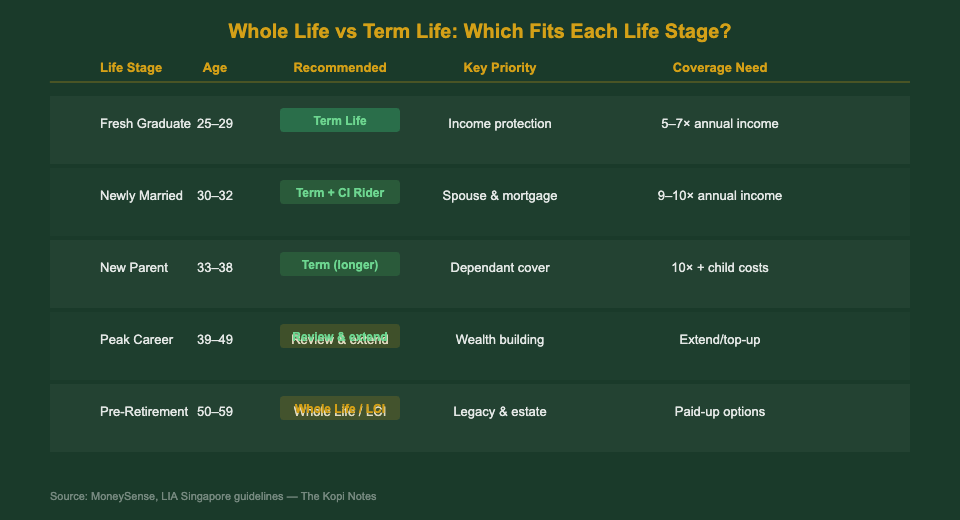
Your insurance priority changes substantially as you move through life. Here is how to frame the whole life vs term life question at each stage.
Stage 1 — Fresh Graduate (Ages 25–29)
Default recommendation: Term life, minimum 5–7× annual income.
At this stage, your financial responsibilities are low, your income is growing, and your budget is tight. The goal is to put the right safety net in place cheaply while freeing up cash for CPF top-ups, an emergency fund, and early investing. A 25-year-old non-smoker male can secure S$500,000 of 20-year term cover for under S$800 a year — roughly the cost of two weekend dinners a month.
Whole life at this stage is expensive relative to the cover it provides. You will pay five to six times more in annual premiums for the same sum assured. Unless you have a specific need — a business key-person arrangement, or an early estate planning conversation with your parents — term is almost always the better starting point here.
Many employers provide some group term cover, and the CPF Dependants Protection Scheme (DPS) gives you automatic S$70,000 coverage once you start working and contributing to CPF. That is a baseline, not a plan — you still need personal coverage on top.
Stage 2 — Newly Married (Ages 30–34)
Default recommendation: Term life (longer tenure) + critical illness rider.
Marriage typically brings a joint mortgage, a spouse who may partially depend on your income, and the beginning of shared financial goals. This is the life stage where the coverage stakes are highest — and where being underinsured is most dangerous.
MoneySense’s basic financial planning guide recommends a minimum of 9× your annual income for death and TPD coverage, and 4× annual income for critical illness. For a Singaporean earning S$80,000 a year, that is a S$720,000 death/TPD sum assured and S$320,000 of CI cover. Layering a CI rider onto a term base plan is usually 30–50% cheaper than buying standalone CI — and far cheaper than the CI component of a whole life plan.
For a deeper comparison of your CI options, see our critical illness vs disability income insurance guide.
Stage 3 — New Parent (Ages 33–42)
Default recommendation: Extend term coverage, increase sum assured to cover child-rearing costs.
A child changes the calculus materially. You now need to account not just for mortgage repayment and income replacement, but for 20-plus years of education and childcare costs. University fees in Singapore run S$30,000–50,000 for a four-year local degree; international school fees can reach S$30,000–50,000 per year on top of that.
A practical approach at this stage is the DIME method: Debt + Income replacement + Mortgage + Education. For a typical dual-income household with one child, this often pushes the coverage need well above S$1 million. A 30-year term policy bought at age 35 covers you to 65 — almost perfectly aligned with the working years your dependants need protection for. This is not the life stage to invest heavily in whole life; every dollar locked into cash value is a dollar not protecting your family. Use our Singapore retirement planning calculator to model how much passive income your savings need to generate so you can right-size your protection layer.
Stage 4 — Peak Career (Ages 43–54)
Default recommendation: Review and extend; consider partial whole life for estate.
By your mid-40s your mortgage is partly paid down, children are older, and you may have accumulated meaningful assets. The original term policy bought at 30 is getting expensive on renewal — term premiums rise steeply with age because mortality risk is rising. This is the stage where the whole life vs term decision becomes genuinely nuanced. If your wealth is substantial enough that your family will face estate planning considerations, a small whole life policy held in trust starts to make sense. For everyone else: review existing term policies, top up if coverage has fallen below the 9× benchmark, and maximise CPF investments in parallel.
Stage 5 — Pre-Retirement (Ages 55–64)
Default recommendation: Whole life for legacy; convert or extend existing term selectively.
As you approach retirement, the nature of the risk you are insuring changes. You likely have fewer active dependants, a fully or partly paid-up home, and a CPF Life payout incoming. If you have a paid-up whole life policy from earlier, the cash value and sum assured now serve as a disciplined estate transfer mechanism — bypassing probate and landing directly with your nominated beneficiaries. DPS coverage ends at 65, so ensure your own coverage is in place before then. Consider the Singapore T-bills guide and other lower-risk options for the wealth accumulation component of your retirement plan.
How Much Cover Do You Need?
The most widely cited benchmark in Singapore comes from the MoneySense Basic Financial Planning Guide: a minimum of 9× your annual income for death and TPD, and 4× annual income for critical illness. These are minimums — if you are the sole breadwinner or have dependants with special needs, your target will be higher.
| Annual Income | Min Death/TPD Cover (9×) | Min CI Cover (4×) | Total Target |
|---|---|---|---|
| S$50,000 | S$450,000 | S$200,000 | S$650,000 |
| S$80,000 | S$720,000 | S$320,000 | S$1,040,000 |
| S$120,000 | S$1,080,000 | S$480,000 | S$1,560,000 |
| S$150,000 | S$1,350,000 | S$600,000 | S$1,950,000 |
Source: MoneySense Basic Financial Planning Guide benchmarks. Your actual needs may differ based on liabilities, dependants, and existing coverage.
Premium Comparison: Term vs Whole Life
To make the cost comparison concrete, here are indicative annual premiums for a S$300,000 sum assured for a non-smoker male at different ages and policy durations. These are illustrative figures based on typical market pricing — use MAS CompareFIRST for personalised quotes from actual insurers.
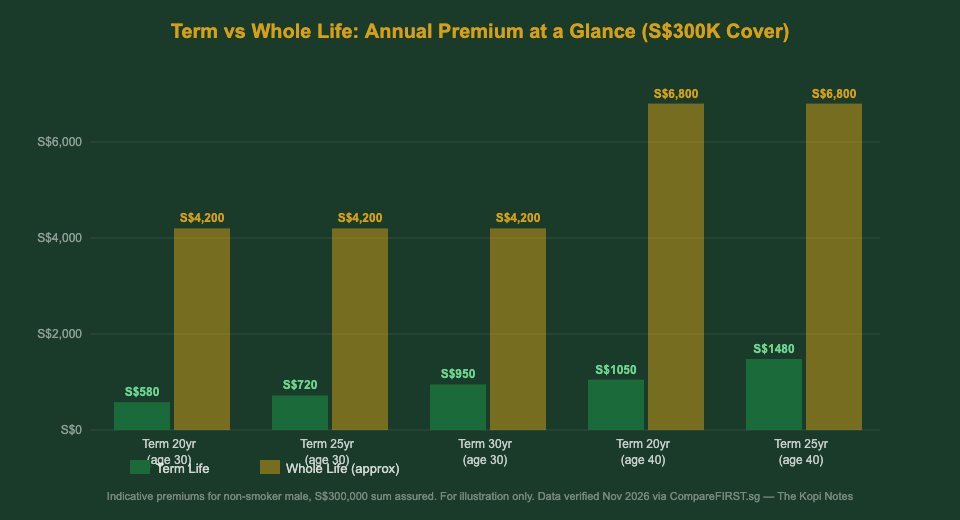
Indicative premiums for a non-smoker male, S$300,000 sum assured. For illustration only. Use CompareFIRST.sg for actual quotes.
The key insight: even a 25-year term bought at age 40 (around S$1,480/year) costs roughly one-quarter of a whole life premium at the same age (around S$6,800/year). The savings — approximately S$5,320 a year — if invested at a modest 4% return in a balanced portfolio or Singapore Savings Bonds, would likely outperform the cash value growth in a whole life policy over the same period. This is the core logic behind the buy-term-invest-the-rest (BTIR) strategy.
When Whole Life Makes Sense
To be fair to whole life insurance, there are specific scenarios where it genuinely outperforms term on a risk-adjusted basis. Estate planning and legacy transfer is the strongest case: whole life proceeds bypass probate and are paid directly to nominees, which matters for high-net-worth individuals who want a specific sum to reach specific beneficiaries without court delays. Business key-person insurance is another valid use case — a business owner insuring a critical director often needs lifetime coverage, not cover that expires at 70.
Children with disabilities or special needs represent a third scenario where whole life is appropriate: if you have a dependant who will never be financially independent, lifetime coverage — rather than a 30-year term — is the right tool. The sum assured can be structured into a trust for their ongoing care. Finally, limited-payment whole life for retirees with stable cash flow — a 10-pay or 15-pay policy bought in your early 50s — means premiums end before retirement while the death benefit continues for life, serving as a tax-efficient legacy mechanism without ongoing cash flow demands.
For everything outside these four scenarios, term life will almost always serve you better. The discipline is to identify which bucket you are in before committing to whole life premiums.
Your 3-Step Action Plan
Step 1 — Identify your life stage and coverage gap. Use the 9× income benchmark to calculate your target death/TPD sum assured. Check existing policies (employer group insurance, DPS, existing personal policies) and subtract them from the target. The difference is your gap.
Step 2 — Compare term options first. Visit MAS CompareFIRST to get side-by-side premium quotes for the coverage amount and policy duration that matches your life stage. Lock in a plan before your next birthday — term premiums step up at each age band.
Step 3 — Add whole life only if a specific need exists. If estate planning, business insurance, or a dependent-with-special-needs situation applies to you, discuss a whole life component with a licensed financial adviser. Use the Singapore retirement planning calculator to model how the premium commitment affects your long-term retirement runway before committing.
Frequently Asked Questions
Is term life insurance enough for most Singaporeans?
What happens to term life insurance when it expires?
Can I have both term and whole life insurance?
How does DPS relate to my personal life insurance?
At what age should I buy life insurance in Singapore?
Is whole life insurance a good investment in Singapore?
Get Free Insurance Advice
Speak with a licensed insurance advisor. No obligation, no cost.
By submitting this form, you agree to our Privacy Policy.
This article was researched with the help of AI. While we strive to keep all information accurate and up to date, there may be errors. If you notice any discrepancies, please contact us.