CPF Enhanced Retirement Sum (ERS) 2026: S$319,500 Explained — Is It Worth Topping Up?
The CPF Enhanced Retirement Sum (ERS) 2026 is set at S$319,500 — the maximum you can hold in your CPF Retirement Account to maximise CPF Life monthly payouts. At ERS, eligible members receive an estimated S$2,480 per month from age 65 under the Standard Plan. This guide covers the 2026 BRS/FRS/ERS table, CPF Life payout estimates, how to top up, tax relief benefits, and who should consider ERS.
Not financial advice. All figures are for educational reference only. Payout estimates are approximate and sourced from the CPF Board CPF Life Estimator as at November 2026. Verify current figures at cpf.gov.sg.
Table of Contents
What Is the CPF Enhanced Retirement Sum?
The CPF Enhanced Retirement Sum (ERS) is the highest of three CPF retirement sum thresholds — the maximum amount you are allowed to set aside in your Retirement Account (RA) for CPF Life. The other two are the Basic Retirement Sum (BRS) and Full Retirement Sum (FRS).
CPF members who turn 55 have their Ordinary Account (OA) and Special Account (SA) savings swept into the RA, up to the prevailing FRS. Members who want to receive a higher monthly income in retirement can voluntarily top up their RA further — all the way up to the ERS — using cash or CPF savings.
The ERS is set at 1.5× the FRS, or equivalently 3× the BRS. It was raised from S$307,500 in 2025 to S$319,500 in 2026 as part of CPF Board’s annual indexation to keep pace with inflation and rising living costs.
Topping up to ERS is entirely voluntary. It is most relevant for members who want the maximum possible CPF Life payout and have the CPF savings or cash available to do so.
2026 BRS, FRS and ERS Comparison Table
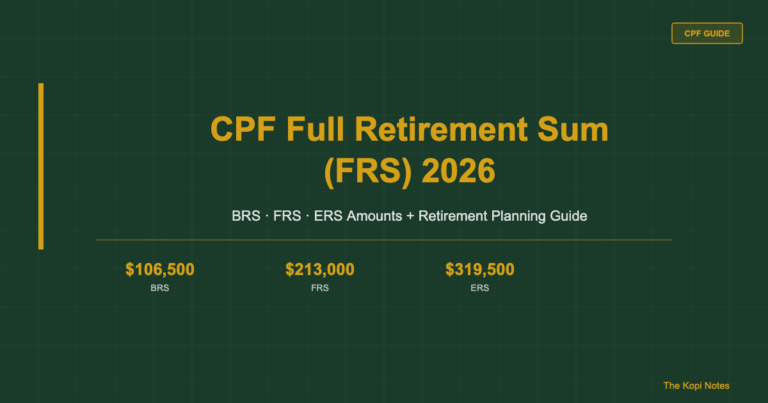
The three CPF retirement sums are adjusted upward each year. Here are the 2026 figures effective from 1 January 2026:
| Retirement Sum | 2026 Amount | Multiple of BRS | Who It Applies To |
|---|---|---|---|
| Basic Retirement Sum (BRS) | S$106,500 | 1× | Members who own property and pledge it to CPF |
| Full Retirement Sum (FRS) | S$213,000 | 2× | Default for most members; no property pledge needed |
| Enhanced Retirement Sum (ERS) | S$319,500 | 3× | Voluntary top-up to maximise CPF Life payout |
Source: CPF Board, effective 1 January 2026. Figures are adjusted annually.
Members who have already hit the FRS in their RA can top up the remaining S$106,500 (the gap between FRS and ERS) in cash through the Retirement Sum Topping Up (RSTU) Scheme.
CPF Life Monthly Payouts at Each Retirement Sum
CPF Life is Singapore’s national longevity insurance annuity scheme. The more you have in your RA at the time you join CPF Life, the higher your monthly payouts will be for life. Here are the estimated monthly payouts for a member turning 65 in 2026 under the Standard Plan (note: actual amounts depend on your birth year, CPF Life plan, and when payouts start):
| Retirement Sum | RA Balance | Est. Monthly Payout (from 65) | Annual Payout |
|---|---|---|---|
| Basic (BRS) | S$106,500 | ~S$850 | ~S$10,200 |
| Full (FRS) | S$213,000 | ~S$1,650 | ~S$19,800 |
| Enhanced (ERS) | S$319,500 | ~S$2,480 | ~S$29,760 |
Source: CPF Board CPF Life Estimator. Payouts are estimates under the Standard Plan for a member born in 1961 starting payouts at age 65. Use the official CPF Life Estimator for personalised projections.
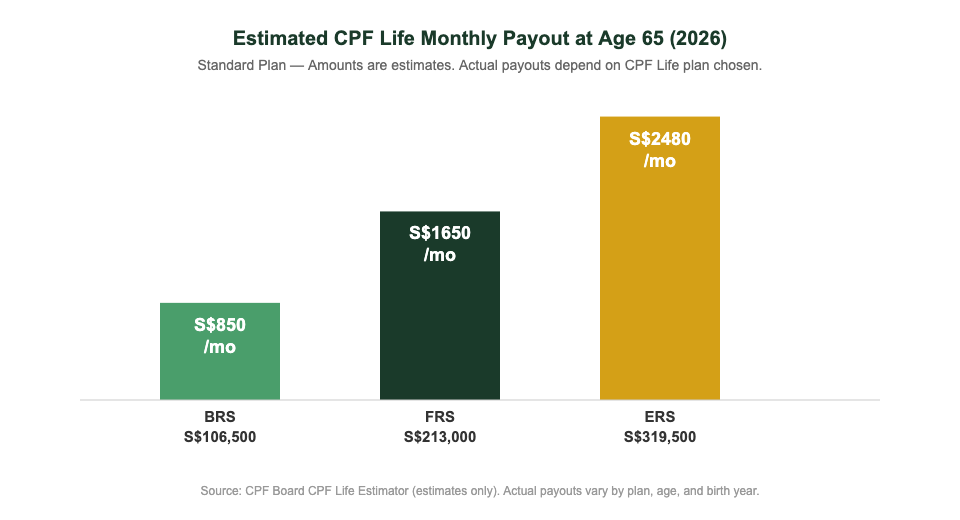
The difference between FRS and ERS payouts is approximately S$830 per month. Over a 20-year retirement, that adds up to roughly S$199,200 in additional CPF Life income. The question is whether the opportunity cost of locking up an extra S$106,500 in CPF is worth this income stream — a topic covered in the comparison section below.
How to Top Up to ERS
There are two ways to increase your RA balance towards the ERS: the automatic sweep at age 55, and voluntary cash top-ups after that.
1. Automatic Transfer at Age 55
When you turn 55, CPF creates your Retirement Account and automatically transfers savings from your OA and SA into it — up to the FRS (S$213,000 in 2026). If your OA and SA combined exceed the FRS, the excess remains in your OA. You cannot automatically reach ERS this way; you must top up voluntarily.
2. Retirement Sum Topping Up Scheme (RSTU) — Cash Top-Up
The RSTU Scheme allows you to top up your RA (and your loved ones’ RAs) in cash, up to the prevailing ERS. Steps:
- Log in to my.cpf.gov.sg using your Singpass.
- Navigate to My Requests → Building My Savings → Top Up Retirement Sum (RSTU).
- Select whether you are topping up your own RA or a family member’s.
- Enter the top-up amount (up to ERS of S$319,500 less your current RA balance).
- Make payment via PayNow, GIRO, or eNETS.
- The top-up is typically credited within 3–5 business days.
Important: RSTU top-ups in cash are irrevocable. Once the funds are in your RA, they cannot be withdrawn — they will form part of your CPF Life annuity. Plan accordingly.
Tax Relief for Topping Up to ERS
One of the strongest financial incentives to top up to ERS is the accompanying income tax relief under the RSTU Scheme. For YA2026, Singapore residents can claim:
- Up to S$8,000 tax relief for cash top-ups to your own RA (or MA).
- Up to an additional S$8,000 for cash top-ups to a spouse’s, parents’, or siblings’ RA or SA.
- Maximum combined relief from RSTU and CPF Cash Top-Up (CRS) is S$16,000 per year.
At the highest marginal income tax bracket (22% on income above S$320,000), every S$8,000 top-up saves S$1,760 in tax. Over 10 years of annual top-ups, that’s S$17,600 in cumulative tax savings — in addition to CPF interest at 4% per annum on the RA balance.
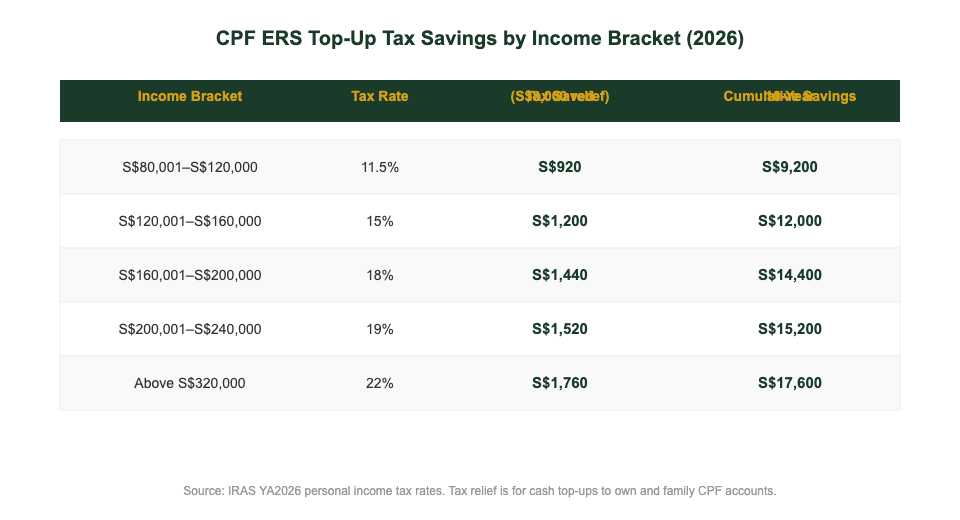
Tax relief is particularly valuable for self-employed individuals and high-income earners in the S$120,000–S$320,000+ income range. Used in combination with an CPF investment strategy and SRS contributions, the annual S$8,000 RSTU top-up can form a powerful tax-mitigation stack.
For employees, consider pairing RSTU top-ups with SRS contributions (up to S$15,300/year for Singaporeans) for a combined tax relief of up to S$23,300 on retirement-focused savings. You can use our Singapore retirement calculator to model how ERS and SRS contributions interact.
Who Should Consider Topping Up to ERS?
Topping up to ERS makes most sense for Singaporeans who:
- Have excess CPF or cash savings beyond what they need for housing, emergencies, and near-term goals.
- Want a guaranteed, inflation-adjusted income floor in retirement — CPF Life pays for life regardless of how long you live.
- Are in a high income tax bracket and can use the annual S$8,000 RSTU relief to reduce their tax bill year after year.
- Lack investment confidence or want to reduce sequencing risk in retirement by having a secure base income separate from their investment portfolio.
- Have a family history of longevity — CPF Life’s annuity structure rewards those who live longer.
Topping up to ERS may be less appropriate for members who:
- Need the liquidity for large near-term expenses (property upgrade, children’s education).
- Have significant investment expertise and prefer to manage the S$106,500 in higher-yield assets like S-REITs or a globally diversified ETF portfolio (see: passive income Singapore).
- Are already receiving sufficient retirement income from other sources (private annuities, rental income, defined benefit pension).
ERS vs Investing the Difference
A common question: should you top up to ERS, or invest the S$106,500 (gap between FRS and ERS) in a diversified ETF portfolio instead?
| Factor | Top Up to ERS | Invest S$106,500 |
|---|---|---|
| Guaranteed return | Yes (4% p.a. on RA) | No (market risk) |
| Longevity protection | Yes (paid for life) | Risk of outliving savings |
| Tax relief | S$8,000/yr (RSTU) | No relief (SRS separate) |
| Liquidity | Locked until 65 | Accessible anytime |
| Potential upside | Capped at CPF Life rates | Higher (8–10% historical equity) |
| Estate inheritance | Bequest under CPF Life | Full value to beneficiaries |
This is not financial advice. Decisions depend on individual risk tolerance, income needs, and retirement goals.
The prudent approach for most Singaporeans is a hybrid strategy: meet at least the FRS (S$213,000) for a solid CPF Life baseline, then allocate remaining investable savings toward a growth portfolio. If you have high income and are in a top tax bracket, the annual S$8,000 RSTU relief makes topping up to ERS increasingly attractive over a 5–10 year horizon.
For platforms to invest outside CPF, consider comparing Syfe referral code and sign-up bonus, Endowus referral code, and the FSMOne referral code for low-cost ETF investing in Singapore.
Frequently Asked Questions
What is the CPF ERS for 2026?
How much CPF Life payout do you get at ERS?
Can I top up to ERS if I have already reached FRS?
Is the ERS top-up tax-deductible in Singapore?
What happens to my ERS top-up if I die before drawing CPF Life?
How does ERS differ from FRS and BRS?
Plan Your Retirement with the Right Tools
Want to model how ERS top-ups affect your retirement income alongside CPF, SRS, and investments? Use our Singapore retirement calculator for a full picture.
For investable savings outside CPF, Singapore retail investors can build a low-cost diversified portfolio through these platforms — each offering referral bonuses for new accounts:
- Syfe referral code and sign-up bonus — robo-advisory with REIT+ and income portfolios
- Endowus referral code — CPF OA/SRS investing at institutional rates
- FSMOne referral code — low-cost ETF and fund platform
Not financial advice. This article is for educational purposes only. All CPF figures should be verified on cpf.gov.sg. Data as at November 2026.
This article was researched with the help of AI. While we strive to keep all information accurate and up to date, there may be errors. If you notice any discrepancies, please contact us.