How to Invest in Singapore: 2027 Investment Outlook and Portfolio Playbook
T-bill yields have compressed, MAS held its exchange rate band in October 2026, and global equities are near multi-year highs. Here is how Singapore investors should position their portfolios for 2027.
To invest in Singapore in 2027, you need to work with five core building blocks: CPF top-ups for guaranteed returns, Singapore Savings Bonds and T-bills for liquid fixed income, the STI ETF for local equity exposure, globally diversified index funds (CSPX or VWRA via the LSE) for growth, and your SRS account as a tax-efficient wrapper. The right mix depends on your age, income, and risk tolerance — this guide walks through each layer with current November 2026 rate data.
Not financial advice. All figures are for educational reference only. Data as at November 2026 unless noted. Past performance does not guarantee future results.
Table of Contents
Contents — Click to expand
The 2026–2027 Investment Backdrop
Singapore investors entering 2027 face a meaningfully different landscape from the high-rate environment of 2022–2024. Three macro shifts define the current moment.
The US Federal Reserve is on pause. At its most recent meeting, the Fed held the federal funds rate at 3.75%–4.00%, signalling that its hiking cycle is over but that cuts will only come gradually as inflation data permits. For Singapore investors, this matters because US rates set the floor for global fixed-income yields — including Singapore Government Securities (SGS) T-bills.
MAS held its exchange rate policy in October 2026. The Monetary Authority of Singapore kept its Singapore Dollar Nominal Effective Exchange Rate (S$NEER) appreciation rate and policy band width unchanged at its October 2026 Monetary Policy Statement. MAS cited cooling domestic inflation and a stable external outlook as reasons to pause. A steady S$NEER means less currency tailwind for imported goods but also signals that MAS is not trying to suppress Singapore-dollar returns on local assets — good news for CPF and SSB holders. (Source: TradingPedia, October 2026.)
Singapore equities have outperformed. The Straits Times Index delivered strong calendar-year gains in 2026, buoyed by financial sector earnings, regional tourism recovery, and a resilient Singapore economy. While past performance is no guide to future returns, Singapore’s low-debt government balance sheet and strategic hub status continue to underpin long-term equity valuations.
What this means for your portfolio: The easy win of parking cash in T-bills at 3.7% (the peak in late 2023) is no longer available. Investors who relied exclusively on risk-free fixed income now need to decide whether to extend duration (SSBs lock in 2.45% for 10 years), tilt toward equities, or accept lower carry. The 2027 playbook is about optimising the mix — not just the yield.
Singapore’s Yield Landscape: November 2026 Rates
Before building a portfolio, every Singapore investor needs to know the current risk-free baseline. These are the rates available as at November 2026 — all verified against official and primary sources.
| Instrument | Current Rate | Term | Min. Amount | Key Caveat |
|---|---|---|---|---|
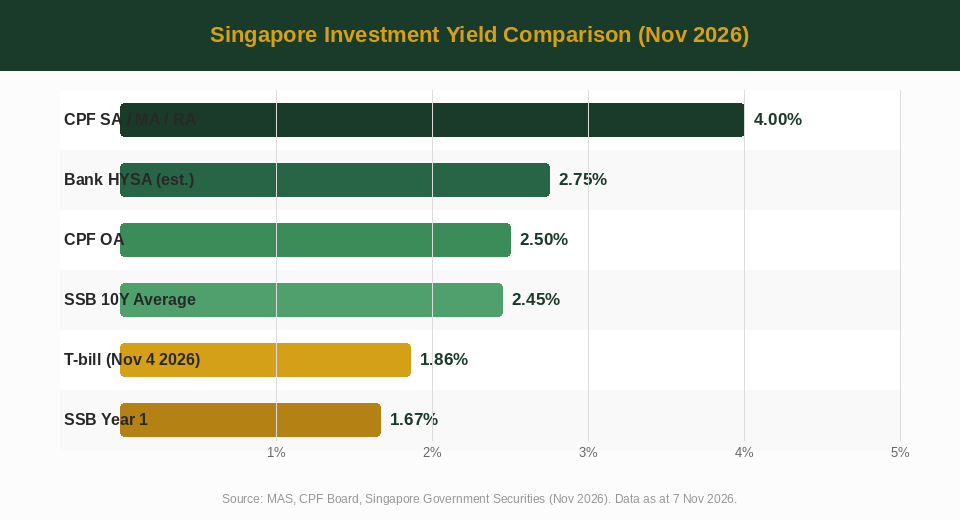
| 6-Month T-bill | 1.86% p.a. | 6 months | SGD 1,000 | Rate set at auction; apply via ATM/CDP |
| SSB (Nov 2026 issue) | 1.67% Yr 1 / 2.45% 10Y avg | Up to 10 years | SGD 500 | Redeem anytime; individual cap SGD 200k |
| CPF Ordinary Account (OA) | 2.50% p.a. | Ongoing | — | Guaranteed by government; illiquid for most purposes |
| CPF Special / Medisave / Retirement Account | 4.00% p.a.* | Ongoing | — | 4% floor confirmed to December 2027 |
| Bank High-Yield Savings (DBS/OCBC/UOB) | ~2.0–3.5%* | Flexible | SGD 0 | Bonus rates require salary credit + spend conditions |
Sources: MAS (T-bill results, Nov 4 2026 auction); CPF Board (cpf.gov.sg, interest rate announcements); MAS SSB issuance data (Nov 2026). *Bank HYSA headline rates vary; check individual bank websites for current tier requirements. CPF SA 4% floor source: CPF Board announcement, 22 September 2026.
The key takeaway: CPF SA at 4.00% is now the highest risk-free rate available to Singapore citizens and PRs, by a wide margin. For every dollar you can top up into SA (subject to the Full Retirement Sum rules), you are earning 1.5 percentage points more than the best T-bill rate. For more detail on maximising CPF, see our CPF investment strategy Singapore guide. For T-bill auction strategies and CPF-OA T-bill investing, see our Singapore T-bills 2026 guide.
Core Asset Classes for Singapore Investors
Singapore investors have access to a wide range of asset classes — many with specific local advantages around tax treatment, CPF/SRS eligibility, and SGX liquidity. Here is a structured overview of each category and what it offers in 2026/2027.
| Asset Class | Example Vehicles | Expected Return (long-run) | Liquidity | CPF/SRS? |
|---|---|---|---|---|
| Risk-free cash/fixed income | CPF OA/SA, SSBs, T-bills | 1.86–4.00% | Low–Medium | CPF OA ✓ / SSB SRS ✓ |
| Singapore equities (STI) | ES3 (SPDR STI ETF), G3B (Nikko AM STI ETF) | ~5–7% incl. dividends | High (SGX) | CPF-IS ✓ / SRS ✓ |
| Global equities (LSE-listed) | CSPX (S&P 500), VWRA (All-World, acc.) | ~7–10% historical | High (LSE) | SRS ✓ (via IBKR/Syfe); CPF-IS ✗ |
| Singapore REITs (S-REITs) | Individual S-REITs or CSOP S-REIT ETF (SRT) | ~5–7% distribution yield | High (SGX) | CPF-IS selected ✓ / SRS ✓ |
| Robo-advisors (managed) | Syfe Core, Endowus Flagship, StashAway | Varies by risk level | Medium (3–5 days) | Endowus CPF ✓ / All SRS ✓ |
| Unit trusts / bonds | FSMOne, Endowus fund shelf | 2–8% depending on fund | Medium | CPF-IS selected ✓ / SRS ✓ |
CPF-IS = CPF Investment Scheme. Not all ETFs and funds are approved for CPF-IS investment. Check CPF Board’s approved investment list before investing CPF monies. Source: CPF Board, November 2026.
Tax efficiency note for Singapore investors: Singapore has no capital gains tax and no dividend withholding tax on locally-sourced dividends. For US-exposed ETFs, the choice of domicile matters significantly — an Ireland-domiciled ETF (such as CSPX or VWRA listed on the London Stock Exchange) pays 15% withholding tax on US dividends under the Ireland-US tax treaty, versus 30% for a US-domiciled ETF. Singapore investors with holdings above USD 60,000 in US-domiciled ETFs also face potential US estate tax exposure — a risk entirely eliminated by holding the LSE-listed Irish equivalent. This is why many Singapore investors choose CSPX over VOO for their S&P 500 exposure.
For a deeper look at passive income strategies using S-REITs, see our passive income Singapore guide. If you are considering Singapore Savings Bonds as part of your fixed-income ladder, our Singapore Savings Bonds guide covers application strategy and the current yield curve in detail.
Building Your 2027 Portfolio (by Risk Profile)
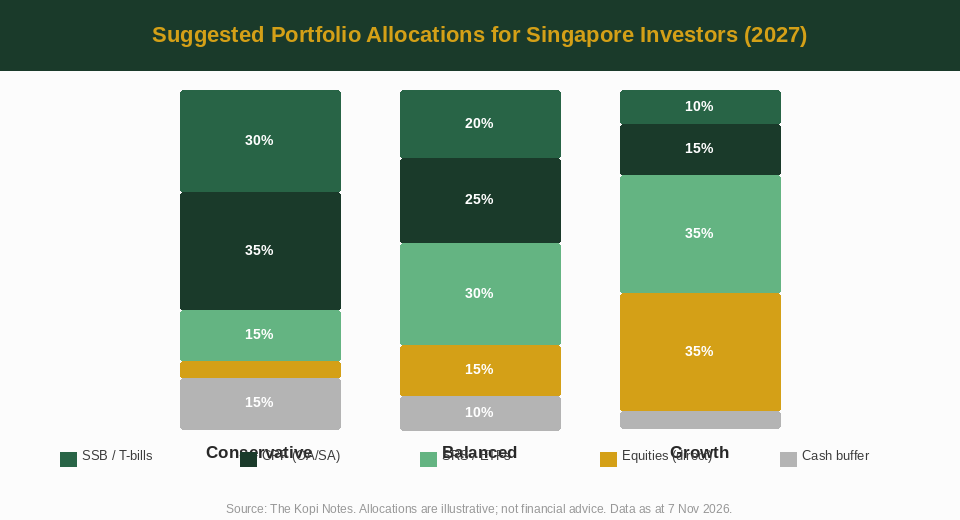
There is no single “best” portfolio for all Singapore investors — the right allocation depends on your time horizon, income, existing CPF balance, and risk tolerance. Below are three model portfolios based on broad investor profiles. These are illustrative starting points, not personalised financial advice — use our Singapore retirement calculator to model your own numbers.
Portfolio 1: Conservative (Age 55+, Capital Preservation)
Goal: Preserve capital, generate income, beat CPF OA rate on the equity portion without taking significant drawdown risk.
| Asset | Allocation | Vehicle |
|---|---|---|
| CPF SA top-up / RA (if applicable) | 30% | CPF — 4.00% guaranteed to Dec 2027 |
| Singapore Savings Bonds | 25% | SSB — 2.45% 10Y average, fully redeemable |
| Singapore REITs | 25% | CSOP S-REIT ETF (SRT) or diversified S-REIT basket |
| STI ETF | 20% | ES3 or G3B — Singapore blue chips + dividends |
Worked example: SGD 300,000 portfolio → SGD 90,000 CPF SA (4.0% = SGD 3,600/yr), SGD 75,000 SSB (2.45% avg = SGD 1,838/yr), SGD 75,000 S-REITs (~6% yield = SGD 4,500/yr), SGD 60,000 STI ETF (~5% total return estimate). Combined expected income + growth: ~SGD 11,938+ per year before taxes (Singapore has no capital gains or dividend WHT for local assets).
Portfolio 2: Balanced (Age 35–55, Growth + Income)
Goal: Long-run wealth accumulation with partial income generation and tax efficiency via SRS.
| Asset | Allocation | Vehicle |
|---|---|---|
| Global equity ETF (LSE-listed) | 35% | VWRA or CSPX via IBKR or Syfe Trade |
| STI ETF | 20% | ES3 or G3B via SGX |
| Singapore REITs | 25% | Diversified S-REIT selection or SRT ETF |
| CPF SA top-up + SSBs (emergency/bond layer) | 20% | CPF SA + SSB ladder for downside cushion |
Portfolio 3: Growth (Age 20–35, Maximum Accumulation)
Goal: Maximise long-run compounding, primarily via low-cost globally diversified ETFs, while using CPF and SRS for tax optimisation.
| Asset | Allocation | Vehicle |
|---|---|---|
| Global equity ETF (LSE-listed) | 60% | VWRA (all-world, accumulating) via IBKR |
| STI ETF | 25% | ES3 or G3B — local home bias for SG-dollar income |
| CPF SA voluntary top-up | 15% | SGD 8,000/yr (tax relief; 4.00% guaranteed to Dec 2027) |
SGD worked example (Growth portfolio, SGD 100,000 investable assets): SGD 60,000 in VWRA via IBKR, SGD 15,300 in SRS invested via Endowus or Syfe (up to SRS contribution limit), SGD 8,000 as CPF SA top-up for income tax relief, SGD 16,700 in cash/T-bills as emergency buffer earning 1.86%. Total annual cost: ~0.22% on VWRA (TER) + ~SGD 1.50 min per IBKR trade. The SGD 15,300 SRS top-up saves approximately SGD 1,377–4,590 in income tax depending on your marginal tax rate (9–30%).
SRS and CPF-IS: Tax-Efficient Wrappers You Should Not Ignore
Singapore offers two tax-advantaged investment vehicles that are genuinely powerful — and frequently underused. Using them correctly can materially improve your after-tax returns over a 20-30 year investment horizon.
Supplementary Retirement Scheme (SRS)
The SRS is an optional government scheme that lets working adults (citizens, PRs, and foreigners) contribute pre-tax dollars into a designated brokerage account and invest them freely. Contributions reduce your chargeable income for the year — meaning you get immediate income tax relief.
- Contribution limit (2026): SGD 15,300 for Singapore citizens and PRs; SGD 35,700 for foreigners
- Tax relief: Contributions are deducted from your chargeable income. At a 15% marginal tax rate, SGD 15,300 in SRS saves you SGD 2,295 in tax this year.
- Withdrawal: From the statutory retirement age (currently 63), only 50% of withdrawals are taxable. If timed correctly with zero other income in retirement, effective tax on SRS withdrawals can approach zero.
- What you can invest: SGX-listed stocks and ETFs, unit trusts on the approved list, bonds, LSE-listed ETFs (via brokers supporting SRS), fixed deposits
Best way to use SRS in 2026/2027: Open an SRS account with any of the three local banks (DBS, OCBC, UOB), link it to a robo-advisor like Endowus or Syfe, and invest the full SGD 15,300 each year into a low-cost global equity portfolio. Both Endowus and Syfe support SRS investing directly with no additional account opening steps.
CPF Investment Scheme (CPF-IS)
The CPF-IS allows you to invest your CPF OA savings (above the first SGD 20,000) in an approved list of investments. The key consideration: the CPF OA earns a guaranteed 2.5% per year. Any CPF-IS investment needs to beat that after costs and fees — a higher bar than it appears, since most actively managed funds underperform their benchmarks over the long run.
For Singapore investors who want to use CPF-IS, the most defensible approach is investing in the STI ETF (ES3 or G3B) — both are on the approved CPF-IS list. This gives you broad Singapore blue-chip exposure at a low cost (TER ~0.30%), and historically the STI has delivered total returns materially above 2.5% p.a. over 10+ year periods, though with significant volatility along the way.
CPF-IS is not recommended for: investors within 5 years of retirement (too little time to recover from a drawdown), or for investing in higher-risk products like gold, single-stock exposure, or complex derivatives.
SRS contribution limit source: Inland Revenue Authority of Singapore (IRAS), tax year 2026. CPF OA rate source: CPF Board, July–September 2026 rates announcement (cpf.gov.sg). The 4% SA/MA/RA floor was confirmed extended to 31 December 2027 in the CPF Board announcement of 22 September 2026.
Where to Invest in Singapore: Platform Comparison 2026
The right platform depends on what you are buying and how often you plan to trade. For long-term index investors making monthly contributions, fees matter enormously over decades — a 0.5% annual fee drag on a SGD 500,000 portfolio costs SGD 2,500 per year, every year.
| Platform | Best For | Key Fee | CPF/SRS? |
|---|---|---|---|
| Interactive Brokers (IBKR) | LSE-listed ETFs, global equities, active traders with large portfolios | 0.05% min USD 1.50 per trade (tiered) | SRS ✓ (via IBKR SRS account) |
| Endowus | CPF-IS, SRS, cash — fund-based investing with low-cost flagship portfolios | 0.25–0.60% p.a. access fee | CPF-IS ✓ / SRS ✓ / Cash ✓ |
| Syfe | Beginners, managed portfolios, Syfe Trade for self-directed ETF investing | 0.35–0.65% p.a. (managed); SGD 1.49/trade (Syfe Trade) | SRS ✓ / Cash ✓ |
| FSMOne | Regular Savings Plans (RSP), unit trusts, bonds, SGX ETFs | From 0.08% per trade (RSP from SGD 50/month) | SRS ✓ / Cash ✓ |
| Trust Bank | High-yield savings, MBM (Money Box) for T-bill-like returns with flexibility | Variable (see Trust Bank app for current rates) | Cash only |
Fee data sourced from each platform’s official fee schedule as at November 2026. Always verify current fees on the platform’s website before investing. IBKR fee: Interactive Brokers SG fee schedule.
Referral bonuses (November 2026): You can earn cashback or fee waivers when opening accounts via TKN’s referral links. See the individual platform pages for current terms:
- IBKR: Use referral code jianxiong368 — see TKN’s IBKR referral page for the current bonus
- Endowus: Use referral code 2V343 — see Endowus referral code for fee-free access period
- Syfe: Use referral code SRPRFFFCD — see Syfe referral code for the latest cashback offer
- FSMOne: Use referral code P0544985 — see FSMOne referral code for account opening rebates
- Trust Bank: Use referral code HTWYQP95 during signup for the current welcome bonus
Frequently Asked Questions
How should I start investing in Singapore as a beginner?
The simplest starting point for a Singapore beginner investor is a three-step foundation: (1) Top up your CPF SA to earn the guaranteed 4.00% p.a. (this is risk-free and tax-relieved); (2) Open an SRS account and contribute up to SGD 15,300 per year, invested in a low-cost robo-advisor like Syfe or Endowus; (3) Set up a Regular Savings Plan (RSP) in the STI ETF via FSMOne from as little as SGD 50 per month. These three steps require no stock-picking skill and cover fixed income, global equities, and Singapore equities at minimal cost.
What is the best investment in Singapore for 2027?
There is no single “best” investment — it depends on your risk tolerance and time horizon. As at November 2026, CPF SA top-ups offer the highest risk-free return at 4.00% p.a. guaranteed through December 2027. For long-run wealth building, globally diversified index ETFs (VWRA or CSPX listed on the London Stock Exchange) have historically delivered 7–10% annual returns over 10+ year periods. For passive income, Singapore REITs (S-REITs) offer distribution yields of approximately 5–7%. A blended approach across all three asset classes typically produces the best risk-adjusted outcome for most Singapore investors.
How do I invest in Singapore using CPF?
You can invest CPF OA savings above the first SGD 20,000 through the CPF Investment Scheme (CPF-IS). Log in to your CPF account via MyInfo, link your CPF-IS account with an approved agent bank (DBS, OCBC, or UOB), and invest in approved products including the STI ETF (ES3, G3B), unit trusts, gold, and Singapore Government Securities. Note: the CPF OA earns 2.5% guaranteed — any CPF-IS investment needs to clear this hurdle after costs. For most Singapore investors, the most defensible CPF-IS strategy is the STI ETF for long-run equity exposure. Separately, you can top up your CPF SA directly (without going through CPF-IS) to earn 4.00% p.a. guaranteed.
Is it better to invest via SRS or CPF in Singapore?
SRS and CPF serve different purposes and are complementary, not competing. CPF gives you a guaranteed return (2.5–4.0%) and is best used for the fixed-income / risk-free layer of your portfolio, particularly via SA top-ups. SRS is best used as a tax-advantaged equity wrapper — you contribute pre-tax dollars, invest them in equities or unit trusts for long-term growth, and benefit from the 50% withdrawal exemption in retirement. If you can only afford one, prioritise the CPF SA top-up first (guaranteed 4.00%), then use SRS for additional equities exposure. Both have annual caps that limit the total amount you can contribute, so many investors use both simultaneously.
What is the minimum amount to start investing in Singapore?
You can start investing in Singapore with very small amounts. Singapore Savings Bonds have a minimum purchase of SGD 500. The STI ETF Regular Savings Plan via FSMOne starts from SGD 50 per month. Robo-advisors like Syfe and Endowus accept initial investments from SGD 1 to SGD 100 depending on the portfolio. For direct ETF purchases via IBKR or other brokers, the minimum is effectively one share of the ETF — VWRA was priced at approximately USD 108 per share in mid-2026, though prices change daily. CPF SA top-ups can be as small as SGD 1. There is no barrier to starting — the more important question is consistency of contributions over time, not the initial amount.
Are Singapore T-bills a good investment in 2026?
Singapore T-bills remain a capital-safe, liquid instrument for short-term cash parking — but their attractiveness has decreased significantly from the 2023 peak of ~3.7%. The 6-month T-bill cut-off yield from the November 4, 2026 auction was 1.86% p.a. For investors who need liquidity within 6 months, T-bills still beat most savings accounts without conditions. However, compared to the CPF SA at 4.00% (for CPF monies) or the SSB 10-year average of 2.45% (for investors who can lock in longer), T-bills are no longer the obvious default choice. Use T-bills for the “cash buffer” portion of your portfolio — money you may need within 6 months — rather than as a primary investment vehicle. See our full Singapore T-bills 2026 guide for application strategies.
Can a foreigner invest in Singapore?
Yes — foreigners can invest in Singapore with very few restrictions. Most brokerage accounts (IBKR, Syfe, FSMOne) are open to foreigners with a valid Singapore address and passport. Foreigners on work passes can open an SRS account with a higher contribution limit of SGD 35,700 per year (versus SGD 15,300 for citizens and PRs). CPF is only available to Singapore citizens and PRs. Foreigners should note that Singapore has no capital gains tax and no withholding tax on locally distributed dividends — a significant advantage versus investing from jurisdictions like Australia or the UK. The main restriction for foreigners is that they cannot invest CPF monies (since they don’t have CPF).
How do Singapore investors avoid US estate tax on global ETFs?
The key is to invest in Ireland-domiciled ETFs listed on the London Stock Exchange (LSE) rather than US-domiciled ETFs listed on NYSE or NASDAQ. As a Singapore tax resident (or any non-US person), you face potential US estate tax if you hold more than USD 60,000 in US-domiciled assets (like VOO, SPY, or QQQ). By holding the LSE-listed equivalent — such as CSPX instead of VOO, or VWRA instead of VT — the ETF itself is domiciled in Ireland, so the USD 60,000 US estate tax threshold does not apply to your holdings. Additionally, Ireland-domiciled ETFs benefit from the 15% US dividend withholding tax rate (versus 30% for US-domiciled ETFs), saving approximately 1.5% per year on the yield of a US-heavy portfolio. This is one of the main reasons experienced Singapore investors buy ETFs on the LSE rather than US exchanges.
Start Building Your Singapore Investment Portfolio
Open an account on one of the platforms below using TKN’s referral links and get exclusive welcome bonuses.
This article was researched with the help of AI. While we strive to keep all information accurate and up to date, there may be errors. If you notice any discrepancies, please contact us.