Critical Illness Insurance for Children in Singapore: Do Your Kids Really Need It? (2026)
As a parent, the instinct is to protect your child from every risk. But does that extend to critical illness (CI) insurance? In this guide, we cut through the marketing noise to explain what CI insurance for children actually covers, the often-overlooked juvenile lien clause, real cost data, and when it makes financial sense to buy coverage for your child.
⚠️ Data verified as at 5 November 2026. All figures are indicative market data; consult a licensed financial adviser for personalised advice.
📋 Table of Contents — Click to Expand
- Why Parents Consider CI Insurance for Children
- What Does CI Insurance Cover for Children?
- The Juvenile Lien Clause — What Every Parent Must Know
- CI Rider for Children vs Standalone Policy
- How Much CI Coverage Do Children Need?
- Indicative Costs: CI Insurance for Children
- When Is CI Insurance for Children Worth It?
- TKN Verdict
- Frequently Asked Questions
Why Parents Consider CI Insurance for Children
Childhood cancer, though relatively rare, is the leading cause of disease-related death in Singapore children. The National Registry of Diseases Office (NRDO) data consistently shows leukaemia, brain tumours, and lymphomas among the top diagnoses for children under 15.
Beyond the medical bills themselves, a serious childhood illness imposes a significant financial burden through:
- Lost parental income — one or both parents may need to take extended unpaid leave or reduce working hours to provide care.
- Out-of-pocket costs not covered by MediShield Life or Integrated Shield Plans — these include non-formulary drugs, experimental treatments, home nursing, and rehabilitation.
- Medical inflation — Singapore’s healthcare costs have risen sharply. WTW’s 2026 Global Medical Trends Survey projects medical inflation in Singapore at approximately 16.9% in 2026, well above the Asia Pacific average.
A CI payout provides a lump sum that the family can use however they need — to cover lost income, offset medical bills, or fund long-term care.
What Does Critical Illness Insurance Cover for Children?
The Life Insurance Association of Singapore (LIA) has standardised definitions for 37 critical illnesses, which all insurers must use as a baseline under its CI framework. These include the major conditions most relevant to children:
- Cancer (of specified severity) — including leukaemia, lymphoma, and solid tumours
- Major organ failure — kidney failure, heart failure, liver failure
- Blindness and deafness (of a permanent nature)
- Major burns
- Aplastic anaemia
- Severe neurological conditions (e.g., coma, motor neurone disease)
- HIV due to blood transfusion or occupational exposure (for older children)
Many insurers also offer Early or Juvenile CI riders that cover earlier-stage diagnoses. Some children-specific CI riders extend coverage to conditions not in the LIA standard list, such as hospitalisation cash benefits, Kawasaki disease, or juvenile diabetes.
Important: Children’s CI policies typically cover up to age 18 or 21, with the option to convert to an adult standalone plan without evidence of insurability — a valuable feature if your child develops a condition during childhood.
⚠️ The Juvenile Lien Clause — What Every Singapore Parent Must Know
This is the most important caveat that many parents miss when buying CI insurance for their children: the juvenile lien clause.
Many life and CI policies impose a lien — a restriction on the payout — if the insured child is diagnosed before a specified age (commonly between 1 and 7 years old). Under this clause, the insurer may only pay a fraction of the sum assured, often around 25%, rather than the full amount.
For example, if you purchase S$200,000 of CI coverage for your newborn, and your child is diagnosed with leukaemia at age 3, the insurer may only pay out S$50,000 (25%) while the lien remains in force. The lien typically lifts once the child reaches the specified age.
Why does this matter? It means that buying a very large sum assured for a newborn to protect against early-diagnosis scenarios may not achieve what you think. The practical implication: once the lien lifts (usually age 7), the full sum assured becomes payable.
Note: The LIA does not standardise the juvenile lien clause, so terms vary significantly between insurers and policies. Always read your policy document carefully and ask your adviser which conditions apply and when the lien lifts.
CI Rider for Children vs Standalone Policy
Parents typically have two ways to get CI coverage for their child: a CI rider attached to a base policy (usually a whole life plan) or a standalone CI plan. Here’s how they compare:
| Feature | CI Rider (on Whole Life) | Standalone CI Plan |
|---|---|---|
| Cost | Lower (bundled premium) | Higher (separate policy) |
| Independence | ❌ Ends if base policy lapses | ✅ Independent coverage |
| Life cover impact after CI claim | ❌ Life cover reduced or zeroed | ✅ Life cover unaffected |
| Waiver of premium on diagnosis | Usually available | Usually available |
| Conversion privilege at 18-21 | Varies by insurer | Often included |
| Best for | Budget-conscious families, bundling with savings plan | Maximum flexibility, independent protection |
TKN’s view: For most families, a CI rider on a whole life base policy offers the best value for children, especially when the base plan doubles as a savings vehicle. However, if you want robust standalone coverage that won’t be affected by future decisions about the base policy, a standalone CI plan makes more sense.
Read more: CI Standalone Plan vs Rider Singapore: Which Is Better?
How Much CI Coverage Do Children Need?
Unlike adults, children do not have an income to replace, so the coverage amount calculation is different. The key costs to cover are:
- Medical treatment costs: Late-stage cancer treatment at a private hospital in Singapore can cost approximately S$100,000 to S$200,000 per year, based on Singlife’s published claims data for private hospital patients (pre-subsidy). Public hospital subsidised treatment is significantly lower.
- Lost parental income: If one parent takes a year off work (average Singapore monthly salary ~S$5,000), that’s roughly S$60,000 of lost household income.
- Non-medical expenses: Home nursing, transport, rehabilitation, and dietary support can add S$10,000–S$30,000 per year.
A commonly used guideline: target at least S$100,000 to S$200,000 in CI coverage for a child to cover a year of treatment plus income replacement for one parent. Many financial advisers suggest S$150,000 as a practical starting point.
Note: If the juvenile lien clause applies, factor in the reduced payout during the lien period when sizing coverage.
Indicative Costs: CI Insurance for Children in Singapore
Premiums for children’s CI coverage are generally lower than adults because children start healthier and younger. Below are indicative annual premiums for a CI rider attached to a whole-life base policy, based on market data as at November 2026:
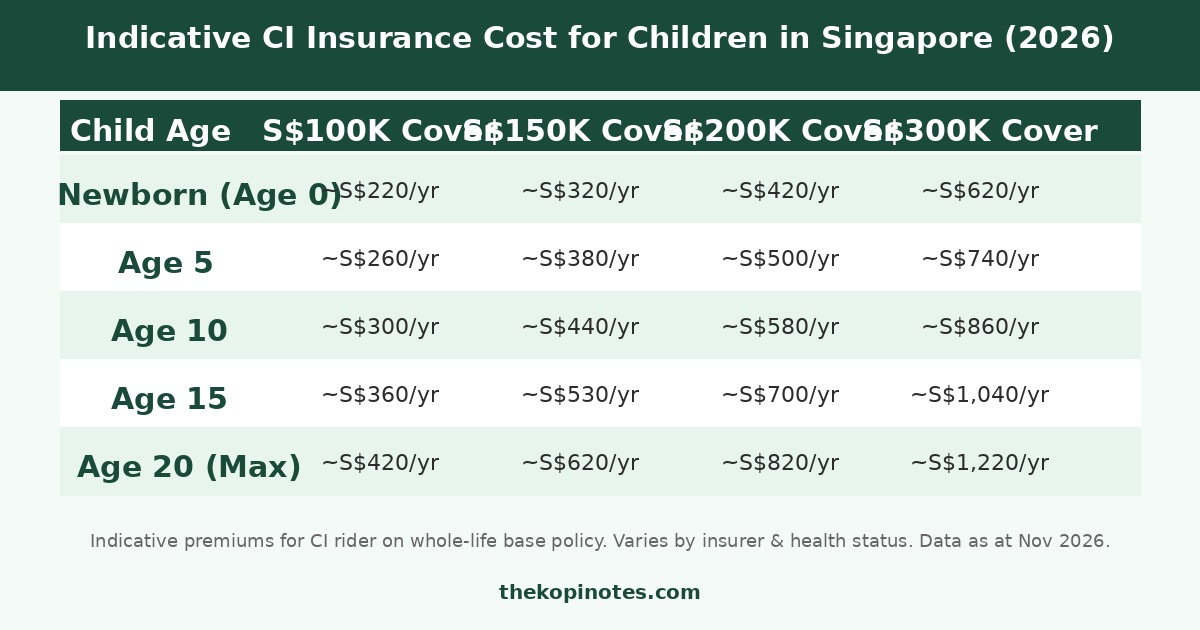
* Indicative premiums for a non-smoking child with no pre-existing conditions, CI rider attached to a whole-life base plan. Actual premiums vary significantly by insurer, plan type, sum assured, and health underwriting. Data as at November 2026. Consult a licensed financial adviser for quotes.
Key takeaway: Starting CI coverage early (at birth or in infancy) locks in the lowest premiums for life. A S$150,000 CI rider for a newborn typically costs under S$370 per year — roughly S$1 per day.
When Is CI Insurance for Children Worth It?
CI insurance for children is not mandatory, and Singapore children already benefit from some baseline protection:
- MediShield Life: All Singapore citizens and PRs are automatically covered from birth, providing subsidised inpatient hospitalisation coverage.
- Integrated Shield Plans (IPs): Many families already add an IP for their child, which covers hospitalisation at a chosen hospital class.
CI insurance fills a different gap — it pays out regardless of hospitalisation, covering the income loss and indirect costs that health insurance does not.
When CI insurance for children makes strong sense:
- You have no emergency fund sufficient to cover 12-24 months of treatment + income loss.
- Your family income relies heavily on one or both parents, and a 6-12 month work break would be financially devastating.
- There is a family history of hereditary cancers or conditions (early buying secures coverage before exclusions apply).
- You want to lock in the lowest possible premiums while your child is young and healthy.
- You want the guaranteed conversion benefit — the right to extend coverage into adulthood without medical underwriting.
When CI insurance for children is less urgent:
- You already have a substantial emergency fund (12+ months of expenses).
- Premium budget is tight and your own CI and life cover gaps are unaddressed. Your coverage comes first.
- Your child already has a comprehensive IP with a critical illness rider bundled in.
TKN Verdict: Should You Buy CI Insurance for Your Child?
Yes — if your own coverage is sorted first and you can afford the premiums comfortably.
Children’s CI insurance offers three compelling benefits: low early-bird premiums, guaranteed conversion to adult coverage, and a lump-sum financial buffer that health insurance alone cannot provide.
The key caveats: understand the juvenile lien clause in your specific policy, start with S$100K–S$150K of coverage as a baseline, and prioritise your own CI and term life coverage if your budget is limited.
The best time to buy is at or shortly after birth, when your child’s health is undeclared and premiums are at their lowest. Every year you wait costs more and introduces underwriting risk.
Related reads: CI Insurance for Couples · How Much CI Cover Do You Need? · Best Age to Buy CI Insurance
Frequently Asked Questions
At what age can I buy CI insurance for my child in Singapore?
What is the juvenile lien clause and does it affect all CI policies?
Does my child's CI insurance cover pre-existing conditions?
How much critical illness insurance should I get for my child?
What are the 37 critical illnesses covered in Singapore CI insurance?
Can my child use CPF to pay for CI insurance premiums?
What happens to my child's CI policy when they turn 21?
Get Free Insurance Advice
Speak with a licensed insurance advisor. No obligation, no cost.
By submitting this form, you agree to our Privacy Policy.
This article was researched with the help of AI. While we strive to keep all information accurate and up to date, there may be errors. If you notice any discrepancies, please contact us.