Medisave Hospitalisation 2026: Real Hospital Bill Examples Under the New ISP Rider Rules
How the 1 April 2026 rider changes affect your actual out-of-pocket bill
From 1 April 2026, Integrated Shield Plan (ISP) riders in Singapore changed the way your hospitalisation bills work. The new rules introduce a mandatory 5% co-payment on eligible claims, an annual cap of at least $6,000, and revised deductibles by ward class. This guide walks you through five real-world hospital bill scenarios to show exactly how much you could owe — and what Medisave can cover.
Not financial advice. All figures are for educational reference only. Data as at October 2026 unless noted.
How the 2026 Hospitalisation Bill Flow Works
When you are hospitalised, your total bill goes through several layers before you pay anything out of pocket. Understanding this sequence is essential to knowing where your ISP rider kicks in — and where the new co-payment rules bite.
Step 1 — MediShield Life covers the first layer. MediShield Life is your government compulsory insurance that pays a fixed claim amount for each type of treatment. The claim limits are set by MOH and rise periodically; they cover a B2/C ward benchmark.
Step 2 — Your ISP (Integrated Shield Plan) tops up the rest. An ISP covers the gap between the MediShield Life payout and your actual bill, up to the ward class your plan covers. Most ISPs cover Class A (restructured hospital) or private hospitals.
Step 3 — Your deductible is subtracted first. Before your ISP pays anything, you must satisfy the annual deductible in full. The deductible resets every policy year. Under the 2026 rules, deductibles have been revised upward for most ward classes.
Step 4 — Co-payment applies to the remaining eligible claim. From 1 April 2026, all new ISP riders must include at least a 5% co-payment. This is your share of every eligible dollar above the deductible. The annual co-payment is capped — no less than $6,000 per policy year, versus the old cap of $3,000.
Step 5 — Medisave can pay some (but not all) of your share. You can use Medisave to pay the deductible and the co-payment — but not rider premiums. There are daily withdrawal limits that govern how much Medisave can cover per day of hospitalisation. Any amount beyond the withdrawal limit, and anything Medisave cannot cover, must be paid in cash. For a full breakdown of what Medisave can cover, see our guide on Medisave withdrawal limits and ISP co-payment rules 2026.
Key 2026 Numbers at a Glance
Before we run through the case studies, here are the verified 2026 figures you need to know.
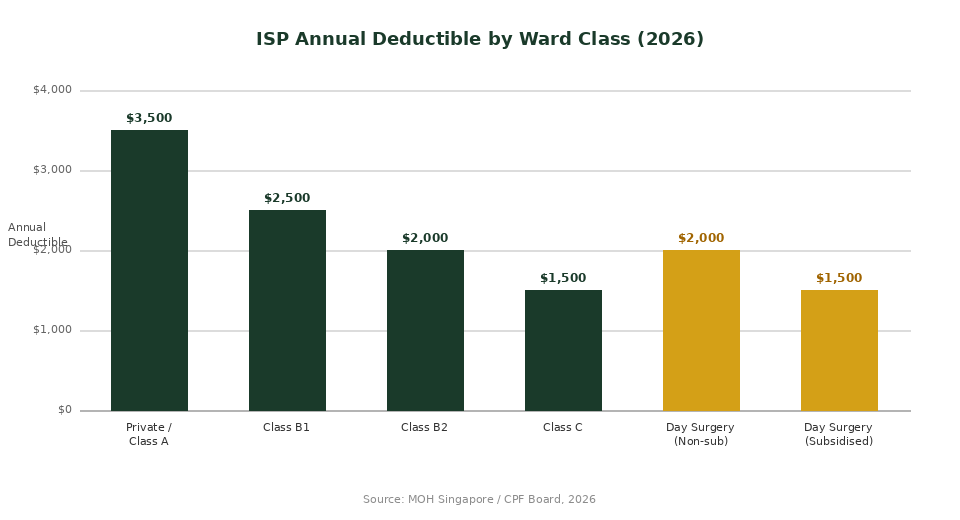
| Ward Class | Annual Deductible (2026) |
|---|---|
| Private Hospital / Class A (Restructured) | $3,500 |
| Class B1 (Restructured) | $2,500 |
| Class B2 (Restructured) | $2,000 |
| Class C (Restructured) | $1,500 |
| Day Surgery (Non-subsidised) | $2,000 |
| Day Surgery (Subsidised) | $1,500 |
Source: MOH Singapore, 2026 ISP framework
| Co-payment Rule | 2026 Figure | Previous Figure |
|---|---|---|
| Co-payment rate on eligible claims | 5% minimum | 0% (full rider) |
| Annual co-payment cap | $6,000 minimum | $3,000 |
| Medisave daily limit: Days 1–2 | $1,130/day | $1,050/day |
| Medisave daily limit: Day 3 onwards | $400/day | $400/day |
| Basic Healthcare Sum (Medisave cap) | $79,000 | $71,500 (2025) |
Source: MOH Singapore / CPF Board, October 2026
Five Real Hospital Bill Case Studies (2026)
All five scenarios assume the patient holds an ISP with a new-style rider (5% co-pay, $6,000 annual cap). The deductible is assumed not yet met for the year. Bills are illustrative but based on typical restructured and private hospital charges for each condition. For a deeper look at how premiums and co-pay are calculated, see the ISP rider co-payment and premium calculation guide for 2026.
Case Study 1 — Appendicitis, Private Hospital (Total Bill $22,000)
Sarah, 38, is rushed to a private hospital for an emergency appendectomy. She has an ISP covering private hospitals and a new-style rider with 5% co-payment. Her total bill is $22,000 for a 4-day stay.
| Bill Component | Amount |
|---|---|
| Total hospital bill | $22,000 |
| MediShield Life payout (benchmark) | −$6,000 |
| ISP covers (above MediShield Life, up to bill) | Applies after deductible |
| Annual deductible (Private/Class A) | $3,500 (patient pays) |
| Eligible amount above deductible | $18,500 |
| 5% co-payment (patient’s share) | $925 |
| ISP rider pays (95% above deductible) | $17,575 |
| Patient total out-of-pocket | $4,425 |
Of the $4,425, the $3,500 deductible and $925 co-pay can both be paid via Medisave (subject to daily withdrawal limits).
Case Study 2 — Knee Replacement Surgery, Class B1 (Total Bill $18,000)
Raj, 64, has an elective knee replacement in a restructured hospital Class B1 ward. He stays 5 days. His ISP covers Class B1 with a 5% co-payment rider.
| Bill Component | Amount |
|---|---|
| Total hospital bill | $18,000 |
| Annual deductible (Class B1) | $2,500 |
| Eligible amount above deductible | $15,500 |
| 5% co-payment | $775 |
| Patient total out-of-pocket | $3,275 |
For a 5-day stay, Medisave can cover: Days 1–2 at $1,130/day = $2,260; Days 3–5 at $400/day = $1,200 — total Medisave coverage up to $3,460 per hospitalisation, well above the $3,275 bill.
Case Study 3 — Day Surgery (Cataract), Non-Subsidised (Total Bill $6,500)
Linda, 67, undergoes cataract surgery as a day procedure at a private specialist. No overnight stay required. She uses her ISP rider (non-subsidised day surgery).
| Bill Component | Amount |
|---|---|
| Total day surgery bill | $6,500 |
| Annual deductible (day surgery, non-sub) | $2,000 |
| Eligible above deductible | $4,500 |
| 5% co-payment | $225 |
| Patient total out-of-pocket | $2,225 |
Day surgery is treated as a 1-day stay for Medisave purposes; up to $1,130 can be drawn, covering most of the deductible.
Case Study 4 — Cancer Diagnosis, Major Resection, Private Hospital (Total Bill $80,000)
Marcus, 55, is diagnosed with colon cancer and undergoes a major resection at a private hospital. He has a full private-hospital ISP with the new 5% co-payment rider. His stay is 10 days.
| Bill Component | Amount |
|---|---|
| Total hospital bill | $80,000 |
| Annual deductible (Private) | $3,500 |
| Eligible above deductible | $76,500 |
| 5% co-payment (uncapped) | $3,825 |
| Annual cap applies? (deductible + co-pay = $7,325 > $6,000) | Yes — capped at $6,000 |
| Patient total out-of-pocket (capped) | $6,000 |
The $6,000 annual cap is a key protection for catastrophic bills. For a 10-day stay, Medisave can cover: 2 days × $1,130 + 8 days × $400 = $5,460, leaving ~$540 to pay in cash.
Case Study 5 — Normal Delivery, Class B1 (Total Bill $5,500)
Hui Ling, 30, delivers her baby in a Class B1 room at a restructured hospital. 3-day stay. She uses her ISP rider for Class B1.
| Bill Component | Amount |
|---|---|
| Total bill | $5,500 |
| Annual deductible (Class B1) | $2,500 |
| Eligible above deductible | $3,000 |
| 5% co-payment | $150 |
| Patient total out-of-pocket | $2,650 |
For a 3-day stay: Medisave covers 2 days × $1,130 + 1 day × $400 = $2,660, fully covering the $2,650 out-of-pocket from Medisave.
What Medisave Can and Cannot Cover
One of the most common misconceptions is thinking Medisave can pay for everything. Here is the reality under the 2026 rules:
Medisave CAN pay for: The annual deductible, the 5% co-payment on eligible claims, day surgery fees, approved outpatient treatments (e.g. chemotherapy, dialysis), and certain chronic disease management fees.
Medisave CANNOT pay for: ISP or rider premiums (these must be paid in cash), non-medical charges (e.g. guest meals, phone, ward upgrade cash differences in some cases), and any amount above the Medisave daily withdrawal limits. In 2026, the Basic Healthcare Sum — the cap on Medisave balances — stands at $79,000.
The daily withdrawal limits are critical. For a 7-day hospitalisation, Medisave can cover: 2 days × $1,130 = $2,260 plus 5 days × $400 = $2,000, for a total of $4,260 from Medisave. Any patient share above $4,260 must be paid in cash. This is why having sufficient cash savings alongside your ISP remains important, even with a good plan.
Planning for long-term healthcare costs? Use our Singapore retirement planning calculator to factor in hospitalisation expenses alongside your CPF projections.
Legacy Rider vs New Rider: The Cost Difference
If you held an ISP with a full rider (zero co-payment above the deductible) before 1 April 2026, you have until the first policy renewal after 1 April 2028 to transition to the new-style rider. After that, old full-rider policies will no longer be available.
The table below shows what the transition means in dollar terms for a patient admitted to a private hospital.
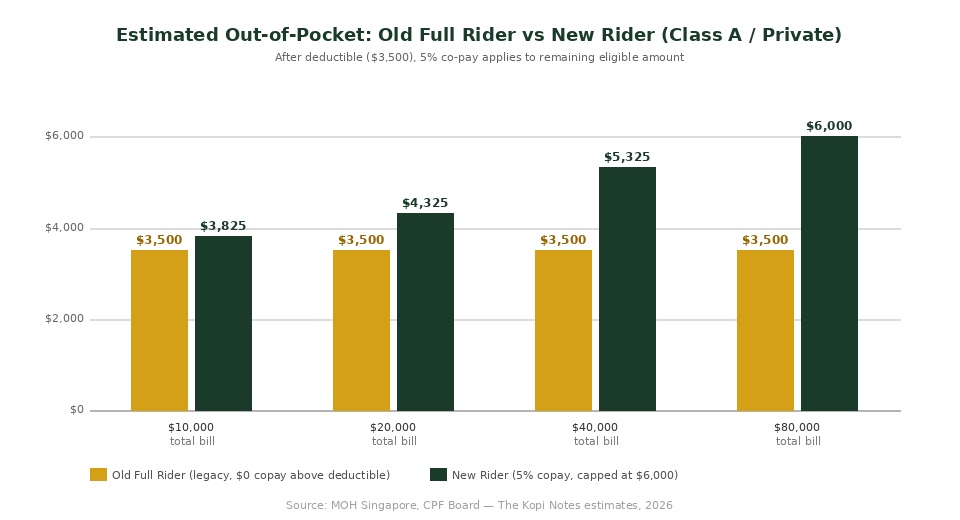
| Total Bill | Legacy Full Rider OOP | New Rider OOP (5%, $6k cap) | Extra Cost |
|---|---|---|---|
| $10,000 | $3,500 | $3,825 | +$325 |
| $20,000 | $3,500 | $4,325 | +$825 |
| $50,000 | $3,500 | $5,825 | +$2,325 |
| $80,000+ | $3,500 | $6,000 (cap) | +$2,500 |
Source: The Kopi Notes estimates based on MOH 2026 deductible and co-pay framework. Legacy OOP = deductible only, no co-pay. New OOP = deductible + 5% co-pay on eligible amount above deductible, capped at $6,000 total.
The additional out-of-pocket cost ranges from $325 for a $10,000 bill to a maximum of $2,500 for very large bills. For most hospitalisation events, the incremental cost is manageable — especially since Medisave can cover both the deductible and the co-payment. The real concern is for patients with multiple hospitalisations in one year, where the annual cap resets each policy year.
Reviewing Your Plan?
If you are reviewing your investment and insurance portfolio in tandem, platforms like Endowus allow you to invest your Medisave in approved funds while your cash savings remain liquid for healthcare co-payments. Always review your ISP with a licensed financial adviser before making changes to your coverage.
Frequently Asked Questions
What is the 2026 Medisave hospitalisation claim limit?
In 2026, Medisave daily withdrawal limits are $1,130 per day for the first two days of hospitalisation, and $400 per day from the third day onwards. These limits apply per hospitalisation episode. You can use Medisave to pay both the annual deductible and the 5% co-payment under your ISP rider.
How is the 5% co-payment calculated under the new ISP rider rules?
The 5% co-payment is calculated on the eligible claim amount above the annual deductible. For example, if your annual deductible is $3,500 and your total bill (eligible portion) is $20,000, the amount above the deductible is $16,500. You pay 5% of that, which is $825. Your ISP rider covers the remaining 95% ($15,675). Your total out-of-pocket is $3,500 + $825 = $4,325, assuming you have not already met your deductible that year.
What is the annual co-payment cap in 2026?
From 1 April 2026, the annual out-of-pocket co-payment cap for new ISP riders must be at least $6,000 per policy year. This is the combined deductible plus co-payment cap. The cap was previously $3,000 for riders with the pre-2016 partial co-payment structure. Once you reach the cap, your ISP rider covers 100% of all further eligible claims for the remainder of the policy year.
Can I use Medisave to pay ISP rider premiums?
No. ISP rider premiums cannot be paid from Medisave. You must pay rider premiums in cash. This is an important planning consideration: if your rider premium increases as you age, your monthly cash outlay will rise. Only the base ISP (MediShield Life supplement) premium has a Medisave payment component subject to Medisave contribution limits.
When do I need to switch from my legacy full rider to the new rider?
If you currently hold a legacy full-rider policy (with zero co-payment above the deductible), you are required to transition to a new-style rider by your first policy renewal on or after 1 April 2028. After that date, insurers will no longer be permitted to offer or renew legacy full-rider products. Contact your insurer well before your renewal date to understand your transition options.
What happens if I am hospitalised multiple times in the same year?
The annual deductible applies once per policy year, not per hospitalisation. If you are hospitalised a second time in the same policy year and have already met your deductible in the first admission, you skip the deductible and only pay the 5% co-payment for the second claim. Once the combined deductible plus co-payment for the year reaches the $6,000 annual cap, all further eligible claims are covered at 100% by your ISP rider for the rest of that policy year.
Does the 5% co-payment apply to the full bill or just part of it?
The 5% co-payment applies only to the eligible claim amount — the portion of the bill that your ISP is designed to cover. Non-covered charges such as certain ward upgrades, personal amenities, or treatments excluded by your policy are not part of the eligible amount. Always check your insurer’s Schedule of Benefits to understand what is covered under your specific plan.
This article is for educational purposes only and does not constitute financial, insurance, or medical advice. ISP benefits, deductibles, and co-payment rules may differ between insurers and individual policy terms. Always verify figures with your insurer and, where applicable, consult a licensed financial adviser before making changes to your health insurance coverage. Data as at October 2026.
Get Free Insurance Advice
Speak with a licensed insurance advisor. No obligation, no cost.
By submitting this form, you agree to our Privacy Policy.
This article was researched with the help of AI. While we strive to keep all information accurate and up to date, there may be errors. If you notice any discrepancies, please contact us.