Singapore T-Bill 2026: Latest Rates, Auction Schedule & How to Apply
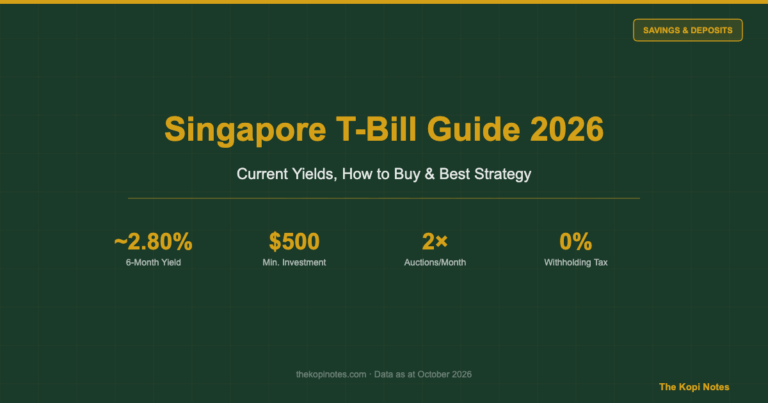
Singapore T-bills (Treasury Bills) are short-term Singapore Government Securities (SGS) issued by the Monetary Authority of Singapore (MAS) with 6-month or 1-year tenors. Unlike fixed deposits, T-bills use a discount mechanism — you pay slightly less than face value upfront and receive the full S$1,000 face value at maturity. They are fully backed by the AAA-rated Singapore Government and available to retail investors from as little as S$1,000 via ATM, internet banking, CPF OA, or SRS.
Not financial advice. All figures are for educational reference only. T-bill cut-off yields change at every auction — check the latest MAS results at mas.gov.sg before applying. Data as at November 2026.
Table of Contents
Jump to a section
What Is a Singapore T-Bill?
A Singapore T-bill is a short-term debt instrument issued by the Singapore Government, auctioned by MAS on its behalf. “T-bill” stands for Treasury Bill. Unlike bonds, T-bills pay no periodic coupon interest. Instead, they are issued at a discount to face value — you pay less than S$1,000 per T-bill, and receive exactly S$1,000 at maturity. The difference is your return.
Two tenors are available to retail investors:
- 6-month T-bill — auctioned roughly every 4 weeks, most popular with retail investors
- 1-year T-bill — auctioned roughly every 3 months
T-bills are issued in multiples of S$1,000, with a minimum of S$1,000 per application. There is no upper limit. They are among the safest investments available to Singapore retail investors — backed by the full faith and credit of the Singapore Government (AAA rating from all major agencies).
Latest Singapore T-Bill Rate & 2026 Auction Schedule
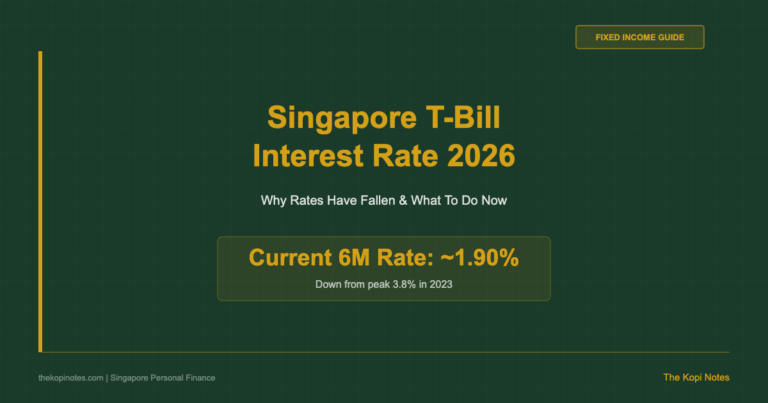
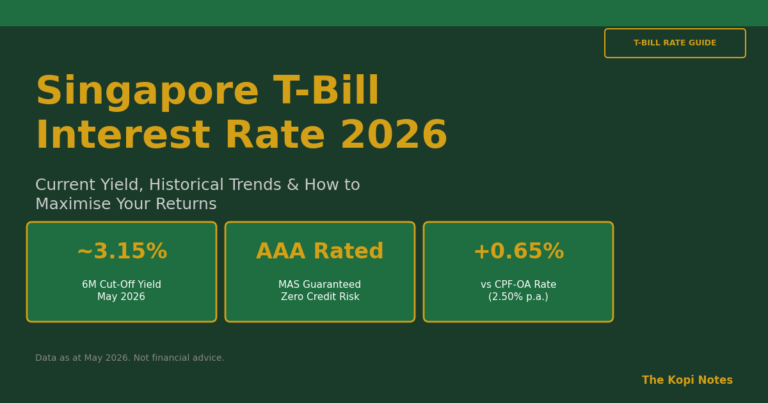
Singapore T-bill cut-off yields are closely tied to global interest rates, particularly the US Federal Reserve’s policy rate. Following a series of Fed rate cuts in 2024–2025, T-bill yields moderated significantly from their 2023 peaks of around 3.8%–4.2%. In 2026, 6-month T-bill yields have broadly ranged between 1.8% and 3.2% p.a., depending on market conditions at each auction date.
Important: The cut-off yield is set by the auction market — it changes every auction and cannot be predicted in advance. Always check the MAS website for the latest results before making financial decisions.
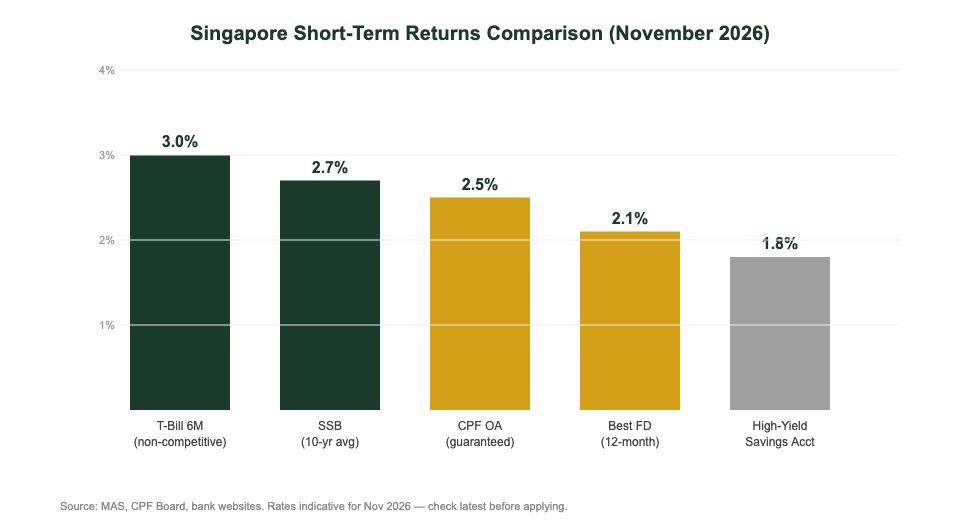
Source: MAS, CPF Board, bank websites. Rates are indicative for Nov 2026 — verify before applying. T-bill yield shown is approximate mid-2026 range.
6-month T-bills are auctioned on the following approximate schedule in 2026 (check MAS.gov.sg for exact dates):
| Auction Month | Tenor | Applications Open (approx.) | Settlement |
|---|---|---|---|
| Monthly (6M) | 6 months | 1st–3rd Thursday of the month | ~8 business days after close |
| Quarterly (1Y) | 1 year | Jan / Apr / Jul / Oct | ~8 business days after close |
Source: MAS SGS auction calendar 2026. Dates subject to change — always verify at mas.gov.sg/monetary-policy-and-markets/singapore-government-securities.
How the Discount Mechanism Works
Many first-time applicants are confused by T-bills because you don’t receive interest separately — the return is built into the purchase price. Here’s how it works:
Suppose the cut-off yield for a 6-month T-bill is 3.0% p.a. If you apply for S$10,000 face value:
- You pay approximately S$9,851 at settlement (the discounted price)
- At maturity (6 months later), MAS credits S$10,000 to your account
- Your profit: S$149, equating to ~3.0% annualised
If the yield is lower — say 2.0% p.a. — you’d pay approximately S$9,900 and receive S$10,000 at maturity (profit: ~S$100 on S$10,000). The lower the yield, the less attractive the T-bill relative to alternatives like the Singapore Savings Bonds guide or CPF top-ups.
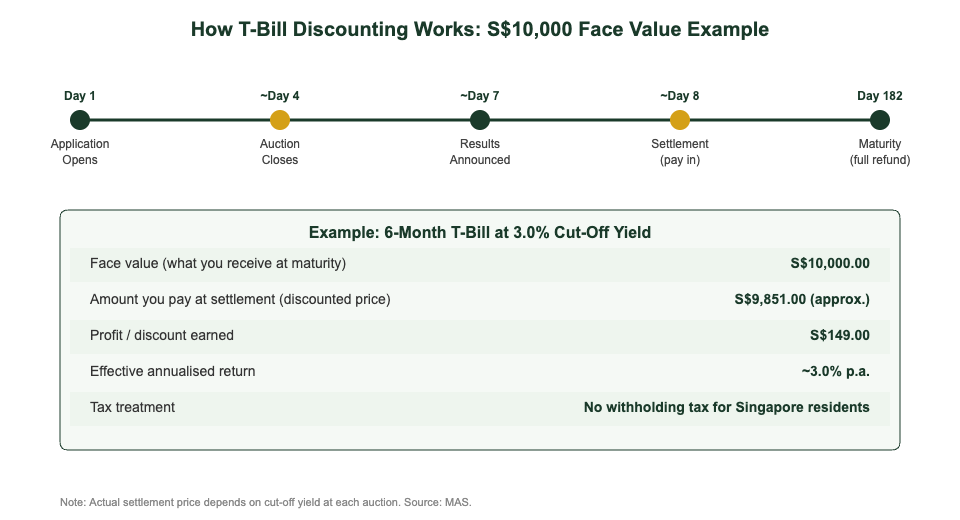
Source: MAS. Example uses illustrative 3.0% yield — check the actual cut-off yield from the latest MAS auction results.
How to Apply for Singapore T-Bills (Step-by-Step)
Retail investors can apply for T-bills through several channels. The most common is via internet banking or an ATM. Here’s the step-by-step process for cash applications:
Via Internet Banking (DBS/POSB, UOB, OCBC):
- Log in to your bank’s internet banking portal
- Navigate to “Investments” → “Singapore Government Securities” or similar
- Select “T-Bills” and the upcoming auction
- Enter your face value amount (minimum S$1,000, multiples of S$1,000)
- Choose “Non-competitive bid” (recommended for retail investors — you receive the cut-off yield automatically)
- Confirm the application — funds are debited from your account at settlement, not immediately
Via ATM (DBS/POSB only):
- Insert your card and enter PIN
- Select “Investment Services” → “Singapore Government Securities”
- Follow on-screen prompts to apply for the desired amount
Important dates to note: Applications typically open 4–5 business days before the auction close date. You must apply before the closing time (usually 9:00pm on the closing day for internet banking; check MAS for exact times).
Applying via CPF OA and SRS
One of the most attractive features of Singapore T-bills is that you can invest CPF Ordinary Account (OA) funds and Supplementary Retirement Scheme (SRS) funds — both typically offering better yields than the base CPF-OA rate of 2.5% p.a. (when T-bill yields are higher than 2.5%).
However, with yields in 2026 dipping close to or below 2.5%, this comparison has become less clear-cut. A Singapore investor with S$100,000 in CPF-OA earning 2.5% guaranteed may be better off leaving funds in CPF-OA rather than locking into a T-bill at 2.0–2.3%. Always compare the current cut-off yield against the guaranteed CPF-OA rate before deciding.
| Application Method | Min Amount | Account Type | Key Notes |
|---|---|---|---|
| DBS/POSB iBanking | S$1,000 | Cash (bank account) | Most straightforward; T-bill maturity credited back to bank |
| UOB iBanking | S$1,000 | Cash | Requires a UOB bank account |
| OCBC iBanking | S$1,000 | Cash | Available via OCBC app or internet banking |
| CPF OA (CPFIS) | S$1,000 | CPF Ordinary Account | Can outperform 2.5% CPF-OA rate only if cut-off yield > 2.5%; check before applying |
| SRS | S$1,000 | SRS Account | Apply via your SRS operator bank (DBS/POSB, OCBC, or UOB) |
| DBS/POSB ATM | S$1,000 | Cash | Older method; internet banking generally easier |
Source: MAS, CPF Board. Verify eligibility and application windows at mas.gov.sg.
T-Bill vs SSB vs Fixed Deposit vs CPF-OA
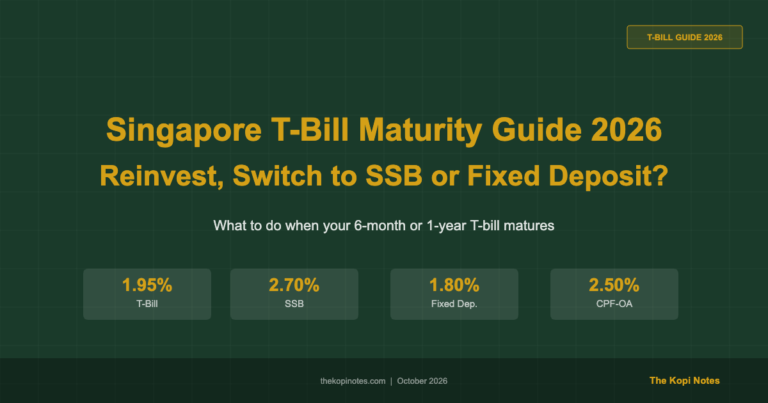
Singapore retail investors in 2026 have several competing risk-free or near-risk-free options. Here’s how T-bills stack up — and why the “best” choice depends on your timeline, flexibility needs, and current yields:
| Product | Typical 2026 Yield | Tenure | Liquidity | Risk |
|---|---|---|---|---|
| 6M T-Bill | 1.8%–3.0% (variable) | 6 months (fixed) | Cannot redeem early; sell on secondary market only | Zero — Singapore Government |
| Singapore Savings Bonds (SSB) | 2.5%–2.8% (10-yr avg) | Up to 10 years, flexible | Can redeem any month with no penalty | Zero — Singapore Government |
| CPF Ordinary Account | 2.5% guaranteed | Ongoing | Illiquid until withdrawal eligibility | Zero — CPF Board |
| Best Fixed Deposit (12M) | 1.8%–2.3% | Fixed term | Typically early withdrawal penalty | SDIC-protected up to S$75,000 |
| High-Yield Savings Acct | 1.5%–2.5% (tiered) | None (ongoing) | Fully flexible | SDIC-protected up to S$75,000 |
Source: MAS, CPF Board, bank websites. Yields indicative for Nov 2026; always verify current rates. For a diversified passive income approach combining T-bills with dividend assets, read our guide on passive income Singapore.
The bottom line in late 2026: When T-bill yields exceed 2.5%, they can make sense for CPF-OA funds and SRS. When they fall below 2.5%, the Singapore Savings Bonds (with their monthly redemption flexibility) or simply leaving CPF-OA untouched often wins on a risk-adjusted, liquidity-adjusted basis.
Investors targeting longer-term passive income beyond cash instruments may also consider best S-REITs in Singapore 2026 for 5–7% yields, or route savings through platforms like Syfe referral code and sign-up bonus for auto-invested portfolios. Use our Singapore retirement calculator to model how different yield scenarios affect your long-term retirement goals.
Pros & Cons of Singapore T-Bills
| Pros | Cons |
|---|---|
| ✅ Zero credit risk — Singapore Government guarantee | ❌ Yield fluctuates — not guaranteed at time of application |
| ✅ Short 6-month tenure — capital returns quickly | ❌ Cannot redeem early (must sell on secondary market at potential discount) |
| ✅ No Singapore income tax on returns for residents | ❌ In 2026, yield often below CPF-OA 2.5% — making CPF-OA the safer guaranteed choice |
| ✅ Usable with CPF OA and SRS funds | ❌ Competitive bid applicants risk being allotted partially or not at all |
| ✅ Simple online application process | ❌ 8-business-day settlement lag — funds tied up during auction period |
Frequently Asked Questions: Singapore T-Bills 2026
What is the current Singapore T-bill interest rate in 2026?
How do I apply for a Singapore T-bill?
Can I use CPF OA money to buy T-bills?
What happens if I don't get allotted in a T-bill auction?
Are T-bills taxed in Singapore?
What is the difference between a T-bill and a Singapore Savings Bond (SSB)?
Can I sell my T-bill before maturity?
Maximise Your Savings with the Right Platform
While T-bills are an excellent risk-free option, diversifying into higher-yielding assets like S-REITs or a managed income portfolio can significantly boost your long-term passive income.
This article was researched with the help of AI. While we strive to keep all information accurate and up to date, there may be errors. If you notice any discrepancies, please contact us.