Dividend Investing in Singapore: Best LSE ETFs for Passive Income (2026 Guide)
Ireland-domiciled. 15% withholding tax. No US estate tax risk.
For Singapore investors building a dividend income portfolio, Ireland-domiciled ETFs listed on the London Stock Exchange (LSE) are the most tax-efficient option available. Funds like VHYL (Vanguard FTSE All-World High Dividend Yield UCITS ETF) pay only 15% withholding tax on US dividends — exactly half the 30% levied on US-listed equivalents such as VYM and SCHD. Singapore residents pay zero additional tax on foreign dividends received personally. The result: materially higher net income every year, from the same underlying holdings.
Not financial advice. All figures are for educational reference only and may not reflect current market conditions. Data as at October 2026 unless noted.
In This Guide
- Why Singapore Investors Should Use LSE Dividend ETFs
- How Dividend ETFs Work (and Why Domicile Matters)
- The Real Cost of Withholding Tax: LSE vs US-Listed
- Best Dividend ETFs for Singapore Investors 2026
- How to Build a Dividend Portfolio in Singapore
- How to Buy Dividend ETFs: Brokers and Step-by-Step
- Frequently Asked Questions
1. Why Singapore Investors Should Use LSE Dividend ETFs
Many Singapore investors discover dividend ETFs through US platforms and naturally gravitate towards American funds like SCHD or VYM. These funds have excellent reputations — low fees, strong track records, and millions of satisfied US investors. But for Singapore residents, buying them directly on the NYSE creates two significant tax disadvantages that quietly erode dividend income every year.
The Withholding Tax Problem
When a US-domiciled ETF (registered in the United States) distributes dividends to a Singapore investor, the US government withholds 30% at source. A Singapore investor who receives SGD 3,200 in gross dividends from VYM walks away with only SGD 2,240 — SGD 960 disappears into the US tax system. There is no way to reclaim this amount for Singapore residents, as Singapore and the United States do not have a comprehensive double tax treaty covering portfolio investments.
Ireland-domiciled UCITS ETFs solve this problem elegantly. Because Ireland and the United States have a bilateral tax treaty, Irish-registered funds pay only 15% withholding tax on dividends received from US companies. When VHYL (domiciled in Ireland) collects dividends from US stocks in its portfolio, the tax rate is half what a US-domiciled fund would pay. That saving flows directly to you as higher net distributions.
US Estate Tax: A Hidden Risk
Beyond withholding tax, Singapore investors who hold US-listed ETFs face US estate tax exposure. The United States imposes estate tax on “US situs assets” — which includes stocks and ETFs listed on US exchanges — held by non-US persons. The exemption threshold for non-residents is only USD 60,000. An investor with more than SGD 80,000 in US-listed ETFs technically has potential US estate tax exposure on the amount above this threshold.
LSE-listed UCITS ETFs are domiciled in Ireland, not the United States. They are not US situs assets, so they carry zero US estate tax exposure regardless of portfolio size. This is a structural advantage that compounds in importance as your portfolio grows.
Singapore’s Tax Advantage for Foreign Dividends
Singapore has no capital gains tax and does not tax individuals on foreign-sourced dividends received into a Singapore bank or brokerage account. This means that when VHYL pays you a quarterly distribution (net of the 15% WHT already deducted at fund level), you receive and keep 100% of that distribution with no additional Singapore income tax due. The tax efficiency of passive income in Singapore extends beyond ETFs to S-REITs and Singapore Savings Bonds — but for global equity dividend exposure, LSE dividend ETFs remain the most efficient vehicle.
2. How Dividend ETFs Work (and Why Domicile Matters)
A dividend ETF holds a basket of stocks selected for their above-average dividend yields or consistent dividend growth history. Instead of building a diversified portfolio of individual dividend stocks, a dividend ETF does this automatically for a small annual fee.
Distributing vs. Accumulating ETFs
A distributing ETF pays out dividends to investors on a regular schedule — quarterly or semi-annually — as cash into your brokerage account. An accumulating ETF automatically reinvests dividends inside the fund; the share price increases over time instead of cash being paid out. For Singapore investors, the accumulating vs. distributing distinction has less tax significance than in many other countries, since Singapore does not tax personally received foreign dividends regardless. For dividend income investors, distributing ETFs are the natural choice. All three ETFs featured in this guide — VHYL, UDVD, and IDVY — are distributing funds.
Where Withholding Tax Is Deducted
This is the part most investors miss. When VHYL holds US stocks in its portfolio and those companies pay dividends, the withholding tax is deducted at the fund level — before the money reaches you as an investor. The WHT is paid by the fund (an Irish entity) to the US government under the Ireland-US tax treaty, at the treaty rate of 15%.
By the time the quarterly distribution appears in your brokerage account, it already reflects the 15% WHT deduction from US-sourced dividends. You do not pay additional withholding tax as a Singapore investor. You do not pay Singapore income tax on this distribution. VHYL’s portfolio is globally diversified — approximately 40% US stocks, 20% European, 20% Asia-Pacific, and 20% other markets — so only the US portion of dividends is subject to the 15% WHT. European, Asian, and other dividends may have their own country-level WHT at typically lower rates, making the blended effective WHT for VHYL notably lower than for a pure-US fund.
3. The Real Cost of Withholding Tax: LSE vs US-Listed
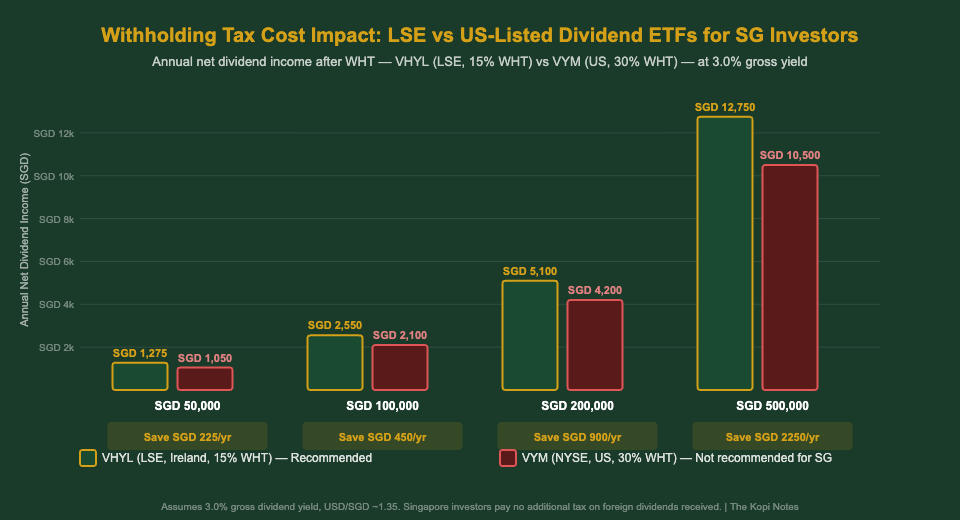
Let’s put concrete numbers to the WHT difference. Assume a 3.0% gross dividend yield — broadly in line with VHYL’s historical distributions. On a SGD 100,000 portfolio, this generates SGD 3,000 in gross dividends annually.
- VHYL (LSE, 15% WHT on ~40% US portion): Net effective yield approximately 2.82%. Annual income on SGD 100,000: ~SGD 2,820.
- VYM (NYSE, 30% WHT for SG investors): At 3.2% gross yield with 30% WHT deducted. Net yield: 2.24%. Annual income on SGD 100,000: ~SGD 2,240.
- Annual WHT saving from VHYL over VYM: ~SGD 580 per SGD 100,000 invested.
| Portfolio Size | VHYL (LSE) Net Income/Year | VYM (US) Net Income/Year | WHT Saving/Year |
|---|---|---|---|
| SGD 50,000 | ~SGD 1,410 | ~SGD 1,120 | ~SGD 290 |
| SGD 100,000 | ~SGD 2,820 | ~SGD 2,240 | ~SGD 580 |
| SGD 200,000 | ~SGD 5,640 | ~SGD 4,480 | ~SGD 1,160 |
| SGD 500,000 | ~SGD 14,100 | ~SGD 11,200 | ~SGD 2,900 |
Illustrative. VHYL: 3.0% gross, 15% WHT on ~40% US portion. VYM: 3.2% gross, 30% WHT applied at SG investor level. Not a guarantee of future income. USD/SGD ~1.35.
Notice that VYM has a slightly higher gross yield but ends up delivering less net income because of the 30% WHT penalty. This is a consistent pattern: low-headline-fee US dividend ETFs often look attractive until you account for the full tax cost for Singapore investors.
4. Best Dividend ETFs for Singapore Investors 2026
The following ETFs are all listed on the London Stock Exchange (LSE), domiciled in Ireland, and structured as UCITS funds. They are accessible to Singapore investors through IBKR, Saxo, FSMOne, Syfe Brokerage, and most major online brokers. All are distributing funds that pay regular dividends.
VHYL — Vanguard FTSE All-World High Dividend Yield UCITS ETF
VHYL is the flagship global dividend ETF for Singapore investors. It tracks the FTSE All-World High Dividend Yield Index, which captures the highest-yielding ~50% of the global FTSE All-World universe by dividend yield. The fund holds approximately 1,900 stocks across more than 40 countries.
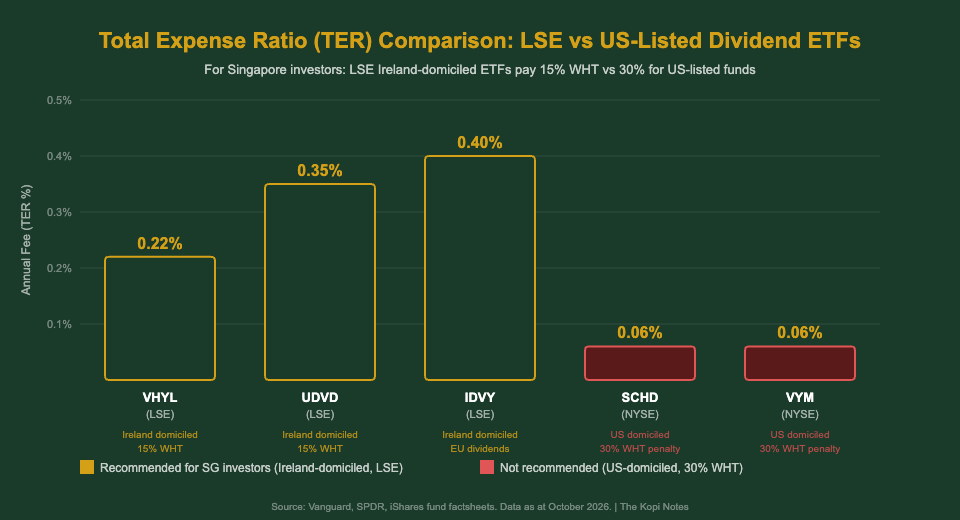
- TER: 0.22% per annum
- Dividend yield: ~3.0–3.5% (varies with market)
- Distribution frequency: Quarterly
- Domicile: Ireland (UCITS)
- LSE ticker: VHYL (USD)
- AUM: Over USD 6 billion
VHYL excludes REITs, which prevents double-counting for Singapore investors who already hold S-REITs separately. Its global reach means no single country, sector, or company dominates the portfolio. The top-10 holdings typically include HSBC, Samsung, Nestlé, and major US financial and energy companies. For most Singapore dividend investors, VHYL is the core holding. Check the VHYL factsheet on Vanguard UK for the latest data.
UDVD — SPDR S&P US Dividend Aristocrats UCITS ETF
UDVD focuses on dividend quality rather than maximising current yield. It selects only US companies from the S&P Composite 1500 that have raised their dividends for at least 20 consecutive years. This results in a portfolio of approximately 65 highly disciplined companies with long track records.
- TER: 0.35% per annum
- Dividend yield: ~2.0–2.5%
- Distribution frequency: Quarterly
- Domicile: Ireland (UCITS)
- LSE ticker: UDVD (USD)
The lower yield of UDVD reflects the quality premium — companies that have consistently raised dividends tend to trade at higher valuations. UDVD pairs well with VHYL: VHYL provides higher current yield, while UDVD provides dividend growth potential.
IDVY — iShares Euro Dividend UCITS ETF
IDVY provides exposure to high-yielding European equities, offering currency diversification (EUR exposure) and sector diversification away from the US-heavy VHYL. European dividend yields tend to run higher than US equivalents.
- TER: 0.40% per annum
- Dividend yield: ~4.0–5.0%
- Distribution frequency: Quarterly
- Domicile: Ireland (UCITS)
- LSE ticker: IDVY (GBP)
IDVY is a specialist pick for investors who want European dividend exposure or are comfortable with currency fluctuation. Check the iShares IDVY product page for the latest factsheet.
Full Dividend ETF Comparison Table
| ETF | Ticker (LSE) | TER | Approx. Yield | Domicile | WHT | Focus |
|---|---|---|---|---|---|---|
| VHYL ✓ | VHYL | 0.22% | ~3.0–3.5% | Ireland | 15% (US) | Global high yield, ~1,900 stocks |
| UDVD ✓ | UDVD | 0.35% | ~2.0–2.5% | Ireland | 15% (US) | US Dividend Aristocrats, 20+ yr record |
| IDVY ✓ | IDVY | 0.40% | ~4.0–5.0% | Ireland | EU WHT varies | European high dividend stocks |
| SCHD ✗ | NYSE: SCHD | 0.06% | ~3.5% | USA | 30% WHT | US dividend quality — not for SG |
| VYM ✗ | NYSE: VYM | 0.06% | ~3.2% | USA | 30% WHT | US high yield — not for SG |
Source: Vanguard UK, SPDR, iShares fund pages. TER and yield as at October 2026. Yield is approximate and varies with market conditions. ✓ = recommended for SG investors. ✗ = not recommended due to 30% WHT.
5. How to Build a Dividend Portfolio in Singapore
How you combine dividend ETFs depends on whether your primary goal is maximising current income, growing income over time, or currency diversification. Here are three practical portfolio models for Singapore dividend investors.
Model 1: Pure Income Portfolio
Best for: Retirees or near-retirees who need regular income today.
| ETF | Allocation | Role |
|---|---|---|
| VHYL | 70% | Global high yield core; maximises current dividend income |
| UDVD | 30% | US dividend quality; adds stability and income growth |
Estimated blended yield: ~2.8–3.2%. All income is paid as cash distributions quarterly. Both ETFs are Ireland-domiciled and listed on LSE.
Model 2: Balanced Growth + Income Portfolio
Best for: Investors who want to accumulate wealth while receiving some dividend income. The core growth engine (CSPX) accumulates dividends internally, while the income layer (VHYL, UDVD) pays regular distributions.
| ETF | Allocation | Role |
|---|---|---|
| CSPX (S&P 500 accumulating) | 50% | Growth core; capital appreciation over time |
| VHYL | 30% | Income layer; regular cash distributions |
| UDVD | 20% | Income layer; US dividend quality and growth |
Model 3: Globally Diversified Income
Best for: Investors who want full global and currency diversification beyond USD.
| ETF | Allocation | Role |
|---|---|---|
| VHYL | 50% | Global diversified income core |
| UDVD | 25% | US dividend quality |
| IDVY | 25% | European dividend stocks; EUR exposure; higher yield |
Dollar-Cost Averaging and RSP
Regardless of which portfolio model you choose, regular investing via dollar-cost averaging (DCA) reduces timing risk. FSMOne and Syfe Brokerage both offer RSP functionality for LSE-listed ETFs. Check the FSMOne referral code for any current sign-up promotions — FSMOne’s RSP lets you automate monthly purchases of VHYL and other LSE ETFs with no minimum holding period requirement.
Using SRS to Amplify Your Dividend Returns
The Supplementary Retirement Scheme (SRS) is an underused tool for Singapore investors. Annual SRS contributions (up to SGD 15,300 for Singapore citizens and PRs) qualify for tax deduction against your personal income tax — effectively giving you a 7–22% upfront bonus on your investment, depending on your income tax bracket. SRS funds can be invested in LSE ETFs through SRS-eligible brokers including IBKR and FSMOne. Use the Singapore retirement calculator on The Kopi Notes to model how your SRS contributions and dividend ETF returns compound over time. For investors who also want Singapore-listed real estate exposure in their income portfolio, our Singapore REIT ETF guide covers the main S-REIT ETF options alongside individual S-REIT investing strategies.
6. How to Buy Dividend ETFs in Singapore: Brokers and Step-by-Step
LSE-listed ETFs like VHYL and UDVD are available through most online brokers in Singapore. The key differences between brokers are commission rates, FX conversion costs, and whether they support SRS investing.
| Broker | Commission (LSE) | Min Commission | SRS? | Best For |
|---|---|---|---|---|
| IBKR | USD 1.70/trade | USD 1.70 | Yes | Lowest cost; large portfolios |
| Syfe Brokerage | USD 1.49/trade | USD 1.49 | No | Beginners; simple app |
| FSMOne | SGD 8.80/trade | SGD 8.80 | Yes | SRS investors; RSP automation |
| Saxo Markets | 0.08% (min USD 3) | USD 3.00 | Yes | Mid-size portfolios; SRS |
| moomoo | 0.03% (min USD 1.99) | USD 1.99 | No | Active traders; low per-trade cost |
Commission rates as at October 2026. Brokers may charge additional FX fees when converting SGD to GBP/USD. Always verify current fees with the broker.
How to Buy VHYL on IBKR (Step-by-Step)
IBKR (Interactive Brokers) offers the lowest commission for most Singapore investors buying LSE ETFs. Use referral code jianxiong368 when signing up at ibkr.com.sg.
- Fund your IBKR account — transfer SGD via FAST or SWIFT. IBKR holds SGD in your account.
- Search for “VHYL” — select the listing on LSE (London Stock Exchange), currency GBP or USD.
- Convert currency — IBKR’s Ideal Pro FX lets you convert SGD to GBP at near-market rates (0.1–0.2% spread).
- Place a Limit Order — set your price just above the current bid for a high fill rate.
- Confirm the trade — VHYL shares settle T+2 (two business days).
How to Buy VHYL on Syfe Brokerage
Syfe Brokerage is the simplest entry point for first-time LSE ETF investors. Sign up via the Syfe referral code and sign-up bonus page (code SRPRFFFCD) for any current promotional bonuses. Then: download the Syfe app → complete account opening → fund via PayNow → select “Self-Directed” → search VHYL → select the LSE listing → place your buy order.
For a detailed comparison of moomoo as an alternative broker, our moomoo Singapore review covers the platform’s fee structure, account opening, and suitability for LSE ETF investing.
Frequently Asked Questions
What is the difference between VHYL and VWRA for Singapore investors?
VWRA (Vanguard FTSE All-World UCITS ETF, accumulating) targets the broadest possible global equity exposure, including both dividend-paying and growth stocks. It is accumulating — dividends are reinvested automatically. VHYL specifically targets the highest-yielding half of the global equity universe and is distributing — it pays dividends as cash to investors quarterly. VWRA is the better choice for long-term wealth accumulation without needing current income; VHYL is the better choice for investors seeking regular dividend income. Both are Ireland-domiciled and listed on LSE.
Do I pay tax on dividend ETF income in Singapore?
Singapore residents do not pay personal income tax on foreign-sourced dividends received into a Singapore bank or brokerage account. This applies to distributions from LSE-listed ETFs like VHYL, UDVD, and IDVY. The withholding tax (15% for Ireland-domiciled funds under the Ireland-US treaty) happens at the fund level before you receive anything. No Singapore tax return filing is required for this income. If you are unsure about your specific tax situation, consult a Singapore-registered tax advisor.
What is the minimum investment to start dividend investing with LSE ETFs?
There is no regulatory minimum investment amount. The practical minimum is one share of VHYL (approximately GBP 60–70, or SGD 100–120, as at 2026) plus broker commission. For commission costs to be a small fraction of your investment (under 1%), a trade size of at least SGD 1,000–2,000 is more sensible. For a meaningful dividend income stream, most investors aim for a portfolio of at least SGD 30,000–50,000 in dividend ETFs.
Can I use my SRS account to invest in VHYL and other LSE ETFs?
Yes. SRS funds can be invested in LSE-listed ETFs through SRS-eligible brokers including IBKR (via their SRS brokerage account), FSMOne, and Saxo Markets. IBKR’s SRS account is separate from your regular cash account — you need to open it specifically as an SRS account and fund it with an SRS transfer from your SRS operator bank. FSMOne also supports SRS investing with a Regular Savings Plan for automated monthly purchases. Contributing to SRS reduces your taxable income by up to SGD 15,300 per year for Singaporeans and PRs, giving you an upfront tax saving at your marginal tax rate.
Is VHYL hedged against currency risk for Singapore investors?
The standard VHYL (USD-denominated, LSE ticker VHYL) is not currency-hedged. Its share price fluctuates in USD, and the underlying holdings are in multiple currencies (USD, EUR, GBP, JPY, HKD, and others). For a Singapore investor, your returns will be affected by SGD/USD movements when you convert. There is a GBP-hedged version (ticker VHYP), but it hedges to GBP rather than SGD, making it less useful for most Singapore investors. Currency risk is inherent in any global ETF and is generally accepted as a diversification trade-off over the long term.
How often does VHYL pay dividends, and how much?
VHYL distributes dividends quarterly — typically in March, June, September, and December. Distribution amounts vary based on the dividends received from underlying holdings during the period. Historical distributions can be found on the Vanguard UK website under the VHYL product page. The annualised yield has historically ranged between 2.5% and 4.0% depending on market conditions. On IBKR or Syfe Brokerage, distributions will appear automatically in your account cash balance after the payment date.
Start Your Dividend ETF Journey Today
Open a brokerage account and buy your first VHYL units. Use these referral codes for sign-up bonuses and promotions:
- IBKR: Code jianxiong368 at ibkr.com.sg
- Syfe Brokerage: Code SRPRFFFCD — Syfe referral code and sign-up bonus
- FSMOne: Code P0544985 — FSMOne referral code
- Endowus: Code 2V343
- Trust Bank: Code HTWYQP95
Not financial advice. Referral codes may change — verify on the respective broker’s website. TKN may receive a referral fee when you sign up using our codes.
This article was researched with the help of AI. While we strive to keep all information accurate and up to date, there may be errors. If you notice any discrepancies, please contact us.