VWRA vs Robo-Advisors: DIY ETF Investing vs Syfe Core & Endowus for Singapore Investors (2026)
A fee-by-fee breakdown of buying VWRA yourself versus letting Syfe Core or Endowus manage a globally diversified portfolio for you.
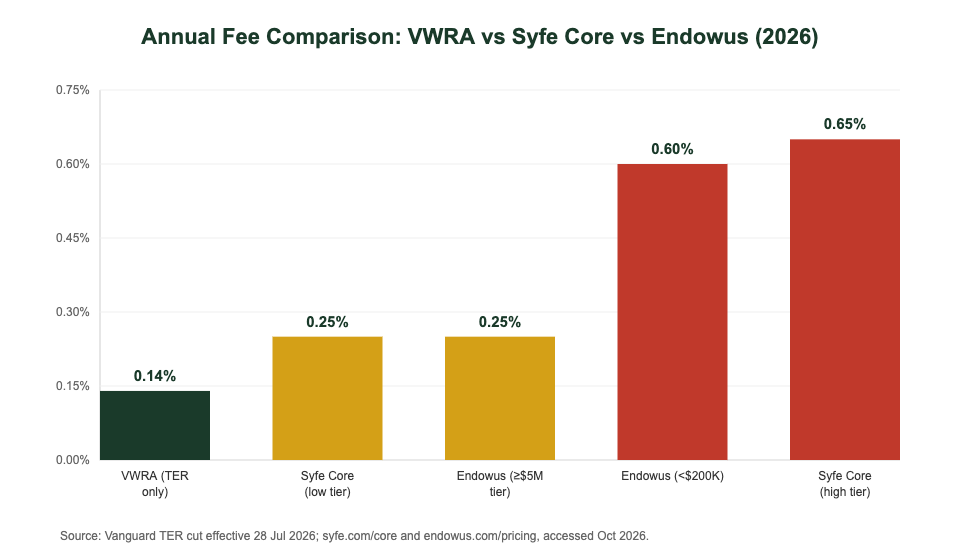
VWRA is a London-listed, Ireland-domiciled ETF tracking the FTSE All-World Index at just 0.14% TER (cut from 0.19% on 28 July 2026) — the cheapest DIY route to global diversification for Singapore investors. Robo-advisors like Syfe Core (0.25%–0.65% p.a.) and Endowus (0.15%–0.60% p.a.) charge more but add automatic rebalancing and zero manual effort. The right pick depends on how much convenience is worth to you.
Not financial advice. All figures are for educational reference only. Data verified as at 31 October 2026 unless otherwise noted.
Table of Contents
Quick Answer: VWRA or a Robo-Advisor?
For a Singapore investor who already has a brokerage account and is comfortable buying a single ETF once or twice a year, VWRA is hard to beat on pure cost — its total expense ratio (TER) was cut to 0.14% p.a. on 28 July 2026, the lowest it has ever been. Robo-advisors such as Syfe Core Equity100 (0.25%–0.65% p.a. all-in) and Endowus Flagship portfolios (0.15%–0.60% p.a. access fee, plus fund-level fees) cost more, but they bundle in automatic rebalancing, dividend handling, and — in Endowus’s case — the ability to invest idle CPF OA/SA and SRS monies, which VWRA cannot do. If you want the lowest lifetime cost and don’t mind the admin, buy VWRA directly through a broker. If you want a hands-off, multi-asset portfolio or need to deploy CPF/SRS funds, a robo-advisor is the more practical choice even at a higher fee.
Key Differences at a Glance
VWRA, Syfe Core Equity100 and Endowus Flagship all give Singapore investors broad, globally diversified equity exposure, but they are structurally very different products. VWRA is a single, self-directed ETF. Syfe Core is a professionally managed basket of UCITS ETFs with a smart-beta tilt. Endowus is an advisory platform that allocates across institutional-share-class funds, mainly from Dimensional. The table below lines up the core facts as at October 2026.
| Feature | VWRA (DIY) | Syfe Core Equity100 | Endowus Flagship |
|---|---|---|---|
| Structure | Self-directed single ETF | Managed multi-ETF portfolio | Managed multi-fund portfolio |
| Underlying holdings | One ETF, FTSE All-World Index (~3,600 stocks) | Multiple UCITS equity ETFs, up to 83% UCITS coverage, factor-tilted | Institutional-share-class funds, mostly Dimensional |
| All-in annual cost | 0.14% TER only | 0.25%–0.65% p.a., tiered by AUM | 0.15%–0.60% access fee + fund-level fee (0.05%–1%) |
| Rebalancing | None needed — single index fund | Automatic, twice yearly (April & October) | Automatic, ongoing |
| Dividend handling | Accumulating — reinvested inside the fund automatically | Auto-reinvested | Auto-reinvested; 100% trailer-fee cashback |
| CPF OA/SA or SRS eligible | No — cash brokerage account only | Core portfolios are cash-funded; Syfe offers separate SRS portfolios | Yes — CPF OA, CPF SA and SRS all supported |
| Account needed | Brokerage account (e.g. IBKR, Syfe Brokerage, moomoo) | Syfe account, no CDP required | Endowus account linked to a UOB Kay Hian trust account |
| Effort required | Significant — you place every trade and manage FX | Low | Low |
| 8-year annualised return | Tracks FTSE All-World Index minus 0.14% | 9.90% p.a. (gross of fees, since 30 Jun 2020 inception, partly backtested) | Varies by fund mix — not a single published figure |
Source: Vanguard TER announcement (effective 28 July 2026); syfe.com/core and endowus.com/pricing, both accessed 31 October 2026.
Tax & CPF/SRS Comparison
On pure tax treatment, there is less daylight between these three options than many investors assume. VWRA is domiciled in Ireland, which means US dividend withholding tax (WHT) on its underlying US holdings is capped at 15% under the Ireland–US tax treaty, versus 30% for a US-domiciled ETF like VOO, and VWRA carries no US estate tax exposure for Singapore-resident holders. Syfe Core Equity100 is explicitly built around UCITS-domiciled ETFs for the same reason — Syfe says its UCITS shift halves the withholding tax on US equity dividends compared with a non-UCITS portfolio. Endowus’s Flagship funds are similarly structured to minimise embedded withholding drag. None of the three attracts Singapore capital gains tax, since Singapore does not tax capital gains for individual investors.
The real differentiator is account eligibility, not tax rate. VWRA and Syfe Core can only be bought with cash — neither is CPF OA/SA or SRS-eligible through a standard brokerage purchase. Endowus is the only one of the three that lets you invest CPF Ordinary Account, CPF Special Account and SRS funds directly into a Flagship portfolio, which matters if your goal is to put idle CPF or SRS balances to work rather than deploying fresh cash. If CPF/SRS access is the deciding factor for you, read our CPF investment strategy guide before comparing platforms further.
Historical Performance
VWRA’s return is, by design, the FTSE All-World Index return minus its 0.14% TER — there is no active management to add or subtract performance. For the index’s own long-run CAGR and recent 1-year/3-year figures, see our dedicated VWRA historical returns breakdown. Syfe Core Equity100 has returned an average of 9.90% p.a. over the past 8 years (gross of fees, in USD terms, since its 30 June 2020 inception, with pre-inception figures based on backtested data), according to Syfe’s own published track record as at October 2026. Endowus does not publish a single blended return figure for Flagship because the exact fund mix depends on your risk profile and goals.
One nuance worth noting: because robo-advisor returns are already net of their advisory fee in most published figures, while a DIY investor must separately track and subtract brokerage costs, the headline numbers are not always comparing like with like. Always check whether a quoted return is gross or net of fees before drawing conclusions.
Total Cost Comparison (SGD 100,000 Example)
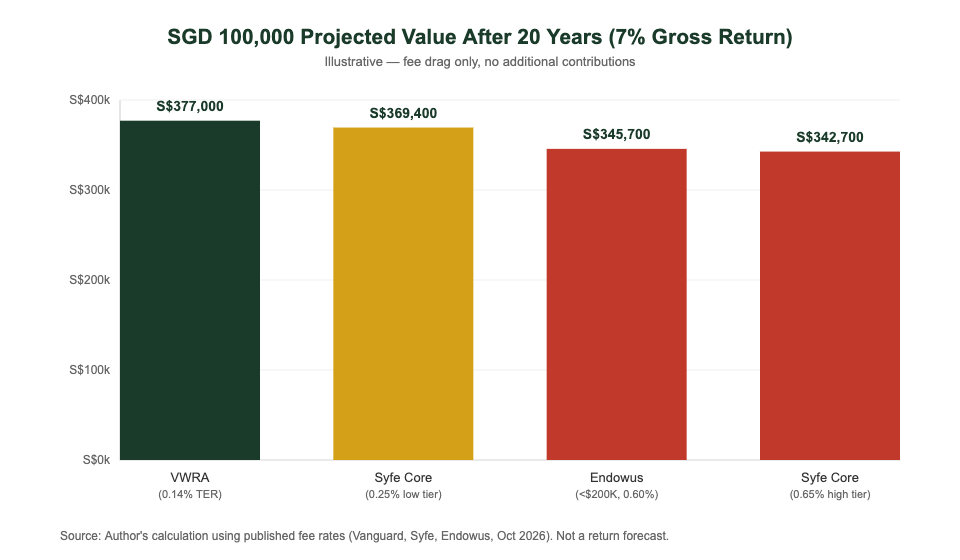
To make the fee difference concrete, here is what each option costs on a SGD 100,000 portfolio in year one, and the illustrative compounding effect over 20 years assuming a flat 7% gross annual return with no further contributions and no change in fee tier.
| Option | Annual Fee | Cost on SGD 100k (Year 1) | Projected Value After 20 Years* |
|---|---|---|---|
| VWRA (DIY, 0.14% TER) | 0.14% | SGD 140 | ~SGD 377,000 |
| Syfe Core Equity100 (lowest tier, 0.25%) | 0.25% | SGD 250 | ~SGD 369,400 |
| Endowus Flagship (<SGD 200K tier, access fee only, 0.60%) | 0.60% | SGD 600 | ~SGD 345,700 |
| Syfe Core Equity100 (highest tier, 0.65%) | 0.65% | SGD 650 | ~SGD 342,700 |
*Illustrative only, not a performance guarantee. Assumes a flat 7% p.a. gross return, no additional contributions, and a constant fee tier throughout — actual returns and fee tiers will vary. Endowus figure excludes the separate underlying fund-level fee (0.05%–1%, embedded in fund NAV per endowus.com/pricing), so real-world Endowus costs are typically higher than shown. Source: author’s calculation using fee rates published by Vanguard, Syfe and Endowus, accessed 31 October 2026.
Who Should Pick Which?
VWRA (DIY) is ideal if: you already hold or are comfortable opening a brokerage account such as Interactive Brokers or moomoo; you want the lowest possible lifetime cost and are willing to accept a small amount of annual admin (funding in USD, placing one trade); you have a long time horizon (15+ years) where a 0.1–0.5 percentage point annual fee difference compounds into a meaningful sum; and you don’t need CPF or SRS funds deployed into this specific holding.
Consider Syfe Core or Endowus instead if: you want a genuinely hands-off experience with automatic rebalancing and no need to think about FX or order types; you want a smoother, more diversified ride across equities, bonds and gold (Syfe’s Growth, Balanced and Defensive tiers do this) rather than 100% equities; or — specifically for Endowus — you want to invest idle CPF OA/SA or SRS balances and value the 100% trailer-fee cashback and conflict-free fund selection. Many Singapore investors use both: a core VWRA holding for cash savings, paired with an Endowus SRS portfolio for tax-relieved retirement contributions. For the maths behind long-term compounding, our retirement planning calculator lets you model either path with your own numbers.
If you’re still deciding between the two robo-advisors themselves rather than against VWRA, our separate Syfe vs FSMOne comparison and the broader ETF vs stock-picking guide cover the decision from other angles. And if cost-efficiency is your main lens, it’s worth re-reading our VWRA historical returns and CAGR analysis alongside this piece.
Reminder: this comparison is for educational purposes and is not financial advice. Fee tiers, TERs and portfolio compositions change over time — always verify current rates on Vanguard’s, Syfe’s and Endowus’s own websites before investing.
Frequently Asked Questions
Is VWRA cheaper than Syfe Core or Endowus for Singapore investors?
Yes, on the headline fee. VWRA’s total expense ratio is 0.14% p.a. as at 28 July 2026, versus 0.25%–0.65% p.a. all-in for Syfe Core Equity100 and 0.15%–0.60% p.a. access fee (plus a separate underlying fund-level fee) for Endowus. The trade-off is that robo-advisors handle rebalancing and, for Endowus, CPF/SRS investing, which VWRA cannot do on its own.
What is VWRA's expense ratio in 2026?
Vanguard cut the ongoing charge on the FTSE All-World UCITS ETF (the VWRA share class) from 0.19% to 0.14% p.a., effective 28 July 2026 — the second cut in about a year, following a reduction from 0.22% to 0.19% at the end of 2025.
Can I invest my CPF or SRS money in VWRA?
Not directly. VWRA is bought through a cash brokerage account on the London Stock Exchange and is not CPF or SRS-eligible through standard brokers. Syfe Core is similarly a cash-funded product, though Syfe offers separate SRS portfolios. Endowus is the only one of the three platforms discussed here that lets you invest CPF OA, CPF SA and SRS funds into a diversified portfolio.
Does Syfe Core Equity100 actually hold VWRA?
No. Syfe Core Equity100 does not hold VWRA directly — it is built from a basket of UCITS-domiciled ETFs selected and weighted using Syfe’s own smart-beta methodology, aiming for broad diversification with factor tilts rather than simply replicating the FTSE All-World Index that VWRA tracks.
Is a robo-advisor worth paying extra over buying VWRA myself?
It depends on what you value. On a SGD 100,000 portfolio held for 20 years at a flat 7% gross return, the fee gap between VWRA and a higher-tier Syfe Core or Endowus plan could mean roughly SGD 30,000–35,000 less in the robo-advisor scenario, purely from fees. If automatic rebalancing, no FX hassle, or CPF/SRS access are worth that much to you, the extra fee can be justified; if not, VWRA is the cheaper path.
Which broker should I use to buy VWRA in Singapore?
Interactive Brokers (IBKR), Saxo Markets, moomoo Singapore and Syfe Brokerage all offer access to VWRA on the London Stock Exchange. IBKR tends to be the most cost-effective for larger trade sizes, while Syfe Brokerage and moomoo are simpler for beginners funding smaller amounts.
Ready to Start Investing?
Whether you go DIY with VWRA or choose a managed portfolio, open an account and put your plan into action today.
This article was researched with the help of AI. While we strive to keep all information accurate and up to date, there may be errors. If you notice any discrepancies, please contact us.