GXS vs MariBank vs Trust Bank 2026: Which Digital Bank Really Pays More?
A straight 3-way comparison of Singapore’s three digital bank savings accounts — headline rate vs what an ordinary saver can actually earn, as at October 2026.
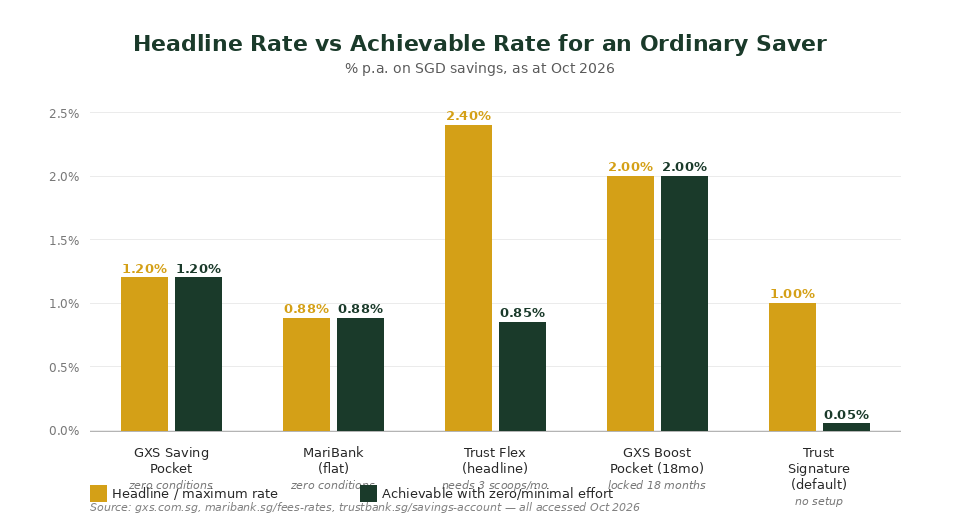
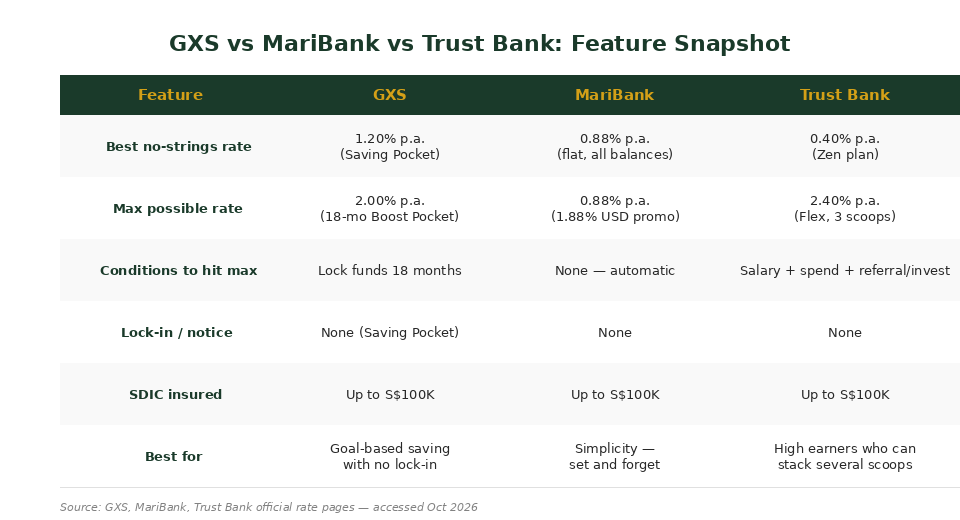
For a saver who won’t chase referrals, 20K TrustInvest purchases or an 18-month lock-up, GXS’s Saving Pocket at 1.20% p.a. currently pays the most with zero conditions, just ahead of MariBank’s unconditional flat 0.88% p.a. Trust Bank’s Flex plan advertises up to 2.40% p.a., but it needs three monthly “scoops” — realistically only 0.85% p.a. for someone doing the basics. The headline numbers rank very differently from what you’ll actually see land in your account.
Not financial advice. All figures are for educational reference only and were verified directly against GXS, MariBank and Trust Bank’s official rate pages as at October 2026 unless otherwise noted.
Table of Contents
Quick Answer
GXS, MariBank and Trust Bank are Singapore’s three standalone digital bank savings accounts, each regulated by the Monetary Authority of Singapore (MAS) and SDIC-insured up to S$100,000 per depositor. Until now, thekopinotes.com has only compared these three as part of larger TribeCar multi-platform combo articles — this is the first direct, standalone 3-way comparison. The short version: GXS’s no-conditions Saving Pocket (1.20% p.a.) and MariBank’s flat rate (0.88% p.a.) are the easiest to actually earn without lifting a finger. Trust Bank’s Flex plan can beat both at up to 2.40% p.a., but only if you commit to specific monthly habits — referring a friend, investing S$20,000, or crediting a salary. For most ordinary savers who don’t want to manage conditions every month, GXS or MariBank will put more real interest in the bank with far less effort.
Key Differences at a Glance
| Feature | GXS | MariBank | Trust Bank |
|---|---|---|---|
| Parent / backer | Grab & Singtel consortium | Sea Group (Shopee/SeaMoney) | Standard Chartered & FairPrice Group |
| No-conditions rate | 1.20% p.a. (Saving Pocket, limited-time) | 0.88% p.a. (flat, all balances) | 0.40% p.a. (Zen plan) |
| Maximum advertised rate | Up to 2.00% p.a. (18-month Boost Pocket) | 0.88% p.a. SGD / 1.88% p.a. USD promo | Up to 2.40% p.a. (Flex plan) |
| Lock-in required for max rate | Yes — 18-month Boost Pocket tenor | No | No — but needs 3 of 8 monthly “scoops” |
| Withdraw anytime | Yes (Saving Pocket & Main); Boost Pocket forfeits bonus if broken early | Yes | Yes |
| Max balance earning full rate | Platform-specific cap per pocket | S$100,000 (platform deposit cap) | First S$1.2 million |
| SDIC insured | Up to S$100,000 | Up to S$100,000 | Up to S$100,000 |
| Fall-below / transfer fees | None | None | None |
Source: gxs.com.sg/savings-account, maribank.sg/fees-rates/mari-savings-account, trustbank.sg/savings-account — all accessed October 2026.
Headline Rate vs What You’ll Actually Earn
This is the real differentiator between the three. Marketing pages lead with the biggest number they can legally advertise, but that number assumes you jump through every hoop. For a Singapore saver who wants decent interest without turning their banking into a part-time hobby, the “achievable” rate matters far more than the headline.
Take Trust Bank’s Flex plan: the advertised 2.40% p.a. requires stacking three of eight monthly “scoops.” The three most realistic ones for an ordinary employee — crediting a S$1,500 salary via GIRO (+0.45%), making five card spends of S$30 each (+0.20% for NTUC Union members, +0.10% otherwise), and receiving S$1,500 via incoming PayNow (+0.15%) — add up to roughly 0.80–0.85% p.a. on top of the 0.05% base, landing at 0.85% p.a. if you’re a Union member, or 0.75% p.a. if you’re not. To actually hit 2.40%, you’d need to also refer a friend who signs up for a Trust credit card (+1.20%) or route S$20,000 into TrustInvest funds every single month (+0.70%) — neither of which a typical saver does routinely.
GXS’s situation is simpler. The Saving Pocket pays 1.20% p.a. as a limited-time promotional rate with absolutely no conditions — no salary crediting, no card spend, no minimum balance, and you can withdraw anytime. The Main Account pays a flat 0.88% p.a. on everyday spending money. The higher 2.00% p.a. rate only applies to an 18-month Boost Pocket, where your funds are tied up for a year and a half to earn the full bonus.
MariBank keeps it the simplest of all: 0.88% p.a. flat on every SGD balance up to the S$100,000 platform cap, with no conditions whatsoever. There’s also a 1.88% p.a. promotional rate on USD balances running until 31 December 2026, but that’s a currency play, not a SGD savings rate, and carries FX risk if you don’t actually need USD.
On a direct MariBank vs Trust Bank comparison, the gap between headline and achievable rate was already the key finding for those two banks — bringing GXS into the picture shows its Saving Pocket actually beats both on a true no-effort basis, at least while the 1.20% promotional rate lasts.
How Each Bank’s Rate Structure Works
GXS: Three Pockets, Three Purposes
GXS splits your money into a Main Account (0.88% p.a., for everyday spending with instant debit card cashback), Saving Pockets (currently 1.20% p.a. promotional rate, no hoops, no lock-in, up to 8 pockets for different goals), and Boost Pockets (0.88% p.a. base plus a maturity bonus that scales with tenor — 0.13% for 1 month up to 1.12% for 18 months, for a total of up to 2.00% p.a.). Breaking a Boost Pocket early forfeits the bonus interest, so it behaves like a soft fixed deposit rather than a true savings account.
MariBank: One Rate, No Exceptions
MariBank doesn’t tier its rate by balance, tenor or behaviour. Every SGD dollar in a Mari Savings Account earns the same 0.88% p.a., whether you have S$500 or the full S$100,000 platform cap sitting there. Transfers, both local and (currently promotional) overseas, are free, and there’s no fall-below fee. The only other rate on the account is a 1.88% p.a. promotional rate on USD balances, running until 31 December 2026, after which it reverts to the SGD base rate.
Trust Bank: Choose Your Plan, Choose Your Scoops
Trust Bank is the most configurable of the three. You pick one of three plans — Signature (the default if you don’t choose, up to 1.00% p.a.), Flex (up to 2.40% p.a., choose any 3 of 8 monthly bonus “scoops”), or Zen (a flat, no-strings 0.40% p.a.) — and can switch plans once a month via the Trust app. The eight Flex scoops range from a S$1,500 GIRO salary credit (+0.45%) to referring a new Trust credit card customer (+1.20%), each stacking on top of the 0.05% base rate, capped at S$1.2 million in deposits.
SDIC Coverage and Spreading Your Cash Across All Three
All three platforms are MAS-regulated banks and all three are covered by the Singapore Deposit Insurance Corporation (SDIC) up to S$100,000 per depositor, per Scheme member bank, in the event the bank fails. Because GXS, MariBank and Trust Bank are each a separate SDIC Scheme member, a saver holding S$100,000 in each gets S$300,000 in aggregate deposit insurance coverage — something a single bank account, however high its advertised rate, cannot offer on its own. For a retiree or anyone holding a large cash buffer, spreading funds across all three isn’t just a diversification habit; it genuinely extends your government-backed protection.
This also solves a practical problem: MariBank caps deposits at S$100,000 per account anyway, so savers with more cash than that have to look elsewhere regardless of rate. Splitting a S$250,000 emergency fund as roughly S$100,000 in MariBank (flat, no-fuss), S$100,000 in a GXS Saving Pocket (currently the highest no-conditions rate), and the remainder in Trust Bank’s Zen plan (flat 0.40%, no strings) keeps every dollar within SDIC limits while still beating a single big-bank savings account on blended yield.
Who Should Pick Which?
Pick GXS if: you want the single highest rate available right now with zero conditions (the 1.20% p.a. Saving Pocket), you like being able to name and track multiple savings goals in separate pockets, or you’re willing to lock funds for 12–18 months in a Boost Pocket to chase the 2.00% p.a. ceiling.
Pick MariBank if: you want the simplest possible account — one flat rate, no behaviour to track, no plan to pick, and transfers that are always free. It’s the easiest “set and forget” of the three, even if its 0.88% p.a. isn’t the headline-grabbing number.
Pick Trust Bank if: you already have a salary GIRO, a Trust credit card, or regular TrustInvest contributions that naturally unlock several Flex scoops — in that case, 2.40% p.a. genuinely beats both of the other two. If you can’t realistically hit 3 scoops every month, you’re likely better off on Zen (flat 0.40%) or one of the other two banks entirely.
Many savers on thekopinotes.com run two or three of these in parallel — see our CPF investment strategy guide for how cash sitting in GXS, MariBank or Trust Bank fits alongside CPF and SRS in a broader plan, and our Singapore retirement calculator to see how much a few extra tenths of a percent on your cash buffer actually moves your retirement number over 10–20 years.
How to Open an Account With Each
All three accounts are opened entirely within their respective apps using Singpass MyInfo, usually in under 10 minutes, with no physical branch visit required.
GXS: Download the GXS app, verify with Singpass, and fund via PayNow or FAST transfer. Use GXS referral code YONG477 when signing up for applicable new-user rewards.
MariBank: Download the MariBank app, complete Singpass verification, and transfer in via PayNow (instant) or FAST. Use MariBank referral code 2DCT80WQ at sign-up for eligible welcome rewards.
Trust Bank: Download the Trust app, verify with Singpass, choose your savings plan (Signature is the default — switch to Flex or Zen anytime in the app), and fund via PayNow or FAST. Use Trust Bank referral code HTWYQP95 for new sign-up rewards.
Frequently Asked Questions
Which digital bank in Singapore pays the highest interest in 2026?
On paper, Trust Bank’s Flex plan has the highest advertised rate at up to 2.40% p.a., followed by GXS’s Boost Pocket at up to 2.00% p.a. (18-month lock), then MariBank at 0.88% p.a. flat. But the Trust Bank rate requires stacking three monthly conditions, so for a saver who won’t manage any conditions, GXS’s no-strings Saving Pocket at 1.20% p.a. is currently the highest achievable rate.
Is GXS, MariBank or Trust Bank safer for my savings?
All three are full banks licensed by the Monetary Authority of Singapore and are separate SDIC Scheme members, so deposits in each are insured up to S$100,000 per depositor. None is inherently “safer” than the others from a deposit-protection standpoint — the main practical difference is MariBank’s S$100,000 platform deposit cap versus Trust Bank’s S$1.2 million cap and GXS’s pocket-based limits.
Can I hold accounts with GXS, MariBank and Trust Bank at the same time?
Yes. There’s no restriction on holding all three digital bank accounts simultaneously, and many Singapore savers do exactly this to diversify both rate exposure and SDIC coverage, since each bank’s S$100,000 insurance limit applies separately.
Do I need to credit my salary to earn the top rate at any of these banks?
Not at GXS or MariBank — both pay their core rates with no salary crediting requirement at all. Trust Bank’s Flex plan does include a salary-crediting scoop (+0.45% p.a. for a minimum S$1,500 GIRO credit) as one of three scoops needed to approach its top rate, but it’s optional if you can hit three other scoops instead.
What happens if I break a GXS Boost Pocket or Trust Bank Flex scoop early?
Breaking a GXS Boost Pocket before its chosen tenor matures forfeits the maturity bonus interest, leaving you with just the 0.88% p.a. base rate for the period held. Trust Bank’s Flex scoops reset monthly rather than locking funds — if you miss a scoop’s condition in a given month, you simply don’t earn that bonus for that month, with no funds locked or penalty applied.
Which is best for a simple emergency fund — GXS, MariBank or Trust Bank?
MariBank’s flat, condition-free 0.88% p.a. and GXS’s no-lock-in Saving Pocket at 1.20% p.a. are both well suited to an emergency fund, since neither penalises withdrawal. Trust Bank’s Zen plan (flat 0.40% p.a., no strings) is the safest “do nothing” option there, but its rate is lower than both GXS and MariBank’s unconditional rates.
Ready to Open a Digital Bank Account?
Use our referral links below for sign-up rewards on GXS, MariBank or Trust Bank.
This article was researched with the help of AI. While we strive to keep all information accurate and up to date, there may be errors. If you notice any discrepancies, please contact us.