How to Make a Critical Illness Insurance Claim in Singapore (2026 Guide)
A practical step-by-step guide for policyholders and their families
Making a critical illness insurance claim in Singapore involves notifying your insurer, submitting medical reports and a completed claim form, and satisfying the survival period (typically 14–30 days after diagnosis). Once approved, a lump-sum payout is deposited into your account — usually within 30–60 calendar days. Knowing this process in advance means you or your family can act quickly when it matters most, rather than scrambling through paperwork during recovery.
Not financial advice. All figures are for educational reference only. Data as at October 2026 unless noted.
Table of Contents
Jump to a section
- What Is a Critical Illness Insurance Claim?
- Step-by-Step: How to Make a CI Claim
- Documents Required for Your CI Claim
- Understanding the Survival Period and Waiting Period
- When Will You Receive Your Payout?
- Common Reasons CI Claims Are Rejected
- Tips to Strengthen Your Claim
- Frequently Asked Questions
What Is a Critical Illness Insurance Claim?
A critical illness (CI) insurance claim is the formal process of notifying your insurer of a qualifying diagnosis and requesting the lump-sum payout that your policy promises. Unlike hospitalisation insurance, which reimburses specific bills, CI insurance pays a fixed sum — regardless of your actual treatment costs — so you can cover income loss, home modifications, overseas treatment, or anything else your recovery requires.
In Singapore, CI policies are regulated by the Monetary Authority of Singapore (MAS). The Life Insurance Association (LIA) Singapore introduced the LIA CI Framework 2024, which updated 7 of the 37 standard CI definitions effective 1 October 2025 for new policies. This affects claims on conditions like major cancer, heart attack, and stroke — making it important to review your specific policy wording.
If you’re unsure how your policy categorises conditions, our guide on critical illness insurance: early stage vs late stage in Singapore explains the difference and what each tier covers.
Step-by-Step: How to Make a Critical Illness Insurance Claim
Step 1: Notify Your Insurer Immediately
Contact your insurer as soon as you receive a confirmed diagnosis — or as soon as you are able to do so (a family member can notify on your behalf). Most insurers accept notification via phone, email, or their digital portal. Early notification matters: some insurers require notification within 30 days of diagnosis, and late notification may delay or complicate your claim.
Step 2: Download and Complete the Claim Form
Each insurer has its own CI Claim Form, available on their website or via their customer service hotline. The form is completed by you (the policyholder or claimant) and typically requires: your policy number, the diagnosis date, the treating doctor’s details, and your bank account for the payout. Download the form early — some forms require your doctor’s signature in a separate section.
Step 3: Arrange the Attending Physician’s Statement (APS)
The APS is a form your treating doctor completes, confirming the clinical diagnosis, severity, and treatment plan. Most insurers require the APS to come from a registered specialist, not a GP. The APS fee (typically S$50–S$200) is borne by the claimant, though some insurers reimburse this upon claim approval. Allow 1–2 weeks for your doctor to complete it.
Step 4: Gather Supporting Medical Documents
In addition to the APS, you’ll need supporting medical evidence. The exact requirements vary by insurer and condition — see the documents table below for the full checklist. For cancer claims, a histopathology or biopsy report is mandatory; for cardiac conditions, ECG reports and imaging results are typically required.
Step 5: Submit Your Claim Package
Submit the completed claim form, APS, and all supporting documents together. Many insurers now accept digital uploads via their app or portal, which speeds up processing. Keep copies of every document you submit. If you submit physically, use registered mail or an insurer service centre for proof of delivery.
Step 6: Survive the Survival Period
Most CI policies include a survival period — a minimum number of days you must survive after the diagnosis date before the claim becomes payable. In Singapore, this is typically 14 days for newer policies (post-2024) and 30 days for older policies. The survival period starts from the diagnosis date, not the date you file the claim. The insurer will confirm the exact period in your policy document.
Step 7: Await Assessment and Payout
Once your documents are complete and the survival period is satisfied, the insurer’s underwriting team assesses your claim. Most major insurers target a 30–60 calendar day assessment window; Singlife has publicised a next-business-day claims payment for eligible policies active for more than 2 years. If your claim is approved, the lump sum is deposited directly into your nominated bank account.
Documents Required for Your CI Claim
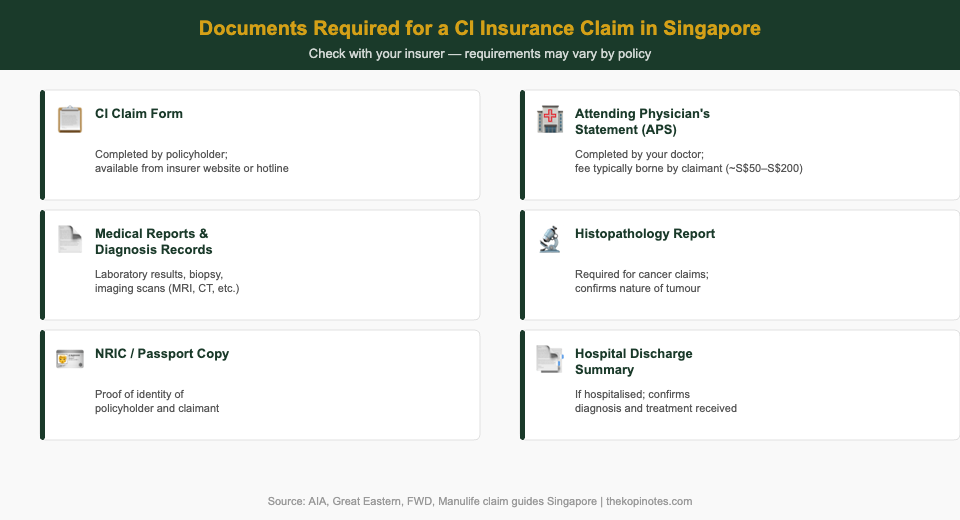
Below is a standard document checklist based on requirements from AIA, Great Eastern, FWD, Manulife, and Singlife (as at October 2026). Requirements vary by insurer and condition — always confirm with your specific insurer before submitting.
| Document | Required For | Who Provides It |
|---|---|---|
| CI Claim Form | All claims | Policyholder / Claimant |
| Attending Physician’s Statement (APS) | All claims | Treating specialist doctor |
| NRIC / Passport copy | All claims | Policyholder |
| Histopathology / biopsy report | Cancer claims (mandatory) | Hospital / lab |
| Imaging reports (MRI, CT, PET scan) | Cancer, stroke, tumour claims | Radiologist / hospital |
| ECG / angiogram reports | Heart attack, coronary artery claims | Cardiologist / hospital |
| Hospital discharge summary | If hospitalised | Hospital |
| Bank account details | All claims (for payout) | Policyholder |
Source: AIA, Great Eastern, FWD, Manulife claim guide documents, Singapore | October 2026
Understanding the Survival Period and Waiting Period
Two timing rules often catch claimants off-guard: the waiting period and the survival period.
The waiting period applies at the start of your policy. Most CI policies in Singapore have a 30–90 day waiting period from the policy start date. Any diagnosis made during this window is not covered. For example, if your policy starts 1 January and you are diagnosed with cancer on 15 January, the claim would be rejected under a standard 90-day waiting period.
The survival period applies at the time of claim. After a qualifying CI diagnosis, you must survive for a minimum number of days before the claim is payable. The LIA CI Framework 2024 standardises this at 14 days for policies issued from 1 October 2025 onwards. Older policies typically require 30 days. The survival period starts from the date of diagnosis as confirmed in the medical report — not the date you notify the insurer or submit the claim.
This is why it is important to notify your insurer early: the claim filing can happen during the survival period, so that all documents are ready for submission immediately after the survival period is satisfied.
When Will You Receive Your Payout?
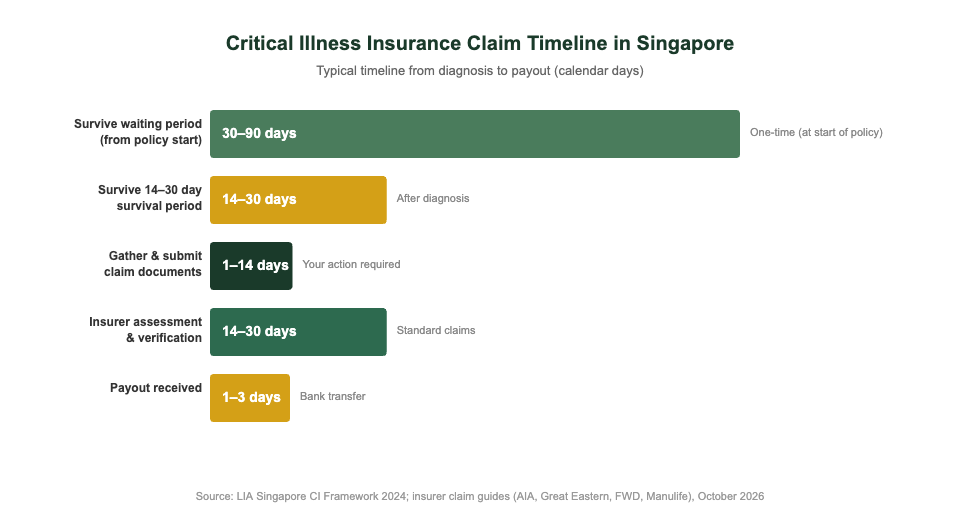
Typical CI claim timeline based on Singapore insurer practices | October 2026
The total time from diagnosis to payout varies by insurer and the complexity of your case. Based on major Singapore insurer practices as at 2026:
| Stage | Typical Timeframe |
|---|---|
| Diagnosis confirmed by specialist | Day 0 |
| Notify insurer + begin collecting documents | Day 1–7 |
| APS completed by doctor | Day 7–21 |
| Survival period satisfied | Day 14–30 (policy-dependent) |
| Submit complete claim package | Day 21–35 |
| Insurer assessment | 30–60 calendar days after submission |
| Payout credited to bank account | Within 5 business days of approval |
Source: AIA, Great Eastern, FWD, Singlife claim guides | October 2026. Singlife has publicised next-business-day payout for policies in-force 2+ years.
To use your lump-sum payout wisely — for example, topping up your investment account during recovery — our Singapore retirement planning calculator can help you model different withdrawal scenarios.
Common Reasons CI Claims Are Rejected
Understanding why claims are denied helps you avoid common pitfalls:
Non-disclosure of pre-existing conditions. If you failed to disclose a pre-existing medical condition at the time of application, the insurer may void the policy. Singapore insurers conduct medical underwriting, and any omission — even if unintentional — can be grounds for rejection.
Diagnosis during the waiting period. A diagnosis made within the first 30–90 days of policy inception is excluded. This applies even if you were unaware of the condition at the time of purchase.
Condition does not meet the policy definition. Under the LIA CI Framework 2024, each condition has a precise clinical definition. For example, a “major cancer” claim requires evidence that the cancer is invasive — a non-invasive carcinoma-in-situ is typically only covered under early-stage CI riders, not standard CI plans. Always review your policy wording with your financial adviser.
Survival period not satisfied. If the policyholder passes away before completing the survival period, the CI benefit is not paid (though a death benefit may be separately payable).
Incomplete documentation. Missing the APS, an unsigned form, or an incomplete histopathology report can delay or reject the claim. Submit a complete package.
Tips to Strengthen Your Claim
Know your policy before you need it. Read your CI schedule of benefits and understand which conditions are covered, at what severity, and under what definition. Consider speaking to your financial adviser annually to review coverage — especially if you purchase a new policy subject to the LIA CI Framework 2024 updates.
Keep your policy documents accessible. Store a digital copy of your policy in cloud storage or share the details with a trusted family member. Many claimants struggle to locate policy numbers during a medical crisis.
Engage your insurer’s claims hotline early. Most major insurers have dedicated CI claims teams. Calling early gives you a named point of contact and a clear document checklist — reducing back-and-forth delays.
Use a financial adviser to manage the process. If you purchased through an agent or adviser, they are obligated to assist with claims. An experienced adviser knows how to present documentation clearly and can follow up with the insurer on your behalf.
For self-employed Singaporeans: your lump-sum payout can be especially critical to cover income loss during recovery. Our article on CI insurance for the self-employed in Singapore covers how to structure adequate coverage for those without employer benefits.
If you receive a CI payout and want to put it to work in the markets during recovery, both Endowus (referral code 2V343) and Syfe (referral code SRPRFFFCD) allow you to invest in globally diversified portfolios with minimal effort — including via CPF-OA and SRS funds.
Frequently Asked Questions
How long does a critical illness insurance claim take in Singapore?
From the date your complete claim package is received, most Singapore insurers take 30–60 calendar days to assess and approve a straightforward CI claim. Singlife has publicised a next-business-day payout for eligible policies in-force for over 2 years. Complex cases or missing documents can extend the timeline. Total time from diagnosis to payout is typically 6–12 weeks.
Can a family member make a CI claim on my behalf?
Yes. A spouse, parent, or other authorised representative can notify the insurer, collect documents, and submit the claim on your behalf. Most insurers accept a letter of authorisation or a signed claim form from the policyholder. If you are incapacitated, a family member can also obtain a court-ordered Lasting Power of Attorney (LPA) to act on your behalf for financial matters.
What is the survival period and how does it affect my claim?
The survival period is the minimum number of days you must survive after a CI diagnosis before the lump-sum benefit is payable. Under the LIA CI Framework 2024 (effective 1 October 2025 for new policies), the standard survival period is 14 days. Older policies typically require 30 days. If the policyholder passes away before the survival period is completed, the CI benefit is not paid — though a separate death benefit may apply depending on the policy type.
Will my CI claim be rejected if I did not disclose a pre-existing condition?
Potentially yes. Singapore insurers have the right to void a policy or reject a claim if a material pre-existing condition was not disclosed at the time of application — even if the omission was unintentional. The MAS requires full disclosure at the point of application. If you are unsure whether something is a “material fact”, err on the side of disclosing it. Your financial adviser can guide you through the underwriting questions.
Does CI insurance pay out if I am still alive after diagnosis?
Yes — this is the key feature of CI insurance. Unlike life insurance (which pays on death), CI insurance pays a lump sum when you are diagnosed with a covered condition AND survive the survival period. You can use the payout for any purpose: income replacement, medical treatment not covered by Medishield Life or Integrated Shield Plans, home care, or retirement planning.
How many CI conditions should my policy cover?
The LIA CI Framework 2024 defines 37 standard critical illness conditions. Most comprehensive CI plans in Singapore cover all 37. When comparing policies, check whether your plan covers all 37 definitions, and whether riders are available for early-stage conditions (cancer, heart attack, stroke), which are more likely to be diagnosed before they reach the late-stage threshold required for a standard CI payout. Our guide on early vs late stage CI in Singapore explains the differences in detail.
What happens if my CI claim is rejected?
If your claim is rejected, the insurer must provide a written explanation citing the specific policy clause or condition for rejection. You can appeal by submitting additional medical evidence. If the appeal fails, you can escalate to the Financial Industry Disputes Resolution Centre (FIDReC) — Singapore’s independent dispute resolution body for financial services — at no cost for claims up to S$100,000.
Get Free Insurance Advice
Speak with a licensed insurance advisor. No obligation, no cost.
By submitting this form, you agree to our Privacy Policy.
This article was researched with the help of AI. While we strive to keep all information accurate and up to date, there may be errors. If you notice any discrepancies, please contact us.