When Should You Buy Critical Illness Insurance? Best Age Guide Singapore 2026
Your age is the single biggest factor affecting CI insurance cost and value — understanding the sweet spot can save you thousands.
The best age to buy critical illness insurance in Singapore is your late 20s to mid-30s. At this stage, premiums are still relatively affordable, you are likely in good health (qualifying easily), and you have maximum years of coverage ahead — protecting you through the highest-risk decades of 40s and 50s. Waiting even five years can raise your annual premium by 30–50%, making early action the financially smarter move.
Not financial advice. All figures are for educational reference only. Premium ranges are indicative only — actual premiums vary by insurer, health status, gender, and plan type. Data verified as at October 2026.
Table of Contents
Contents — Click to expand
- Why Age Is the Most Important Factor
- Buying CI Insurance in Your 20s
- Buying CI Insurance in Your 30s (The Sweet Spot)
- Buying CI Insurance in Your 40s
- Buying CI Insurance in Your 50s and Beyond
- Premium Comparison by Age
- How Much CI Coverage Do You Actually Need?
- Key Considerations Before You Buy
- Frequently Asked Questions
Why Age Is the Most Important Factor in CI Insurance
Critical illness insurance in Singapore is priced primarily on two factors: your age at entry and your health status. The younger and healthier you are when you buy, the lower your premiums — and crucially, those premiums are locked in (or increase more gradually) for the life of the policy.
Unlike health insurance that renews annually, most CI policies in Singapore are long-term protection plans. Once you are covered, a diagnosis of cancer, heart attack, stroke, or any of the other 37 standardised critical illnesses recognised by the Life Insurance Association (LIA) Singapore will trigger a lump-sum payout — regardless of when in your policy term the diagnosis occurs.
This creates a powerful argument for buying early: you lock in cover while you are young and healthy, and the policy pays out when you are older and statistically more likely to need it. According to Singapore Cancer Registry data, cancer incidence rises sharply after age 40, with the highest rates in the 60–79 age group. Your CI policy bought at 30 is doing its most valuable work in your 50s and 60s.
There is also the question of insurability. If you develop a chronic condition — hypertension, high cholesterol, pre-diabetes — in your 40s, insurers may exclude that condition or charge a premium loading. By buying in your 30s when you are likely in peak health, you avoid these exclusions entirely.
For more on what the 37 LIA conditions cover and what gets paid out, see our guide to critical illness insurance coverage in Singapore.
Buying Critical Illness Insurance in Your 20s
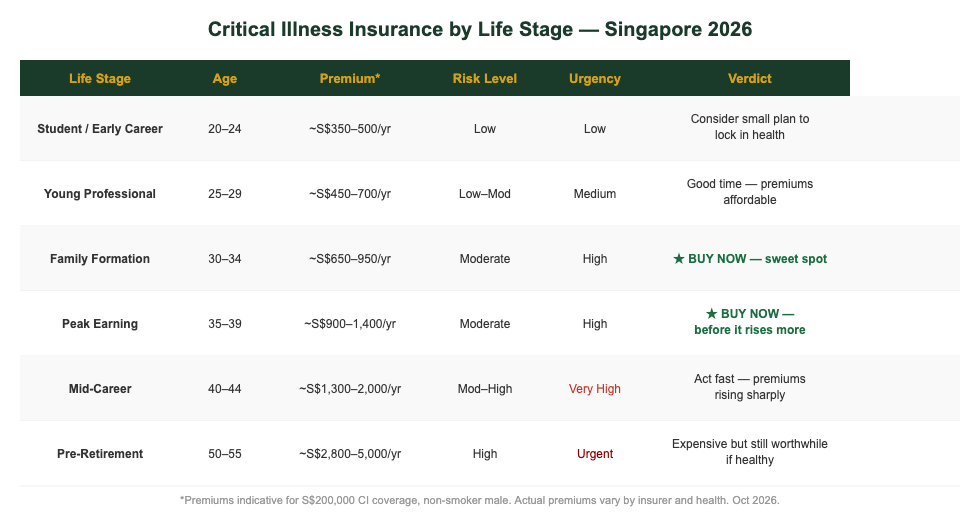
In your 20s, CI insurance is at its cheapest. A standard plan offering S$200,000 coverage for a non-smoking male might cost as little as S$350–550 per year. For most young Singaporeans, that is a highly manageable premium — roughly S$30–45 per month.
However, the decision to buy in your 20s involves some trade-offs. Your risk of a critical illness is statistically very low in this decade. You may also have limited disposable income, particularly if you are repaying student loans or building an emergency fund. Some financial advisers in Singapore suggest prioritising an emergency fund and term life insurance before CI coverage in your early 20s.
That said, there are two strong reasons to consider CI insurance early:
- Lock in your health status. If you have a family history of heart disease or cancer, buying while young and healthy ensures you are covered before any hereditary condition surfaces.
- Premium savings over a lifetime. A plan bought at 25 versus 35 could save you S$15,000–25,000 in cumulative premiums over a 30-year policy term, even accounting for the extra 10 years of paying.
If budget is a concern in your 20s, consider a smaller coverage amount (S$100,000–S$150,000) that you can top up later, or look at early critical illness (ECI) plans that cover early-stage cancers — statistically the most common first claim in Singapore.
Buying CI Insurance in Your 30s — The Sweet Spot
Your 30s represent the optimal window for critical illness insurance in Singapore, and most financial professionals agree on this. Here is why this decade is the sweet spot:
Premiums are still affordable — annual costs for S$200,000 coverage typically run S$600–1,000 for a non-smoker in their 30s, before rising significantly in the 40s.
Protection need is highest. By your 30s, you are likely to have taken on a mortgage, started a family, or become the primary income earner. A critical illness diagnosis without coverage in your 30s could devastate a household’s finances — mortgage, school fees, and daily expenses do not pause during a two-year cancer treatment.
You are still highly insurable. Most Singaporeans in their 30s are in good health. Loading exclusions are uncommon, and standard wordings apply.
You maximise coverage years. A plan bought at 32 covers you through your 50s and 60s — the decades where critical illness claims spike dramatically.
If you are in your 30s and do not yet have CI insurance, this is the clearest call to action in this article: the cost-benefit calculus is firmly in favour of buying now. See our deep dive on how CI premiums change with age for a detailed breakdown of what you would pay at each age bracket.
For those planning for long-term financial security beyond CI cover, the Singapore retirement calculator can help you see how your insurance decisions fit into a broader plan.
Buying CI Insurance in Your 40s
If you reach your 40s without CI coverage, the calculus changes — but it does not disappear. Premiums in this decade run approximately S$1,300–2,000 per year for S$200,000 coverage, roughly double what you would have paid in your early 30s. That said, the risk of actually needing the payout is materially higher now.
Cancer, heart disease, and stroke — the three most common CI claims in Singapore — begin rising sharply in the 40–55 age band. The protection value of the policy is at its peak precisely because the statistical likelihood of a claim is increasing. You are paying more, but you are also buying insurance when you are statistically more likely to need it.
Key considerations if you are buying in your 40s:
- Undergo a thorough health check first. Insurers will request medical underwriting. Existing conditions may result in exclusions or loadings — get clarity on this before committing.
- Prioritise multi-pay or early critical illness plans. Some policies pay out at early and intermediate stages of illness, not just at severe/end stages. Multi-pay plans allow multiple claims across different illness categories, which offers better value when you are buying later.
- Consider a shorter policy term. Rather than a whole-life CI plan, a 20-year term plan may be more cost-effective and still covers you through your highest-risk years.
- Act before pre-existing conditions emerge. Many people in their 40s are managing early-stage hypertension or high cholesterol. If these are recent diagnoses, you may still qualify for standard cover — but do not delay.
Buying CI Insurance in Your 50s and Beyond
By your 50s, CI insurance premiums are significantly higher — often S$2,800–5,000 or more annually for S$200,000 coverage. The question shifts from “should I buy?” to “does the maths still work for me?”
For many Singaporeans in their 50s, the answer is still yes — particularly if they have dependants, ongoing mortgage obligations, or limited savings. A single hospitalisation and treatment for cancer can cost S$150,000–300,000 or more at private hospitals in Singapore. A CI payout offsets this without depleting your retirement nest egg.
However, if you are already nearing 55 with significant CPF savings and your children are financially independent, the cost-benefit may be less compelling. Consider your CPF investment strategy alongside insurance decisions — CPF Life provides a base of retirement income that partially reduces the financial impact of a critical illness in retirement.
For self-employed individuals who may not have employer health benefits, CI insurance remains important at any age. See our guide on CI insurance for the self-employed in Singapore for tailored advice.
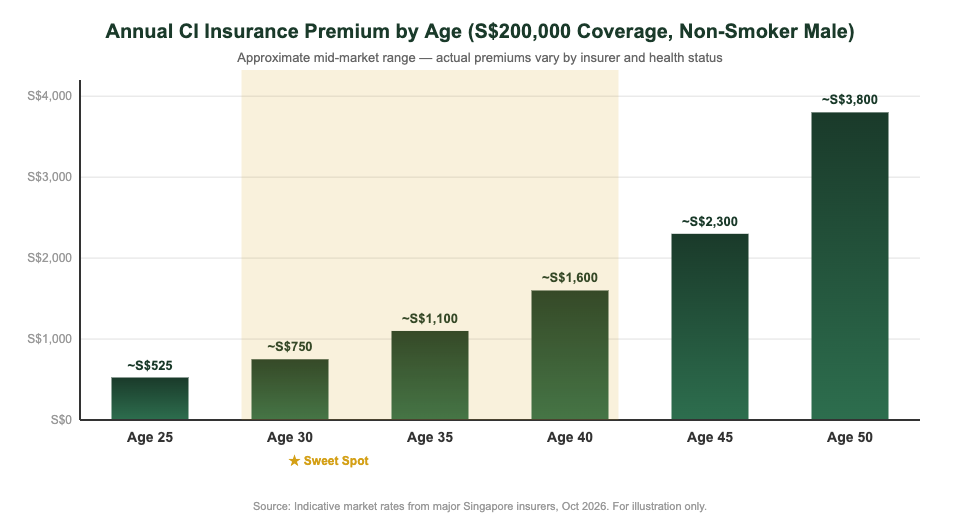
CI Premium Comparison by Age — What to Expect
The table below shows indicative annual premiums for a S$200,000 critical illness plan covering the standard 37 LIA-defined conditions, for a non-smoking male in good health. Female premiums are typically 5–15% lower. Smoker premiums can be 50–100% higher.
| Age at Entry | Indicative Annual Premium | Premium Change vs Age 30 | Verdict |
|---|---|---|---|
| Age 25 | ~S$350–700/yr | −25 to −30% | Cheapest; consider if budget allows |
| Age 30 | ~S$550–1,000/yr | Baseline | ★ Sweet spot — buy now |
| Age 35 | ~S$850–1,400/yr | +45–55% | ★ Still a strong buy |
| Age 40 | ~S$1,200–2,000/yr | +100–120% | Worthwhile; act promptly |
| Age 45 | ~S$1,800–3,000/yr | +200–250% | Costly but risk is rising too |
| Age 50 | ~S$2,800–5,000/yr | +380–450% | Review total financial position first |
Source: Indicative market rates from major Singapore insurers, October 2026. Figures are approximate and for illustration only. Get a personalised quote from a licensed financial adviser.
How Much Critical Illness Coverage Do You Actually Need?
The standard recommendation from financial planners in Singapore is to secure CI coverage of at least 3–5 times your annual income, or enough to cover 3–5 years of living expenses. This reflects the typical recovery and treatment period for serious conditions like cancer, which often requires 2–3 years of active treatment followed by a monitoring phase.
Consider a Singaporean earning S$80,000 per year with a family of four and a mortgage. A CI diagnosis at age 42 might mean:
- Two years of cancer treatment at a private hospital: S$150,000–250,000
- Lost income during treatment: S$120,000–160,000 over 2 years
- Mortgage obligations that continue regardless: S$2,000–3,000/month
A S$300,000–400,000 CI payout provides a meaningful buffer — not to pay for treatment (MediShield Life and Integrated Shield Plans handle hospitalisation), but to replace income, maintain lifestyle, and cover out-of-pocket expenses during recovery.
For households with lower incomes or younger families, a S$150,000–200,000 plan can still provide substantial protection at a manageable premium, especially when purchased in your 30s.
Key Considerations Before You Buy
Before purchasing a critical illness plan in Singapore, run through these checks:
1. Do you have MediShield Life and an Integrated Shield Plan (IP)? CI insurance is not a substitute for hospitalisation insurance. Your IP covers treatment costs; CI insurance replaces income and covers other living expenses. Both serve different roles.
2. Do you need early critical illness (ECI) coverage? Standard CI plans pay out at severe/advanced stages. ECI plans pay out at early-stage diagnosis — for example, early-stage cancer in situ. Given that early-stage cancer is by far the most common claim in Singapore, ECI coverage adds meaningful protection, albeit at a higher premium.
3. Whole life CI vs term CI vs standalone CI rider? A whole life CI plan builds cash value and covers you for life but has higher premiums. A term CI plan is more affordable and covers a fixed period. A CI rider attached to a life insurance plan offers bundled coverage. Your choice should match your budget and long-term needs.
4. Consider using SRS funds for premiums. Premiums for some qualifying life insurance plans can be paid from your Syfe or other SRS-linked accounts in a tax-efficient manner — check with your insurer on SRS compatibility.
5. Comparison shop. Premiums vary meaningfully across AIA, Prudential, Great Eastern, Singlife, FWD, NTUC Income, and other providers. Use MAS-licensed comparison tools or consult a fee-based adviser to compare plans objectively.
Frequently Asked Questions
What is the best age to buy critical illness insurance in Singapore?
The best age to buy critical illness insurance in Singapore is your late 20s to mid-30s — typically between 28 and 35. At this stage, premiums are still relatively affordable, you are in good health (making it easier to qualify without exclusions), and you lock in coverage for the decades when your risk of a serious illness is highest. Waiting until your 40s can more than double your annual premium for equivalent coverage.
Is it too late to buy critical illness insurance at 45 or 50 in Singapore?
It is not too late, but it is significantly more expensive. At age 45, premiums for S$200,000 CI coverage can run S$1,800–3,000 per year — roughly three times what a 30-year-old would pay. At 50, costs can exceed S$4,000–5,000 annually. Whether this makes financial sense depends on your health, income, dependants, and existing savings. If you have a family to protect and limited liquid assets, CI coverage is still worthwhile even at 50.
How many critical illnesses are covered in Singapore CI insurance plans?
All major CI plans in Singapore must cover at least the 37 standardised critical illnesses defined by the Life Insurance Association (LIA) Singapore. These include severe cancers, heart attack, stroke, kidney failure, major organ failure, and other serious conditions. Many plans also include early critical illness (ECI) coverage for early-stage conditions, particularly early-stage cancer — at an additional cost. Always check whether your plan includes both severe and early-stage coverage.
Can I buy critical illness insurance if I have a pre-existing condition?
Yes, but with important caveats. If you have a pre-existing condition such as high blood pressure, high cholesterol, or a prior cancer history, insurers may exclude that condition from coverage, charge a premium loading, or decline to cover you. The key is to apply as early as possible — before conditions develop. If you already have a pre-existing condition, compare plans from multiple insurers, as underwriting decisions vary. A licensed financial adviser can help you navigate this.
Should I buy a whole life CI plan or a term CI plan in Singapore?
This depends on your budget and goals. A whole life CI plan provides lifelong coverage, often with cash value and the ability to make multiple payouts for different conditions. It is more expensive but offers comprehensive protection. A term CI plan is more affordable, covering a fixed period (e.g., until age 70 or 75), and is ideal if your primary concern is protecting your working years and paying down your mortgage. For most Singaporeans in their 30s, a combination of a term CI plan for the large coverage amount plus a smaller whole life plan works well.
How much critical illness insurance coverage do I need in Singapore?
The standard recommendation is 3–5 times your annual income, or enough to cover 3–5 years of living expenses during treatment and recovery. For a Singapore household earning S$80,000–100,000 per year, a S$300,000–500,000 CI plan is a common target. As a practical starting point, S$200,000 is considered the minimum meaningful coverage for most working adults, with top-ups added over time. Factor in your mortgage balance, number of dependants, and any existing coverage from your employer when calculating your own target.
Take Control of Your Financial Protection
The best time to buy critical illness insurance is before you need it. Use our tools and guides to plan your financial protection strategy.
Get Free Insurance Advice
Speak with a licensed insurance advisor. No obligation, no cost.
By submitting this form, you agree to our Privacy Policy.
This article was researched with the help of AI. While we strive to keep all information accurate and up to date, there may be errors. If you notice any discrepancies, please contact us.