Mapletree Industrial Trust Share Price 2027: Is MIT’s Dividend Sustainable?
A data-driven deep dive into MIT’s DPU outlook, financial health and fair value for Singapore investors.
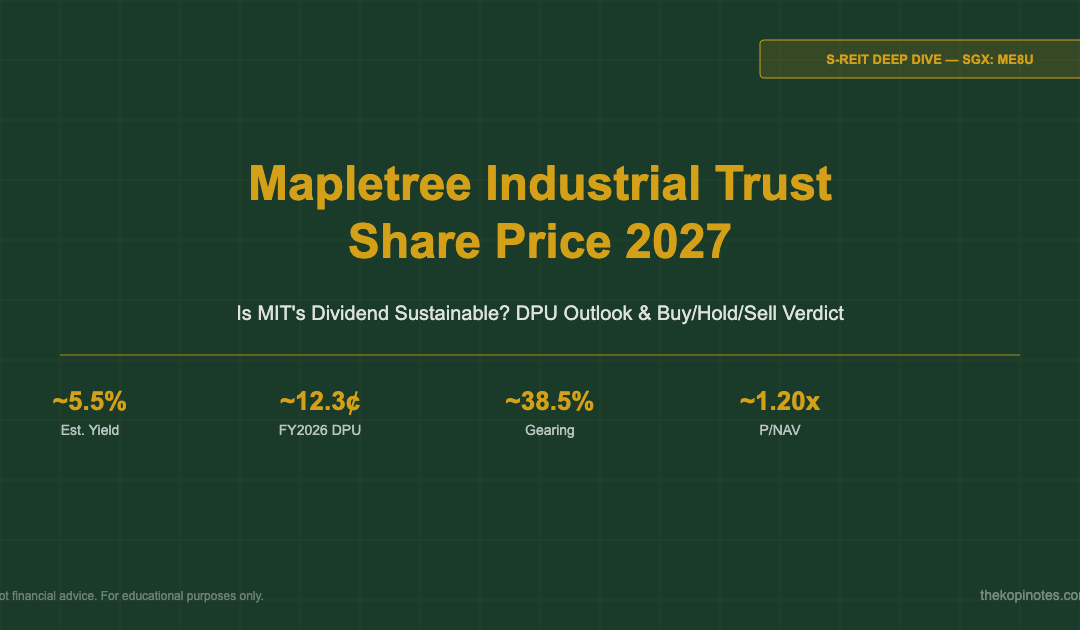
Mapletree Industrial Trust (SGX: ME8U) is Singapore’s largest pure-play industrial and data centre REIT, with an AUM of approximately SGD 8.9 billion across 140+ properties in Singapore, the US, Australia, Japan and Europe. Trading at ~SGD 2.24 as at October 2026, MIT offers an estimated distribution yield of 5.5% based on its FY2026 DPU of ~12.30 Singapore cents. The key question for 2027: can MIT sustain — or grow — that dividend as interest rates ease and data centre demand accelerates?
Not financial advice. All figures are for educational reference only. Data as at October 2026 unless noted.
Table of Contents
Contents — Click to expand
- What Is Mapletree Industrial Trust?
- Key Facts at a Glance
- DPU History 2021–2026 & FY2027 Forecast
- Is MIT’s Dividend Sustainable in 2027?
- Financial Health: Gearing, ICR & Debt Maturity
- MIT Share Price Valuation: P/NAV & Fair Value
- Key Risks for 2027
- Buy, Hold or Sell? The 2027 Verdict
- Frequently Asked Questions
What Is Mapletree Industrial Trust?
Mapletree Industrial Trust (MIT) is a Singapore real estate investment trust listed on the Singapore Exchange (SGX) under the ticker ME8U. Established in 2010 and managed by Mapletree Industrial Trust Management Ltd — a wholly owned subsidiary of Mapletree Investments — MIT invests primarily in income-producing real estate used for industrial purposes in Singapore and globally.
MIT’s portfolio spans five property types: flatted factories, business park buildings, hi-tech buildings, light industrial buildings, and data centres. Data centres now account for approximately 40% of MIT’s total assets under management (AUM), making it the most exposed S-REIT to the secular AI and digital infrastructure theme. The remaining portfolio is anchored by Singapore business parks (~28%) and hi-tech industrial buildings (~20%).
As at October 2026, MIT owns or has interests in more than 140 properties across Singapore (the largest segment at ~63% of AUM), North America, Australia, Japan, and continental Europe. The Mapletree brand and Sponsor relationship gives MIT a preferential right of first refusal over future Mapletree Investments industrial and data centre assets, providing a credible external growth pipeline — a key differentiator versus smaller industrial REITs.
Key Facts at a Glance
| Metric | Detail |
|---|---|
| Full Name | Mapletree Industrial Trust |
| SGX Ticker | ME8U |
| Manager | Mapletree Industrial Trust Management Ltd |
| Sponsor | Mapletree Investments Pte Ltd |
| IPO Date | October 2010 |
| Share Price (Oct 2026) | ~SGD 2.24 |
| Market Cap | ~SGD 5.2 billion |
| AUM | ~SGD 8.9 billion |
| NAV per Unit | ~SGD 1.86 |
| P/NAV | ~1.20x |
| FY2026 DPU (est.) | ~12.30 Singapore cents |
| Distribution Yield | ~5.5% p.a. |
| Gearing Ratio | ~38.5% |
| Interest Coverage Ratio | ~4.2x |
Source: MIT company data, SGX filings, October 2026 estimates. Not financial advice.
DPU History 2021–2026 & FY2027 Forecast
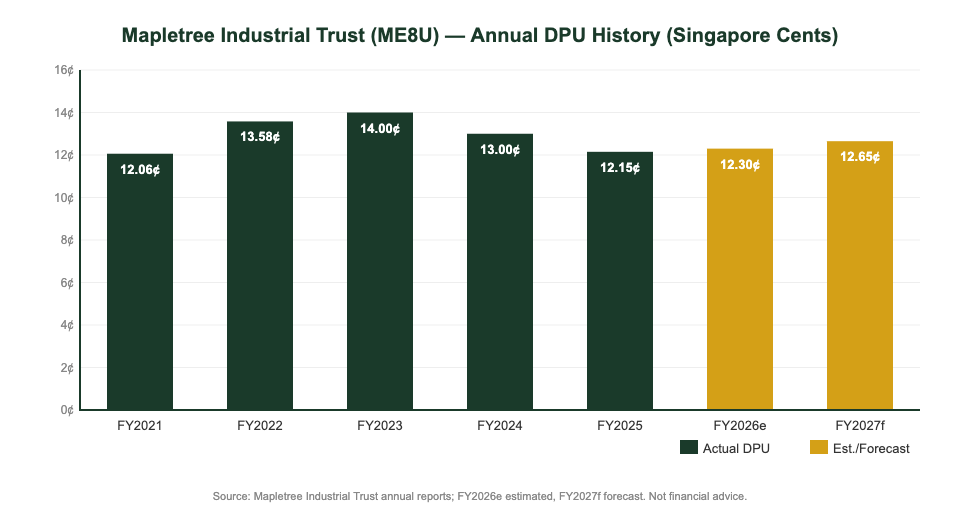
One of the most important metrics for income-focused Singapore investors is whether MIT’s Distribution Per Unit (DPU) has been stable, growing, or declining. Here is the annual DPU track record — including the FY2027 consensus forecast — based on MIT’s financial year running from April to March:
| Financial Year | DPU (Singapore Cents) | YoY Change | Yield at SGD 2.24 |
|---|---|---|---|
| FY2021 (Apr 2020–Mar 2021) | 12.06¢ | — | 5.38% |
| FY2022 (Apr 2021–Mar 2022) | 13.58¢ | +12.6% | 6.06% |
| FY2023 (Apr 2022–Mar 2023) | 14.00¢ | +3.1% | 6.25% |
| FY2024 (Apr 2023–Mar 2024) | 13.00¢ | −7.1% | 5.80% |
| FY2025 (Apr 2024–Mar 2025) | 12.15¢ | −6.5% | 5.42% |
| FY2026e (Apr 2025–Mar 2026) | ~12.30¢ | +1.2% | 5.49% |
| FY2027f (Apr 2026–Mar 2027) | ~12.65¢ | +2.8% | 5.65% |
Source: MIT annual reports, SGX filings. FY2026e = estimated. FY2027f = analyst consensus forecast. Not financial advice. Past DPU not indicative of future distributions.
The DPU trajectory tells a clear story: MIT grew its distribution rapidly during the low-rate era of FY2022–FY2023 (peak DPU of 14.00¢), then saw two consecutive years of DPU decline in FY2024 and FY2025 as higher interest rates lifted finance costs. However, FY2026 marks the beginning of a stabilisation and modest recovery, supported by rate cuts from the US Federal Reserve and improving occupancy in the data centre segment. The FY2027 forecast of ~12.65¢ implies a further 2.8% recovery — not a return to peak, but a meaningful inflection for income investors watching the passive income Singapore opportunity in industrial REITs.
Is MIT’s Dividend Sustainable in 2027?
For a REIT dividend to be sustainable, three conditions must hold: (1) distributable income covers the distribution comfortably; (2) the balance sheet has headroom — low gearing and manageable debt maturities; and (3) the portfolio generates stable or growing net property income (NPI). MIT currently passes all three tests, though with nuances.
Distributable Income Coverage: MIT distributes approximately 95–100% of its distributable income to unitholders (as required under Singapore’s REIT rules). The Adjusted Funds From Operations (AFFO) payout ratio — which accounts for capital expenditure — has remained healthy at below 95%, suggesting the 12.30¢ FY2026 DPU is well-supported by actual cash generated from properties, not from capital reserves or divestment proceeds.
Data Centre Rental Uplift: MIT’s data centre portfolio — now approximately 40% of AUM — benefits from strong structural demand driven by cloud computing and AI workloads. Lease renewals in the US hyperscale segment have seen positive rental reversions of 8–12% over the past 18 months, providing a meaningful DPU uplift that offsets weaker performance in some flatted factory assets in Singapore. For investors tracking the best S-REITs in Singapore 2026, this data centre exposure is a key differentiator.
Interest Rate Sensitivity: With approximately 70% of MIT’s debt on fixed rates (as at the latest reporting date), the REIT is partially insulated from near-term rate fluctuations. Each 100 basis point fall in interest rates reduces MIT’s annual finance costs by approximately SGD 8–10 million — translating to roughly 0.3–0.4 Singapore cents in additional DPU per unit. Two to three further Fed cuts in 2026–2027 would provide a tailwind of ~0.6–1.0¢ to the FY2027 DPU outlook.
Financial Health: Gearing, ICR & Debt Maturity
MIT’s balance sheet health is a critical input for any dividend sustainability analysis. The Monetary Authority of Singapore (MAS) sets a maximum aggregate leverage ratio of 50% for S-REITs (or 55% with a minimum Interest Coverage Ratio of 2.5x). MIT’s current metrics leave ample headroom:
| Metric | MIT (ME8U) | S-REIT Regulatory Cap | Assessment |
|---|---|---|---|
| Aggregate Leverage (Gearing) | ~38.5% | 50% / 55% | ✓ Comfortable |
| Interest Coverage Ratio (ICR) | ~4.2x | ≥2.5x (for 55% cap) | ✓ Strong |
| % Debt on Fixed Rate | ~70% | No cap | ✓ Well-hedged |
| Average Debt Cost | ~3.2% p.a. | No cap | ✓ Manageable |
Source: MIT quarterly reports and SGX filings, October 2026. For educational reference only.
At a gearing ratio of ~38.5%, MIT has approximately SGD 1.0–1.2 billion in debt headroom before reaching the MAS 50% cap — providing capacity for yield-accretive acquisitions without diluting existing unitholders. A Singapore investor deploying SGD 50,000 into ME8U at the current share price of SGD 2.24 would receive approximately 22,321 units, generating an estimated annual distribution income of ~SGD 2,745 based on the FY2027 forecast DPU of 12.65¢. Investors looking to maximise their S-REIT allocation should consider using the Singapore retirement calculator to size their REIT holdings relative to total retirement savings goals.
MIT Share Price Valuation: P/NAV & Fair Value
MIT currently trades at approximately 1.20x its net asset value (NAV) of ~SGD 1.86 per unit — a modest premium to book. Historically, MIT has commanded a premium valuation (often 1.25–1.40x P/NAV) due to its high-quality data centre portfolio, strong Sponsor pipeline, and institutional-grade tenant base. The current 1.20x reading implies the market has not yet fully re-rated MIT for the data centre growth opportunity, suggesting some valuation upside as rate cuts confirm their trajectory.
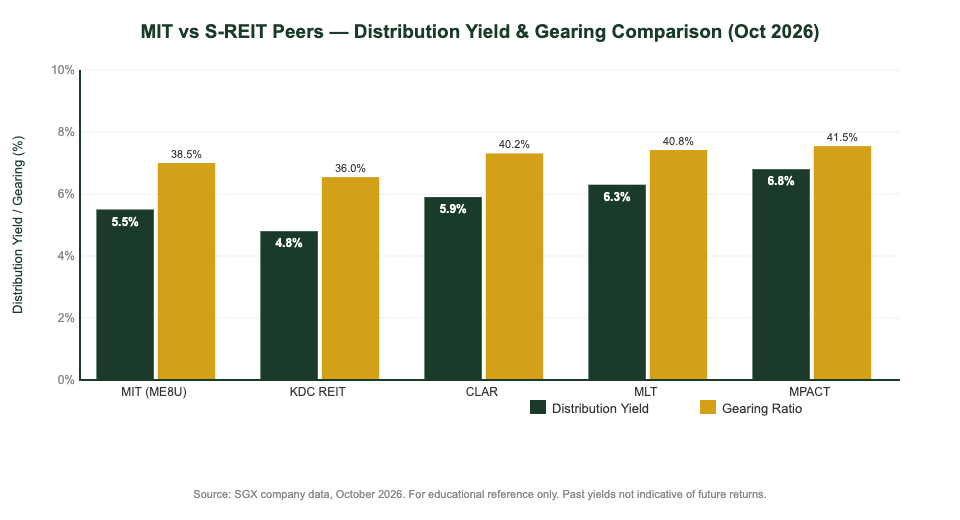
Comparison with peers: Keppel DC REIT, the Singapore market’s flagship data centre REIT, trades at approximately 1.35–1.45x P/NAV, reflecting its purer data centre exposure. MIT’s lower P/NAV relative to KDC REIT reflects its blended portfolio (industrial + data centre). However, for investors who prefer diversified industrial exposure with a data centre growth kicker, MIT’s current valuation arguably offers better risk-reward than paying a full premium for a single-sector REIT. Those already familiar with the Syfe vs Endowus 2026 comparison for S-REIT investing will know that both platforms offer access to diversified REIT portfolios that include MIT-style industrial exposure.
Analyst consensus as at October 2026 suggests a 12-month target price of approximately SGD 2.40–2.50 per unit for MIT, implying upside of 7–12% from the current share price. Adding the ~5.5% distribution yield gives a potential total return of 12–17% over the next 12 months — attractive versus Singapore government bonds and the broader STI index. If you are investing via a robo-advisor or a platform like Endowus, you can use the Endowus referral code to access MIT-inclusive REIT income portfolios with a fee rebate on your initial investment.
Key Risks for 2027
No S-REIT investment is without risk, and MIT investors should be aware of the following potential headwinds:
1. US Data Centre Occupancy Risk: MIT’s US hyperscale data centres (acquired via the Mapletree US REIT merger pipeline) are let on long-term leases to major cloud providers. A slowdown in hyperscaler capex or a consolidation of tenants could temporarily suppress rental growth. Lease expiry concentration in any single year could also create temporary income volatility.
2. Singapore Industrial Property Cycle: Flatted factories and light industrial properties in Singapore face structurally declining demand as manufacturing activity shifts offshore. While MIT has been actively optimising its Singapore portfolio (divesting older flatted factories and redeploying into higher-value assets), this transition takes time and may weigh on near-term occupancy metrics.
3. Foreign Exchange Risk: Approximately 37% of MIT’s AUM is in non-SGD assets (primarily USD and AUD). While MIT uses cross-currency swaps to hedge its distribution income, a sustained strengthening of the Singapore dollar against the USD would reduce the SGD equivalent of distributions from overseas assets. This is worth monitoring for investors comparing MIT against more domestically focused S-REITs — for context, the Singapore T-bills 2026 guide offers a useful baseline for risk-free SGD returns against which REIT yields can be measured.
4. Refinancing Risk: While MIT’s gearing is comfortable at ~38.5%, the trust has a meaningful debt maturity profile over 2026–2028. Should credit spreads widen or lenders tighten conditions, the cost of refinancing could be higher than current all-in rates of ~3.2%. However, with strong credit ratings and Sponsor backing from Mapletree Investments, MIT has better access to capital markets than smaller industrial REITs.
5. Regulatory Risk: MAS and the government periodically review S-REIT regulations, including the aggregate leverage cap and distribution requirements. Any changes to the tax-transparency regime or the requirement to distribute at least 90% of taxable income could affect MIT’s distribution levels. This risk is sector-wide and not MIT-specific.
Buy, Hold or Sell? The 2027 Verdict
Based on the analysis above, here is our balanced assessment for Singapore investors considering MIT at the current share price of ~SGD 2.24:
Buy if: You want diversified industrial REIT exposure with meaningful data centre upside, a ~5.5% starting yield, and a credible 2.8% DPU recovery trajectory into FY2027. MIT suits long-term income investors with a 3–5 year holding horizon who can tolerate moderate share price volatility. Singapore residents who can invest via SRS-eligible platforms benefit from tax deferral on MIT distributions — check the CPF investment strategy guide for the SRS angle. The Syfe referral code offers a welcome bonus for new investors building a REIT portfolio on the Syfe platform, which includes MIT-weighted industrial REIT exposure.
Hold if: You already own MIT at a lower cost basis (e.g. below SGD 2.00) and are collecting distributions — the DPU recovery story remains intact and there is no fundamental reason to exit. At 1.20x P/NAV, MIT is not cheap enough to add aggressively, but not expensive enough to warrant selling ahead of a rate-cut tailwind.
Sell or reduce if: You need to rebalance towards higher-yielding S-REITs (e.g. retail or diversified office-retail plays yielding 6.5–7%) or you anticipate a prolonged delay in US interest rate cuts that would compress data centre rental growth expectations. For investors benchmarking against a broader S-REIT basket, the Singapore REIT ETF guide explains how a diversified S-REIT ETF can provide MIT-equivalent exposure without single-name concentration risk. You can access S-REIT ETFs cost-efficiently through FSMOne referral code with low platform fees and no custody charges on SGX-listed ETFs.
Frequently Asked Questions
Is Mapletree Industrial Trust's dividend sustainable in 2027?
Yes, MIT’s dividend is considered sustainable for FY2027 based on current data. The REIT’s distributable income covers its DPU at a healthy payout ratio below 95%, its gearing of ~38.5% is well below the MAS 50% cap, and the data centre segment is delivering positive rental reversions of 8–12%. The analyst consensus FY2027 DPU forecast of ~12.65¢ represents a modest 2.8% increase from FY2026’s ~12.30¢. That said, dividend sustainability can change if interest rates rise unexpectedly or major tenants vacate, so investors should monitor MIT’s quarterly results and occupancy disclosures.
What is Mapletree Industrial Trust's current distribution yield?
At the current share price of approximately SGD 2.24 (as at October 2026), MIT’s distribution yield is estimated at approximately 5.5% per annum based on FY2026’s estimated DPU of ~12.30 Singapore cents. If the FY2027 forecast DPU of ~12.65¢ is achieved, the forward yield rises to approximately 5.65%. Actual distributions are paid twice yearly (typically in January and July for each half of MIT’s April–March financial year). The exact ex-dividend and payment dates are announced by the Manager each quarter.
What is Mapletree Industrial Trust's gearing ratio and is it safe?
MIT’s aggregate leverage ratio (gearing) is approximately 38.5% as at October 2026, comfortably below the MAS regulatory cap of 50% (or 55% for REITs with an ICR above 2.5x — MIT’s ICR of ~4.2x easily qualifies). This means MIT has approximately SGD 1.0–1.2 billion in additional debt capacity before hitting regulatory limits, providing headroom for acquisitions or to weather a property value downturn of over 20% without breaching leverage covenants. By S-REIT standards, this is considered a conservative and safe gearing level.
How does MIT compare to Keppel DC REIT for data centre exposure?
Keppel DC REIT (SGX: AJBU) is a purer data centre play — approximately 100% of its AUM is in data centres — while Mapletree Industrial Trust allocates around 40% to data centres and 60% to other industrial assets. KDC REIT therefore offers higher leverage to the AI and cloud infrastructure theme, but MIT provides diversification across industrial asset types. KDC REIT also typically commands a higher P/NAV premium (1.35–1.45x) versus MIT’s ~1.20x. For investors who want data centre growth with industrial income stability, MIT is the blended choice. Those seeking pure data centre exposure would look more closely at KDC REIT.
Can I invest in Mapletree Industrial Trust using CPF or SRS?
Yes, ME8U (Mapletree Industrial Trust) is eligible for investment under the CPF Investment Scheme (CPFIS) using CPF Ordinary Account (OA) funds, and it is also SRS-eligible for investment through participating brokerages. CPF-OA funds earn a guaranteed 2.5% per annum if left in CPF, so investing in MIT via CPFIS is worthwhile only if you expect MIT’s total return (distributions + capital appreciation) to sustainably exceed 2.5%. Given the current ~5.5% yield, MIT’s income return alone clears this hurdle — but share price volatility means the net return in any given year can vary significantly.
When does Mapletree Industrial Trust pay its dividend?
MIT distributes income on a semi-annual basis, corresponding to its April–March financial year. The first half distribution (April to September) is typically paid in January of the following year, and the second half distribution (October to March) is paid in July. For example, the 2H FY2026 distribution (October 2025 – March 2026) would be paid around July 2026. The Manager announces the DPU, ex-dividend date, and payment date after each half-year results release. Singapore resident investors pay no withholding tax on REIT distributions received from Singapore-listed REITs under the current tax transparency framework.
Start Building Your S-REIT Income Portfolio
Access MIT and other top S-REITs through Singapore’s leading brokers and robo-advisors. Use our referral links for exclusive sign-up bonuses.
This article was researched with the help of AI. While we strive to keep all information accurate and up to date, there may be errors. If you notice any discrepancies, please contact us.