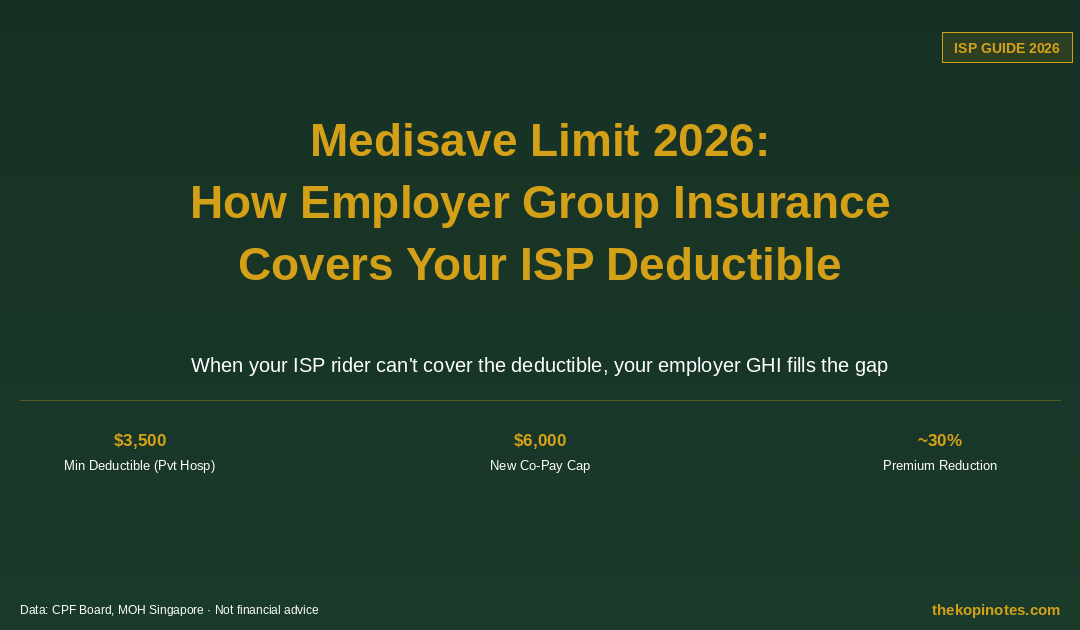
Medisave Limit 2026: How Employer Group Insurance Covers Your ISP Deductible
After April 2026, new ISP riders no longer cover the minimum deductible. Here’s how your employer’s group health insurance fills that gap — and where Medisave fits in.
Since 1 April 2026, new Integrated Shield Plan (ISP) riders in Singapore can no longer cover the minimum IP deductible — up to $3,500 for private hospital stays. Many employed Singaporeans have both an ISP and employer group health insurance (GHI). If your GHI covers deductibles not paid by other insurance, it can step in to cover this gap — potentially reducing your net out-of-pocket to zero. Medisave also plays a supporting role, paying ISP premiums and co-payments within CPF withdrawal limits.
Not financial advice. All figures are for educational reference only. Data verified as at 23 October 2026. Sources: CPF Board, MOH Singapore, AIA Singapore.
Table of Contents
Contents — Click to expand
- What Changed on 1 April 2026: New ISP Rider Rules
- The Deductible Gap: What You Now Pay
- How Employer Group Health Insurance Fills the Gap
- Medisave’s Role: Premiums, Deductibles and Co-Payments
- Three Real-World Claim Scenarios
- Who Benefits Most: Employer GHI + ISP
- What You Should Do Now
- Frequently Asked Questions
What Changed on 1 April 2026: New ISP Rider Rules
From 1 April 2026, the Ministry of Health (MOH) introduced mandatory changes to Integrated Shield Plan rider structures in Singapore. These changes were designed to restore cost-sharing incentives and rein in rising private healthcare utilisation. The key changes for new riders are:
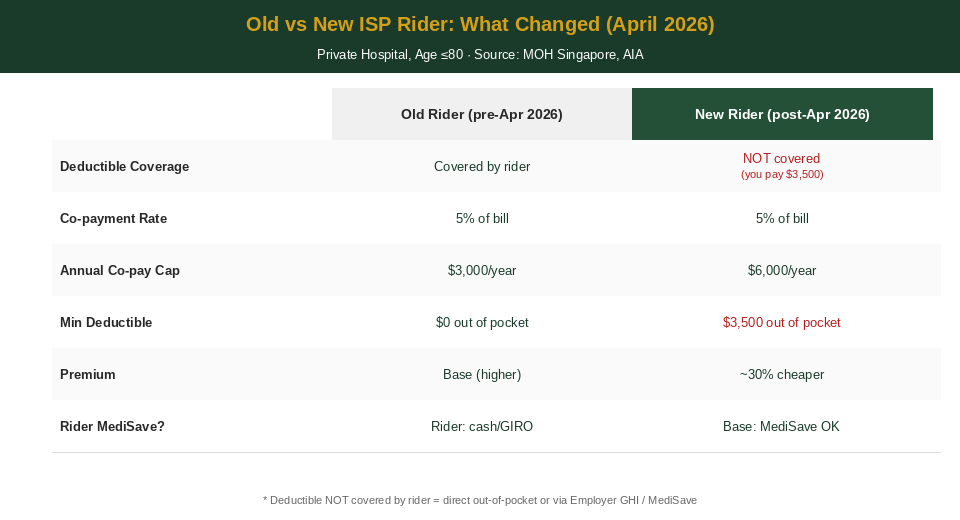
- Riders can no longer cover the minimum IP deductible. Previously, comprehensive (“max cover”) riders absorbed your ISP deductible on your behalf. Under new riders, the minimum deductible — up to $3,500 for private hospital stays — must be paid by you directly.
- Annual co-payment cap rises from $3,000 to $6,000. Your rider covers 95% of eligible bills above the deductible; you pay 5% co-payment up to this annual cap.
- New rider premiums fall by approximately 30%, partly because the deductible coverage has been removed. This equates to roughly $400–$700 per year in savings on private hospital plan riders.
Legacy riders purchased on or before 26 November 2025 continue under the old structure until the holder’s first renewal after 1 April 2028. If you are on a legacy rider, you are not immediately affected, but transition is coming. For a detailed look at the legacy rider timeline, see our analysis of the ISP legacy rider transition to 2028.
The Deductible Gap: What You Now Pay
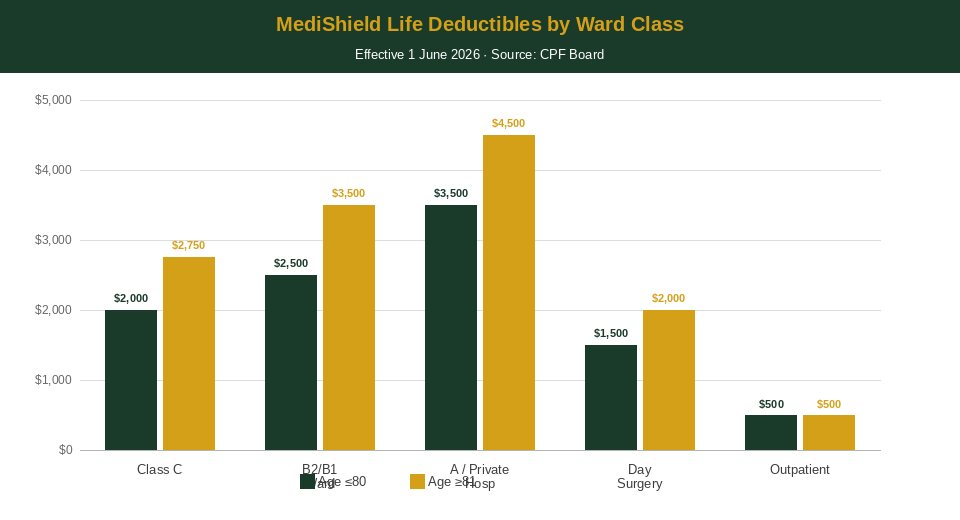
Under new ISP riders, the minimum IP deductible is a fixed first-dollar amount you pay each year before your ISP covers the rest of the hospital bill. This is separate from the 5% co-payment that your rider does cover. From June 2026, MediShield Life deductible amounts were also revised upward, as shown in the table below.
| Ward / Treatment Type | Age ≤80 | Age ≥81 |
|---|---|---|
| Class C ward | $2,000 | $2,750 |
| Class B2, B2+, B1 ward | $2,500 | $3,500 |
| Class A / Private Hospital | $3,500 | $4,500 |
| Day Surgery | $1,500 | $2,000 |
| Community Hospital (subsidised) | $2,000 | $2,750 |
| Outpatient (e.g. chemo, dialysis) | $500 | $500 |
Source: CPF Board — MediShield Life Deductible, effective 1 June 2026.
For most Singaporeans holding a private hospital ISP plan, the annual minimum deductible under a new rider is $3,500 (age ≤80). This applies once per policy year — so a single hospitalisation episode triggers it. Understanding how this interacts with your MediSave account is covered in detail in our guide on the Medisave limit 2026 and ISP deductible impact.
How Employer Group Health Insurance Fills the Gap
Many Singaporean employees receive group health insurance (GHI) as part of their employment package. Typically, GHI provides inpatient and surgical coverage with its own annual limit (ranging from $10,000 to $200,000+ per year, depending on seniority and company policy). After the April 2026 ISP rider changes, employer GHI has become significantly more valuable for ISP holders.
Why? Because GHI can cover the $3,500 deductible that your new ISP rider will not. Most employer GHI policies in Singapore are structured as complementary or secondary coverage — meaning they pick up bills remaining after your primary insurer (ISP + MediShield Life) has paid its share. If your GHI policy language covers “deductibles not paid by other insurance” or “remaining out-of-pocket amounts”, it will apply to the minimum deductible gap directly.
Consider how a typical multi-layer claim flows at a private hospital:
- MediShield Life pays a capped portion of the bill based on schedule rates
- Your ISP covers the balance above MediShield Life limits (at private ward rates), minus the $3,500 deductible
- Your new ISP rider covers 95% of the amount above the deductible (you pay 5%)
- Employer GHI (as secondary payer) covers the $3,500 deductible — and possibly the 5% co-payment too, depending on your plan
- Net out-of-pocket: potentially close to zero
Tip: Review your HR benefits handbook or ask your HR team specifically whether your GHI covers “deductibles not covered by your own ISP or other insurance”. This one line in your policy document determines whether your employer fully eliminates the April 2026 deductible gap. Not all GHI plans are structured this way — some only cover bills above a sub-limit or only for specific procedures.
For a full comparison of how the new rider cost structure plays out in real SGD terms, see our guide to the new ISP rider 2026 co-payment breakdown.
Medisave’s Role: Premiums, Deductibles and Co-Payments
Medisave does not simply sit idle. When you have an ISP alongside employer GHI, your Medisave account plays three distinct supporting roles.
1. Paying ISP Base Premiums
A portion of your ISP base premium (the part above the MediShield Life base premium) can be paid from Medisave, up to the Medisave Additional Withdrawal Limit (AWL) set by CPF Board. The AWL scales with age — higher for older policyholders — and is reviewed periodically. Check CPF’s official website for the current AWL applicable to your age band. Top-up riders are generally paid by cash or GIRO.
2. Paying the Minimum Deductible
If your employer GHI does not fully cover the minimum deductible, Medisave can be used to pay it — subject to daily hospitalisation withdrawal limits set by CPF Board. The practical implication: the $3,500 deductible for private hospital stays need not come from your cash savings if your Medisave balance is healthy. This is a key part of the Medisave limit 2026 framework for ISP holders.
3. Paying the 5% Co-Payment
Under new ISP riders, you pay 5% of the claimable bill above the deductible, up to the $6,000 annual cap. This co-payment can also be paid via Medisave for eligible hospitalisation charges. If your employer GHI has already covered the deductible, the remaining 5% co-payment is the only amount you need to settle — and Medisave can handle it, further reducing your cash outlay.
The overall hierarchy, when everything aligns: MediShield Life → ISP → New Rider (95%) → Employer GHI (covers deductible) → Medisave (covers 5% co-payment). This four-layer stack can reduce your direct cash out-of-pocket to close to zero even under the new co-payment regime.
Three Real-World Claim Scenarios
The following scenarios model a Singaporean employee aged 45, admitted to a private hospital, holding: (a) a post-April 2026 ISP rider for private hospital class, and (b) employer GHI that covers deductibles not paid by other insurance. MediShield Life and ISP payouts are approximate; actual amounts depend on bill components, ward class, and insurer schedules.
| Item | Scenario A $10,000 bill |
Scenario B $25,000 bill |
Scenario C $80,000 bill |
|---|---|---|---|
| Total hospital bill | $10,000 | $25,000 | $80,000 |
| MediShield Life pays | ~$3,900 | ~$5,500 | ~$6,500 |
| ISP pays (above MSHL, less deductible) | ~$2,775 | ~$14,700 | ~$57,800 |
| New rider covers (95% of ISP portion) | ~$2,636 | ~$13,965 | ~$54,910 |
| Minimum deductible (your liability) | $3,500 | $3,500 | $3,500 |
| 5% co-payment | ~$139 | ~$735 | ~$2,890 |
| Employer GHI covers deductible | ✅ $3,500 | ✅ $3,500 | ✅ $3,500 |
| Net cash/Medisave out-of-pocket | ~$139 | ~$735 | ~$2,890 |
Figures are illustrative. Actual MediShield Life and ISP payouts vary by bill composition, procedures and ward class. The $6,000 annual co-payment cap applies across the policy year. Source: CPF Board, MOH Singapore. Data as at October 2026.
The key insight: the $3,500 deductible is a fixed annual charge regardless of bill size. Whether your bill is $10,000 or $80,000, the deductible only applies once per policy year. Employer GHI coverage of the deductible is most impactful on smaller bills — a $10,000 bill without GHI would mean $3,639 out of pocket (36% of the bill); with GHI covering the deductible, it drops to just $139.
Who Benefits Most: Employer GHI + ISP
After April 2026, the combination of employer GHI and ISP is more powerful than ever. But not every employee benefits equally.
- Employees with GHI that explicitly covers deductibles: If your policy language says it covers “amounts not covered by other insurance including deductibles”, you benefit fully. This is the most important check to do.
- Employees with frequent hospitalisation: The $3,500 annual deductible applies once per policy year — so even with multiple hospital stays, GHI only needs to cover it once. For those with chronic conditions, this provides predictable protection.
- Mid-career employees with a large Medisave balance: Even if your GHI doesn’t cover the deductible, a Medisave balance above $10,000–$15,000 means the $3,500 doesn’t hit your cash savings. Building Medisave is a valuable secondary protection.
- Those nearing retirement: Your employer GHI disappears when you leave employment. Planning in advance — either by maintaining sufficient Medisave, or choosing an ISP rider that is sustainable post-employment — is critical.
For Singaporeans evaluating whether the new rider structure makes financial sense for their specific situation, our analysis of the real cost of ISP riders in Singapore 2026 breaks down premium savings versus long-term out-of-pocket exposure in detail.
What You Should Do Now
If you have both employer GHI and an ISP, here is your immediate action list:
- Review your current ISP rider type. Are you on a legacy (pre-27 November 2025) rider, or a new post-April 2026 rider? Legacy riders transition by first renewal after 1 April 2028. New riders already carry the $3,500 non-covered deductible today.
- Read your employer GHI policy document — specifically, look for language about covering “deductibles not paid by other insurance” or “remaining out-of-pocket hospital costs”. If unclear, ask your HR or benefits administrator directly.
- Check your Medisave balance. A healthy balance (above $10,000–$15,000) acts as a secondary buffer for the $3,500 deductible and any co-payments your rider or GHI does not fully cover.
- Consider switching to a new, cheaper rider if your GHI fully covers the deductible. The ~30% premium reduction for new riders may outweigh the loss of deductible coverage — especially if your employer absorbs that $3,500 anyway. Get advice from a licensed financial adviser before switching.
- Plan for your post-employment period. Your GHI ends when you leave your employer. Build a plan for sustaining ISP coverage without GHI support — this is especially important from your mid-50s onward when hospitalisation risk rises and rider premiums increase.
For a complete overview of how the April 2026 changes affect ISP base premiums, see our guide to ISP base premium increases in 2026.
Frequently Asked Questions
Can my employer group health insurance cover my ISP deductible after the April 2026 changes?
Can Medisave pay the ISP minimum deductible?
Does the 5% co-payment apply on top of the minimum deductible?
If I still have a legacy ISP rider, am I affected by the April 2026 deductible change?
What happens to my ISP coverage when I leave my employer and lose GHI?
Is it worth switching to a new, cheaper ISP rider if my employer GHI covers the deductible?
What is the Medisave Additional Withdrawal Limit (AWL) for ISP premiums?
Get Free Insurance Advice
Speak with a licensed insurance advisor. No obligation, no cost.
By submitting this form, you agree to our Privacy Policy.
This article was researched with the help of AI. While we strive to keep all information accurate and up to date, there may be errors. If you notice any discrepancies, please contact us.